










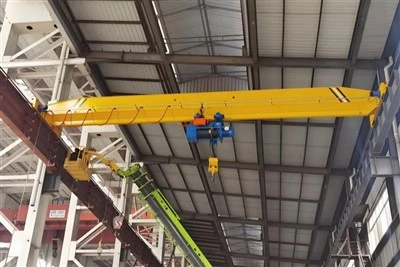
7.5 Ton Overhead Crane
Products Description
Basic Specifications (Typical, can vary by manufacturer):
Lifting Capacity: 7.5 tons (7,500 kg)
Span Length: Typically 5–30 meters (customizable)
Lifting Height: Depends on site, often 6–30 meters
Work Duty: A3–A5 (depending on usage frequency)
Power Supply: 380V, 50Hz, 3-phase (can vary per country)
Control Method: Pendant control, wireless remote, or cabin
Core Components: Gearbox, Motor, Gear
Place of Origin: Henan, China
Warranty: 1 Year
Weight (KG): 10000 kg
Video outgoing-inspection: Provided
Machinery Test Report: Provided
Selling Units: Single item
Single package size: 600X300X300 cm
Single gross weight: 200.000 kg
Pictures & Components
1.Main beam
1)Structure
Type: Usually a box girder or I-beam (rolled or welded) structure.
Box girder – fabricated from steel plates, high rigidity, used for longer spans.
I-beam – cost-effective, used for shorter spans.
2)Material
High-strength low-alloy steel or Q235/Q345B steel.
Surface often treated with anti-corrosion primer and industrial paint.
2.Lifting System
1)Electric Wire Rope Hoist (or Chain Hoist)
Capacity: Rated for 7.5 tons (7,500 kg)
Type: Most commonly an electric wire rope hoist for this capacity
Mounting: Runs along the bottom flange or top of the main girder
Motor: Three-phase induction motor with brake
Gearbox: Enclosed reduction gearbox with hardened gears
Safety: Equipped with upper & lower limit switches
2)Lifting Motor
Power typically ranges from 5.5 kW to 15 kW, depending on hoist design
Duty class: S3 or S4 (intermittent duty), varies by application
3)Wire Rope
Material: High-strength galvanized steel
Diameter: ~10–18 mm (varies by hoist brand)
Rope reeving: 2/1 or 4/1 reeving for balanced lifting
Drum: Grooved drum with pressure roller to guide rope
4) Hook Block
Forged steel hook with 360° swivel
Equipped with safety latch
Suspended from a hook block with pulley sheaves
5)Control System
Control methods:
Pendant push-button
Remote control
Optional: cabin control (rare for this size)
Limit switches: Prevent over-lifting or over-lowering
Overload protection: Some hoists have built-in load limiters
6)Braking System
Electromagnetic or hydraulic brake
Automatically engages when power is cut
 |
 |
3.End carriage
Main Frame:Made of welded box or rectangular steel profiles; high-strength and rigid.
Travel Wheels:Typically 4 wheels (2 per end carriage); made from 45# steel or forged carbon steel; hardened tread surface.
Wheelbase:Depends on span – typically 1/5 to 1/7 of the span for good stability.
Drive Unit:One end carriage has a motor-reducer-wheel assembly for driving (motorized end truck); the other may be idle or also motorized.
Motor + Gearbox:Three-phase motor (often with brake), coupled with helical gearbox.:Integrated systems like SEW, ABM, or domestic alternatives (e.g., Jiangte).
Rail Sweeper:Mounted at each end to clear debris from the rail.
Buffers / Bumpers:Polyurethane or rubber bumpers at each end to prevent collision.
Connection Bolts:High-strength bolts or pins connect the end trucks to the main girder.
 |
 |
4.Crane travelling mechanism
This system includes:
Travel drive motors
Gear reducers
Travel wheels
Couplings and shafting (if needed)
Control system (inverter, pendant, or remote)
5.Trolley travelling mechanism
Travel motor:Powers the movement of the hoist trolley across the girder
Gearbox Reduces:speed and increases torque for smooth motion
Trolley wheels:Run along the lower flange of the I-beam or box girder rail
Control system:Controls speed and direction (manual or VFD)
6.Crane wheel
1)Crane Wheels (End Carriage Wheels)
Mounted on the end carriages, used for long travel (LT) motion.
Carry the full crane + load weight.
2)Trolley Wheels
Mounted under the hoist trolley, used for cross travel (CT).
Carry only the hoist and load weight.

7.Crane Hook
Hook:Lifting point – grabs or attaches to the load
Hook Block:Houses pulleys and suspends the hook via wire rope
Pulley Sheaves:Guide the wire rope for lifting
Thrust Bearing:Allows hook to rotate 360° under load
Safety Latch:Prevents the sling or chain from slipping out
Yoke / Suspension:Connects the hook block to the wire rope

8.Motor
The motor of a 7.5-ton single girder overhead crane plays a vital role in driving the crane's three main motions:
Lifting (Hoisting)
Trolley traveling (cross travel)
Crane traveling (long travel)
Each motion may use a dedicated motor, with distinct power and features.

.
9.Sound and light alarm system & limit switch
For a 7.5-ton single girder overhead crane, the sound and light alarm system and limit switches are critical safety and operational devices. They ensure safe crane operation by warning personnel and preventing over-travel or mechanical damage.
1)Sound and Light Alarm System
Purpose
Alerts nearby workers of crane operation (movement or lifting).
Provides visual (flashing) and audible (buzzer or siren) warnings.
Often activated automatically when the crane is in motion or lifting.
2)Limit Switches
Purpose
Prevent over-travel, over-lifting, or collision. Limit switches are safety cutoffs that stop motor operation at the end of allowed motion range.

10.Safety Devices
1)Overload Protection
Purpose: Prevents the crane from lifting loads that exceed its rated capacity (7.5 tons).
Features:
Load cells or strain gauges detect load weight.
Triggers audible and visual alarms or cutoff when the crane is overloaded.
Operation: Integrated into the hoist mechanism.
2)Limit Switches
Purpose: Automatically stops crane or hoist motion at predefined positions to prevent over-travel.
Types:
Lifting limit switch: Stops the hoist at top or bottom positions.
Trolley limit switch: Stops the trolley at the end of the girder.
Crane travel limit switch: Stops the crane at the end of the runway.
Function: Mechanical or electronic switches that prevent movement beyond safe limits.
3)Anti-Collision Devices
Purpose: Prevents the crane from colliding with obstacles, other cranes, or structures.
Types:
Infrared sensors (IR) or ultrasonic sensors.
Mounted on crane or trolley.
Automatically detects proximity to objects and stops the motion.
11.Control Mode
1)Pendant Control (Wired Control)
Description: A wired control pendant is connected to the crane's control panel via cables. The operator uses the pendant to control all crane movements (lifting, traveling, and trolley).
Features:
Operator manually moves crane in all directions (long travel, cross travel, hoisting).
Button layout typically includes up, down, left, right, stop, and emergency stop.
Emergency Stop button for safety.
Fixed cable length (limited distance of movement).
Use case: Common in workshops, warehouses, or places with frequent crane operation in a confined space.
2)Radio Remote Control (Wireless Control)
Description: A wireless remote control (via radio frequency) allows the operator to control the crane from a distance without being tethered to the control panel.
Features:
Similar functionality to pendant control but operated remotely using buttons or joysticks.
Range: 50–300 meters depending on the system.
Ergonomically designed for operator comfort.
Safety features: Includes emergency stop button and interlock systems.
Use case: Preferred in large open spaces, construction sites, and where the operator needs to maintain a safe distance from the crane.
3)Cabin Control
Description: The operator controls the crane from an operator cabin located on the crane itself. This mode is typically used for larger cranes where high visibility and detailed control are needed.
Features:
Joystick control for precise movement.
Pedal/lever controls for travel and hoist.
Full control over all crane functions (hoisting, trolley, long travel).
Equipped with warning lights and alarms inside the cabin for operator safety.
Use case: Suitable for large overhead cranes used in industrial plants, warehouses, or port operations.

Sketch

Main technical

Advantages
1)Cost-Effective Solution
Lower Initial Investment:
Single girder cranes are generally more affordable compared to double girder cranes, making them a good choice for businesses with budget constraints.
Simple design means fewer components and lower manufacturing costs.
Reduced Maintenance Costs:
With fewer moving parts than double girder cranes, maintenance is simplified and costs are typically lower.
2)Compact and Space-Efficient Design
Space-Saving:
The single girder design means more headroom compared to double girder cranes, providing better vertical space for lifting.
Ideal for smaller facilities with limited ceiling height or narrow aisle configurations.
Flexibility in Installation:
Can be installed in existing buildings with low headroom.
Flexible runway systems (e.g., single beam supports) allow for easier setup in various spaces.
3)Efficient and High-Performance Operations
Smooth and Precise Movements:
With a well-designed hoisting system, the crane provides smooth lifting and lowering of loads, ensuring precision.
VFD (Variable Frequency Drive) control options allow for smooth starts and stops, reducing load sway and improving load handling.
High-Speed Performance:
Despite its compact design, the crane can achieve high lifting speeds and travel speeds, ensuring fast material handling.
It is capable of handling high-duty cycles efficiently, making it suitable for industries requiring consistent operation.
4)Enhanced Safety Features
Advanced Safety Devices:
Incorporates limit switches, overload protection, and safety alarms (visual and audible) to ensure safe operation.
Emergency stops and crash protection systems can be integrated to prevent accidents and collisions.
Anti-Sway Features:
Many systems come with anti-sway control to reduce the swinging of the load, enhancing safety during the lifting process.
5)Easy Operation and Control
User-Friendly Controls:
Comes with options like pendant controls, radio remote control, or cabin controls, allowing operators to choose the most convenient and efficient method of operation.
Ergonomically designed controls make the crane easy to operate, even during long working hours.
Reduced Operator Fatigue:
Remote controls and joystick-based systems offer ease of operation, reducing the physical strain on operators and minimizing errors during handling.
Application:
1. Manufacturing Facilities
A. Material Handling
Lifting and moving heavy components: The crane is used to transport large parts, machinery, and materials across the factory floor.
Assembly lines: In production environments, it helps move materials between workstations for assembly and further processing.
Efficient production flow: Improves workflow by automating material handling, reducing manual labor, and increasing throughput.
B. Precision Lifting
For lifting and placing delicate or precise components without damaging them during movement.
2. Warehouse Operations
A. Inventory Management
Efficient storage and retrieval: The crane can move goods from storage shelves to picking areas or loading docks, optimizing the flow of inventory.
Heavy goods handling: Used for handling bulk materials such as raw materials, pallets, or large boxed goods.
B. Space-Saving Design
The single girder structure makes it ideal for warehouses with low ceilings or confined spaces, where a larger crane wouldn't fit.
3. Heavy Equipment Lifting
A. Lifting Machines and Components
Lifting and positioning of machinery parts, motors, and other equipment in places like machine shops or repair shops.
Installation and maintenance: Used to lift heavy machinery into place or during maintenance tasks to move large parts or replace worn-out components.
4. Construction Sites
A. Lifting Construction Materials
Transporting construction materials: The crane helps move materials such as steel beams, concrete blocks, or precast panels.
Precise material placement: Helps position materials in tight spaces or at height.
B. Site Assembly
Assembling structures: It can be used for assembling prefabricated components, placing beams, columns, and other heavy elements.
5. Ports and Shipping Terminals
A. Cargo Handling
Loading and unloading ships: A 7.5-ton crane can move cargo from the docks to storage areas or vice versa. This is especially useful in ports where moderate weight lifting is required.
Handling containers: Though not as heavy-duty as larger cranes, it can be used for smaller containers or cargo boxes.
6. Retail and Distribution Centers
A. Stock Management
Inventory loading and unloading: The crane is useful for moving bulk goods, retail stock, and palletized goods within a distribution center.
Sorting and organizing: Moves items from receiving to storage or sorting areas for further distribution to retail outlets or other locations.
Crane production procedure
1. Design Phase
A. Requirements Gathering
Customer Specifications: Understand the specific requirements such as load capacity (7.5 tons), span, lifting height, and operating environment (e.g., indoor, outdoor, hazardous zones).
Customization Needs: Based on the application (e.g., warehouse, manufacturing), the crane's design is customized for features such as control systems (pendant, radio remote, cabin), and safety devices.
B. Design and Engineering
Structural Design:
The main girder is designed based on load capacity and span.
Detailed engineering plans are made for the end trucks, hoist, and trolley.
A CAD (Computer-Aided Design) model is created to ensure precision in manufacturing.
Component Selection:
Steel grades for beams, motors, and mechanical parts are selected based on load-bearing requirements and environmental conditions.
Choose appropriate motors, wheels, and control systems.
Safety Compliance: Ensure the design complies with safety standards like ISO and CE regulations, with features like overload protection, emergency stop systems, and limit switches.
2. Manufacturing Phase
A. Fabrication of Major Components
Main Girder Production:
The main girder (single beam) is fabricated from high-strength steel.
Welding is performed by skilled technicians to ensure the girder's structural integrity.
Cutting and shaping of steel are done based on precise measurements from the design phase.
End Carriages and Trolley:
End carriages are assembled, with heavy-duty wheels mounted to ensure smooth crane travel.
Trolley is built, housing the hoist and equipped with wheels to travel along the main girder.
Hoist Production:
The hoist (typically electric) is assembled with lifting motors, gearbox, and wire ropes.
The load block or hook is connected to the hoist for lifting purposes.
Safety devices such as limit switches and overload protection are installed.
B. Assembling the Components
Frame Assembly:
The main girder is joined with the end carriages to form the base structure.
The trolley is installed onto the girder, ensuring it can travel smoothly across the crane's span.
Hoist Installation:
The hoist is mounted onto the trolley system, with proper alignment to ensure smooth lifting and lowering operations.
Wiring and cabling are done for power supply, control circuits, and communication.
3. Electrical and Control System Setup
A. Control System Integration
Control Panel Assembly:
Pendant control system or radio remote control system is integrated, depending on customer specifications.
PLC (Programmable Logic Controller) may be used for more advanced control systems, enabling automation features.
Safety Features Integration:
Limit switches are installed to prevent overtravel of the hoist, trolley, or crane.
Emergency stop buttons and alarms are added to the control system for safety purposes.
B. Motor and Drive System Installation
Motors:
Hoisting motor, travel motors, and trolley motors are installed.
VFD (Variable Frequency Drive) systems may be included for speed control and smooth acceleration/deceleration.
Power Supply Wiring:
The crane's electrical system is connected to the power supply, ensuring proper voltage and current flow for all components.
4. Testing and Quality Control
A. Factory Testing
Load Test:
The crane is subjected to load testing to ensure it can safely handle its rated capacity (7.5 tons).
The load test checks the hoist, trolley, and girder for proper operation under maximum load.
Functionality Test:
Testing the crane's lifting, lowering, traveling, and trolley movement functions.
Ensuring smooth control of the crane through various speeds and directions.
Safety Test:
Overload protection: Verify the crane's response when exceeding the rated load.
Limit switch checks: Ensure the crane automatically stops if it reaches the travel or lifting limit.
Alarm and emergency stop systems are tested for reliability.
B. Inspection and Certification
Quality Inspection:
A thorough inspection of all components, including welds, bearings, and structural elements.
Visual checks and non-destructive testing (such as ultrasonic or X-ray) to ensure no structural defects.
Certification:
The crane may be certified for compliance with local safety standards (e.g., CE, ISO, or ANSI).
If necessary, third-party inspection organizations will certify the crane's load capacity and safety features.
5. Shipping and Delivery
A. Packaging and Shipping
Disassembly:
The crane may be partially disassembled for easier transportation, with components like the hoist, end carriages, and control panel carefully packed.
Delivery:
The crane is shipped to the customer's site, either by truck, rail, or sea, depending on the distance and location.
Documentation:
Delivery includes manuals, maintenance guides, and warranty information.
6. Installation and Commissioning
A. On-Site Assembly
Installation:
At the customer's site, the crane is assembled, including mounting the main girder and trolley, and connecting it to the power supply.
Final Testing:
On-site load testing is performed to verify the crane's operation in its intended environment.
Operator Training:
Operators are trained on how to use the control systems, safety procedures, and maintenance tasks.
7. After-Sales Service
Post-Installation Support:
Ongoing technical support, maintenance, and service packages are often offered.
Spare parts are provided for routine maintenance or emergency replacements.

Workshop view:
The company has installed an intelligent equipment management platform, and has installed 310 sets (sets) of handling and welding robots. After the completion of the plan, there will be more than 500 sets (sets), and the equipment networking rate will reach 95%. 32 welding lines have been put into use, 50 are planned to be installed, and the automation rate of the entire product line has reached 85%.


Hot Tags: 7.5 ton overhead crane, China 7.5 ton overhead crane manufacturers, suppliers, factory, Single Girder Overhead Travelling Crane, Single Girder Overhead Crane
You Might Also Like



Send Inquiry