










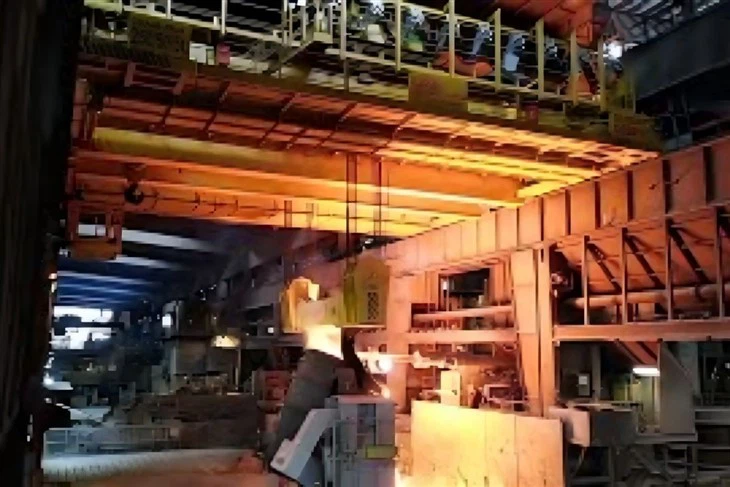

Metal Melting Crane
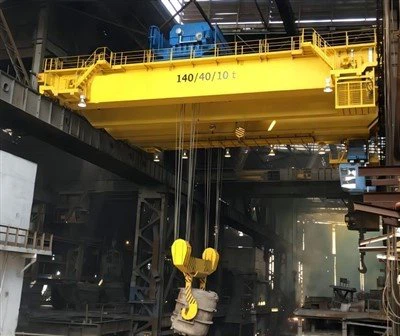
A metal melting crane, often referred to as a ladle crane or foundry crane, is a specialized type of overhead crane used in foundries and steel plants. Its main job is to handle molten metal, usually moving it from the furnace to the casting area safely and efficiently.
Key Features of a Metal Melting (Ladle) Crane:
High-temperature resistance – Built with heat-shielding to withstand extreme environments.
Heavy-duty structure – Can lift extremely heavy loads (often 10–500 tons or more).
Precision control – Offers smooth movement and accurate positioning to avoid spillage.
Special lifting devices – Uses ladle hooks or other devices to secure containers with molten metal.
Safety systems – Includes redundant brakes, limit switches, and emergency stop systems due to the high-risk nature of the work.
- Capacity: 5-800/50ton
- Span length: 4-35m
- Lifting height: 3-50m
- Work duty: A4, A5, A6,A7
- Raged voltage: 220V~690V, 50-60Hz, 3ph AC
- Work environment temperature: -25℃~+50℃, relative humidity ≤85%
- Crane control mode: Floor control / Remote control / Cabin room

Pictures & Components

2. Main girder
"Metal melting crane Main girder" refers to the main girder used in metal melting cranes. This is one of the most critical load-bearing components of the crane, responsible for supporting the lifting device (such as hooks, electromagnets, etc.) and its load, and transferring the load to the end beams and wheels, and then from the wheels to the tracks.
Here are some key points about this component:
📌 Function of the Main Girder:
Carrying heavy objects: supporting the lifting trolley and the metal materials or ladles it lifts, etc.
Ensuring structural strength: The design must meet the strength and stability requirements in high temperature environments.
Connecting with the end beam: forming the bridge part of the crane.
Installing tracks: The main girder is usually equipped with tracks for the trolley to run.
🔧 Common main girder structures:
Box girder: suitable for heavy loads and large spans, such as steel mill cranes.
I-beam girder: common in light cranes.
Welded plate girder: The strength and size can be customized according to the requirements.

3. Lifting System
Main Components:
Bridge Crane Structure
Runs on rails along the workshop ceiling.
Provides horizontal movement across the workspace.
Trolley and Hoist
Carries the lifting mechanism.
Moves along the bridge to position over the ladle or furnace.
Ladle Hook / Lifting Beam
Designed to hold the molten metal ladle securely.
Often includes double hooks or tilting mechanisms for pouring.
Heat Shields
Protect electrical and mechanical components from radiant heat.
Ladle Tongs or Lifting Bail
Grabs and secures the ladle during lifting and tilting.
Control System
Can be cab-controlled, remote-controlled, or pendant-controlled.
Some systems include automated or semi-automated features.
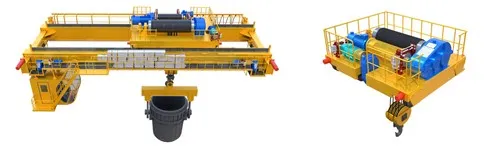
4. End Carriages
"Metal melting crane end carriages" refers to the end carriages used in metal melting cranes, such as foundry cranes in steel mills. These end carriages are important components at both ends of the crane bridge, supporting and moving the entire crane. They are usually equipped with a drive system such as wheels, motors, reducers and brakes to enable the crane to move laterally on the track.
Usually includes the following key features:
Heavy-duty design
Cranes used in metal melting (especially casting) environments need to handle high temperatures and high loads, so the end carriages usually adopt reinforced structures, such as welded steel structures, to ensure high strength and durability.
Drive system
Equipped with high-power drive devices (motor + reducer), commonly using electrical systems from SEW, ABB, Schneider and other brands.
Traveling wheel set
Usually uses a two-wheel or four-wheel structure, and the wheels may be made of forged steel or heat-resistant alloy to adapt to high-temperature working environments.
Mounting form
Can be a single-beam or double-beam crane end carriage, depending on the crane body structure.
Equipped with protective devices
Such as high-temperature protective covers, limit switches, anti-collision devices, etc., to ensure safe operation.
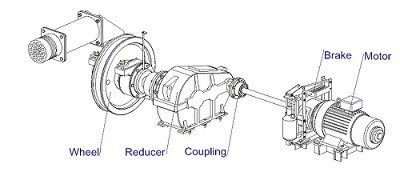
5. Crane traveling mechanism
Main Components of Traveling Mechanism:
Motor
Usually a heavy-duty electric motor.
Drives the motion of the crane along the runway.
Reducer / Gearbox
Reduces the motor speed and increases torque.
Ensures smooth movement and load stability.
Wheel Assemblies
Made from forged steel.
Run on crane rails and support the entire crane structure.
Often divided into:
Driven wheels (connected to motor)
Idle wheels
Brake System
Electromagnetic or hydraulic brakes.
Engages automatically when the motor stops to prevent slipping.
Coupling
Connects motor to gearbox or wheel axle.
Transfers power efficiently while absorbing shock.
Control System
Coordinates start, stop, speed control, and emergency braking.
Can be operated from cabin, pendant control, or remote.
6. Trolley traversing mechanism
The trolley traversing mechanism in a metal melting crane is a critical component that enables horizontal movement along the bridge girder, allowing precise positioning of the ladle or crucible over the furnace, pouring area, or mold. Here's a detailed breakdown of its design and functionality:
1. Key Components of the Trolley Traversing Mechanism
Electric Motor: Provides the driving force (typically AC/DC, with variable speed control for precision).
Gearbox: Reduces motor speed to increase torque for smooth movement.
Wheels & Rail System:
Wheels: Forged steel wheels (often with double flanges for safety) to withstand high loads.
Rails: Heavy-duty steel rails (usually QU80 or QU100 grade) mounted on the crane bridge.
Braking System:
Disc or drum brakes for controlled stopping.
Fail-safe brakes to prevent unintended movement during power loss.
Drive Configuration:
Single-Drive: One motor drives both wheels via a connecting shaft (common in smaller cranes).
Dual-Drive: Separate motors on each side for better synchronization (used in heavy-duty applications).
Bearings & Shafts: Robust bearings (spherical roller bearings) to handle radial and axial loads.
2. Special Features for Metal Melting Applications
Heat Resistance:
Heat shields or refractory coatings to protect components from radiant heat.
High-temperature lubricants for gears and bearings.
Precision Control:
Variable frequency drives (VFDs) for smooth acceleration/deceleration.
Encoder feedback for position accuracy (±5 mm tolerance typical).
Safety Systems:
Limit switches to prevent over-travel.
Load sensors to detect imbalance (critical when carrying molten metal).
Emergency stop (E-stop) linked to the brake system.
7. Crane wheel
1. Types of Cranes Used in Metal Melting
Overhead Cranes (EOT Cranes) – Commonly used in foundries and steel plants.
Ladle Cranes – Specifically designed for transporting molten metal.
Gantry Cranes – Used in heavy-duty melting and casting operations.
2. Crane Wheel Requirements for High-Temperature Environments
Heat-Resistant Material: Wheels must withstand radiant heat from molten metal (up to 1000°C+ near ladles).
Common materials: Forged steel, alloy steel (e.g., 42CrMo), or heat-treated wheels.
High Load Capacity: Must support extreme weights (molten metal ladles can weigh several tons).
Wear Resistance: Frequent movement in harsh conditions requires durable wheels.
Flanged or Double-Flanged Wheels: Prevents derailment due to thermal expansion or misalignment.
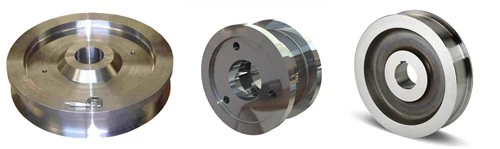
8. Crane hook
A metal melting crane is a specialized overhead crane designed for handling extremely high-temperature materials, such as molten metal, in industries like steelmaking, foundries, and metal casting. The crane hook used in such environments must be exceptionally durable, heat-resistant, and capable of withstanding thermal expansion and mechanical stress.
Key Features of a Metal Melting Crane Hook:
Heat-Resistant Material
Made from high-grade alloy steel (e.g., 30CrMo, 35CrMo) or forged steel with heat treatment.
Some hooks may have ceramic or refractory coatings to reduce heat damage.
Specialized Design for Molten Metal
Forged construction (not welded) for maximum strength.
Wide throat opening to accommodate ladles or crucibles.
Safety latch (if required) to prevent load slippage.
Load Capacity & Safety Factor
Rated for heavy loads (often 5-50 tons or more).
Designed with a high safety factor (typically 5:1 or higher) to handle dynamic loads.
Thermal Expansion Compensation
Some hooks have thermal-resistant shanks or swiveling mechanisms to prevent warping.
Cooling fins or heat shields may be integrated for prolonged exposure.
Compatibility with Ladles & Crucibles
Often used with bail-type or trunnion-type ladles for molten metal transfer.
May include auxiliary attachments like C-hooks or lifting beams.

9. Motor
1. Motor Type
Hoist Motor: Lifts and lowers the ladle or crucible containing molten metal.
Trolley/Traverse Motor: Moves the hoist horizontally along the bridge.
Bridge/End Carriage Motor: Drives the entire crane along the runway rails.
2. Key Requirements for Motors in Metal Melting Cranes
High Temperature Resistance: Motors must withstand radiant heat from molten metal (up to 1000°C+ near the ladle).
Explosion-Proof (Ex) Rating: Often required due to flammable dust/gases in metal processing.
Duty Cycle (S3/S4): Frequent starts/stops and heavy loads demand motors with high duty cycles.
Ingress Protection (IP65/IP66): Protects against dust, moisture, and splashes of molten slag.
Overload Capacity: Must handle sudden load shifts (e.g., tilting ladles).
Braking System: Fail-safe brakes to prevent free-fall in case of power loss.
3. Common Motor Technologies Used
AC Induction Motors (Robust & Reliable)
Preferred for general crane movements.
Often paired with variable frequency drives (VFDs) for smooth control.
Explosion-Proof Motors (ATEX/IECEx Certified)
Required in hazardous zones (e.g., aluminum smelting with hydrogen risk).
Furnace Duty Motors
Special insulation (Class H) for extreme heat resistance.
Geared Motors
Integrated gearboxes for precise speed control in ladle handling.

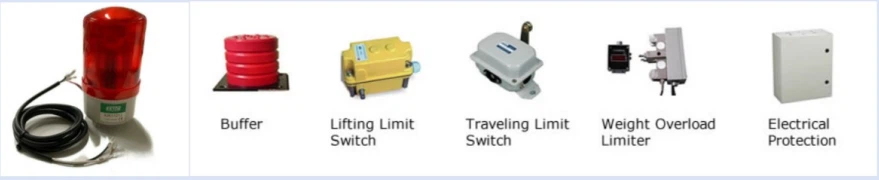
10. Sound and light alarm system & limit switch
A metal melting crane used in foundries, steel plants, or metal processing facilities typically requires robust safety and control systems, including a sound and light alarm system and limit switches to ensure safe operation. Here's a breakdown of their functions:
1. Sound and Light Alarm System
Purpose: Alerts operators and nearby personnel about critical crane operations or malfunctions.
When Activated:
Startup/Shutdown: Warns workers before the crane begins moving.
Overload: Triggers if the crane exceeds safe load capacity.
Emergency Stop: Sounds when the E-stop is pressed.
Approaching Limit: Alarms when the crane nears its travel limits (before the limit switch engages).
System Fault: Indicates electrical or mechanical failures.
Components:
Rotating Beacon (Light): High-intensity LED/strobe light (often red/yellow).
Horn/Siren: Loud audible alarm (adjustable volume for noisy environments).
2. Limit Switches
Purpose: Prevents the crane from over-traveling, protecting against collisions or mechanical damage.
Types:
Hoisting Limit Switch: Stops the hoist motor if the hook approaches the upper/lower safe limit.
Trolley/Travel Limit Switch: Prevents the trolley or bridge from moving beyond rail ends.
Slewing Limit (for rotary cranes): Limits rotational movement.
Operation:
Mechanical Limit Switch: Physically triggered by a cam or lever when the crane reaches a set position.
Proximity Sensor (Non-Contact): Uses magnetic or inductive sensing for precise positioning.
Encoder-Based: Tracks movement via an encoder and cuts power at preset limits.
11. Safety Devices
Metal melting cranes operate in high-risk environments, handling molten metal at extreme temperatures. Proper safety devices are crucial to prevent accidents, injuries, and equipment damage. Below are essential safety features for such cranes:
1. Overload Protection Systems
Load Limiters – Prevent the crane from lifting beyond its rated capacity.
Weighing Systems – Monitor the load in real-time to avoid overloading.
2. Emergency Stop (E-Stop) Systems
Redundant E-Stop Buttons – Located at multiple positions (cabin, ground, remote).
Fail-Safe Braking – Immediate stopping in case of power loss or emergency.
3. Thermal & Heat Protection
Heat Shields & Insulation – Protect crane components from radiant heat.
Cooling Systems – For motors, gearboxes, and electrical panels.
Molten Metal Splash Guards – Prevent spills from damaging the crane.
4. Anti-Collision & Positioning Systems
Laser/Ultrasonic Sensors – Detect obstacles and prevent collisions.
Automated Positioning – Ensures precise placement of molten metal.
Limit Switches – Prevent over-travel of hoist and trolley movements.
5. Redundancy in Critical Systems
Dual Braking Systems – Mechanical + regenerative braking.
Backup Power Supply – Ensures safe shutdown during power failure.
6. Fire & Explosion Prevention
Spark-Resistant Components – Non-sparking brakes and electrical systems.
Fire Suppression Systems – Automatic extinguishers for electrical fires.
7. Operator Safety Features
Insulated Cabin – Protects the operator from heat and fumes.
Emergency Escape Routes – Quick exit options in case of failure.
PPE Compliance Alarms – Ensures operator wears heat-resistant gear.
8. Structural Integrity Monitoring
Crack Detection Sensors – On hooks, girders, and load-bearing parts.
Regular Automated Inspections – Checks for wear and deformation.
9. Remote Monitoring & Diagnostics
IoT Sensors – Track temperature, vibration, and load stress.
Predictive Maintenance Alerts – Warns before critical failures.
10. Compliance with Standards
OSHA, ANSI, ISO, and EN Standards – Ensures adherence to safety regulations.
Third-Party Certification – Regular inspections by certified agencies.
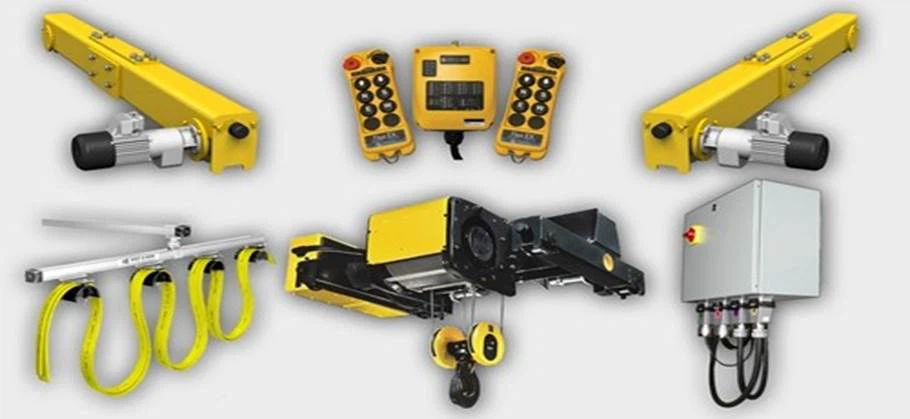
12. Control Mode
The control mode of a metal melting crane (typically used in foundries, steel plants, or smelting facilities) depends on the type of crane and its automation level. Here are the common control modes used in such cranes:
1. Manual Control Mode
Operated by a crane operator via a pendant control (push-button pendant) or cabin control.
Used for precise handling of molten metal in ladles or crucibles.
Requires skilled operators to ensure safety and accuracy.
2. Semi-Automatic Control Mode
Combines manual and automated functions.
Example: The crane automatically positions itself over the furnace or pouring station, but the operator controls the lifting and tilting of the ladle.
Often uses programmable logic controllers (PLCs) for intermediate automation.
3. Fully Automatic Control Mode
Operates without human intervention using pre-programmed sequences.
Uses sensors, encoders, and laser guidance for positioning.
Common in modern Industry 4.0 foundries with AI-based optimization.
Reduces human error and improves efficiency.
4. Remote Control Mode
Operator controls the crane from a safe distance (via wireless remote or control room).
Protects workers from extreme heat and fumes.
Often used in electromagnetic cranes for scrap handling.
5. Emergency Stop & Safety Modes
E-stop function for immediate shutdown in case of danger.
Overload protection to prevent crane failure.
Anti-sway control for stable molten metal transport.

13. Sketch
Main Technical Data
Advantages
A metal melting crane is a specialized overhead crane used in foundries, steel plants, and metal processing industries to handle molten metal safely and efficiently. Here are its key advantages:
1. Enhanced Safety
Designed to withstand extreme heat and prevent accidents.
Equipped with heat-resistant materials (refractory coatings, special alloys) to avoid structural damage.
Fail-safe mechanisms (dual brakes, emergency stop) to prevent molten metal spills.
2. High Efficiency & Productivity
Enables fast and precise pouring of molten metal into molds or furnaces.
Reduces manual labor and speeds up production cycles.
Can be automated for consistent, repeatable operations.
3. Durability & Long Service Life
Built with heavy-duty construction to handle extreme temperatures and heavy loads.
Resistant to thermal fatigue, corrosion, and oxidation.
Requires less maintenance compared to standard cranes.
4. Precision Control
Features smooth hoisting and traversing to avoid splashing molten metal.
Variable speed controls for accurate positioning.
Some models include remote or automated operation for better handling.
5. Versatility
Can be used in foundries, steel mills, aluminum plants, and recycling facilities.
Compatible with ladles, crucibles, and other molten metal containers.
Customizable for different load capacities and furnace types.
6. Reduced Downtime & Cost Savings
Minimizes metal wastage due to controlled pouring.
Lowers risk of equipment failure, reducing maintenance costs.
Improves overall energy efficiency in metal processing.
7. Compliance with Industry Standards
Meets OSHA, ISO, and other safety regulations for molten metal handling.
Designed to prevent workplace hazards like spills, explosions, and burns.
Application
A metal melting crane is a specialized overhead crane used in foundries, steel plants, and metal processing facilities to handle molten metal safely and efficiently. These cranes are designed to withstand extreme temperatures, heavy loads, and harsh environments. Below are the key applications and features of metal melting cranes:
Applications of Metal Melting Cranes
Foundries & Casting Plants
Transporting molten metal from furnaces to molds or ladles.
Pouring molten metal into casting machines.
Steel Mills & Aluminum Smelters
Handling ladles containing molten steel or aluminum.
Transferring molten metal between refining stations.
Die-Casting & Forging Operations
Moving molten metal to die-casting machines.
Supporting forging processes by positioning hot metal billets.
Recycling & Scrap Melting
Loading scrap metal into induction or arc furnaces.
Removing slag and waste materials from molten metal.
Automotive & Aerospace Manufacturing
Supplying molten alloys for high-precision components.
Crane Production Procedure
The production of a metal melting crane involves several critical stages to ensure safety, durability, and performance in high-temperature industrial environments. These cranes are specifically designed for handling molten metals in foundries, steel mills, and other metal processing facilities.
Production Stages
1. Design Engineering
Thermal analysis for high-temperature operation
Structural calculations for heavy load capacity
Safety factor determination (typically 5:1 or higher for molten metal applications)
CAD modeling and simulation of crane movements
2. Material Selection
High-grade steel for main structure (often heat-resistant alloys)
Special heat-resistant coatings for critical components
High-temperature lubricants for all moving parts
Non-sparking materials for electrical components
3. Main Bridge Fabrication
Cutting and shaping of steel girders using CNC machines
Welding by certified welders (following AWS D1.1 standards)
Stress-relieving heat treatment
Non-destructive testing (X-ray, ultrasonic)
4. Trolley and Hoist Assembly
Construction of double-girder trolley frame
Installation of redundant braking systems
Heat shielding for hoist motor and gearbox
Special hook block design for molten metal ladles
5. Electrical Systems
Explosion-proof wiring and components
Fail-safe control systems
Emergency stop circuits with backup power
Thermal protection sensors
6. Safety Features Installation
Secondary load path for critical components
Ladle alignment systems
Anti-collision systems
Over-temperature alarms
7. Quality Control and Testing
Dimensional verification
Load testing to 125% of rated capacity
Heat resistance testing
Functional testing of all safety systems
8. Surface Treatment
Sandblasting to SA 2.5 standard
Application of high-temperature resistant paint
Marking and labeling according to safety standards
9. Final Assembly
Integration of all systems
Software programming for control systems
Final inspection and certification
10. Factory Acceptance Testing
Operational testing under simulated conditions
Verification of all safety interlocks
Documentation review

Workshop View
The company has installed an intelligent equipment management platform, and has installed 310 sets (sets) of handling and welding robots. After the completion of the plan, there will be more than 500 sets (sets), and the equipment networking rate will reach 95%. 32 welding lines have been put into use, 50 are planned to be installed, and the automation rate of the entire product line has reached 85%.


Hot Tags: metal melting crane, China metal melting crane manufacturers, suppliers, factory, Metallurgical Crane, Metallurgical Overhead Crane, Casting Overhead Ladle Crane
Previous
Casting Bridge CraneNext
Casting CraneYou Might Also Like


Send Inquiry