







Casting Crane
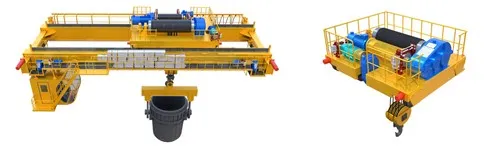
A Casting Crane (also known as a Foundry Crane or Ladle Crane) is a specially designed overhead crane used in metallurgical and foundry applications for handling molten metal. These cranes ensure safe and efficient transportation of ladles, crucibles, and other high-temperature materials in steel mills, foundries, and casting workshops.
Key Features
High-Temperature Resistance
Heat-resistant materials and protective shields to withstand molten metal splashes.
Special insulation for hoists and electrical components.
Safety Mechanisms
Dual braking systems for emergency stops.
Overload protection and anti-sway technology.
Explosion-proof options available for hazardous environments.
Precision & Stability
Smooth lifting and traversing to prevent molten metal spills.
Variable speed control for accurate positioning.
Durable Construction
Reinforced steel structure for heavy-duty operations.
Corrosion-resistant coatings for longevity.
Customizable Configurations
Available in single-girder or double-girder designs.
Different lifting capacities (typically 5T to 500T+).
Options for remote control or cabin operation.
- Capacity: 5-800/50ton
- Span length: 4-35m
- Lifting height: 3-50m
- Work duty: A4, A5, A6,A7
- Raged voltage: 220V~690V, 50-60Hz, 3ph AC
- Work environment temperature: -25℃~+50℃, relative humidity ≤85%
- Crane control mode: Floor control / Remote control / Cabin room

Pictures & Components
1. Whole set crane
A casting crane is a specialized overhead crane designed for handling molten metal in foundries, steel plants, or casting workshops. These cranes must withstand high temperatures, heavy loads, and harsh environments.
Whole Set Crane (Complete Crane System)
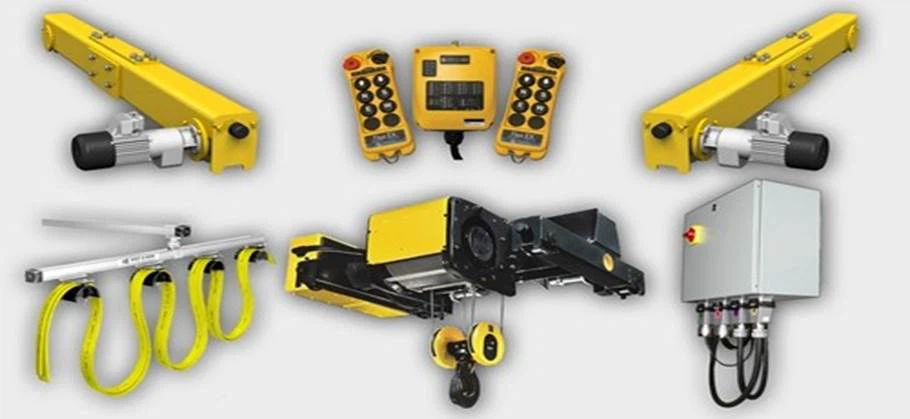
A whole set crane typically refers to a complete crane package, including:
Crane bridge & hoist (single or double girder).
End carriages & runway beams.
Electrical control system (pendant, remote, or cabin-operated).
Safety devices (limit switches, overload protection, emergency stop).
Installation & commissioning services.

2. Main girder
The main girder of a casting crane is a critical structural component that supports the load and ensures stability during lifting operations. Casting cranes (also called foundry cranes or ladle cranes) are specially designed for handling molten metal in steel plants, foundries, and metallurgical industries.
Main Girder of a Casting Crane: Key Features
Robust Construction
Made of high-strength steel (e.g., Q235B, Q345B) to withstand heavy loads and high temperatures.
Designed to resist thermal distortion from molten metal heat.
Double-Girder vs. Single-Girder
Double-girder designs are common for heavy-duty casting cranes (e.g., ladle cranes) for better stability.
Single-girder may be used for lighter-duty applications.
Heat-Resistant Modifications
Heat shields or refractory coatings to protect against radiant heat from molten metal.
Special insulation for electrical components (e.g., hoist motors, controls).
Reinforced Load Capacity
Higher safety factor (usually ≥1.5 times the rated load) due to hazardous lifting conditions.
Often equipped with dual-hoist systems for redundancy.
Anti-Deflection Design
Pre-cambering (pre-bending upward) to counteract deflection under full load.
Stiffened web plates and reinforced end carriages.
Ladle Handling Features (for ladle cranes)
Safety hooks or bail systems to secure the ladle.
Tilting mechanism for controlled pouring.

3. Lifting System
A casting crane lifting system is a specialized type of overhead crane used in foundries, steel mills, and metalworking industries to handle molten metal, heavy castings, and other high-temperature materials. These cranes are designed for extreme conditions, including high heat, dust, and heavy loads.
Key Features of a Casting Crane Lifting System:
High Heat Resistance
Heat-resistant steel construction
Specialized insulation for hoists and electrical components
Protective shields for cables and motors
Robust Lifting Mechanism
Main Hoist: Handles the primary load (e.g., ladles with molten metal).
Auxiliary Hoist: For secondary lifting tasks (e.g., molds, slag pots).
Fail-Safe Braking System: Prevents accidental drops.
Safety Systems
Overload protection
Emergency stop (E-stop) functions
Redundant load-bearing mechanisms
Specialized End Effectors
Ladle hooks or tongs for molten metal
Grippers for ingots, molds, or castings
Control System
Pendant control (manual) or radio remote control
Variable speed drives for precise positioning
4. End Carriages
Casting crane end carriages are crucial components of overhead cranes, supporting the bridge girders and facilitating smooth movement along the runway rails. They house the wheels, bearings, drive mechanisms (if motorized), and sometimes braking systems.
Key Components of Cast Crane End Carriages:
Wheels & Axles – Typically made of forged steel or ductile iron, designed to handle heavy loads with minimal wear.
Bearings – Heavy-duty roller or spherical bearings ensure smooth wheel rotation.
Drive Mechanism (if powered) – Includes motors, gearboxes, and couplings for driven end carriages.
Buffers/Bumpers – Absorb shocks when the crane reaches travel limits.
Braking System – Used in motorized cranes for controlled stopping.
Frame Structure – Cast or fabricated from high-grade steel for durability.
Types of End Carriages:
Driven (Motorized) End Carriage – Equipped with drive motors for movement.
Idler (Non-Driven) End Carriage – Passive, supports the load without propulsion.
Materials & Manufacturing:
Cast Steel – Offers high strength and impact resistance, ideal for heavy-duty applications.
Ductile Iron – Provides good wear resistance and cost efficiency for moderate loads.
Fabricated Steel – Welded construction for custom designs.
5. Crane traveling mechanism
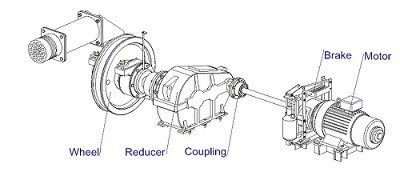
The traveling mechanism of a casting crane (also known as a ladle crane or steel mill crane) is a critical component that allows the crane to move along the runway rails in a workshop or foundry. This mechanism is responsible for transporting molten metal (in a ladle) or heavy castings safely and precisely within the working area.
Components of the Crane Traveling Mechanism:
Traveling Motors
Electric motors (usually AC or DC) provide the power for movement.
Often equipped with variable frequency drives (VFDs) for smooth acceleration and deceleration.
Braking System
Disc brakes or electromagnetic brakes ensure controlled stopping.
Essential for safety, especially when transporting molten metal.
Wheels and Axles
Heavy-duty forged steel wheels with high load capacity.
Some cranes use double-flanged wheels to prevent derailment.
Gearbox & Couplings
Reduces motor speed to achieve the desired traveling speed.
Flexible or rigid couplings connect the motor to the gearbox.
Runway Rails
Heavy-duty steel rails installed on crane runway girders.
Must be precisely aligned to prevent excessive wear or derailment.
Buffers & End Stops
Rubber or hydraulic buffers at the ends of the runway to absorb impact.
Limit switches prevent over-travel.
Festoon System or Cable Reel
Manages power and control cables as the crane moves.
6. Trolley traversing mechanism
The trolley traversing mechanism in a casting crane is a critical component that enables horizontal movement of the trolley along the crane bridge. This mechanism is essential for precise positioning of the load, especially in applications like foundries, steel mills, and casting operations where accuracy and smooth operation are crucial.
Key Components of the Trolley Traversing Mechanism:
Drive Motor
Provides the power for trolley movement.
Typically an AC or DC motor, often with variable frequency drive (VFD) for smooth speed control.
Braking System
Ensures controlled stopping to prevent load sway.
May include mechanical, hydraulic, or electromagnetic brakes.
Gearbox & Transmission
Reduces motor speed to achieve the desired trolley travel speed.
May use helical, bevel, or planetary gear systems.
Wheels & Rails
The trolley moves on wheels along rails mounted on the crane bridge.
Wheels are often made of forged steel with high load-bearing capacity.
Guide Rollers / Flange Guides
Prevent derailment and ensure smooth tracking.
Limit Switches & Position Sensors
Prevent over-travel and ensure safe operation within designated limits.
Buffers / Shock Absorbers
Reduce impact at the end of travel.
7. Crane wheel
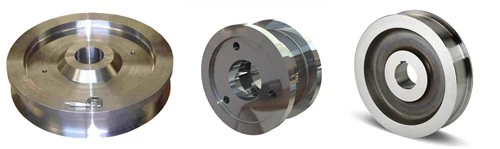
Crane wheels are crucial components in overhead cranes, gantry cranes, and other material-handling equipment. They are typically mounted on the crane's end trucks or bogies and run along rails to facilitate movement.
Types of Cast Crane Wheels:
Forged Steel Wheels – High strength, used for heavy-duty applications.
Cast Steel Wheels – Good durability and wear resistance, common in industrial cranes.
Ductile Iron Wheels – Cost-effective with decent strength, used in medium-duty cranes.
Cast Iron Wheels – Economical but less durable, suitable for light-duty applications.
Key Considerations for Cast Crane Wheels:
Material Grade (e.g., ASTM A148, ASTM A536 for ductile iron).
Hardness & Wear Resistance (often heat-treated for longer life).
Flange Design (to prevent derailment).
Load Capacity (must match crane specifications).
Precision Machining (for smooth operation and reduced rail wear).
Manufacturing Process:
8. Crane hook
Casting a Crane Hook – Key Steps:
Material Selection
Typically made from carbon steel (e.g., ASTM A148, EN 13889 grades) or alloy steel for high strength and toughness.
Ductile iron or forged steel may also be used depending on load requirements.
Pattern Making
A pattern (usually made of wood, plastic, or metal) is created in the shape of the crane hook, including allowances for shrinkage and machining.
Mold Preparation
Sand casting is commonly used (green sand or resin-bonded sand).
The mold is created by packing sand around the pattern, then removing it to leave a cavity.
Melting & Pouring
The selected metal is melted in a furnace (electric arc, induction, or cupola).
Molten metal is poured into the mold cavity carefully to avoid defects.
Cooling & Solidification
The casting is left to cool slowly to prevent cracks or internal stresses.
Shakeout & Cleaning
After cooling, the sand mold is broken away (shakeout).
Excess material (gates, risers) is removed, and the surface is cleaned (shot blasting, grinding).
Heat Treatment
Normalizing or quenching & tempering improves mechanical properties (strength, toughness).
Stress relieving may also be done.
Machining & Finishing
Critical surfaces (load-bearing areas) are machined to precise dimensions.
Surface treatments (galvanizing, painting) may be applied for corrosion resistance.
Testing & Inspection
Non-destructive testing (NDT) like ultrasonic testing (UT), magnetic particle inspection (MPI), or dye penetrant testing (PT) checks for defects.
Load testing ensures the hook meets safety standards (e.g., ISO 4309, ASME B30.10).

9. Motor
Casting cranes are specialized overhead cranes commonly used in steel mills and foundries to handle molten metal, such as in ladle transfer, casting, or continuous casting processes.
Motor Requirements for Casting Cranes:
High Reliability & Durability – Must withstand high temperatures, dust, and harsh industrial environments.
Explosion-Proof or Heat-Resistant Design – Since they operate near molten metal, motors should be flameproof or have high thermal resistance.
Variable Speed Control – Precision handling of molten metal requires smooth acceleration/deceleration (often using frequency inverter-controlled motors).
High Torque & Power – Typically AC induction motors (squirrel cage or slip-ring) or DC motors (in older systems).
Insulation Class (H or F) – High-temperature insulation to prevent failure due to radiant heat.
IP Rating (IP55 or higher) – Protection against dust and moisture.
Common Motor Types Used:
AC Motors (with Inverter Control) – Most modern casting cranes use three-phase AC motors with variable frequency drives (VFDs) for smooth operation.
DC Motors (Older Systems) – Some older cranes may still use DC motors for precise speed control.
Explosion-Proof Motors – Required in hazardous zones where flammable gases or dust may be present.

10. Sound and light alarm system & limit switch
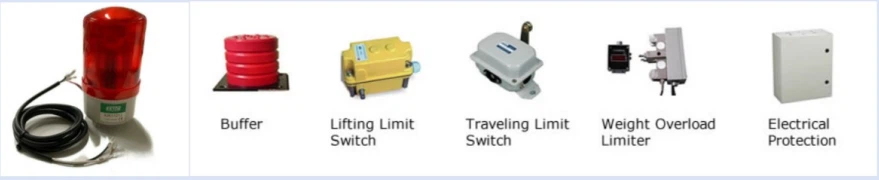
A casting crane's safety system typically includes both sound/light alarm systems and limit switches to ensure safe operation, especially in foundries or steel mills where heavy, molten materials are handled.
Sound and Light Alarm System
Components:
Horns/Sirens - Audible warning devices (typically 100-120dB)
Strobe Lights/Rotating Beacons - Visual warning devices (usually red/yellow)
Control Unit - Manages activation/deactivation
Push Buttons/Remote Control - For operator activation
Functions:
Pre-operation warning - Activated before crane movement begins
Emergency alerts - For hazardous situations or malfunctions
Approach warnings - When crane nears restricted areas
System status indicators - Different light colors/patterns for various states
Limit Switch System
Types:
Hoist Upper/Lower Limit Switches
Prevents over-hoisting or excessive lowering
Typically mechanical or proximity type
Trolley/Travel Limit Switches
Restricts crane movement within defined area
Often uses cam-operated switches
Load Monitoring Switches
Prevents overload conditions
May be integrated with load cells
Features:
Fail-safe design - Default to safe position on failure
Adjustable settings - For different operational requirements
Redundant systems - Often multiple switches for critical limits
Self-checking capability - Some models include diagnostic features
11. Safety Devices
Crane safety devices are critical for preventing accidents, protecting operators, and ensuring safe lifting operations. Below are some essential safety devices commonly used in casting cranes (foundry cranes) and other overhead cranes:
1. Overload Limiters (Load Limiters)
Prevents the crane from lifting loads beyond its rated capacity.
Automatically cuts off power if the load exceeds a safe threshold.
2. Limit Switches
Hoisting Limit Switch – Stops the hoist when the hook reaches the upper or lower limit.
Trolley/Travel Limit Switch – Prevents the trolley or bridge from overtraveling beyond safe limits.
3. Emergency Stop (E-Stop)
Allows immediate shutdown of crane operations in case of an emergency.
Usually a prominently placed red button.
4. Anti-Collision System
Used when multiple cranes operate in the same area to prevent collisions.
May use sensors, lasers, or RFID technology.
5. Braking Systems
Mechanical Brakes – Applied automatically when power is cut.
Regenerative Braking – Helps control speed during lowering.
6. Load Moment Indicator (LMI)
Monitors load weight and boom angle to prevent tipping (more relevant for mobile cranes but sometimes used in foundry applications).
7. Thermal Protection for Motors
Prevents motor overheating due to overuse or electrical faults.
8. Insulated / Explosion-Proof Components
Foundry cranes often work in high-temperature environments, so insulation or explosion-proof electrical components may be required.
9. Voltage Protection & Phase Monitoring
Protects against power fluctuations and phase failures.
10. Warning Alarms & Lights
Audible alarms and flashing lights alert workers before crane movement.
11. Safety Latches for Hooks
Prevents slings or loads from slipping off the hook.
12. Wind Speed Indicators (for outdoor cranes)
Alerts or stops crane operation if wind speeds are dangerously high.
13. Redundant Safety Systems
Backup systems (e.g., dual brakes, redundant limit switches) ensure safety if primary systems fail.
12. Control Mode
The casting crane control mode refers to the method by which the crane is operated during the casting process, typically in steel mills or foundries where molten metal is handled. The control mode ensures precision, safety, and efficiency when transporting ladles or crucibles containing molten metal.
Common Control Modes for Casting Cranes:
Manual Control Mode
Operated by a trained crane driver via a cabin or remote control.
Used for general movements and positioning.
Requires high skill to ensure smooth, jerk-free motion to avoid spillage.
Semi-Automatic Control Mode
Combines manual control with automated functions (e.g., pre-set lifting/lowering speeds).
May include anti-sway systems to stabilize the ladle.
Fully Automatic Control Mode
Programmed movements for repetitive tasks (e.g., transferring molten metal from furnace to casting area).
Uses PLC (Programmable Logic Controller) and sensors for precise positioning.
May integrate with Industry 4.0 systems for real-time monitoring.
Remote Control Mode
Operator uses a wireless pendant or HMI (Human-Machine Interface) to control the crane from a safe distance.
Reduces exposure to extreme heat and fumes.
Fail-Safe & Emergency Modes
Slow-down mode for delicate positioning near molds.
Emergency stop (E-stop) to halt operations in case of danger.
Backup power in case of main power failure.

13. Sketch
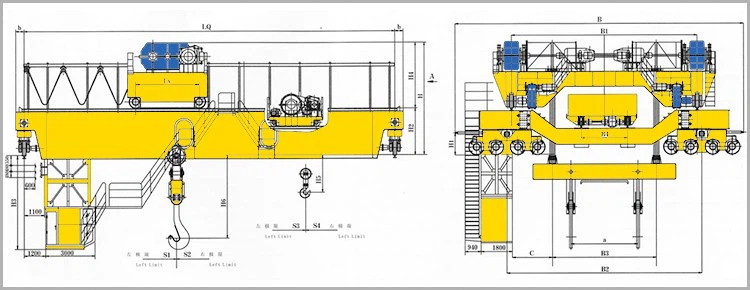
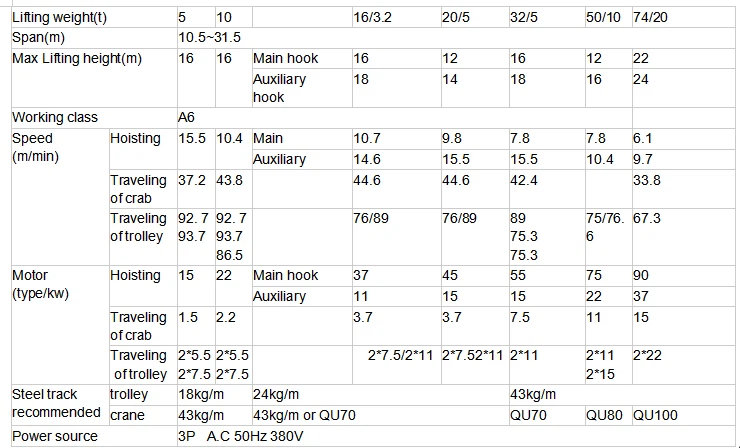
Main Technical Data
Advantages
A casting crane is a specialized type of overhead crane used in foundries and steel mills for handling molten metal. It plays a crucial role in metal casting processes, ensuring safe and efficient transportation of ladles containing molten metal. Here are some key advantages of using a casting crane:
1. High Safety Standards
Designed with double braking systems and redundant safety features to prevent accidents.
Equipped with anti-sway technology to stabilize the ladle and minimize spills.
Heat-resistant materials and protective shields to withstand high temperatures.
2. Precision Handling
Smooth and controlled movements for accurate pouring of molten metal into molds.
Variable speed control allows operators to adjust lifting and traversing speeds for delicate operations.
3. Heavy-Duty Performance
Capable of lifting extremely heavy loads (up to hundreds of tons) with high reliability.
Robust construction with reinforced hooks, girders, and trolleys for long-term durability.
4. Enhanced Efficiency in Foundry Operations
Reduces manual labor and speeds up the casting process.
Minimizes metal wastage by ensuring precise pouring.
5. Customizable Features
Can be tailored with automated controls, remote operation, or semi-automatic systems.
Options for explosion-proof motors in hazardous environments.
6. Reduced Downtime & Maintenance
Built with high-quality components that resist wear from heat and heavy loads.
Easy maintenance access for inspections and repairs.
7. Improved Workplace Safety
Reduces the risk of worker exposure to molten metal.
Complies with industry safety standards (ISO, OSHA, FEM, or DIN).
Application
1. Foundry & Steel Plant Applications
Ladle Handling: Transporting molten metal from furnaces to casting molds.
Pouring Operations: Precisely pouring molten metal into molds.
Mold Handling: Moving heavy sand molds or die-casting molds.
Slag Pot Handling: Removing slag waste from furnaces.
2. Key Features of Casting Cranes
Heat-Resistant Construction: Uses special materials to withstand high temperatures.
Safety Mechanisms: Dual braking, anti-sway, and explosion-proof options.
Precision Control: Smooth movement to prevent molten metal spills.
High Load Capacity: Typically ranges from 5 tons to over 500 tons.
3. Types of Casting Cranes
Ladle Cranes: Specifically designed for molten metal handling.
Foundry Cranes: Used for general mold and casting transport.
Overhead (Bridge) Cranes: Common in large foundries.
Gantry Cranes: Used in outdoor casting yards.
4. Industries Using Casting Cranes
Steel Mills (Continuous casting, blast furnaces)
Aluminum & Copper Smelters
Automotive Foundries (Engine blocks, transmission parts)
Heavy Machinery Manufacturing (Large cast components)
Crane Production Procedure
1. Design and Engineering Phase
Requirements Analysis: Determine load capacity, span, lifting height, and operating environment
CAD Modeling: Create detailed 3D models of all crane components
Structural Calculations: Perform stress analysis and fatigue calculations
Material Selection: Choose appropriate casting materials (typically steel or iron alloys)
Pattern Design: Develop patterns for casting molds
2. Pattern Making
Create precise patterns (wood, metal, or plastic) for mold formation
Include proper allowances for shrinkage, machining, and draft angles
Quality check patterns for dimensional accuracy
3. Mold Preparation
Sand Molding: Most common for crane components
Prepare molding sand mixture (silica sand, binder, additives)
Compact sand around patterns in flasks
Remove patterns carefully
Core Making: For hollow sections if needed
Alternative methods: Investment casting for complex parts
4. Melting and Pouring
Charge furnace with selected metal (typically carbon steel or alloy steel)
Melt to precise temperature (1500-1600°C for steel)
Add alloying elements if required
Degas and remove impurities
Pour molten metal into prepared molds
Control pouring speed to avoid defects
5. Cooling and Solidification
Allow controlled cooling to prevent internal stresses
Solidification time depends on component thickness
Monitor for proper directional solidification
6. Shakeout and Cleaning
Break away sand mold after complete cooling
Remove gates, runners, and risers
Shot blast to remove residual sand
Grind rough edges
7. Heat Treatment
Normalize or anneal to relieve internal stresses
Quench and temper for required mechanical properties
Stress relief if needed for large components
8. Machining and Finishing
Machine critical surfaces to precise tolerances
Drill and tap holes for assembly
Grind bearing surfaces
Apply protective coatings (paint, galvanizing, etc.)
9. Quality Control
Dimensional Inspection: Verify all critical dimensions
NDT Testing: Ultrasonic, radiographic, or magnetic particle inspection
Load Testing: Proof load test critical components
Material Certification: Verify chemical composition and mechanical properties
10. Assembly
Assemble cast components with other crane parts
Install electrical systems, motors, and controls
Lubricate all moving parts
11. Final Testing and Certification
Perform full operational tests
Verify safety systems
Issue certification documents
Prepare for shipment or installation
12. Documentation and Delivery
Prepare operation and maintenance manuals
Provide spare parts lists
Complete packaging for shipment
Arrange transportation to customer site

Workshop View
The company has installed an intelligent equipment management platform, and has installed 310 sets (sets) of handling and welding robots. After the completion of the plan, there will be more than 500 sets (sets), and the equipment networking rate will reach 95%. 32 welding lines have been put into use, 50 are planned to be installed, and the automation rate of the entire product line has reached 85%.


Hot Tags: casting crane, China casting crane manufacturers, suppliers, factory, Metallurgical Overhead Crane, Casting Overhead Ladle Crane, Metallurgical Crane
Previous
Metal Melting CraneYou Might Also Like


Send Inquiry