








Industrial Eot Crane
Products Description
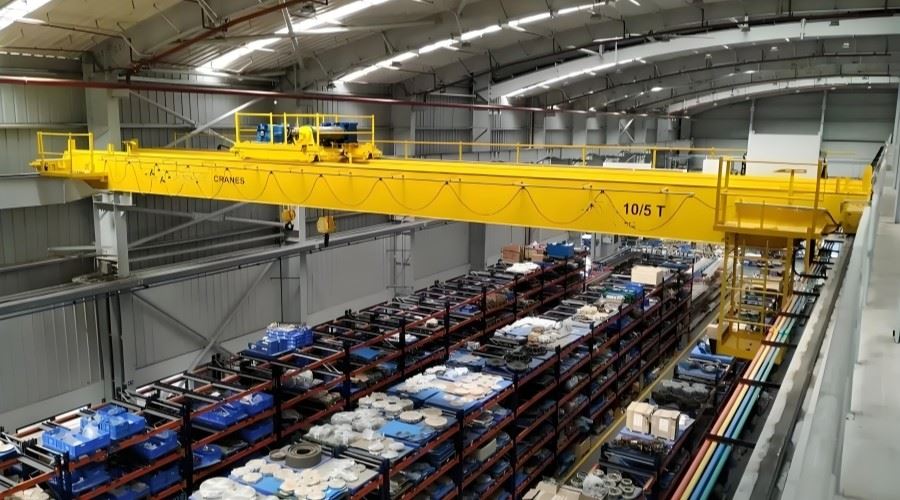
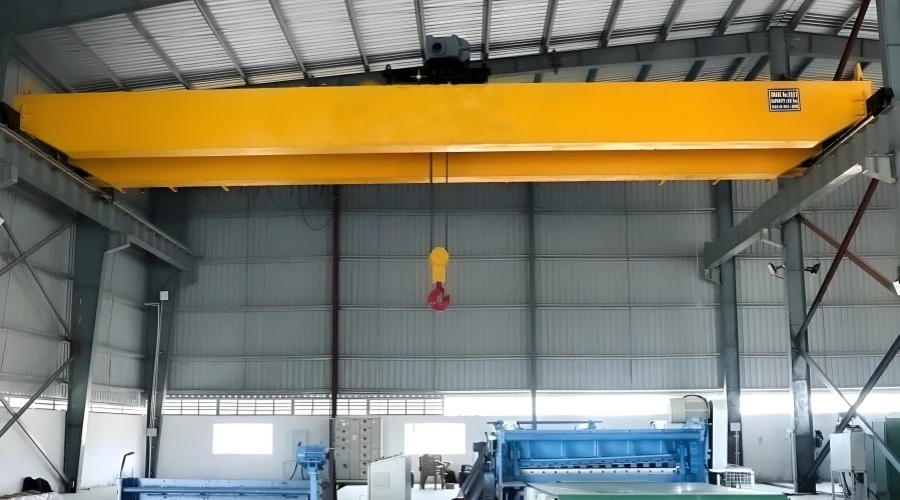
An Industrial EOT (Electric Overhead Traveling) Crane is a critical piece of equipment in industries for efficient material handling, load lifting, and transportation. These cranes are widely used in manufacturing plants, warehouses, assembly lines, power plants, and construction sites.
An Electric Overhead Traveling Crane is designed for seamless, reliable, and safe movement of heavy loads within industrial settings. The crane operates on an elevated runway system with parallel beams, enabling overhead transportation of materials.
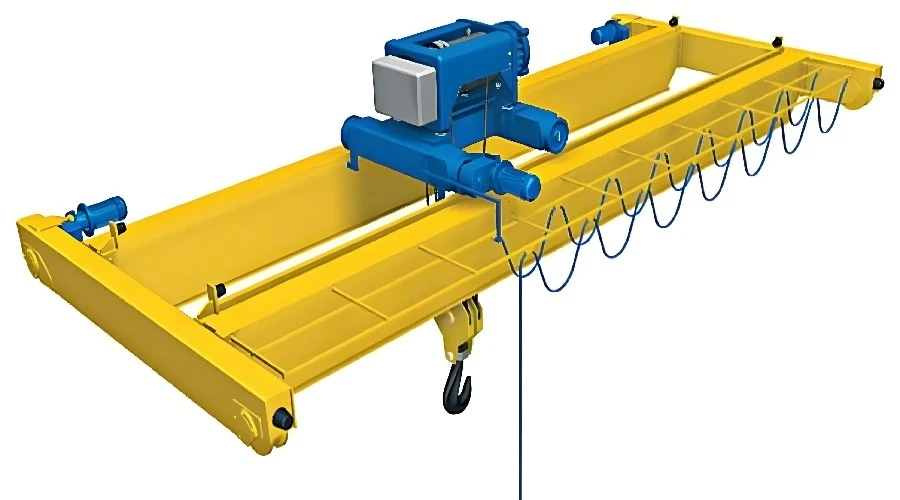
Double Girder EOT Crane is suitable for heavy-duty operations and larger spans with higher load capacities.Equipped with wire rope hoists or chain hoists for precision handling.Powered by electric motors for smooth operation.Made of robust steel girders to ensure structural integrity and durability.It have Options for pendant control, wireless remote control, or cabin operation.
Industrial EOT Cranes are indispensable for industries requiring precision, safety, and efficiency in material handling. They not only improve operational efficiency but also contribute to workplace safety by automating heavy load movements. Choosing the right EOT crane tailored to specific industrial needs ensures optimal performance and long-term reliability.
Core Components:Motor
Warranty:1.5 Year
Place of Origin:Henan, China
Weight (KG):8000 kg
Video outgoing-inspection:Provided
Machinery Test Report:Provided
Lifting mechanism:Electric wire rope hoist
Control method:Ground control+Wireless remote control
Lifting Capacity:3~20t
Lifting speed:3.5(0.35/3.5)~8(0.8/8) m/min
Lifting height:6~18m
Traveling Speed:20; 30m/min
Power supply:380V 3Phases 50Hz,AC
Work Duty:A3~A4
Material:Q235B
Pictures & Components
1.Main beam
1) The main beam of an industrial EOT (Electric Overhead Traveling) Crane is one of the primary structural components responsible for supporting the loads lifted by the crane. It is a horizontal girder that spans the width of the working area, typically mounted on end carriages or wheels that run on rails or gantry tracks.
2) The Double Girder Comprises two main beams for handling heavy loads and larger spans.The beam may be box-shaped, I-beam, or fabricated for enhanced structural strength.Made from high-strength steel to withstand bending, torsion, and other stresses during operation..The beam transfers the weight of the load, the hoist, and other crane components to the crane's end carriages, which distribute the forces to the supporting structure.
The main beam is engineered to ensure minimal deflection under load to maintain operational safety and precision.Designed based on operational requirements like load capacity, span length, crane type, and working environment (e.g., outdoor, hazardous areas).
Lifting System
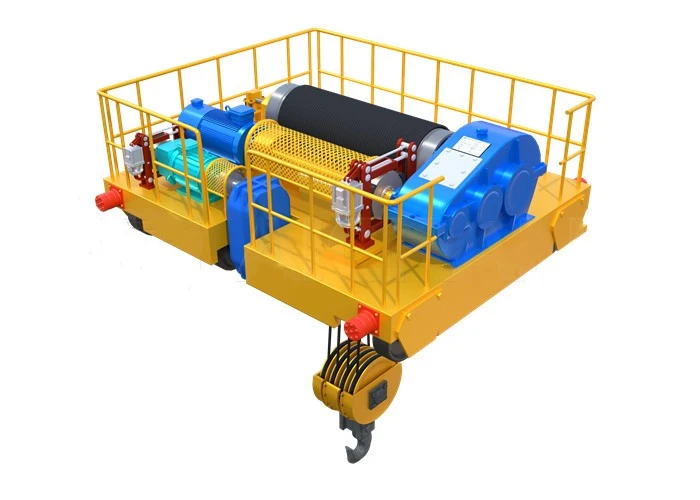
1) Motor: The motor in the lifting system of an Industrial EOT (Electric Overhead Traveling) Crane plays a vital role in powering the hoisting mechanism, enabling the crane to lift and lower loads safely and efficiently. .
2) Reducer: The reducer of a lifting system in an Industrial EOT (Electric Overhead Traveling) Crane is a critical component that regulates the speed and torque of the crane's motor for lifting and lowering heavy loads.
3) Drum: The Drum Lifting System in an EOT (Electric Overhead Traveling) Crane is a critical component in the hoisting mechanism. It plays a key role in lifting, lowering, and holding heavy loads.
4) Wire rope: Wire ropes are a crucial component of the lifting systems in Electric Overhead Travelling (EOT) cranes, as they are responsible for bearing and transmitting the load during lifting and movement. Proper selection, maintenance, and handling of wire ropes ensure safe and efficient operation.
5) Pulley block: A pulley block in the lifting system of an industrial EOT (Electric Overhead Traveling) crane is a crucial component that enhances lifting efficiency and allows for the movement of heavy loads with reduced effort. Fixed blocks are stationary, while movable blocks are attached to the load, creating a compound system for lifting.
6) Lifting device: The lifting device of an EOT (Electric Overhead Traveling) Crane is a critical component responsible for raising, lowering, and holding loads during material handling operations in industrial environments.
 |
 |
3.End carriage
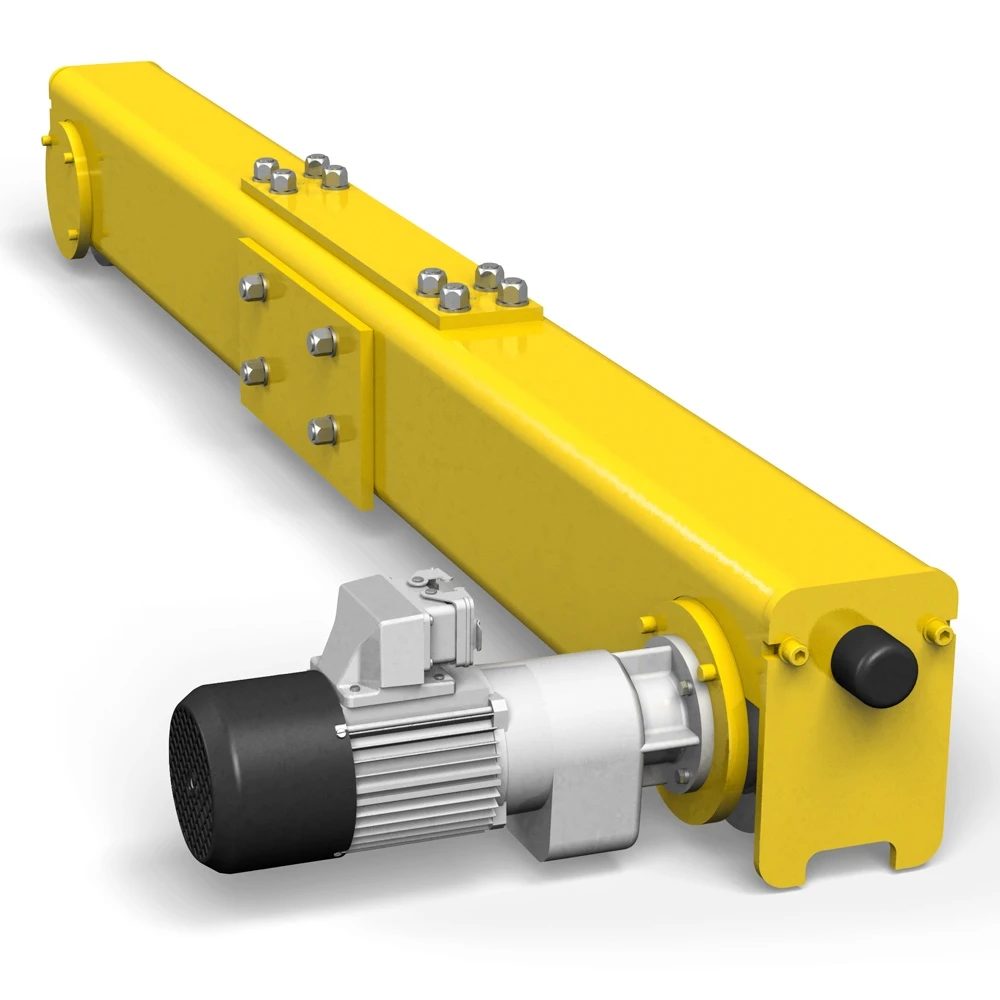
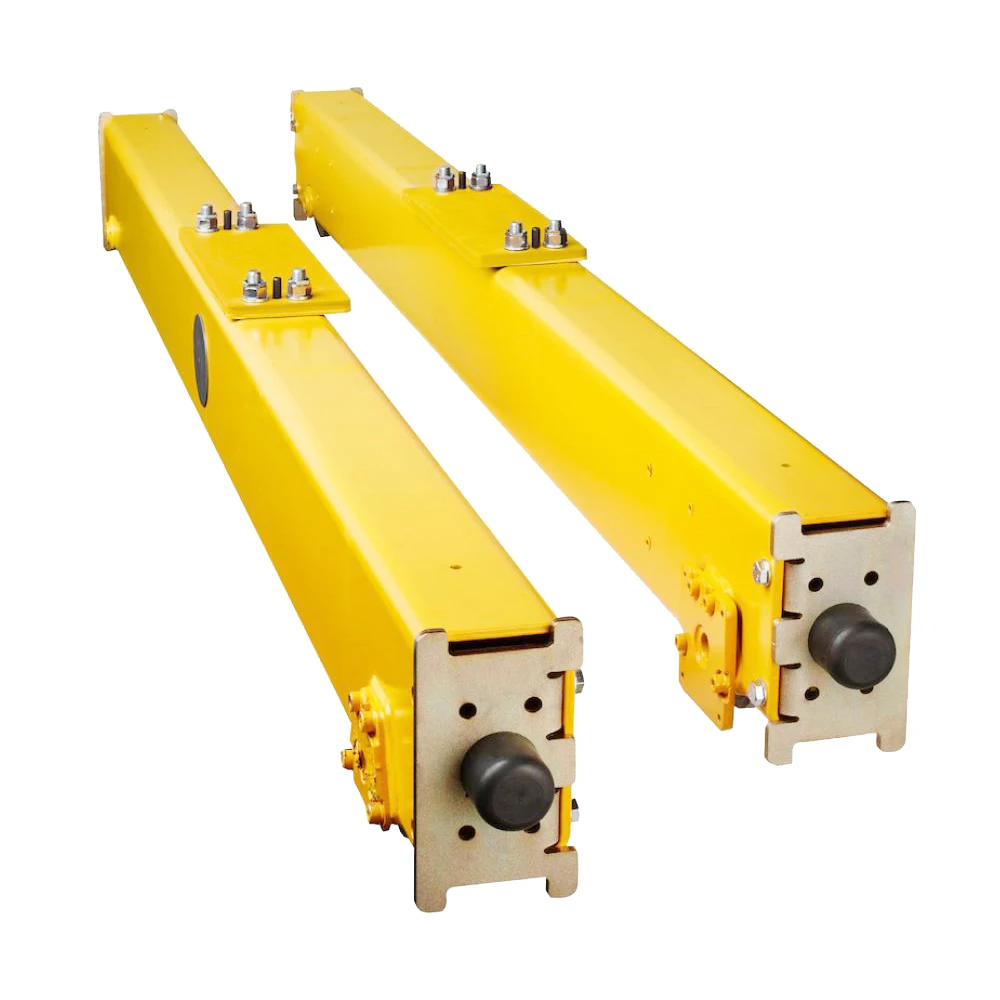
The end carriage of an industrial EOT (Electric Overhead Traveling) crane plays a crucial role in its functionality and structural integrity. It is part of the crane's movement system and supports the entire bridge structure as it travels along the runway beams. Fabricated from high-strength steel or alloy to ensure durability and load-bearing capacity.Designed for lightweight but robust construction to reduce stress on the runway beams.Wheels are Typically made from forged steel or hardened alloy for wear resistance.
The end carriage of an industrial EOT (Electric Overhead Traveling) crane s Functions: Facilitates longitudinal motion of the crane across the runway beams.Evenly distributes the weight of the bridge and the load being lifted across the runway.Provides structural stability to the crane system during operation.Provides structural stability to the crane system during operation.
Key Features of High-Quality End Carriages: Allows for easy installation and maintenance.Ensures alignment with the runway rails to minimize wear and operational issues.Advanced materials and bearings reduce operational noise.Overload protection, limit switches, and buffer systems enhance safety.
 |
 |
4.Crane travelling mechanism
1) Working principle
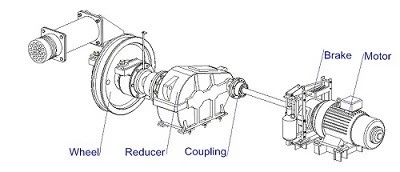
Electricity is supplied to the drive motors through a power system such as festoon cables or a conductor bar.The operator uses a control system to signal the motors.The motors convert electrical energy into mechanical energy to drive the wheels.The powered wheels (usually located on one or both end carriages) roll along the runway rails.The other wheels act as idlers, stabilizing the movement.
2) Functions of the crane operating mechanism
Horizontal movement: Facilitates the crane's motion along the runway girders to reach different areas of the workspace.Ensures precise positioning over the desired location for lifting or placing loads.
Load distribution: Allows the entire crane structure, including the hoist and the load, to travel horizontally, enabling the transport of heavy materials across large distances in the workspace.
Controlled Speed and Acceleration: The mechanism ensures smooth acceleration and deceleration, preventing abrupt movements that could cause instability or damage to the load.
5.Trolley travelling mechanism
1) Structural composition
Trolley frame: Made of steel plates or welded steel sections.Designed to support the hoisting mechanism and other components.Provides rigidity and strength to bear loads during operations.
Wheel set: Usually made of forged steel or cast steel.Mounted on axles and supported by bearings for smooth rotation.Designed to run on rails fixed on the bridge girders.
Drive device: AC or DC motors drive the trolley.Coupled with gearboxes for controlled speed and torque.Gearboxes:Transmit power from the motor to the wheels.Typically enclosed helical or spur gear systems.Couplings:Flexible couplings connect the motor shaft to the gearbox.Absorb misalignments and vibrations.
2) Function of the trolley operating mechanism
Horizontal Load Movement:The trolley moves along the bridge of the EOT crane, enabling horizontal displacement of the hoisted load. This facilitates the accurate positioning of loads over the desired area.
Load Handling Flexibility:It works in conjunction with the hoisting mechanism, allowing the crane to pick up, transport, and place loads at varying locations within the crane's operational range.
Precise Positioning:The mechanism ensures smooth and precise movement for exact placement of the load, which is crucial in applications requiring high accuracy, such as assembly lines or warehouses.
6.Crane wheel
1) Function of wheels
The crane wheel is a crucial component of an EOT (Electric Overhead Travelling) Crane. It is designed to support and facilitate the movement of the crane on its tracks or rails.
2) Design requirements
Precision-designed to withstand high loads and operational stresses.It can have a tapered tread or flat tread, depending on the rail type and crane design.Typically made from forged steel or cast steel for durability.Common grades include EN8, EN9, or EN24, offering high strength and resistance to wear and tear.

7.Crane Hook
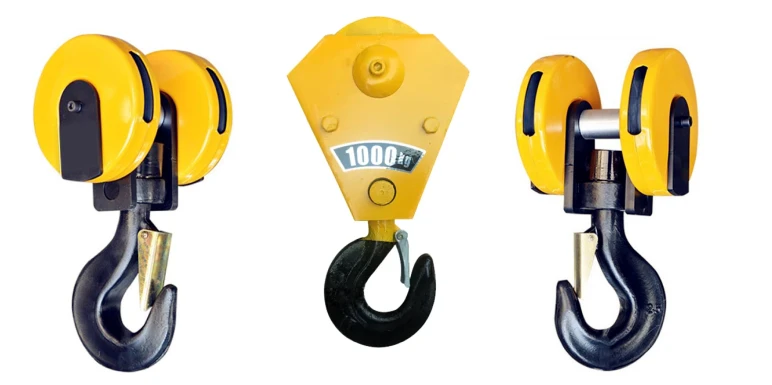
The crane hook is a crucial component of an EOT (Electric Overhead Traveling) crane, used to lift and transport heavy loads in industrial settings.The main part of the hook, typically made from high-strength alloy steel or carbon steel, ensuring durability and resistance to heavy loads.Designed with a curved profile to securely hold slings, chains, or other lifting attachments.
Double Hook:Used for heavy loads to distribute weight evenly.Offers better stability and reduces stress on the crane mechanism.Ramshorn Hook:A specialized type of double hook with two curved prongs for lifting multiple load points simultaneously.
Material: High-strength steel (alloy or carbon steel), heat-treated for enhanced durability.
Load Capacity: Designed to handle loads based on the EOT crane's rated capacity (e.g., 1 ton, 5 tons, 10 tons, or more).
Design Standards: Complies with international safety standards like ISO, DIN, or ASME.
Safety Factor: Hooks are designed with a safety factor (typically 4:1 or 5:1) to ensure operational reliability.
Motor
The motor of an Industrial EOT (Electric Overhead Traveling) Crane is a critical component responsible for driving various crane movements, such as hoisting, trolley travel, and bridge travel. These motors are designed to handle heavy-duty operations, frequent starts and stops, and high torque requirements.
Types of Motors Used
Squirrel Cage Induction Motor:Commonly used due to its robust construction, low maintenance, and cost-effectiveness.Suitable for hoisting and traveling mechanisms.
Slip Ring Induction Motor:Preferred for applications requiring high starting torque and smooth operation.Often used in older cranes or in heavy-duty applications.
DC Motors:Used in older systems or where precise speed and torque control are required.Gradually being replaced by AC motors with variable frequency drives (VFD).
Servo Motors:Employed in modern cranes for precise positioning and control.Works well in automated crane systems.
Stepper Motors:Used in smaller or specialized cranes requiring incremental movement control.
EOT crane motors are designed for intermittent duty (S3 or S4 duty class), meaning they can handle frequent starts/stops and varying loads.Motors often come with electromagnetic or fail-safe brakes to ensure load safety during power outages.
.
Sound and light alarm system & limit switch
1) Sound and light alarm system
Audible Alarm (Sound System):Typically, a buzzer or siren.Produces loud, distinguishable sounds.Can vary in tone for different warnings (e.g., movement warning vs. emergency).Volume levels must comply with industrial safety regulations.
Visual Alarm (Light System):Strobe Lights or Flashing LEDs.Often uses bright colors like red, amber, or blue for high visibility.Lights flash in sync with sound to ensure visibility in noisy environments.
2) Limit switch
In an industrial EOT (Electric Overhead Traveling) crane, limit switches are essential safety devices used to prevent damage to the crane or its components by ensuring the crane does not travel beyond its designed range of motion. These switches are installed at key points along the crane's movement path, such as at the ends of the horizontal runway or at the upper and lower limits of the hoisting mechanism.
Functions of Limit Switches in EOT Cranes: Limit switches are used to stop the crane when it reaches the maximum or minimum allowable position, preventing over-travel in any direction (horizontal or vertical).They act as a fail-safe by preventing the crane's trolley or hoist from moving beyond safe operational limits, reducing the risk of damage or injury.Limit switches can be integrated into the crane's control system to signal the crane's position and automatically stop movement when required.By stopping the crane when it reaches a predefined limit, these switches help prevent mechanical or electrical overloads.
Types of Limit Switches in EOT Cranes:
Hoist Limit Switches: These switches are mounted on the hoist to limit the upward and downward movement of the hook or lifting mechanism. They prevent the hook from rising too high (which could cause damage to the crane structure or other components) or from descending too low.
Trolley Limit Switches: These are mounted on the trolley, limiting its movement along the runway. They ensure the trolley doesn't move past the end of the crane's beam.
Bridge Limit Switches: These switches limit the movement of the entire crane bridge along the runway. They are located at the ends of the runway to stop the crane from traveling beyond its track.

10.Safety Devices
1) Overload protection device:Protects the crane from lifting loads beyond its rated capacity. The device automatically stops crane operation if the weight exceeds the limit.
2) Limit Switches:Prevents the crane from exceeding its safe operating limits (e.g., hoisting beyond maximum height or traveling too far).
3) Emergency Stop Buttons: Allows operators to immediately stop the crane in case of an emergency, halting all crane movements instantly.
4) Audible Alarms: These alarms sound when the crane starts or operates, or when it's nearing a hazard zone, to warn people nearby of potential danger.
5) Anti-Collision System:Prevents cranes from colliding with other cranes, machinery, or obstacles within the working area.
6) Load Indicators: Provides real-time monitoring of the load being lifted, ensuring that it doesn't exceed the crane's capacity.
11.Control Mode
1) Pendant Control Mode (Wired Control): The crane operator uses a pendant with buttons or joysticks to control the crane's movements.The pendant is connected to the crane by a cable, and the operator typically walks along the crane's path to control movements.
2) Radio Remote Control Model: This mode offers more freedom for the operator to move around the crane, providing a better view of the load and surroundings.
It's often used in more complex or hazardous environments, as it allows the operator to maintain a safe distance from the crane's operation.
3) Cabin Control Mode (Operator Cabin)l: This mode is common for large industrial cranes, where the operator needs to have a broad view of the load and the surrounding area.The cabin may be fixed or able to rotate for better visibility.
4) Automated control: The crane may be able to perform tasks such as lifting, lowering, and transporting loads without direct human control, based on predefined instructions or input from a central system.
5)PLC (Programmable Logic Controller) Control: The PLC can control the crane's functions, based on inputs from the operator or sensors that monitor crane performance and environmental conditions.PLC control can be integrated into any of the aforementioned modes.

12.Sketch
Main technical

Advantages
1. High Lifting Capacity
EOT cranes are designed to handle heavy loads, ranging from a few tons to several hundred tons, depending on the model. This makes them suitable for lifting and transporting large, heavy materials in factories, ports, and construction sites.
2. Improved Efficiency and Productivity
These cranes can operate quickly and precisely, minimizing downtime and speeding up material handling processes. The automation capabilities also help in reducing human labor, leading to increased productivity.
3. Space Optimization
EOT cranes maximize floor space in industrial facilities. Since they travel overhead, they free up valuable floor area for other operations. This vertical movement makes them ideal for areas with limited ground space.
4. Precise Load Handling
These cranes can lift and move heavy loads with high precision. This level of control is vital in industries where accurate placement of loads is crucial, such as in assembly lines or when handling delicate equipment.
5. Durability and Longevity
Built to withstand heavy-duty use, EOT cranes are durable and can last for many years with proper maintenance. They are typically designed to handle continuous operation under demanding conditions.
6. Reduced Labor Costs
With automation and electric control systems, these cranes reduce the need for manual labor, which can lead to cost savings in wages, training, and safety measures.
7. Safety
EOT cranes are equipped with advanced safety features such as overload protection, anti-collision systems, emergency stop functions, and limit switches. These features help prevent accidents and ensure the safety of both operators and workers in the vicinity.
8. Customization Options
These cranes can be customized to suit specific industrial needs. Whether it's a particular lifting height, span, or weight capacity, EOT cranes can be tailored to match the unique requirements of a business.
9. Energy Efficiency
Modern EOT cranes are designed to be energy-efficient, utilizing electric power, which is often cheaper and more sustainable than other fuel-based power sources. Additionally, regenerative braking systems can be used to recover energy during crane operation.
10. Versatility
EOT cranes can be used for a wide range of lifting and transportation tasks across various industries, including construction, metalworking, automotive, and logistics. Their versatility makes them indispensable in manufacturing plants and distribution centers.
11. Reduced Maintenance Costs
EOT cranes have fewer moving parts than traditional cranes, reducing wear and tear. With proper maintenance, these systems tend to have lower repair costs and a longer operational lifespan.
Application:
1. Manufacturing and Assembly Lines
Heavy Equipment Handling: EOT cranes are commonly used in factories where heavy equipment or components need to be moved, assembled, or lifted.
Production Lines: In automotive or aerospace manufacturing, these cranes handle heavy parts and tools to speed up the production process.
2. Steel Plants and Foundries
Material Handling: EOT cranes are used to move molten metal, scrap material, ingots, and other heavy metal components.
Casting and Molding: In foundries, these cranes handle molds, ladles, and casting equipment, aiding in the efficient pouring and forming of metal products.
3. Warehouses and Distribution Centers
Bulk Material Handling: In large warehouses, EOT cranes are used to load and unload goods from high storage racks, especially for oversized and heavy items.
Sorting and Packaging: Cranes assist in sorting, packaging, and distributing materials efficiently within large distribution centers.
4. Shipyards and Ports
Cargo Handling: At ports and shipyards, EOT cranes are essential for loading and unloading large cargo, containers, and heavy equipment from ships.
Ship Building and Repair: They are also used for transporting heavy parts and materials during the construction or repair of ships.
5. Construction Sites
Material Transport: On construction sites, EOT cranes are used to move heavy construction materials, such as steel beams, concrete blocks, and equipment, from one location to another.
Lifting for High-Rise Buildings: EOT cranes in construction sites are capable of moving large prefabricated parts to great heights, assisting in the construction of tall buildings and skyscrapers.
6. Mining Industry
Material Handling in Mines: EOT cranes are used in underground and surface mining operations to move raw materials, extracted ore, and heavy mining equipment.
Maintenance of Mining Equipment: They also play a role in lifting and maintaining mining machinery and heavy tools.
7. Power Plants
Turbine and Boiler Installation: In thermal, nuclear, or hydro power plants, EOT cranes are used to install or repair heavy equipment such as turbines, generators, and boilers.
Maintenance and Overhaul: EOT cranes are frequently used for routine maintenance, moving parts for repair or replacement.
8. Textile and Paper Mills
Material Transport: These cranes are used for moving raw materials like paper rolls, fabric rolls, and chemicals.
Loading and Unloading of Machines: They assist in loading and unloading equipment for maintenance or installation in these mills.
9. Defense and Aerospace
Aircraft Assembly and Maintenance: EOT cranes are widely used in defense and aerospace sectors to assemble and maintain aircraft, move heavy military equipment, and lift machinery.
Weapon Handling: EOT cranes are used for lifting and moving heavy weapons or ammunition, ensuring the safety and efficiency of these operations.
10. Automotive Industry
Car Assembly: In automotive plants, EOT cranes are used to move parts like car chassis, engines, and large body panels along the production line.Parts Storage and Distribution: They are also employed for moving heavy automotive parts in storage and distribution areas.
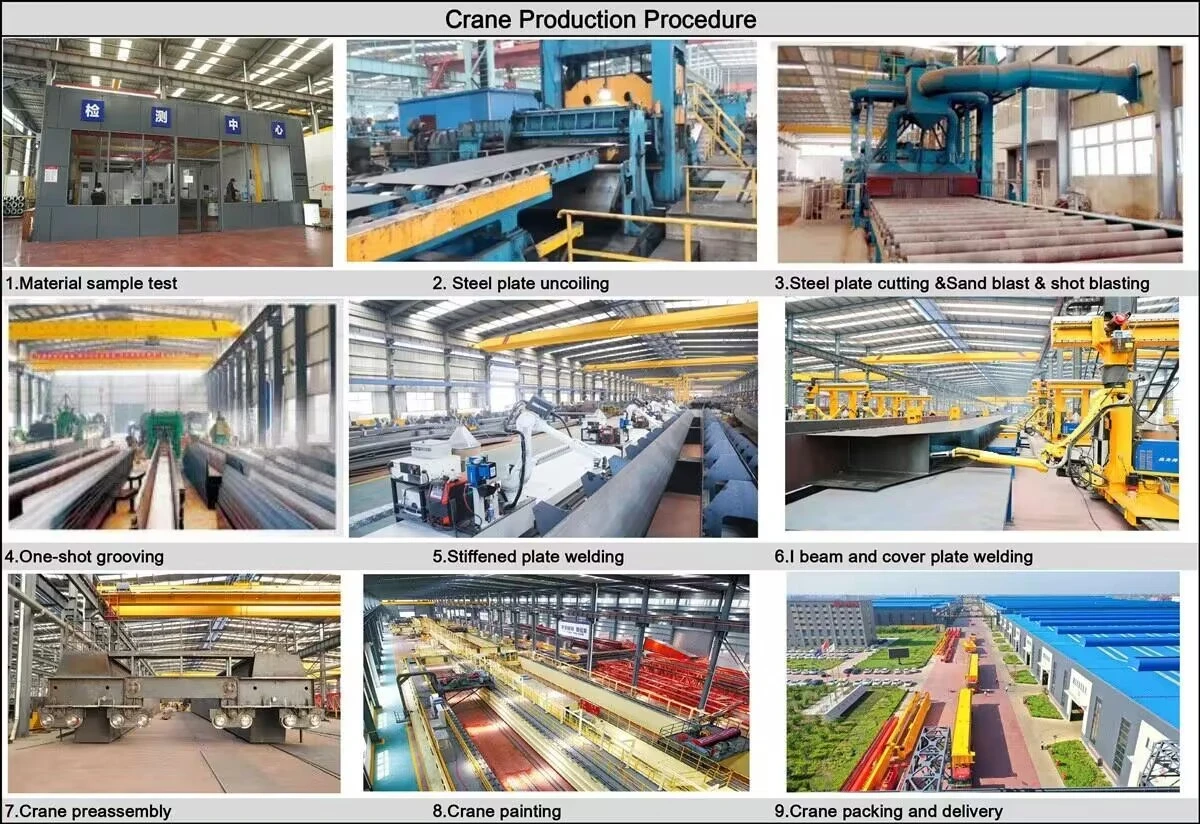
Crane production procedure
1. Design Phase
Client Requirements: Understanding the specific requirements of the client, such as load capacity, span, lifting height, working conditions (temperature, environment), and safety features.Engineering Drawings: Based on the client's specifications, detailed engineering drawings are created for the entire crane system, including the trolley, hoist, bridge, and control systems.Selection of Components: Choice of suitable materials (steel, electrical components, motors, gearboxes, etc.) based on structural integrity, durability, and operational requirements.
2. Material Procurement
Steel and Other Materials: Procurement of raw materials like high-quality steel for the crane frame, beams, trolleys, and structural components.Electrical Components: Purchase of electrical components such as motors, control panels, transformers, wiring, and sensors.Other Components: Bearings, ropes, gears, and other mechanical parts are also sourced from specialized suppliers.
3. Fabrication and Manufacturing
Cutting and Shaping: Raw steel is cut, welded, and shaped into various components like the crane's bridge, girders, end trucks, and trolleys.Welding: Welding is a critical step to ensure that all structural parts are securely joined. The quality of welding is tested to avoid any defects.Machining: After the basic assembly, precision machining is performed to ensure that all components meet exact measurements, including hoist drums, gearboxes, and rail wheels.Assembly of Sub-Components: Assembly of smaller components such as the hoist unit, trolley, and bridge begins at the workshop. The trolley system includes electric motors, drives, and controls for movement.
4. Electrical and Mechanical Integration
Motor and Control System: Motors, speed controllers, and electrical wiring are installed into the crane. These systems control the movement of the crane, including hoisting, traveling, and turning.Control Panel: The control panel, which can be a pendant or radio remote control, is integrated into the crane system, allowing operators to control all movements and monitor operational status.
5. Assembly of Crane Structure
Girders and Bridge Assembly: The two main girders of the crane (often fabricated separately) are connected with cross beams and end trucks, forming the crane's bridge.Hoist and Trolley Installation: The hoist system, which is the primary lifting mechanism, is mounted on the trolley, which is then installed on the crane bridge.
Running Gear Installation: The rail wheels and other running gear are mounted to the crane's end trucks, ensuring smooth movement along the tracks.
6. Testing and Quality Control
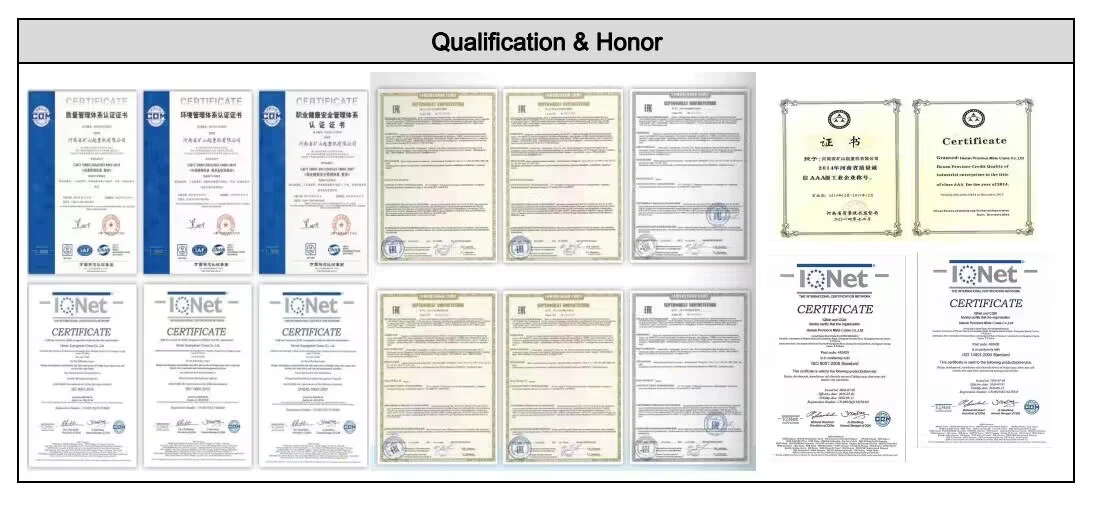
Load Testing: The crane is subjected to load testing, where it is tested under various working conditions (e.g., maximum load capacity and safety limits) to ensure safe operation.Operational Testing: The movement of the crane (hoisting, traveling, and rotating) is tested to confirm that all mechanisms function smoothly.Electrical System Testing: Electrical systems, including controls, sensors, and overload protection, are tested for reliability and safety.Compliance Check: Ensure the crane meets all relevant safety standards and regulations, such as ISO, CE, or local industrial standards.
7. Painting and Finishing
Surface Treatment: After assembly, the crane components are sandblasted and cleaned to remove any impurities, followed by applying a corrosion-resistant coating or paint.Final Inspection: A final inspection is conducted to check for any manufacturing defects, ensuring that the crane is in proper working condition and ready for delivery.
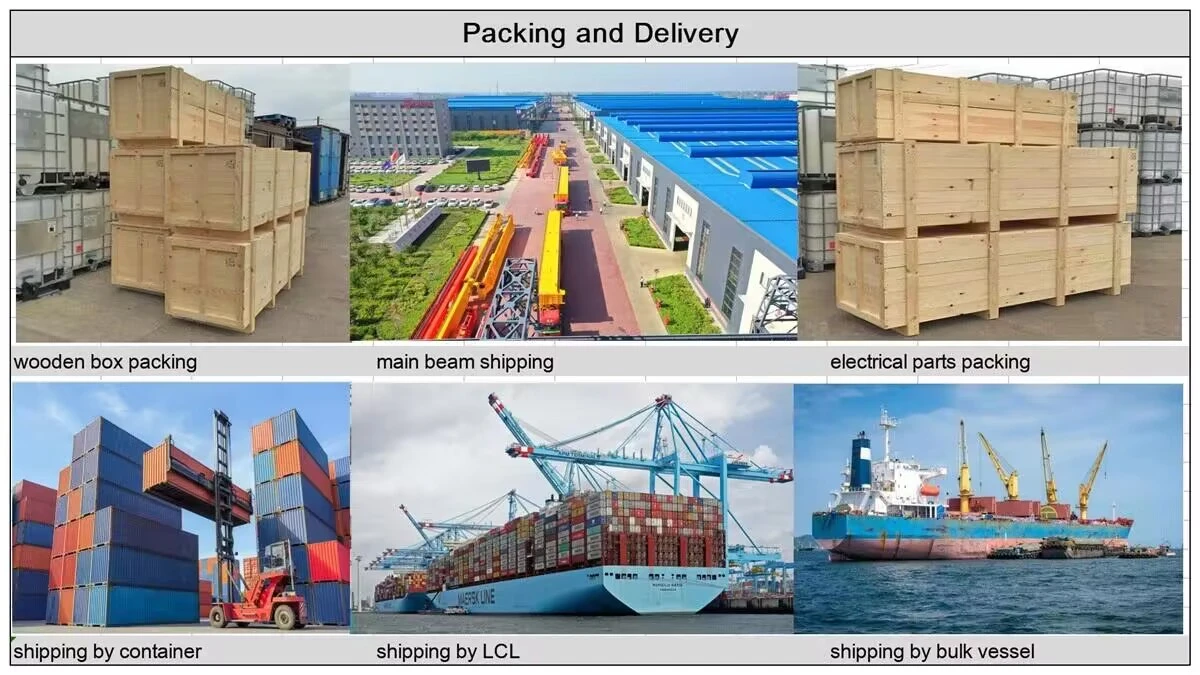
8. Packaging and Delivery
Dismantling: Depending on the size and transport limitations, the crane may be partially dismantled for transport.Transport to Site: The crane parts are carefully packed and shipped to the installation site.On-Site Assembly and Commissioning: At the client's facility, the crane is reassembled and further tested to ensure it operates properly.
9. Installation and Training
Installation: The crane is installed on its tracks or rails at the client's location, and all components are connected and aligned.Operator Training: The client's operators are trained on how to safely use and maintain the crane.Final Acceptance Test: The crane undergoes a final acceptance test by the client, ensuring that all systems work as required.
10. After-Sales Support
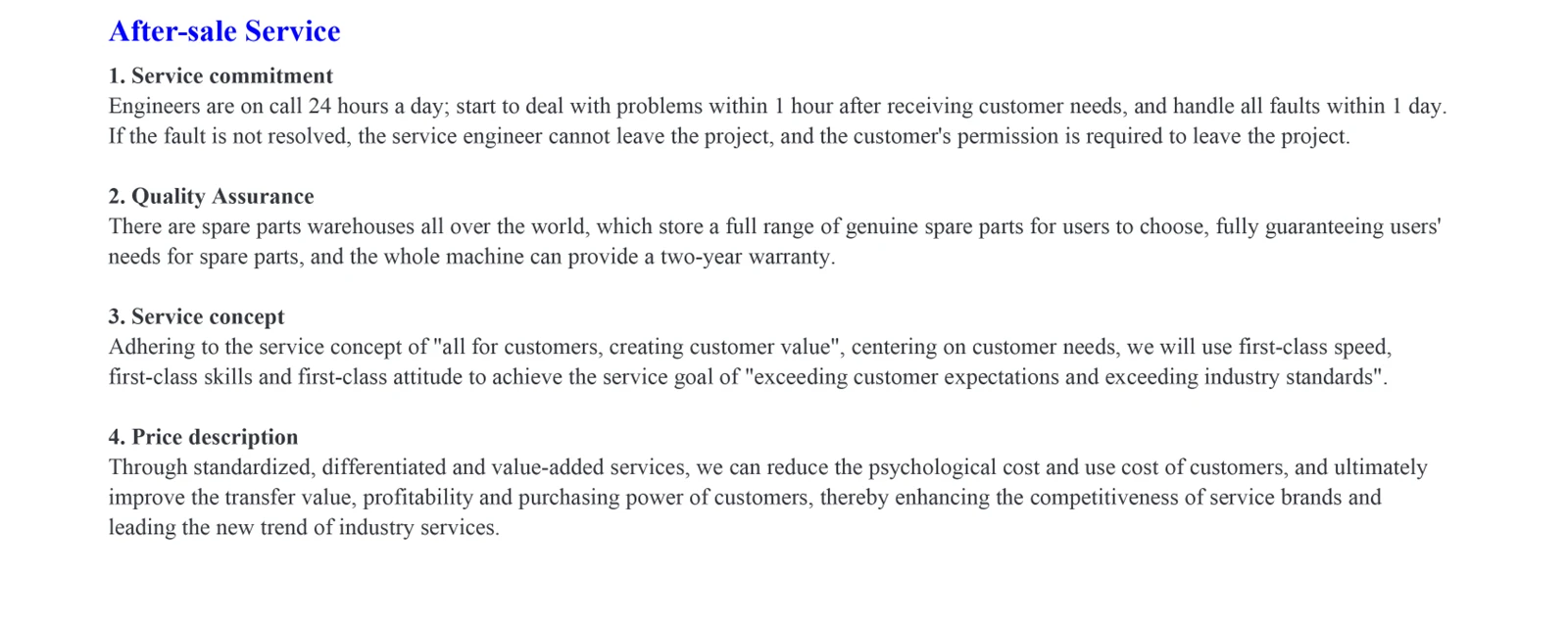
Maintenance: Some crane manufacturers offer periodic maintenance services to ensure long-term operation.Spare Parts Supply: The manufacturer typically provides spare parts for maintenance and repair.
Workshop view:
The company has installed an intelligent equipment management platform, and has installed 310 sets (sets) of handling and welding robots. After the completion of the plan, there will be more than 500 sets (sets), and the equipment networking rate will reach 95%. 32 welding lines have been put into use, 50 are planned to be installed, and the automation rate of the entire product line has reached 85%.


Hot Tags: industrial eot crane, China industrial eot crane manufacturers, suppliers, factory, Double Girder Overhead Cranes, Single Girder Overhead Crane Company, Eot Crane
Previous
Double Beam Eot CraneYou Might Also Like


Send Inquiry