







Eot Overhead Crane
Products Description
An EOT (Electric Overhead Traveling) Crane is a versatile and efficient material handling solution used across various industries for lifting, transporting, and positioning heavy loads. Designed for robust performance and reliability, EOT cranes are ideal for applications in manufacturing plants, warehouses, shipyards, and construction sites.
EOT overhead cranes are available in lifting capacities ranging from 1 ton to over 500 tons. Span and height can be customized to meet specific operational needs. Available in single and double beam configurations to accommodate different load capacities and spans. Compact design for efficient use of space and better load handling. Strong steel construction for durability.
EOT overhead cranes have integrated advanced motor and gear mechanism for precise control. Variable frequency drive (VFD) ensures smooth start-stop motion and minimizes wear. Operate via pendant controller, remote control or cab operating system..EOT overhead cranes provide a user-friendly interface for operators.
Core Components:Motor
Place of Origin:Henan, China
Warranty:2 years
Weight (KG):3000 kg
Video outgoing-inspection:Provided
Machinery Test Report:Provided
Application:workshop
Lifting mechanism:Eliectric Hoist
Crane feature:Easy Operated Girder Bridge Crane
Control method:Wireless Remote Control
Power Source:Users' Local Power System
Color:Customized Color Acceptable
Lifting speed:Adjustable Speed
Pictures & Components
1.Main beam
1) The main beam (or girder) of an EOT (Electric Overhead Traveling) crane is a critical structural component that supports the hoist and provides the horizontal path for lifting and transporting loads. The design and construction of the main beam play a significant role in the crane's overall capacity, efficiency, and safety.
The main beam of an EOT overhead crane is usually made of structural steel to provide the necessary strength and durability. Common materials include mild steel or high-strength steel, depending on the load requirements.
The beam can be a box girder, I-beam, or double girder, depending on the crane's design and load capacity.The beam is designed to handle the maximum rated load (including dynamic effects).Includes factors such as dead load (beam weight), live load (lifting capacity), and impact load.
The length of the main beam determines the coverage area of the crane and must account for the working area and building dimensions.The main beam is mounted on end trucks with wheels that travel on the crane runway.Must comply with relevant standards, such as ISO, FEM, ASME B30.2, or local regulations for cranes.
2.Lifting System
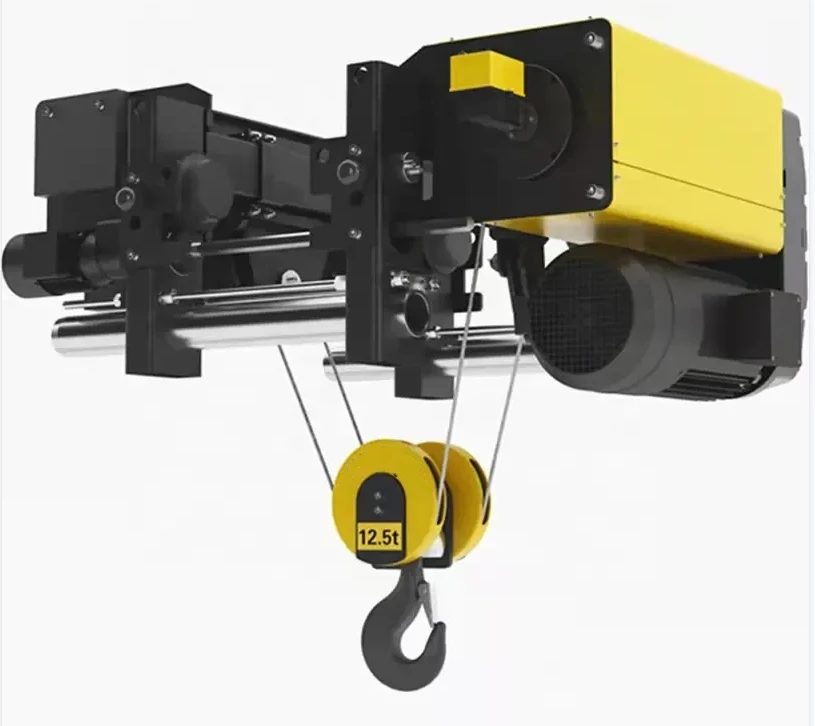
Motor: The motor of a lifting system in an EOT (Electric Overhead Traveling) crane is a critical component responsible for driving the hoisting mechanism that lifts and lowers heavy loads. The motor typically operates in conjunction with various other systems like brakes, control panels, and safety devices.
The reducer in the lifting system of an EOT (Electric Overhead Traveling) crane plays a crucial role in the mechanical drive system. It is used to reduce the rotational speed of the motor and increase the torque delivered to the crane's lifting mechanism (the hoist).The reducer decreases the speed of the electric motor's output shaft. Cranes typically need a much slower speed at the hoist mechanism compared to the motor speed.
Drum: The drum of the lifting system in an EOT (Electric Overhead Traveling) crane plays a crucial role in the hoisting and lowering of the load. It is typically a cylindrical component that serves to wind and unwind the lifting rope or wire rope. This drum is driven by a motor, which allows the crane to raise or lower the hook (or load block) attached to the rope.
Wire rope: In an EOT (Electric Overhead Traveling) crane, the wire rope is a critical component of the lifting system. It is responsible for lifting, lowering, and moving loads. The wire rope, in this context, is typically used in the hoist mechanism, where it connects the hoist drum or winch to the hook or lifting device.
Pulley block: In the context of an EOT (Electric Overhead Traveling) crane, the pulley block is a key component in the lifting system that helps facilitate the movement of the crane's load. It is part of the hoisting mechanism and works with the wire rope to raise or lower heavy loads.The pulley block is used to change the direction of the lifting rope or wire rope and to distribute the load more efficiently.It provides a mechanical advantage, allowing heavier loads to be lifted more easily by reducing the effort required.
Lifting device: The lifting device in the lifting system of an explosion-proof single-beam suspension overhead crane is a critical component designed for safe and efficient material handling in hazardous environments where explosive gases or dust may be present.All electrical and mechanical components are enclosed or treated to prevent sparking or heat generation.Materials used are non-sparking, anti-static, and corrosion-resistant.
 |
 |
3.End carriage
1) The end carriage of an EOT (Electric Overhead Traveling) crane is a crucial component that supports and moves the crane's bridge along the runway beams. It is located at both ends of the bridge and plays a key role in ensuring smooth and efficient crane operation.
2)The end beams of EOT (Electric Overhead Travel) cranes are made of high-strength steel or other durable materials to provide rigidity while minimizing weight to reduce stress on the crane structure.The primary purpose of the end carriage is to allow the EOT crane to traverse horizontally along the runway beams, providing access to the entire working area beneath the crane. It supports the weight of the crane and the load while ensuring stability and smooth operation.
3) Some end carriages use side rollers or guide mechanisms to maintain alignment with the rails, reducing wear and tear.The end carriages are rigidly connected to the main bridge girders.Alignment is critical to ensure even load distribution and smooth operation.
 |
 |
4.Crane travelling mechanism
1) Working principle
Movement Along Rails or Beams
The main crane frame (bridge) is mounted on two end carriages, each of which has a set of wheels that run on parallel rails laid on the runway. The bridge is driven by motors on one or both carriages. When the motor is powered, the wheels rotate and move the crane horizontally along the rails. On the bridge, a trolley moves along the length of the bridge and can also be driven by an electric motor. The trolley is where the hoist mechanism is located. The trolley's movement is typically controlled separately, and it allows the hoist to move the load along the bridge and in the vertical direction.The crane typically uses electric motors for driving the wheels, which are powered by a combination of AC/DC supply, depending on the crane type. The motors are linked to the wheels via reduction gearboxes that control the speed and torque.
2) Functions of the crane operating mechanism
Horizontal Movement:The primary function of the traveling mechanism is to move the crane's trolley along the length of the runway. This is accomplished using motors and drives that move the crane's wheels along the tracks fixed on the support beams.
Support and Stability:The traveling mechanism provides support to the entire crane structure, ensuring it remains stable during horizontal movement. The crane wheels and the rails work together to maintain balance and prevent wobbling during operation.
Load Transport:The traveling mechanism allows the crane to carry the load from one part of the facility to another. By moving horizontally across the workspace, the crane can transport materials, goods, or equipment over long distances.
Alignment and Precision:The traveling mechanism helps maintain precise alignment of the crane along the runway beams. Accurate movement is essential for proper handling of loads, especially in environments where safety and precision are critical (e.g., manufacturing plants, construction sites, or warehouses).
Cross-Traveling (Side Movement):The crane's trolley can move along the length of the runway beam (longitudinal direction), but the traveling mechanism also provides the ability for cross-traveling (side movement) of the entire crane. This allows the crane to access various areas within the facility.
5.Trolley travelling mechanism
1) Structural composition
Trolley Frame:The frame is the main structural part of the trolley, usually made of welded steel or a combination of steel and alloy material for strength and durability.It supports the hoist unit and other components like wheels, motors, and brakes.
Traveling Wheels:These are the wheels that allow the trolley to move along the crane's bridge rails. The wheels are typically made of steel or cast iron, and they are mounted to the trolley frame on bearings or shafts.The wheels are designed to fit the rails on which the trolley runs (usually grooved or flat rails).
Motor and Drive Mechanism:A reversible electric motor is used to drive the trolley movement, often coupled with a gearbox to provide the necessary torque.The motor is typically mounted on the trolley frame and drives the traveling wheels via a chain drive, gear drive, or belt drive, depending on the design.
Bearings and Shafts:The trolley wheels are mounted on bearing units or bushings to allow smooth and efficient movement of the trolley.Shafts and bearings reduce friction between moving parts and improve the reliability and longevity of the system.
Braking System:A braking mechanism is crucial for stopping the trolley safely. Typically, electromagnetic brakes or mechanical friction brakes are used.The braking system is either spring-applied, electrically released or electrically applied, spring-released, depending on the design of the crane and trolley.
Control System:The trolley traveling mechanism is typically operated via a pendant control, radio remote, or cabin control.The control system includes the electrical wiring, safety limit switches, and relays to ensure smooth operation, including the reverse direction and speed control.
Limit Switches:These are installed to detect the position of the trolley at the end of its travel range. They provide a safety feature to prevent over-travel or mechanical damage.
Safety Features:Anti-collision devices, such as proximity sensors, prevent the trolley from colliding with other parts of the crane structure or with other equipment.Emergency stop systems are integrated into the control system for safe shutdowns.
Rail System:The rails on which the trolley moves must be aligned and level to prevent misalignment and ensure smooth operation. These are mounted on the overhead bridge structure.
Connection Points:The trolley is connected to the crane bridge and hoist via linkages or cross beams that maintain structural integrity and allow efficient transfer of loads.
Lubrication System:The trolley traveling mechanism often includes a lubrication system that ensures all moving parts such as wheels, bearings, and gears operate smoothly with minimal wear.
2) Function of the trolley operating mechanism
Horizontal Movement: The trolley is mounted on the bridge of the EOT crane, and its primary function is to move the hoisting unit horizontally across the bridge. This allows for coverage of the entire area under the crane.
Lifting and Lowering Loads: The trolley system can move the lifting mechanism closer to or further away from the operator or the desired load position. This helps in lifting, lowering, and precisely positioning loads across a wide area.
Motors and Drive Mechanism: The trolley is typically powered by an electric motor that drives wheels mounted on rails or tracks located along the bridge. These motors are designed to move the trolley smoothly and at varying speeds as required.
Controls and Precision: The movement of the trolley is controlled by the crane operator through a control system, which can include pendant controls, radio remote controls, or cabin controls. This allows for accurate positioning and control over the load.
Safety Features: To ensure smooth and safe movement, the trolley mechanism is often equipped with safety features like limit switches (to prevent the trolley from traveling beyond the set area), braking systems (to prevent runaway or uncontrolled movement), and sensors for overload protection.
6.Crane wheel
The crane wheel on an EOT (Electric Overhead Traveling) crane is a crucial component of the crane's running gear. These wheels allow the crane to move along its track, enabling horizontal motion along the bridge.
Function:Support and Movement: The crane wheels support the weight of the crane and its load while enabling it to travel along the bridge rails or tracks. They also help in guiding the crane's movement on the girder.Load Distribution: The wheels are designed to evenly distribute the weight of the crane, including the trolley and load, to the track or rail system.
Material and Construction:crane wheels are usually made from high-strength steel or cast steel for durability and to withstand high loads and wear.The outer surface may be hardened or treated to increase wear resistance and prevent surface degradation due to constant friction with the track..

7.Crane Hook
The crane hook is a critical component of an EOT (Electric Overhead Traveling) crane, which is used to lift, carry, and lower heavy loads. The hook is typically designed to handle significant loads and is one of the most important parts of the crane system.
The crane hook is generally made of high-strength steel or alloyed steel to ensure it can handle the large forces exerted during lifting operations. Sometimes, hooks are forged for increased strength and durability.The hook is usually shaped in a "C" or "J" curve with a point of attachment at the top for the lifting cable or chain. It often has a safety latch or locking mechanism to prevent the load from slipping off during the operation.
The crane hook is designed to handle the weight capacity of the crane. Load capacity varies depending on the specific crane model and the size of the hook. The hook's capacity should match or exceed the crane's lifting capacity to ensure safe operation.

Motor
The motor of an Electric Overhead Traveling (EOT) crane is a critical component that provides the power necessary for lifting and moving heavy loads. EOT cranes typically use electric motors to drive different parts of the crane, including the hoist, trolley, and bridge movements.
Key Motor Functions:
Hoisting:The motor drives the hoist mechanism to lift and lower heavy loads vertically. The motor is often coupled with a gearbox to reduce speed and increase torque.
Trolley Movement:The motor moves the trolley horizontally along the length of the crane's bridge. This allows the operator to position the load along the span of the crane.
Bridge Movement:The motor drives the bridge to move along the runway beams of the crane, typically powered by large geared motors on each side of the bridge.
Motor Specifications:Power Rating: The size and power rating of the motor are selected based on the maximum load the crane is designed to lift and move. This could range from small motors (for lighter-duty cranes) to large motors (for heavy-duty cranes).
Maintenance of Crane Motors:Regular Lubrication: Ensure that bearings and other moving parts are regularly lubricated to prevent wear and tear. Motors are equipped with protection mechanisms such as thermal overload relays to prevent overheating and damage from exceeding their rated load.Ensure that bearings and other moving parts are regularly lubricated to prevent wear and tear.Periodic inspections of motor windings, insulation resistance, and the motor casing should be performed to detect early signs of damage or wear.
Types of Motors Used in EOT Cranes:
Squirrel Cage Induction Motors:The most commonly used motor type for EOT cranes due to their robustness, reliability, and low maintenance requirements.They are widely used for both hoist and trolley drives.
Wound Rotor Induction Motors:These motors are used when variable speed control is required. They have better torque characteristics and can be used in more demanding applications.
DC Motors:Though less common today, DC motors were traditionally used in older crane systems. They offer excellent speed control and are used in applications where smooth control of the load is needed.

.
Sound and light alarm system & limit switch
1) Sound and light alarm system
Purpose of Sound and Light Alarm Systems
Warning for Crane Movements: Alerts personnel when the crane is about to start, stop, or change direction.Overload Warning: Signals when the crane is operating above its safe load limit.Speed Warning: Warns if the crane is moving too fast, either in terms of hoist, trolley, or bridge speed.
Sound Alarms:Horn or Siren: Typically used for general warnings or emergency situations.Buzzer or Beep: Used for non-urgent alerts, like indicating a system is functioning outside of its ideal parameters (e.g., a slight overload condition).Audible Warning for Motion: A continuous or intermittent sound that alerts personnel to the crane's movement, such as when it is traveling along the runway.
Light Alarms:Flashing Light: Typically used for urgent or critical alarms, such as an overload condition, limit switch activation, or emergency stop.Indicator Lights: May be used to show the operational status of the crane (e.g., green for normal operation, red for emergency, yellow for caution).Strobe Lights: Often used for high-visibility warnings in busy environments or low-light conditions. This is especially important in large industrial settings.
2) Limit switch
A limit switch on an EOT (Electric Overhead Traveling) crane is a safety device used to monitor the position of various crane components, such as the hook, hoist, trolley, or bridge, to prevent overtravel or unsafe movement beyond a preset limit. It ensures that the crane operates within designated boundaries, preventing damage to the crane, its load, and surrounding equipment.
Functionality:Position Detection: The limit switch detects the position of the moving parts (like the hoist, bridge, or trolley) and sends signals when they reach the preset travel limits.Safety: It stops the crane's movement when it reaches the end of its range of motion, thus preventing damage from over-traveling.Control System Integration: The limit switch is integrated into the crane's control system, sending signals to stop the motor or activate safety functions when the preset limits are reached.
Types of Limit Switches on EOT Cranes:Hoist Limit Switch: Monitors the height or depth of the hoist, ensuring the hook does not travel too high (overhead) or too low (into the ground).Trolley Limit Switch: Prevents the trolley from moving beyond its designated position along the bridge.Bridge Limit Switch: Ensures the bridge doesn't travel beyond the crane runway, protecting both the crane and the building structure.
Applications and Benefits:Preventing Overload: Ensures that the crane does not exceed safe operational limits.Improved Safety: Protects both operators and equipment from damage caused by accidental over-travel or malfunction.Reduced Maintenance Costs: By preventing extreme movements, it reduces wear and tear, leading to longer service life for the crane.
Limit switches are typically mechanical or electronic, with mechanical ones using physical contacts that engage when the crane parts move to their limit. Electronic ones may use sensors like proximity or optical sensors to detect the position.

10.Safety Devices
Limit Switches:These are used to limit the travel of the crane in all directions (horizontal and vertical). They prevent the crane from moving beyond its safe operational range, reducing the risk of mechanical damage or accidents.
Overload Protection:Overload sensors and devices ensure that the crane does not lift a load beyond its rated capacity. If the load exceeds the safe limit, the crane's lifting mechanism is automatically halted, preventing damage and accidents.
Safety Latch and Hook:A safety latch on the hook ensures that the load remains securely attached during lifting. The latch prevents the load from accidentally detaching from the hook.
Emergency Stop Button:Located in the crane's cabin and on the pendant control, the emergency stop button allows operators to halt the crane's operation in the event of an emergency. It is a critical safety feature in case of malfunction or hazard.
Anti-Sway System:This system reduces the swaying or swinging motion of the load, which can occur during lifting, lowering, or travel. It helps improve load control and reduces the risk of accidents.
Crane Cab Safety:The operator's cabin should be equipped with safety features such as a protective guard or cage, a safe entry/exit system, and clear visibility to ensure the safety of the operator.
Warning Lights and Alarms:Warning lights and audible alarms signal when the crane is about to move, when there is an overload, or when there is a malfunction. These signals help in preventing accidents by alerting both the operator and anyone nearby.
Motion Sensors:Sensors may be used to detect obstacles in the crane's path. If an obstruction is detected, the crane automatically stops or adjusts its movement to avoid a collision.
11.Control Mode
Pendant Control:Operated via a wired or wireless pendant connected to the crane.Offers direct manual control with buttons for hoisting, lowering, trolley travel, and crane movement.Explosion-proof pendant units ensure safety in hazardous areas.Suitable for smaller cranes or simpler operations.Used in hazardous zones where direct, close monitoring of load movements is required.
Wireless Remote Control:Handheld remote provides wireless operation.Operators can control the crane from a safe distance, improving visibility and safety.The transmitter and receiver are explosion-proof.Ideal for applications requiring operator mobility or enhanced safety by maintaining distance from hazardous zones.
Control Cabin Operation:Operator sits in an enclosed, explosion-proof cabin mounted on the crane or nearby.All crane functions are managed using joysticks, buttons, or a console.Used for heavy-duty cranes in hazardous environments.Suitable for applications requiring high precision or repetitive, complex tasks.
Automatic or Semi-Automatic Control:Pre-programmed operation using PLCs (Programmable Logic Controllers).Can include automated lifting, movement, and positioning of loads.Explosion-proof sensors, controllers, and actuators ensure safety.Suitable for repetitive operations in hazardous areas.Reduces human intervention and potential exposure to dangerous conditions.
Grounding and Electrical Safety:Electrical grounding ensures that the crane is safely connected to the ground to prevent electrical shocks. Proper insulation, circuit breakers, and fuses are also critical for preventing electrical hazards.
Load Indicator:A load indicator system shows the weight of the load being lifted in real-time. It helps the operator monitor and avoid exceeding the crane's safe lifting capacity.
Rail Clamps and Brakes:Rail clamps are used to secure the crane on the tracks and prevent it from derailing.

Sketch

Main technical

Advantages
1. High Lifting Capacity
EOT cranes are designed to handle heavy loads, ranging from a few tons to hundreds of tons. This makes them suitable for demanding industrial applications, including steel plants, shipyards, and manufacturing facilities.
2. Efficient Material Handling
They enable precise and quick movement of materials over a large area, reducing manual labor and operational time.
3. Space Optimization
Mounted on an overhead beam or structure, EOT cranes maximize floor space, leaving the ground area free for other operations or equipment.
4. Versatility
These cranes can be customized for various applications, including single girder, double girder, or under-hung models, depending on the load and space requirements.
5. Cost-Effective Operations
By reducing manual labor and minimizing downtime, EOT cranes improve productivity and offer a good return on investment over time.
6. Enhanced Safety
Equipped with advanced safety features like overload protection, emergency stop systems, and anti-collision devices, EOT cranes ensure safer operations in industrial environments.
7. Automation Capabilities
Many modern EOT cranes support automated or semi-automated operations, increasing efficiency and reducing the need for skilled operators.
8. Ease of Maintenance
Designed with accessible components and standardized parts, EOT cranes are relatively easy to maintain, reducing downtime.
9. Energy Efficiency
Advanced models are energy-efficient, featuring variable frequency drives (VFDs) and energy-saving motors to reduce power consumption.
10. Durability and Longevity
Built from robust materials, EOT cranes are designed to withstand harsh industrial environments, offering long service life with proper maintenance.
Application:
1. Manufacturing Industries
Automobile Industry: Transporting heavy components like engines, chassis, and other machinery parts.
Steel and Metal Fabrication: Handling raw materials (steel coils, sheets) and finished products.
Assembly Lines: Moving large components during production processes.
2. Warehousing and Logistics
Storage Management: Stacking, loading, and unloading heavy goods.
Transportation Assistance: Transferring materials within warehouse sections or to transport vehicles.
3. Construction Industry
Building Material Handling: Lifting and placing heavy materials like beams, girders, and prefabricated sections.
Infrastructure Projects: Assisting in the construction of bridges, buildings, and large structures.
4. Power Plants
Turbine Maintenance: Handling heavy turbine parts during assembly or maintenance.
Nuclear Plants: Moving radioactive materials securely and efficiently.
5. Shipyards and Ports
Shipbuilding: Lifting ship components, engines, and heavy machinery.
Cargo Handling: Loading and unloading containers or goods.
6. Mining Industry
Ore Processing Plants: Transporting heavy ore or equipment.
Maintenance: Lifting and assembling large mining machinery.
7. Paper and Textile Industry
Roll Handling: Transporting large rolls of paper or fabric.
Machinery Maintenance: Assisting in the installation and maintenance of heavy machinery.
8. Chemical and Petrochemical Plants
Handling Hazardous Materials: Transporting chemicals and other heavy materials safely.
Equipment Installation: Lifting and positioning reactors, columns, and heat exchangers.
Crane production procedure
1. Requirement Analysis and Design
Understanding Client Needs: Identify the crane's purpose, lifting capacity, span, lifting height, duty cycle, and working environment.
Engineering Design:
Prepare technical specifications.
Create structural, mechanical, and electrical designs using CAD software.
Perform simulations and calculations (e.g., load stress analysis).
Standards Compliance: Ensure the design adheres to standards like ISO, FEM, CMAA, or other regional codes.
2. Material Procurement
Structural Components:
High-strength steel for the girders and supporting structures.
Mechanical Components:
Gearboxes, hooks, sheaves, and drums.
Electrical Components:
Motors, control panels, limit switches, and electrical cables.
Other Accessories:
Painting materials, bolts, and safety devices.
Quality inspection of all raw materials.
3. Fabrication of Structural Components
Girder Fabrication:
Cut steel plates using plasma cutting or laser machines.
Weld sections to form single or double girders (box-type or I-beam).
End Carriages:
Fabricate the frame and assemble wheels with bearings.
Machining:
Precision machining of parts like drums and shafts.
Stress Relieving:
Perform stress-relief treatments to reduce residual stresses in welded parts.
4. Assembly
Structural Assembly:
Attach end carriages to girders.
Mechanical Assembly:
Install hoisting mechanisms, gearboxes, and sheaves.
Mount wire ropes and hooks.
Electrical Assembly:
Install motors, control panels, and cabling.
Configure automation systems if required.
5. Painting and Surface Treatment
Clean all surfaces through sandblasting or other methods.
Apply anti-corrosion primer and finish coats.
Mark safety warnings and load capacity indicators.
6. Quality Control and Testing
Component Testing:
Inspect welds and material quality (ultrasonic or X-ray testing).
Load Testing:
Perform static and dynamic load tests.
Verify the operation under rated load and overload conditions.
Electrical Testing:
Test motor performance, control system functionality, and safety devices.
Dimensional Verification:
Ensure compliance with design specifications.
7. Packaging and Delivery
Disassemble the crane into transportable parts if needed.
Securely package parts to prevent damage during transport.
Prepare detailed assembly instructions for installation.
8. Installation and Commissioning
Assemble the crane at the client site.
Align and test the crane on its runway beam.
Perform a final load and operational test.
Train operators and maintenance personnel.
9. Documentation and Handover
Provide operation manuals, maintenance schedules, and warranty documents.

Workshop view:
The company has installed an intelligent equipment management platform, and has installed 310 sets (sets) of handling and welding robots. After the completion of the plan, there will be more than 500 sets (sets), and the equipment networking rate will reach 95%. 32 welding lines have been put into use, 50 are planned to be installed, and the automation rate of the entire product line has reached 85%.


Hot Tags: eot overhead crane, China eot overhead crane manufacturers, suppliers, factory, Single Girder Overhead Crane Company, Double Girder Overhead Cranes, Eot Crane
Previous
Overhead Eot CraneYou Might Also Like


Send Inquiry