







With Grab Waste Grab Bridge Crane
Products Description
Why Choose a Garbage Grab Bridge Crane?
You invest in a specialized Grab Waste Bridge Crane when:
Your Material is Loose and Bulk: You are handling un-contained, loose materials like MSW, RDF, or scrap.
Mixing is Required: You need to homogenize the material pile for consistent quality, crucial in Waste-to-Energy plants.
The Environment is Harsh: The crane must survive abrasion, corrosion, dust, and potential chemical exposure.
Process Integration is Key: The crane is not just for moving things but is a critical part of the production process, requiring features like weighing and automation.
Capacity and Duty Cycle are High: You need a robust machine for 24/7 operation moving multi-ton loads.
| Feature | Garbage Grab Bridge Crane | Standard Overhead Crane (Hook) | Magnet Crane | Manual Grab Crane |
|---|---|---|---|---|
| Primary Function | Grabbing, mixing, & feeding loose bulk materials. | Lifting & moving pre-slung, unitized loads. | Lifting & moving ferrous materials. | Grabbing bulk materials (lighter duty). |
| End Effector | Motorized Grab (Orange Peel, Cactus) | Hook | Electromagnet | Rope-Operated Grab |
| Control Precision | High (for grabbing, mixing) | High (for load placement) | High (for load placement) | Low to Moderate |
| Automation Potential | Very High (Often fully automated) | Moderate (Can be automated) | Moderate (Can be automated) | Low (Manual operation) |
| Typical Capacity | 5 to 30+ Tons (per grab) | 5 to 500+ Tons | 5 to 30+ Tons | 1 to 10 Tons |
| Work Environment | Extreme: Abrasive, corrosive, dusty, explosive gases. | General workshop, clean, organized. | Scrapyards, recycling. | Milder industrial settings. |
| Key Advantage | Purpose-built for waste handling, mixing, and process feeding. | Versatility for general lifting. | Speed & efficiency with ferrous scrap. | Lower initial cost for bulk grabbing. |
| Key Limitation | High initial cost. Overkill for any non-bulk application. | Cannot handle loose, unpackaged materials. | Only works on magnetic materials. Power failure causes load drop. | Slow, labor-intensive. Unsuitable for heavy, abrasive waste. |
Core Components:Bearing, Gearbox, Motor, Pump
Place of Origin:Henan, China
Warranty:1 Year
Weight (KG):2000 kg
Video outgoing-inspection:Provided
Machinery Test Report:Provided
Design:Double beam
Effectiveness:high efficiency
Operating speed:High speed operation
Stability:Anti-swing function
Color:Optional
Power Source:110V/220V/230V/380V/440V,customized
Span:7.5-31.5m

Pictures & Components
This type of crane is a complex integration of structural, mechanical, and electrical parts designed for extreme duty.
Component Breakdown of a Grab Waste Grab Bridge Crane
The system can be divided into four main segments:
The Bridge Structure (The "Bridge Crane" part)
The Grab / Grapple (The "Grab" tool)
The Hoist and Trolley (The lifting and moving mechanism)
The Control and Power System (The "nervous system")

1. The Bridge Structure
This is the primary framework that spans the work area, such as a waste bunker.
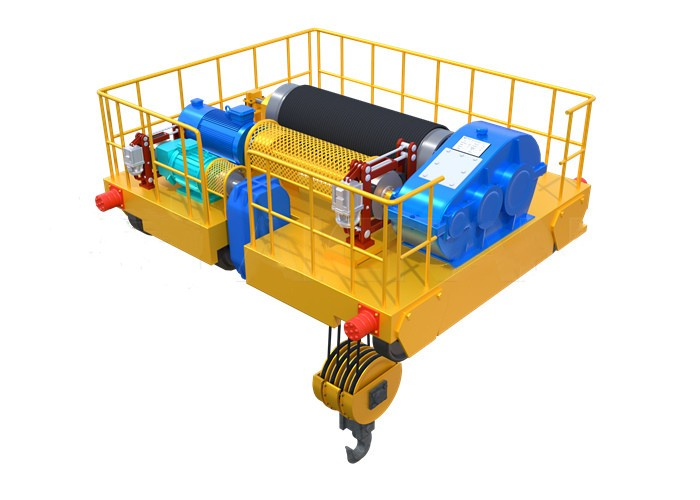
Bridge Girder(s): The main horizontal beam(s) that form the crane's span. They are designed for extreme rigidity to support heavy loads and resist twisting.
Single Girder: One main box-style beam. Used for lighter duty and shorter spans.
Double Girder: Two main beams. Standard for heavy-duty waste applications as they provide greater hook height and capacity.
 |
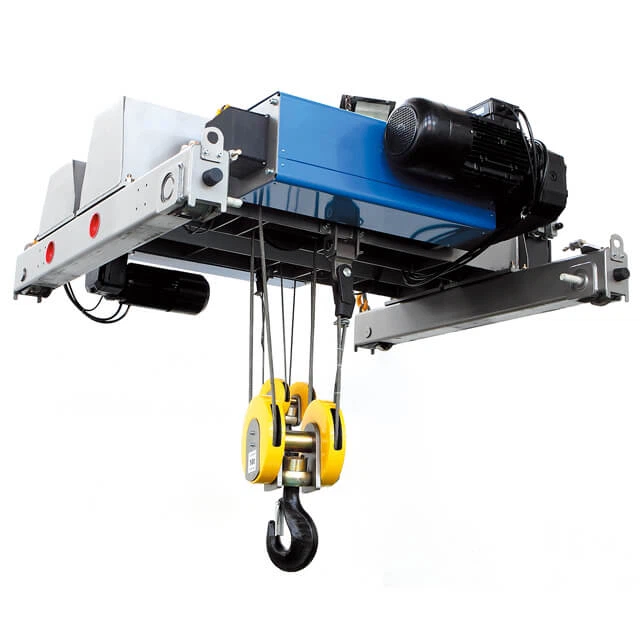 |
End Trucks: The assemblies mounted at each end of the bridge girders. They house the components that allow the entire crane to move.
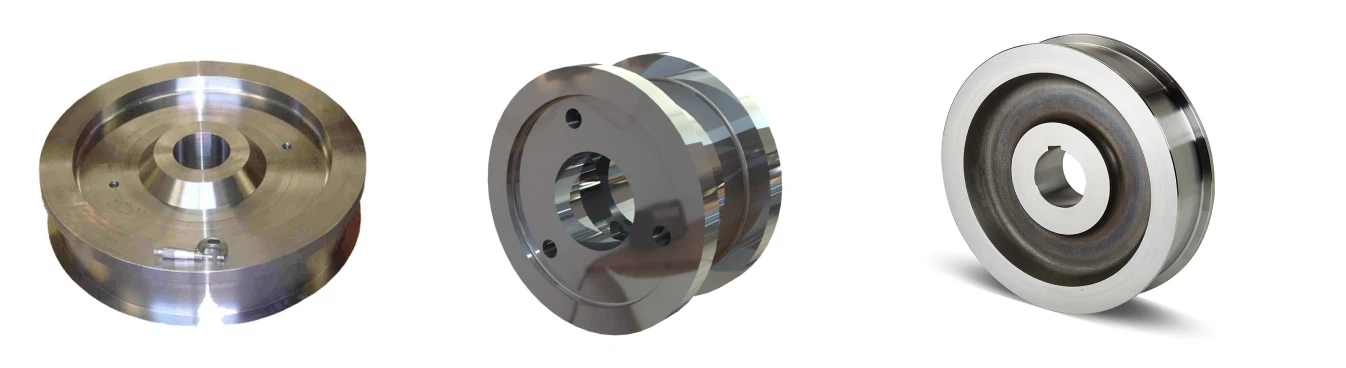
Wheels / Tires: Large, forged steel wheels that run on the runway rails. Often have double flanges for safety in dirty environments.
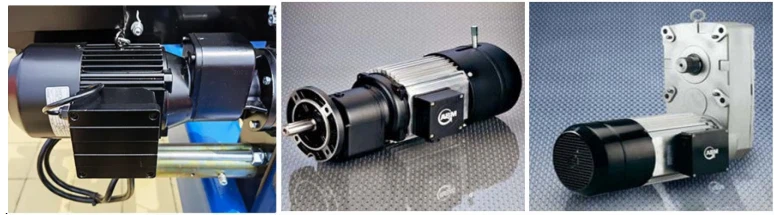
Drive Motors: AC or DC electric motors that provide power to the wheels for long travel (movement along the length of the building).
Brakes: Fail-safe brakes that engage automatically if power is lost.
Runway Rails: Heavy-duty steel rails, securely mounted to the building's support columns, on which the crane's end trucks travel. Note: While not part of the crane itself, they are a critical component of the system.
 |
 |
2. The Grab / Grapple
This is the specialized tool that defines the crane's purpose. It's attached to the hoist and is designed specifically for waste.
Jaws (Shells): The main parts that close to grab the material. For waste, they are not smooth but have features to dig into and hold loose, tangled materials.
Orange Peel Grab: Has 4, 5, or 6 jaws that close to form a sphere. Excellent for general municipal solid waste (MSW), scrap, and demolition waste.
Cactus Grab: Similar to an orange peel but with longer, more pointed jaws for penetrating deeper into piles.
Clamshell Grab: Two hinged jaws, more common for sand, gravel, or grain, but sometimes used for certain waste types.
Upper Frame / Head: The top structure of the grab that connects to the hoist. It contains the mechanism that opens and closes the jaws.
Rope Sheaves or Hydraulic Cylinders:
Rope-operated: Uses multiple wire ropes (cables) from the hoist to open and close the jaws. Very common and robust.
Motor-operated: Has an independent electric motor on the grab to drive the opening/closing mechanism.
Hydraulic-operated: Uses a hydraulic power unit on the trolley to actuate cylinders on the grab for powerful closing force.
3. The Hoist and Trolley
This is the unit that lifts the grab and moves it across the width of the bridge.
Trolley Frame: The steel frame that carries the hoist unit and travels along the bridge girder(s) via trolley rails.
Trolley Drive: The motor, gearbox, wheels, and brakes that provide cross travel (movement across the width of the crane).

Hoist Unit: The core lifting mechanism.
Hoist Motor: A powerful, often variable-frequency drive (VFD) electric motor for precise control of lifting speed.
Drum(s) or Sheaves: Holds and spools the wire rope (cable). A 4-rope grab requires a hoist with multiple drums or a single drum with multiple grooves.
Wire Rope: Special, high-grade steel cable designed for extreme abrasion and fatigue resistance. For a rope-operated grab, there are multiple ropes (e.g., hold, close, and open ropes).
Hoist Brake: A primary mechanical brake that automatically holds the load if power is lost.
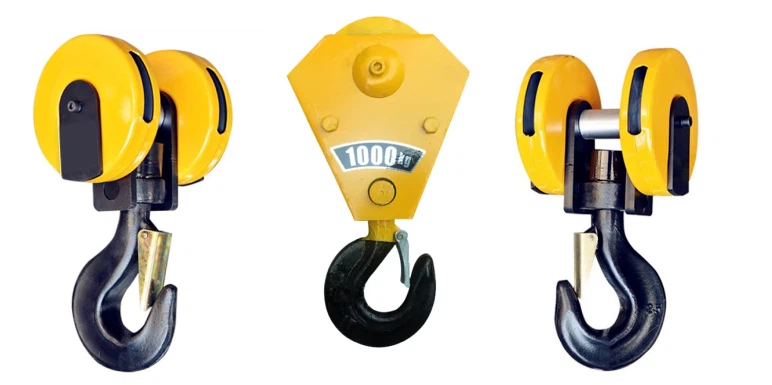
Load Block / Hook: The assembly that connects the wire ropes to the grab. It includes a large, forged steel hook or a master link.
4. The Control and Power System
Cabin or Radio Remote Control:
Operator's Cabin: An enclosed, air-conditioned, and pressurized cab mounted to the crane or trolley. It protects the operator from dust, fumes, and noise. Equipped with joysticks, cameras, and monitors.
Radio Remote Control: A portable, waterproof transmitter worn by the operator. This allows them to move to the best vantage point for safe and efficient grabbing.
Festoon System / Cable Reels:
Festoon: A track with sliding carriers that carry power and control cables along the bridge and trolley. Common but subject to wear.
Cable Reels (Drums): Motorized reels that coil and uncoil a heavy power cable as the crane moves. Often used for long travel motion.

Intelligent Control System:
Programmable Logic Controller (PLC): The brain of the crane. It manages all motions, safety interlocks, and automated functions.
Weighing System: A sensor that measures the weight of each grab load, crucial for process control in waste-to-energy plants.
Anti-Collision and Automation Systems: Sensors and software that allow for semi or fully automated operation, preventing cranes from colliding in a bunker served by multiple cranes.
Safety Components:
Limit Switches: Prevents the crane, trolley, and hoist from traveling beyond their safe limits.
Anemometer: Measures wind speed (if the crane is outdoors) and can disable operation if levels are too high.
Emergency Stop Buttons: Located at multiple points on the crane and on the remote control.
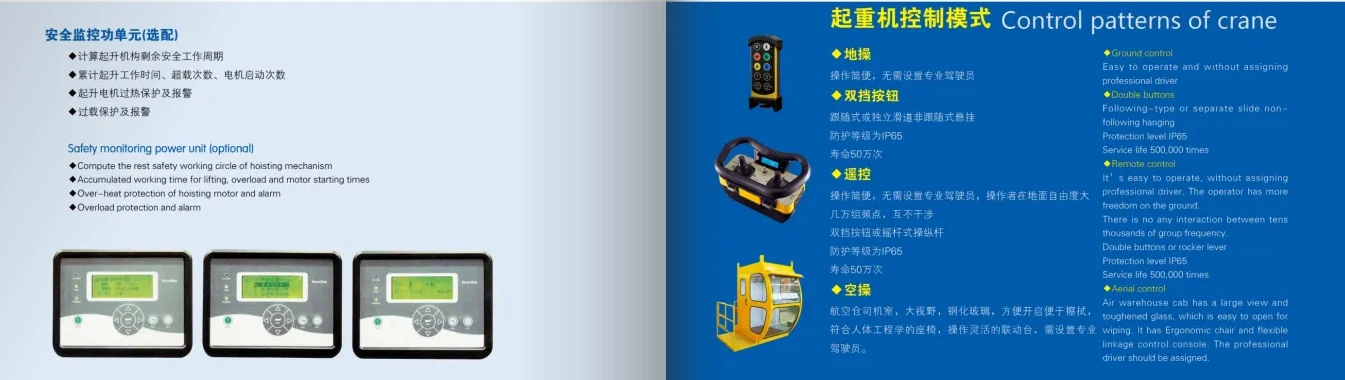
Sketch

Main technical

Advantages
Advantages of a Grab Waste Grab Bridge Crane
This system offers significant benefits over other material handling methods like front-end loaders or bulldozers.
1. Maximum Space Utilization and Large Coverage:
The crane operates overhead, freeing up the entire floor space of the bunker or storage area. This allows for a much larger volume of waste to be stored compared to facilities that rely on ground-based equipment that needs room to maneuver.
The bridge's long travel (along the length of the building) and the trolley's cross travel (across the width of the bridge) provide a massive, rectangular work envelope, ensuring no material is out of reach.
2. Superior Mixing and Homogenization:
This is a critical advantage, especially in Waste-to-Energy (WtE) plants. The grab can continuously turn over the waste pile, mixing materials of different ages and compositions.
This creates a homogeneous fuel with a consistent calorific value (energy content) and moisture content, which is essential for efficient and stable combustion in the boiler.
3. High Efficiency and Continuous Feeding:
The crane can grab several tons of material in a single cycle and transport it quickly to the feed hopper.
It enables a continuous and controlled feed rate to the processing line (shredder, conveyor, boiler), optimizing the entire plant's operational efficiency.
4. Improved Working Environment and Safety:
Containment: The overhead operation contains the waste within the bunker, reducing dust, odor, and litter escape into other parts of the facility.
Operator Safety: The operator works from a safe, enclosed, and climate-controlled cabin or from the floor via remote control. This removes them from direct contact with the waste, heavy machinery traffic, potential bunker fires, and hazardous gases (like methane).
5. Versatility in Material Handling:
The specialized grabs (orange peel, cactus) are designed to handle a vast range of difficult materials: mixed municipal solid waste (MSW), bulky items, tires, mattresses, scrap metal, construction debris, and more.
6. Automation and Process Control:
These cranes are ideal candidates for automation. They can be programmed to work 24/7, following optimized paths to feed the plant continuously.
Integrated weighing systems provide precise data on throughput, allowing for exact process control and valuable operational data.
7. Reduced Maintenance and Operating Costs:
While the initial investment is high, a single bridge crane can replace multiple pieces of ground equipment (loaders, dozers), reducing the maintenance, fuel, and manpower costs associated with a fleet of vehicles.
Application:
Applications of a Grab Waste Grab Bridge Crane
The unique advantages of this system make it the preferred choice in several key waste and recycling sectors:
1. Waste-to-Energy (WtE) / Energy-from-Waste (EfW) Plants:
Primary Application: This is the most common and critical use.
Function: To reclaim waste from the massive storage bunker, mix it for homogeneity, and feed it into the hopper that leads to the combustion grate.
Why it's used: The mixing capability for consistent fuel quality is unmatched by any other technology.
2. Material Recovery Facilities (MRFs) and Recycling Centers:
Function: To move and sort large volumes of commingled recyclables (paper, plastic, metals) from receiving pits onto conveyor lines for processing.
Why it's used: The overhead grab can efficiently "grab and place" materials, helping to organize the flow and even perform rough sorting (e.g., grabbing primarily cardboard from one area).
3. Scrap Metal Yards and Recycling:
Function: Handling and loading shredded automotive scrap (ASR), fragmented metals, loose scrap, and end-of-life vehicle (ELV) parts.
Why it's used: The grab's jaws are strong enough to handle sharp, heavy, and abrasive metal pieces that would damage other equipment.
4. Landfill and Transfer Station Operations:
Function: At transfer stations, they organize and load waste into containers for transport. At landfills, they can be used for waste placement and compaction.
Why it's used: They improve the density of waste in containers, reducing transportation costs.
5. Bulk Handling Terminals (For Waste-Derived Fuels):
Function: Handling and moving Refuse-Derived Fuel (RDF) or Solid Recovered Fuel (SRF), which are processed waste products meant for use as fuel in cement kilns or power plants.
Why it's used: Efficiently moves large volumes of loose, bulk fuel without degradation.
Crane production procedure
The manufacturing process of a QDY metallurgical casting bridge crane involves strict quality control and specialized engineering to ensure durability, heat resistance, and safety. Below is a step-by-step breakdown of the production procedure:
1. Design & Engineering
Load & Environment Analysis – Calculations for lifting capacity (5–500+ tons), span, and heat resistance.
CAD/3D Modeling – Structural design, stress simulations (FEA), and compliance with ISO, FEM, or GB standards.
Customization – Optional features (explosion-proofing, insulated hoists, automation) are integrated.
2. Material Selection & Preparation
Main Girders & End Carriages – High-strength steel (Q345B, Q460C) or heat-resistant alloy steel.
Wire Ropes & Hooks – Special heat-treated alloy steel (for molten metal handling).
Electrical Components – High-temperature-resistant cables, motors, and insulation materials.
3. Fabrication of Key Components
A. Bridge Girder Construction
Cutting & Welding – CNC plasma/laser cutting for precision; submerged arc welding (SAW) for high-strength joints.
Heat Treatment – Stress-relieving annealing to prevent deformation.
Machining – Drilling, milling, and surface grinding for assembly accuracy.
B. Hoist & Trolley Assembly
Hoist Drum & Gearbox – Machined for smooth operation; tested under 1.25x rated load.
Heat-Resistant Brakes – Dual-disc or electromagnetic brakes for fail-safe holding.
Ladle Hook & Safety Latch – Forged and ultrasonically tested for cracks.
C. End Trucks & Runway System
Wheel & Rail Machining – Hardened steel wheels for long wear life.
Drive Motors & Reducers – Equipped with anti-skid mechanisms for heavy loads.
4. Electrical & Control System Integration
Festoon/Conductor Bar System – For power supply along the runway.
Variable Frequency Drives (VFDs) – For smooth speed control and energy efficiency.
Safety Circuits – Overload sensors, limit switches, and emergency stop.
Operator Controls – Pendant, cabin, or remote/automated systems.
5. Surface Treatment & Corrosion Protection
Sandblasting (SA 2.5 Grade) – Removes rust and improves paint adhesion.
High-Temp Paint/Coating – Zinc-rich primer + heat-resistant topcoat (up to 800°C).
Critical Component Insulation – Ceramic fiber or refractory coatings on hooks and ropes.
6. Assembly & Testing
A. Pre-Assembly Checks
Dimensional inspection of girders, trolley, and end carriages.
Alignment of runway rails and crane tracks.
B. Load Testing (Per ISO 4310 / GB Standards)
No-Load Test – Checks motor, brake, and travel functions.
Static Load Test – 1.25x rated capacity for 10+ minutes.
Dynamic Load Test – 1.1x rated capacity with repeated movements.
Emergency Brake Test – Verifies fail-safe mechanisms.
C. Heat Resistance Validation (For Foundry Cranes)
Simulated high-temperature exposure (if required).
7. Packaging & Delivery
Disassembly (if needed) – For large cranes, components are shipped separately.
Anti-Corrosion Packaging – VCI film or desiccant for overseas transport.
Documentation – Manuals, test reports, and certifications (CE, ISO, GOST, etc.).
8. Installation & Commissioning (On-Site)
Runway alignment and crane reassembly.
Final load testing and operator training.
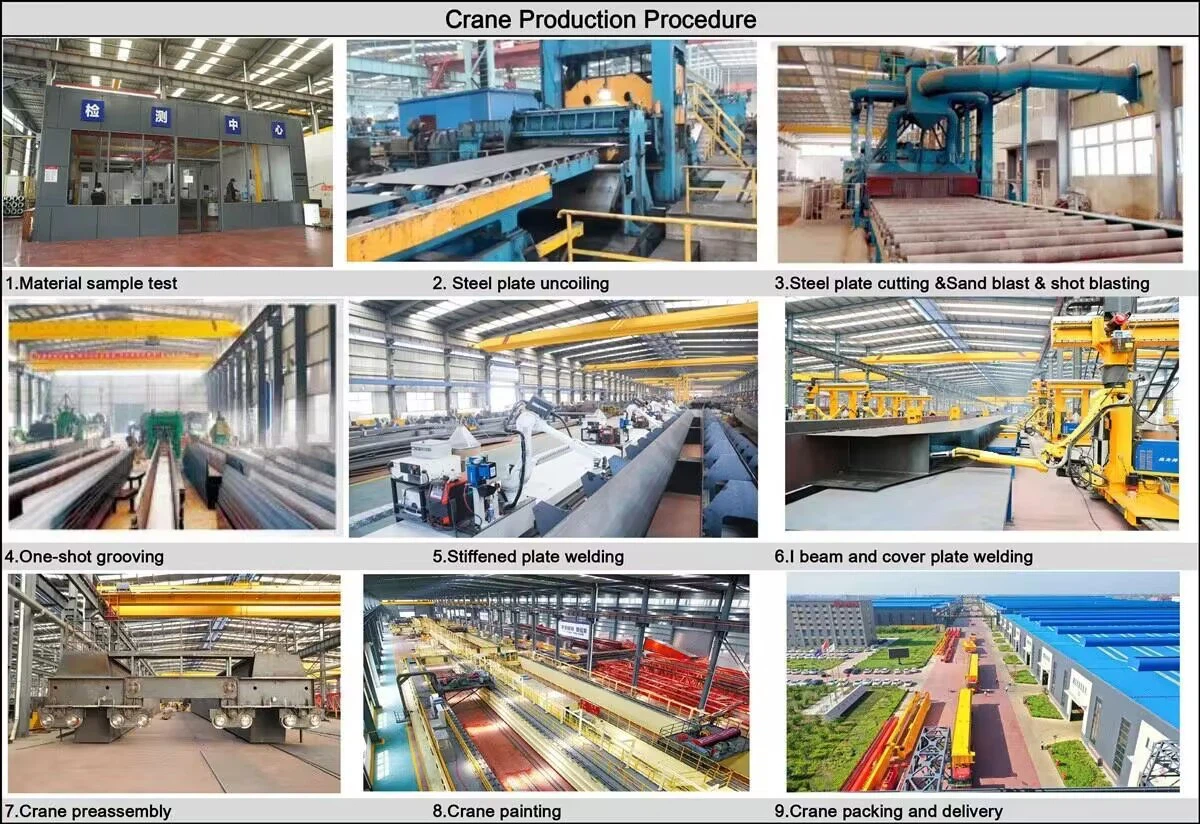
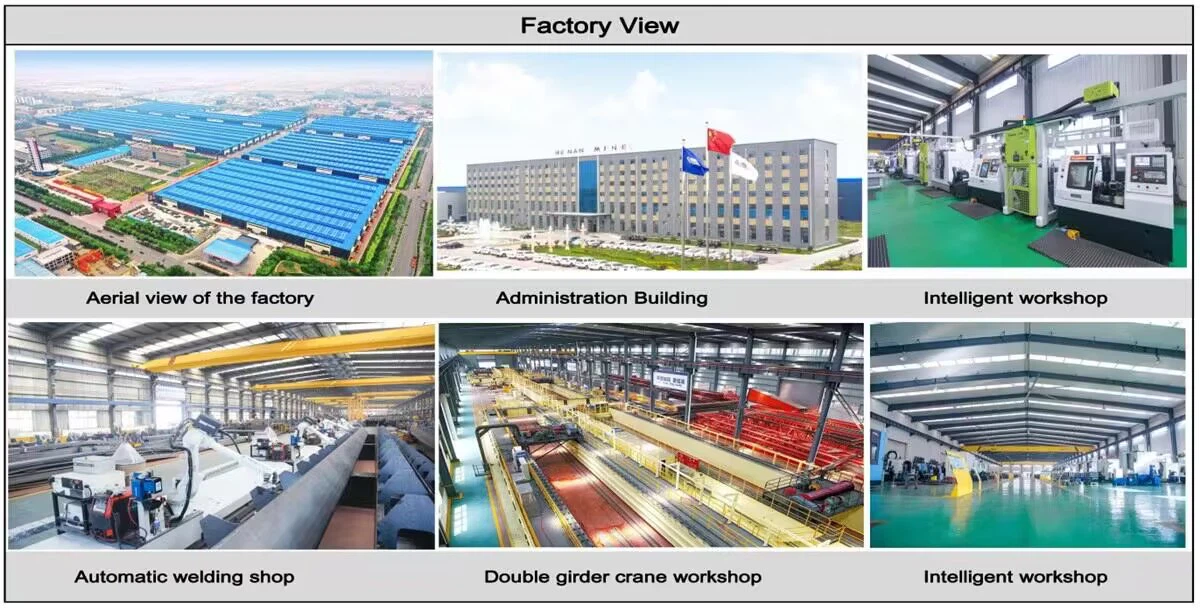
Workshop view:
The company has installed an intelligent equipment management platform, and has installed 310 sets (sets) of handling and welding robots. After the completion of the plan, there will be more than 500 sets (sets), and the equipment networking rate will reach 95%. 32 welding lines have been put into use, 50 are planned to be installed, and the automation rate of the entire product line has reached 85%.


Hot Tags: with grab waste grab bridge crane, China with grab waste grab bridge crane manufacturers, suppliers, factory, Double Girder Overhead Travelling Crane, Double Girder Overhead Crane
You Might Also Like


Send Inquiry