










Clamshell Bucket Overhead Crane
Products Description
Clamshell bucket overhead crane is a highly efficient and versatile lifting equipment that is widely used in industries such as construction, mining, and shipyards. This type of crane is equipped with a clamshell bucket attachment, which allows it to handle a variety of materials, such as sand, gravel, coal, and scrap metal.
One of the main advantages of the clamshell bucket overhead crane is its ability to pick up and release materials quickly and efficiently. This is especially useful in situations where time is of the essence, such as in loading and unloading ships or trucks. Additionally, the clamshell bucket attachment can be easily controlled from the crane's cabin, allowing for precise and accurate placement of materials.
Another key feature of the clamshell bucket overhead crane is its durability and reliability. These cranes are designed to withstand heavy loads and harsh working conditions, making them ideal for tough industrial environments. With proper maintenance and care, a clamshell bucket overhead crane can provide years of dependable service.
In conclusion, the clamshell bucket overhead crane is a valuable and essential tool for industries that require the efficient handling of materials. Its versatility, efficiency, and reliability make it a preferred choice for many businesses. Invest in a clamshell bucket overhead crane today and experience the benefits of this high-quality lifting equipment.
Warranty:1 Year
Weight (KG):1000 kg
Feature:Bridge Crane
Condition:New
Rated Lifting Moment:100kn
Max. Lifting Load:32t
Span:3-28m
Control method:Remote control or Cabin control
Work Duty:A3-A8
Color:Yellow .Red . Orange or customized
Lifting mechanism:electric hoist

Pictures & Components
Main girder
The main girder of a clamshell bucket overhead crane is a crucial structural component that directly supports the crane's lifting and load-carrying capacity. The characteristics of the main girder in this type of crane are designed to handle the specific stresses and demands of operating with a clamshell bucket, which is commonly used for handling bulk materials like sand, gravel, or coal. Here are the key features:
1. Structural Design:
Box Beam or I-Beam Structure: The main girder is typically designed as a box beam for heavy-duty applications or an I-beam structure for lighter duties. The box girder provides superior torsional resistance, making it ideal for cranes that need to handle large and unpredictable loads, such as when operating the clamshell bucket.
Welded Construction: The girder is often made of high-strength steel plates welded together to form a closed structure, improving both strength and durability. The welding quality is critical to ensure that the girder can withstand high stresses without failure.
2. Strength and Load Distribution:
The girder is designed to support the dynamic and static loads exerted by the clamshell bucket, which can vary significantly during operation (e.g., when the bucket is being filled or emptied). The structure must be able to absorb shock loads and distribute forces evenly to avoid excessive wear or failure.
High Load Capacity: The girder needs to have a high load-bearing capacity to support the weight of the clamshell bucket and the material being lifted. For this reason, high-quality steel is typically used, and the dimensions of the girder are optimized based on the expected load range.
3. Resistance to Torsion:
Given that a clamshell bucket operates with a range of motions (lifting, lowering, swinging, etc.), the main girder must be designed to resist torsion. The box girder structure excels here, as it provides better resistance to twisting forces compared to an I-beam structure.
4. Long Span and Stability:
For larger overhead cranes with a longer span, the main girder is designed to be stable and minimize any deflection under load. The design also takes into account factors such as crane span, lifting height, and overall dimensions to ensure optimal operation.
5. Durability and Maintenance:
Corrosion Resistance: Depending on the crane's operating environment (e.g., marine or industrial settings), the main girder may have additional corrosion-resistant coatings to protect against the elements.
Ease of Inspection and Maintenance: The design of the girder often includes access points or inspection slots, allowing for easy maintenance and checking of welds and joints to ensure the long-term structural integrity of the crane.
6. Weight Considerations:
Although strength is the main consideration, the weight of the main girder must also be optimized to avoid unnecessary excess that could affect the overall performance of the crane. Lightweight yet strong materials are often chosen to strike a balance between strength and efficiency.
7. Integration with Other Components:
The main girder is designed to seamlessly integrate with other key crane components, such as the trolley, hoist, and rails. Special attention is paid to ensure the girder provides a stable and rigid base for these components, which must operate in coordination with the clamshell bucket's movements.
8. Welding and Fabrication Technology:
Automated Welding Processes: Modern cranes use advanced automated welding technologies to ensure precise and consistent weld quality, which is vital for the safety and longevity of the crane.
Quality Control: As with all heavy-duty cranes, rigorous quality control is applied during the fabrication process of the main girder to ensure that the welded joints and overall structure meet the required strength standards.
In summary, the main girder of a clamshell bucket overhead crane is a highly engineered component designed to support large and varying loads while resisting torsional and bending stresses. Its design prioritizes strength, stability, and durability, ensuring the crane can safely and effectively handle the demands of lifting bulk materials with the clamshell bucket.

The lifting system of a clamshell bucket overhead crane is specifically designed to handle the precise operation of the clamshell bucket, which is used for picking up, carrying, and releasing bulk materials such as coal, gravel, sand, or even scrap material. The lifting system must be robust, precise, and capable of handling dynamic loads due to the nature of the bucket's operation. Here's an overview of the key components and characteristics of the lifting system in a clamshell bucket overhead crane:
1. Hoisting Mechanism:
The hoisting mechanism is the core of the lifting system and is responsible for raising and lowering the clamshell bucket. It typically consists of:
Hoist Drum: A large drum that winds and unwinds the hoist rope or cable. The hoist drum is powered by an electric motor, which is often geared to provide optimal lifting speed and force.
Wire Rope or Steel Cable: The rope or cable is attached to the clamshell bucket via the bucket's lifting points (usually hooks or eyes) and is wound onto the hoist drum. The rope is made of high-tensile strength steel to withstand the significant forces involved in lifting heavy or bulky materials.
Motor and Gearbox: The hoisting motor provides the power needed for lifting. It is typically coupled with a gearbox to adjust the lifting speed and torque, ensuring precise control during the lifting operation.
2. Trolley System:
The trolley moves along the girder, supporting the hoist mechanism. It is mounted on a set of wheels and is designed to move horizontally along the crane's span, allowing the clamshell bucket to be positioned over the load and moved across the workspace.
Electric Motor: The trolley is powered by an electric motor, which drives the movement of the trolley along the rails of the crane. This allows for precise positioning of the bucket over the material to be picked up.
Rails: The trolley runs along rails attached to the main girder of the crane, providing smooth and stable motion for the hoisting mechanism.
3. Clamshell Bucket Control:
The operation of the clamshell bucket itself is managed through a bucket-opening and closing mechanism:
Bucket Lifting Mechanism: The clamshell bucket has two jaws (or halves) that open and close in a scissor-like motion. These jaws are controlled by a combination of hydraulic or mechanical linkages, which are powered by motors or hydraulic cylinders.
Hydraulic Cylinders (or Mechanical Actuators): The most common mechanism for controlling the opening and closing of the bucket is hydraulic. Hydraulic cylinders are used to open and close the jaws, providing high force in a relatively compact space. These cylinders are often controlled by an onboard hydraulic power unit that manages the pressure and flow of the hydraulic fluid.
Opening and Closing Control: The operator controls the bucket's jaws using a set of levers or electronic controls, allowing for precise manipulation when the bucket is scooping or releasing material.
4. Braking System:
The lifting system must be equipped with a reliable braking system to hold the bucket at a specific height or position when needed, such as during unloading or when the bucket is suspended while being moved. The braking system typically consists of:
Mechanical or Electromagnetic Brakes: These brakes are designed to hold the hoist drum in place, preventing the bucket from descending unintentionally.
Fail-Safe Features: The braking system often includes fail-safe features to ensure the load remains safely suspended in the event of a power failure or other system malfunction.
5. Safety Features:
Load Limiters: The lifting system includes load limiters or overload protection systems to prevent the crane from lifting more than the rated capacity of the hoist, ensuring safety during operation.
Slack Rope Detection: Systems are in place to detect if the hoist rope becomes slack or disengaged from the drum, which could cause instability or damage. This can trigger automatic shutdowns or alerts to the operator.
Emergency Stops and Limit Switches: Emergency stop buttons and limit switches are installed to halt operations in case of any malfunction or abnormal operation. These safety features prevent overtravel of the trolley or hoist, reducing the risk of accidents.
Anti-Sway Systems: To prevent the swinging motion of the bucket when it is moving, anti-sway technology can be integrated into the lifting system. This ensures smooth operation, especially when lifting and transporting materials over long distances.
6. Lifting Speed and Precision:
Variable Speed Control: To ensure the safe and accurate movement of the clamshell bucket, many lifting systems are equipped with variable speed drives that allow the operator to adjust the lifting and lowering speeds, particularly when scooping or unloading material.
Precision Control: The system needs to provide smooth and precise control of the bucket's position, especially when dealing with bulk materials that must be carefully managed to avoid spillage.
7. Power Supply and Distribution:
Electric Motor or Hydraulic Power: Most overhead cranes are powered by electric motors, but some may use hydraulic systems, especially in applications requiring higher power or more precise control. Hydraulic systems are often used for controlling the clamshell bucket's opening/closing mechanism, while electric motors handle the hoisting and trolley motions.
8. Control System:
The entire lifting system is controlled through a crane control panel or remote control, which allows the operator to:
Lift and Lower the Bucket: The operator can control the hoist speed, as well as the movement of the clamshell bucket.
Control the Bucket's Jaws: The operator can adjust the bucket's opening and closing, depending on the material being handled.
Monitor System Health: Modern control systems provide diagnostics, load data, and safety alerts to keep the system functioning optimally.


End Carriages
The end carriages of a clamshell bucket overhead crane are essential components that allow the crane to move horizontally along its rail system. These carriages house the wheels, drive mechanisms, motors, and brakes, and they are responsible for supporting and stabilizing the crane during operation. Key design considerations include load capacity, stability, durability, and the integration of safety features such as overload protection and anti-sway systems. The end carriages are designed to ensure the crane can safely and efficiently move the clamshell bucket, regardless of load size or operating environment.

Crane traveling mechanism
1) Crane motor: The crane motor is the main power source of the crane running mechanism. The crane travel and speed control of the crane are achieved by controlling the start and stop and speed of the trolley motor. The crane motor is usually equipped with a brake device to ensure accurate positioning when stopping and prevent sliding.
2) Reducer: Since the output speed of the motor is high, directly acting on the wheel will cause the speed to be too fast and uncontrollable. Therefore, the reducer is used to reduce the high-speed rotation of the motor and increase the output torque at the same time, so that the crane can run smoothly at a suitable speed. To ensure the smooth operation of the crane when starting and stopping, the reducer is usually designed to be multi-stage.
3) Transmission mechanism: The coupling connects the motor and the reducer to transmit the power of the motor. The coupling can also absorb certain vibrations and protect the motor and reducer. The power is transmitted to the wheel system of the trolley through the transmission shaft to ensure that the trolley travels smoothly and has sufficient driving force.
4) Wheel system: The trolley running mechanism is usually composed of a driving wheel and a passive wheel. The driving wheel drives the trolley to travel on the track through the motor and the transmission system, while the passive wheel is used to keep the trolley running smoothly. Wheels are usually made of high-strength steel to ensure that they will not deform under heavy loads. The diameter, material and structural design of the wheels have a direct impact on the load-bearing capacity and running smoothness of the truck.
5.Trolley traveling mechanism
1) Motor drive: The operator starts the trolley motor through the control system. The motor is the power source of the trolley's running mechanism and drives the movement of the trolley through electricity. The speed of the motor can be adjusted by a frequency converter or a speed regulating device to achieve different walking speeds.
2) Reducer conversion power: The high speed of the motor is converted into a low-speed, high-torque output through a reducer. The reducer is usually multi-stage to ensure the smooth operation of the trolley. The reducer amplifies the power torque of the motor and provides sufficient power to overcome the friction and load in the movement of the trolley.
3) Transmission system: The coupling connects the motor with the reducer and transmits power to the transmission shaft. The coupling can compensate for slight misalignment of the shaft and reduce vibration. The transmission shaft transmits the output power of the reducer to the wheel system of the trolley.
4) Wheel system: The driving wheel is the main power wheel of the trolley, which is directly driven by the motor through the transmission system to drive the trolley to move on the bridge. The passive wheel is used to support the trolley and guide the direction of movement to ensure the stability of the trolley. The passive wheel does not provide power, but only carries and guides.
5) Track operation: The trolley runs on tracks on the bridge. The tracks are usually fixed to the bottom or side of the bridge to ensure smooth movement of the trolley. The tracks need to be kept straight and level to prevent the trolley from drifting or derailing. There is rolling friction between the wheels and the tracks, and the movement of the trolley depends on overcoming this friction. The design of the wheels and the maintenance of the tracks are crucial to the smooth operation of the trolley.
6.Crane wheel
1) Wheel construction
Wheel material: Wheels are usually made of high-strength steel to withstand the heavy load of the crane. Steel wheels have high wear resistance and load-bearing capacity.
Wheel structure: Wheels are generally designed as round or ring-shaped with inner grooves to adapt to the shape of the track and provide a stable contact surface. The inner hole design of the wheel must also match the axle to ensure that the wheel can be installed correctly.
2) Wheel type
Drive wheel: The drive wheel is the main power wheel of the trolley running mechanism, driven by an electric motor, and drives the trolley to move on the track through a transmission system. The drive wheel usually has high wear resistance and load-bearing capacity.
Passive wheel: The passive wheel is used to support the trolley and guide its direction of movement, and does not directly transmit power. The design requirements of the passive wheel are equally high to ensure the stable operation of the trolley.

7.Crane hook
The hook of a double-beam bridge crane is an important component of the crane system. It can grab, lift and carry materials through its special design and structure. The material, structure, installation and maintenance of the hook need special attention to ensure the efficiency and safety of the crane. Regular inspection and maintenance are the key to ensure the long-term stable operation of the hook.
1) Regular inspection: The hook needs to be regularly inspected for structural integrity, including the wear of the hook body, bearings, locks and other components. The inspection also includes whether the hook body has cracks, deformation and other problems.
2) Lubrication and maintenance: For the rotating part of the hook, regular lubrication and maintenance are required to reduce friction and wear and extend the service life.
3)Replacement and repair: When the hook is severely worn, damaged or has other safety hazards, it needs to be replaced or repaired in time. The maintenance and replacement of the hook needs to be carried out in accordance with the manufacturer's regulations and standards.

8.Motor
Maintenance of the motor
1) Regular inspection: Regularly check the operating status of the motor, including the temperature, vibration, noise, etc. of the motor. Check the insulation resistance and winding status of the motor to ensure its normal operation.
2) Cleaning and lubrication: Keep the motor clean and regularly clean the dust and debris inside the motor. Lubricate the bearings and other moving parts to reduce friction and wear.
3) Replacement and repair: When the motor fails, it needs to be repaired or replaced in time. The failure may include overheating, abnormal vibration, noise and other problems of the motor.

. 

9.Sound and light alarm system & limit switch
1. Sound and light alarm system
1) Warning function: The main function of the sound and light alarm system is to alert the operator and surrounding personnel to the operating status of the crane. It can emit sound alarms and flashing light signals to attract attention.
2) Safety reminder: The system is usually used to remind the operator of abnormal conditions of the crane, such as overload, collision warning, or reaching the limit position.
2. Limit switch
1) Position control: Limit switches are used to detect the operating position of each moving mechanism of the crane to prevent the crane from exceeding the design range during operation. They help protect the mechanical structure and load safety of the crane.
2) Automatic stop: When the crane or its accessories approach or reach the set limit position, the limit switch will trigger an automatic stop to prevent further movement to avoid damage.

10.Safety Devices
1) Overload protection device: The overload protection device is used to monitor the load of the crane to prevent the load from exceeding the design load capacity of the equipment. When the load exceeds the safety range, the device will send out an alarm signal and automatically stop lifting or other movements to protect the safety of the equipment and load.
2) Emergency stop device: In an emergency, the operator can immediately stop all movements of the crane through the emergency stop device to prevent accidents. Usually set on the operation panel and key positions for quick triggering.
3) Safety belts and guardrails: Safety belts and guardrails are used to protect operators and maintenance personnel from accidental falls during operation or maintenance.
4) Braking system: The braking system is used to control the moving speed and stop position of the crane to ensure smooth operation. In the event of a fault or emergency, additional braking force is provided.
5) Electrical protection device: Prevent short circuits in the electrical system and protect motors and electrical components. Prevent electrical systems from failing under overload conditions.
11.Control Mode
1) Manual control: Manual control is the most traditional control method, which controls various functions of the crane, such as lifting, walking and trolley operation, through buttons, switches and joysticks on the operation panel. It is simple to operate and suitable for environments that do not require complex operations.
2) Wireless remote control: The wireless remote control system allows the operator to operate near or far away from the crane, and transmits control instructions through wireless signals. Improves operational flexibility and comfort, suitable for scenarios that require operators to move and observe.
3) Automatic control: The automatic control system automatically performs crane operations based on preset programs and parameters without human intervention. Improves operational accuracy and is suitable for repetitive work or scenarios that require high precision.
4) Computer control: Use computers for comprehensive control and monitoring, and operate and monitor through a graphical interface. Able to record and analyze operational data and provide decision support.

Sketch

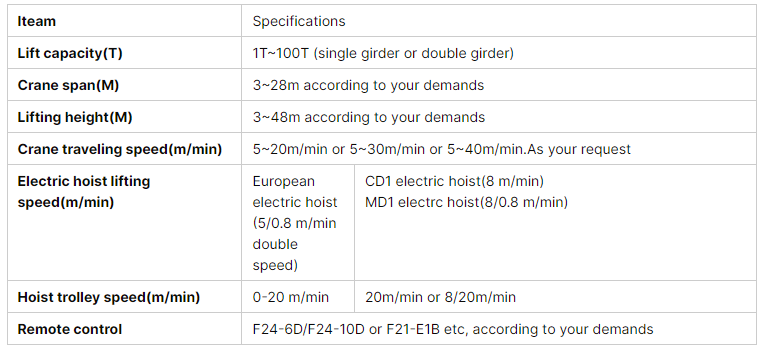
Main technical data
Advantages
High load-bearing capacity: Double-beam bridge cranes use a double-beam structure, which enables them to withstand larger loads. Each beam shares a part of the load, thereby increasing the overall load-bearing capacity. The double-beam design provides greater stability and is suitable for handling heavy loads.
Larger lifting height and span: The bridge design of double-beam bridge cranes allows for higher lifting heights, allowing them to operate in larger working areas. The large span of the bridge can cover a wider working area, which is very suitable for large workshops and storage facilities.
Efficient working performance: Double-beam bridge cranes have a faster travel speed and can quickly complete material handling tasks and improve production efficiency. Due to its stable structure, the crane can remain stable during operation, reducing vibration and swaying.
Flexible operation: It can be equipped with a variety of control methods, such as manual control, wireless remote control, automatic control, etc., which is flexible and convenient to operate. It has a high-precision control system that can accurately adjust the position and load of the hook to improve the accuracy of the operation.
Convenient maintenance and overhaul: The structure of the double-beam bridge crane is relatively simple, which is convenient for daily maintenance and overhaul. The equipment status can be detected in real time through the operation panel and monitoring system, making it easy to find and eliminate faults.
Application
Manufacturing: used to lift large pieces of steel, steel plates, furnace materials, etc. Steel mills usually need cranes with high load-bearing capacity to handle heavy materials and for lifting hull components, heavy equipment and materials to help assemble and repair ships.
Construction: used to lift construction materials such as concrete beams, steel structures and prefabricated components. The high lifting capacity and large span of double-beam bridge cranes are suitable for the needs of construction sites. Used to lift heavy equipment and materials in tunnel construction to assist in tunnel excavation and construction.
Power industry: used to lift generator sets, large equipment and maintenance tools to ensure smooth equipment maintenance and overhaul work in power plants. Used to lift transformers and other power equipment for easy installation and maintenance.
Mining: used to lift ore, equipment and mine construction materials to help mining and transportation operations in mines. Used to carry heavy materials and equipment generated during mineral processing.
Facility maintenance and overhaul: In terms of plant maintenance, it is used to maintain and repair equipment in large plants, such as motors, fans and conveyors. In addition, it can also be used to lift equipment and tools during the maintenance process to ensure the normal operation and maintenance of the equipment.
Crane production procedure
Demand analysis and design: Understand the specific needs of customers, including the working environment, load requirements, span, lifting height, etc. of the crane. Determine technical specifications and performance parameters according to the needs and develop a preliminary design plan. According to the preliminary design, carry out detailed structural design and component design, and draw detailed engineering drawings.
Material procurement: Select reliable suppliers and evaluate them to ensure the quality and delivery time of the materials. Sign a procurement contract with the supplier to clarify the material specifications, quantity, price and delivery time.
Manufacturing and processing: Cut, bend, weld and other processing of steel to manufacture major components such as bridges, end beams, and support structures. Carry out precision processing of components to ensure that the size and shape of each part meet the design requirements. Install motors, reducers and drive systems to ensure the normal operation of the crane's power system. Install electrical equipment such as control panels, sensors, limit switches, and complete the wiring and connection of the electrical system. Weld and fix each component to ensure the stability of the structure.
Testing and debugging: Check the structural connections and welding parts of the crane to ensure that there are no defects. Test the connection and function of the electrical system to ensure that each electrical component is working properly. Adjust the control parameters according to the test results to optimize the operating performance. Deal with problems found during testing to ensure that the equipment meets the design requirements.
Acceptance and delivery: Conduct final quality inspection to ensure that all components and systems meet design standards and quality requirements. Conduct final performance tests to verify the functions and safety performance of the crane. Deliver the completed crane to the customer for on-site installation and commissioning. Provide operation training to customers, explaining the use of the equipment and maintenance knowledge.

GlobalMarket


Hot Tags: clamshell bucket overhead crane, China clamshell bucket overhead crane manufacturers, suppliers, factory
Previous
Garbage Grab CraneNext
5T EOT CraneYou Might Also Like


Send Inquiry