






16 Ton LD Single Girder Overhead Crane
Products Description
💡 Features & Considerations
Safety Devices: Standard equipment includes lifting limit switches, overload protection, and buffers to ensure safe operation .
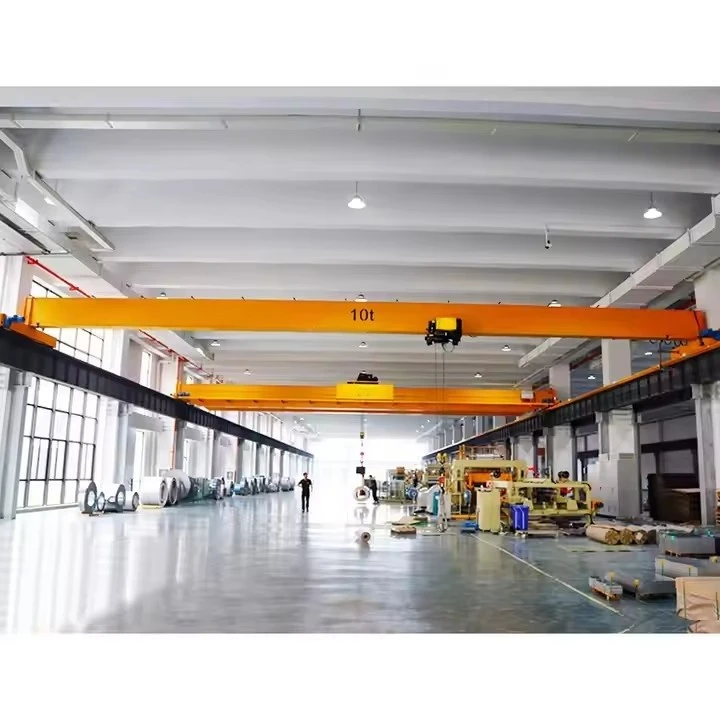
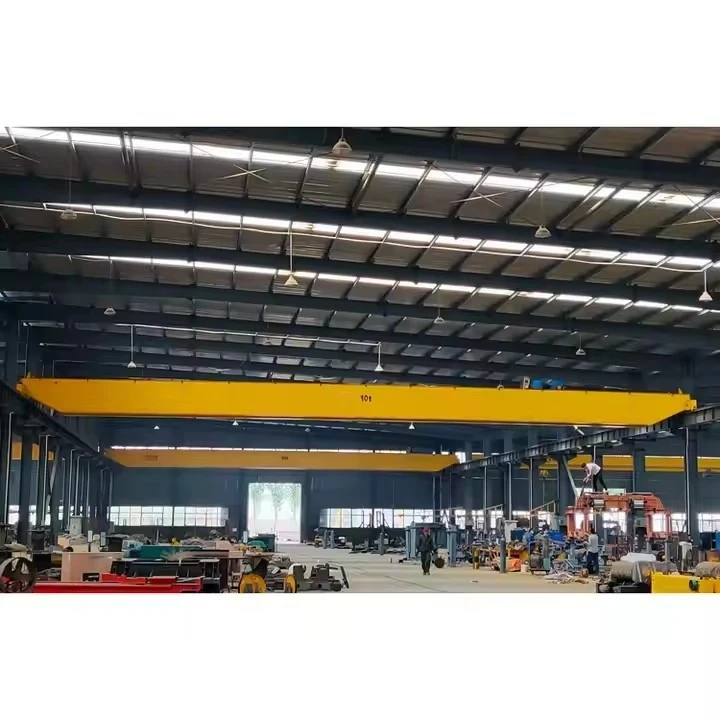
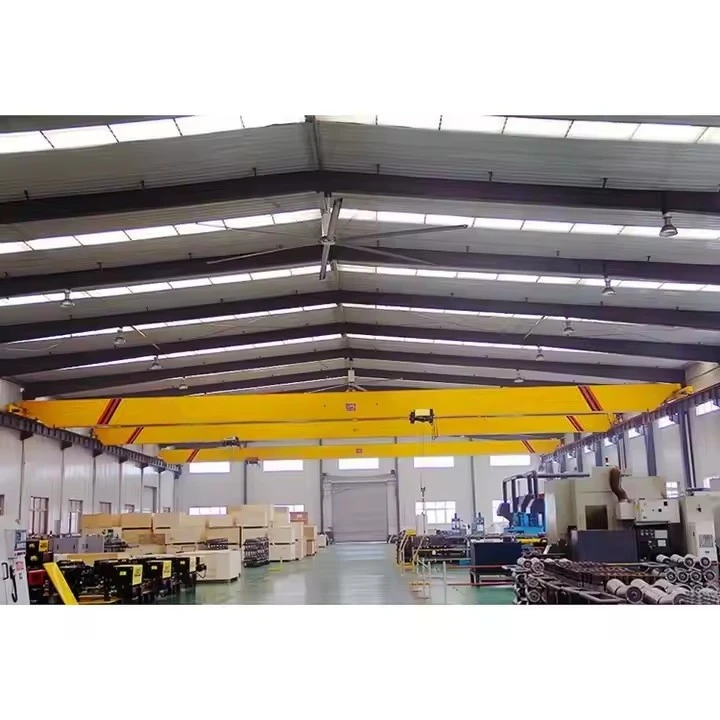
Applications: It is widely used in manufacturing plants, assembly workshops, and warehouses for general material handling .
Environment: This crane is not suitable for use in flammable, explosive, or corrosive environments, nor for lifting molten metal . Specialized cranes are required for those conditions.

Pictures & Components
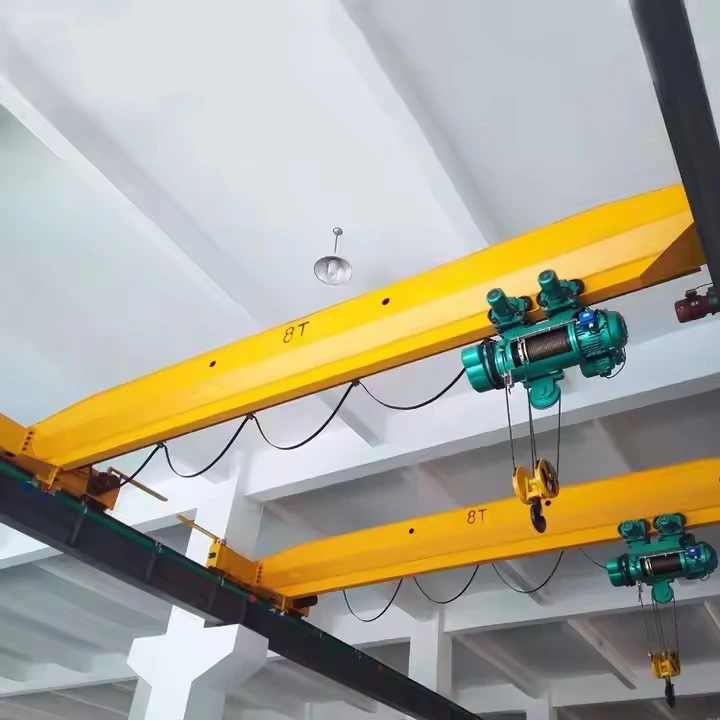
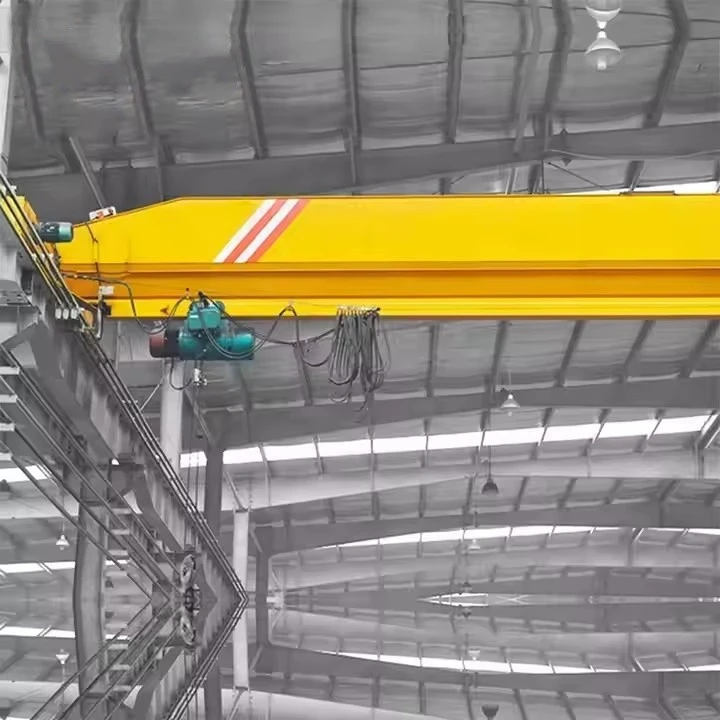
Main Girder: The primary load-bearing beam. For a 16-ton capacity, it is typically constructed from steel plates welded into an I-beam or a box girder configuration. It supports the hoist and carries the load .

End Carriages (End Beams): Located at both ends of the main girder. They connect to the main girder (often using high-strength bolts) and house the wheels that allow the entire crane to travel along the runway rails .
 |
 |
The core lifting component is usually a CD1 or MD1 model wire rope electric hoist .
Hoist Trolley: The structure that carries the hoist and moves it horizontally along the bottom flange of the main girder .
 |
 |
Hoisting Motor: Provides the power for lifting. CD1 models use a single-speed motor, while MD1 models use a dual-speed motor for precise positioning .
Wire Rope Drum & Guide: The drum winds the steel wire rope. For a 16-ton hoist, the rope is typically heavy-duty, and a rope guide ensures it spools correctly .

Hook Block: The assembly that holds the load. For 16-ton capacity, it typically uses a double-pulley design to manage the load .

Crane Travel Mechanism
Drive System: The crane travels via motors mounted on the end carriages. It usually uses a separate drive mode (one motor per side) for smoother movement and reduced wheel wear .

Wheels: Flanged steel wheels that ride on the runway rails. The wheel diameter and track width are matched to the 16-ton load and span .
.
Control System: Can be operated via a pendant control (button box on a cable) or a wireless remote. The control voltage is often stepped down (e.g., 36V or 24V) for operator safety .

Power Supply: The main power (typically 380V, 3-phase) is supplied to the crane via a festoon cable system or conductor rails running along the runway .
Safety Devices: Essential components include limit switches (to prevent over-hoisting or over-travel), an overload protector, and buffers at the ends of the runway .

Sketch

Main technical

Advantages
The core advantage of a 16-ton LD single girder overhead crane is that it delivers medium-tonnage, intermittent-duty lifting at a significantly lower cost. It is not designed to replace a double girder crane for heavy-duty or high-frequency work, but within its intended range, it offers excellent value.
Cost & Building Compatibility
Lower purchase and installation cost: The simple structure and light self-weight mean the price is typically half to two-thirds that of a comparable double girder crane, with a shorter installation period.
Lower demands on the building: Wheel loads are small (roughly 4–7 kN per ton), which greatly reduces the load-bearing requirements on columns and runway beams. For older buildings being upgraded or new projects with limited structural capacity, this can save considerable civil engineering costs.
Structure & Maintenance
Compact design saves space: The overall height is relatively low, requiring less headroom, which makes it suitable for workshops with limited vertical clearance.
Simple, low-cost maintenance: More than 95% of faults are concentrated in the standard electric hoist. Parts are common and inexpensive, and routine servicing can be handled by ordinary maintenance staff, minimizing downtime.
Performance Boundaries to Keep in Mind
Positioning and rigidity: A single girder is inherently less rigid than a double girder, so the load tends to sway more during travel. It is not ideal for precision positioning or heavy mold flipping, where stability is critical.
Duty class limitation: Most models are rated A3–A5, and are not designed for continuous, high-intensity operation around the clock. If your daily lifting frequency is very high (e.g., hundreds of lifts per day), a double girder crane is the safer choice.
Application
Here is the English version of the typical applications for a 16-ton LD single girder overhead crane.
🏭 Typical Applications
The 16-ton LD single girder overhead crane is best suited for medium-duty, intermittent lifting in indoor industrial environments. Common applications include:
Manufacturing & Assembly
General manufacturing plants for moving raw materials, semi-finished parts, and finished products
Assembly workshops where components need to be lifted and positioned
Machine shops for handling workpieces during machining and fabrication
Warehousing & Logistics
Warehouses for loading and unloading goods
Material storage yards for moving heavy items between storage areas
Distribution centers for general material handling
Maintenance & Service
Equipment maintenance workshops for lifting motors, pumps, and machinery parts
Vehicle repair shops for engine and component handling
Municipal maintenance facilities
Specific Industry Examples
Steel fabrication: Lifting steel plates, beams, and welded structures
Concrete products: Handling precast concrete elements
Paper & packaging: Moving paper rolls and heavy packaging materials
Plastics & rubber: Handling molds and raw material bales
Food processing: Lifting bulk ingredients and equipment (in non-corrosive areas)
Crane Production Procedure
The production of an LD single girder overhead crane follows a structured sequence that combines heavy steel fabrication, precision assembly, and rigorous quality control. The process can be broken down into four main phases: Design, Fabrication of the Bridge (Main Girder & End Carriages), Assembly, and Testing & Finishing.
📐 Phase 1: Design & Engineering
The process begins with engineering, where the crane is designed using Computer-Aided Design (CAD) software to ensure accuracy and precision for the specific capacity, span, and lifting height required. This phase determines all material specifications and welding details.
🏗️ Phase 2: Fabrication of the Bridge Structure
This is the most critical phase, where the load-bearing steel structure is created. The bridge consists of the main girder and the two end carriages.
Main Girder Fabrication
The main girder for an LD crane is typically a composite structure. Modern manufacturing often uses a cold roll forming process for the U-shaped side grooves, which eliminates the need for welding multiple short segments together and results in a seamless, higher-quality girder.
The general fabrication flow is:
Material Preparation: Steel plates undergo shot blasting (Sa2.5 grade) to remove rust and are primed to prevent corrosion before cutting.
Forming: The U-shaped grooves are formed from steel plates. Traditional methods involve stamping and splicing, while modern methods use continuous cold roll forming.
Welding & Assembly: The U-grooves are welded to an I-beam (which serves as the hoist track) and diaphragm plates at intervals. Side plates are then assembled and the main longitudinal welds are completed. Robot automatic welding is often used for high consistency.
Quality Control: Critical welds undergo non-destructive testing (NDT). A key requirement is pre-cambering (upward arching) to counteract deflection under load, typically achieved through flame heating or mechanical pressing.
End Carriage Fabrication
The end carriages are fabricated from steel plates and U-grooves, similar to the main girder. They are welded into a rigid box structure. A critical quality control point is ensuring the wheel mounting surfaces are perpendicular to prevent the crane from skewing or derailing on the runway.
🔧 Phase 3: Assembly
This phase brings together the fabricated structure and purchased components.
Bridge Assembly: The main girder is connected to the end carriages, usually via high-strength bolts for easier transport and assembly on-site. The crane span and diagonal dimensions are meticulously checked using levels and gauges.
Component Installation: The electric hoist (CD1 or MD1 type) and its trolley are mounted onto the bottom flange of the main girder's I-beam. The crane travel drive mechanisms (motors, gearboxes, wheels) are installed on the end carriages. The electrical system, including the festoon cable system or conductor rails for power supply, and the pendant/remote control are wired up.
✅ Phase 4: Testing, Painting & Finishing
Testing: Before shipping, the crane undergoes rigorous testing to ensure it meets safety and performance standards. This includes no-load and load tests to verify lifting capacity, braking, and travel functions.
Painting: The crane is painted to protect against corrosion. Modern factories often use an automatic spraying production line with controlled drying for a durable finish.
Packaging: Finally, the crane is packaged for shipping. The main girder is often shipped in sections to be assembled at the customer's site.

Workshop view:
The company has installed an intelligent equipment management platform, and has installed 310 sets (sets) of handling and welding robots. After the completion of the plan, there will be more than 500 sets (sets), and the equipment networking rate will reach 95%. 32 welding lines have been put into use, 50 are planned to be installed, and the automation rate of the entire product line has reached 85%.


Hot Tags: 16 ton ld single girder overhead crane, China 16 ton ld single girder overhead crane manufacturers, suppliers, factory
You Might Also Like


Send Inquiry