










150T Bridge Beam Launcher For Highway Railway Girder Erection manufacturers
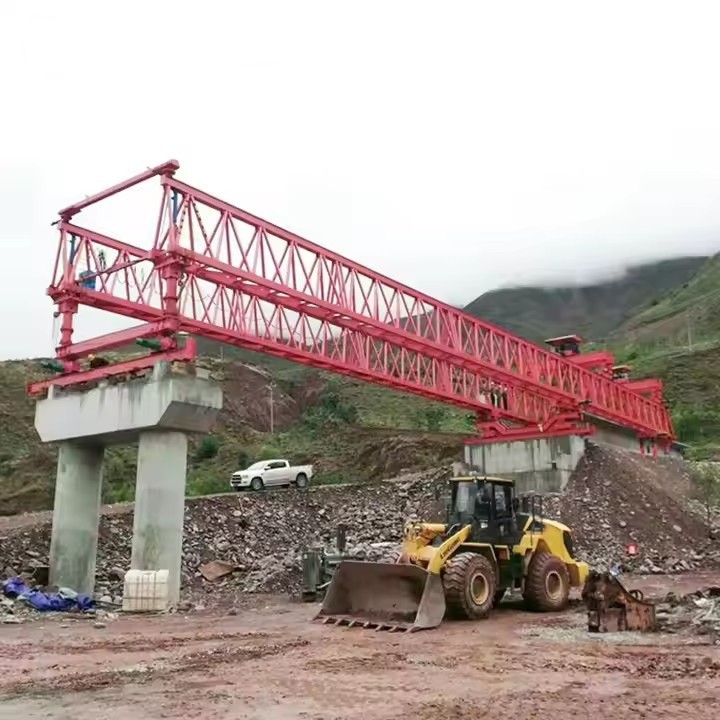
150T Bridge Beam Launcher For Highway Railway Girder Erection suppliers

150T Bridge Beam Launcher For Highway Railway Girder Erection factory
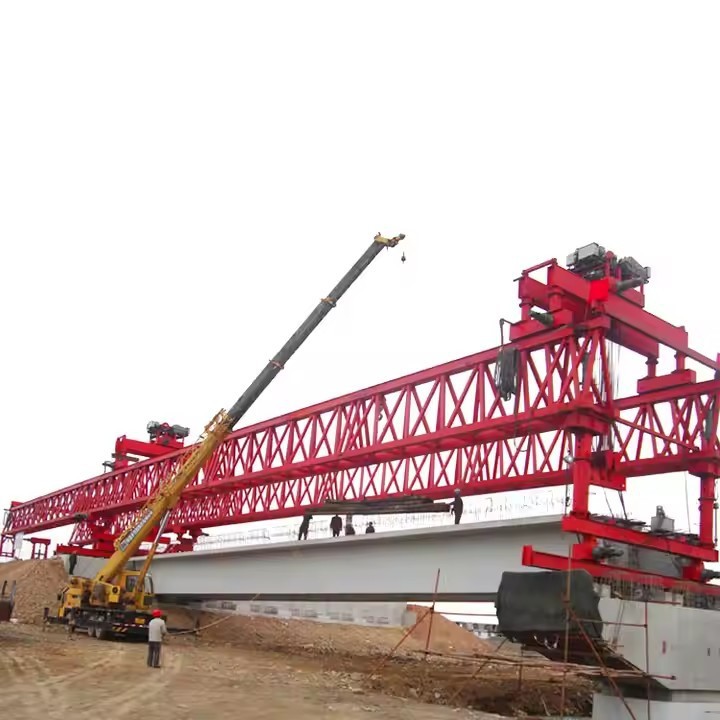
150T Bridge Beam Launcher For Highway Railway Girder Erection best

150T Bridge Beam Launcher For Highway Railway Girder Erection high quality
150T Bridge Beam Launcher For Highway Railway Girder Erection
A 150 Ton Bridge Beam Launcher, also known as a girder erection machine, is specialized heavy lifting equipment used for the installation of precast concrete beams or steel girders in highway bridges, railway bridges, viaducts, and elevated structures.
It is designed to lift, transport, and accurately place bridge beams from one pier to another safely and efficiently, eliminating the need for large ground-based cranes.

Core Function
The primary purpose of a 180ton bridge launcher is to lift, transport, and precisely place heavy prefabricated concrete or steel bridge components, typically weighing up to 180 tons (metric tons, ~165 US tons), during the construction of viaducts, overpasses, and highway bridges.
Key Design Parameters & Performance Specifications
| Parameter | Specification |
|---|---|
| Lifting Capacity (per girder) | 150 Metric Tons |
| Maximum Span (Pier to Pier) | 50 meters (Typical), customizable up to 60m |
| Minimum Curve Radius | 2,000 meters (can be designed for tighter radii) |
| Maximum Supported Grade | ±4% |
| Lifting Hoists | 2 x Main Hoists (typically 120-ton capacity each) |
| Hoist Lifting Speed | 0-5 m/min (variable speed control) |
| Trolley Traversing Speed | 0-10 m/min (variable speed control) |
| Main Beam Launching Speed | 0-5 m/min (variable speed control) |
| Machine Self-Propelling Speed | 0-5 m/min (variable speed control) |
| Control System | Centralized PLC with frequency control for all motions. Remote control operation. |
| Power Supply | 380V / 50Hz / 3 Phase (or as per project requirement) |

Pictures & Components
🚧 Main Components
1. Main Truss Girder (Primary Structure)
The core load-bearing frame of the launcher
Constructed from high-strength steel box or truss beams
Designed for:
Long-span support
High rigidity
Minimal deflection under 150T load
👉 Carries all lifting and traveling systems
2. Lifting System (Twin Hoists / Winches)
Main lifting mechanism for precast beams
Includes:
Electric or hydraulic winches
Wire rope drums
Heavy-duty braking systems
👉 Operates in synchronized lifting mode for balance and safety
3. Lifting Trolley
Moves along the main girder
Carries hooks, spreader beams, or lifting frames
Provides precise positioning of bridge girders
4. Spreader Beam / Lifting Beam
Connects lifting hooks to the precast beam
Ensures even load distribution
Prevents deformation or stress concentration
5. Longitudinal Traveling System
Moves the entire launcher forward along bridge spans
Includes:
Drive motors
Gear reducers
Rail wheels or walking beams
👉 Enables self-advancing construction
6. Lateral Movement System
Allows side shifting of beams or trolley
Improves alignment accuracy during installation
Essential for fine positioning on piers
7. Support Legs / Temporary Supports
Adjustable steel legs supporting the structure
Transfer load safely to:
Bridge piers
Temporary foundations
👉 Provide stability during beam erection
8. Hydraulic System
Controls lifting and structural adjustments
Includes:
Hydraulic pumps
Cylinders
Valves and oil tanks
👉 Ensures smooth and synchronized operations
9. Electrical Control System
Central control unit of the machine
Includes:
PLC control system
Control cabinet
Sensors and encoders
Wiring and communication system
👉 Coordinates all movements safely and precisely
10. Operator Cabin / Control Station
Enclosed control room for operator
Equipped with:
Joysticks and control panels
Monitoring display (load, position, alarms)
Air conditioning (optional)
11. Safety Protection System
Critical safety components include:
Overload protection system
Anti-tip and balance monitoring system
Limit switches (hoist & travel)
Wind speed alarm system
Emergency stop system
Mechanical locking devices
12. Wire Rope & Pulley System
High-strength steel wire ropes
Multi-sheave pulley blocks
Designed for:
Heavy load lifting
Fatigue resistance
Smooth operation
13. Power System
Depending on configuration:
Diesel generator system (common for field construction)
Electric power system (grid-connected sites)
Hybrid system (optional)
14. Rail or Walking System
Rail-mounted wheels or tracked movement system
Ensures stable movement along erected bridge sections
Designed for heavy load distribution

Sketch
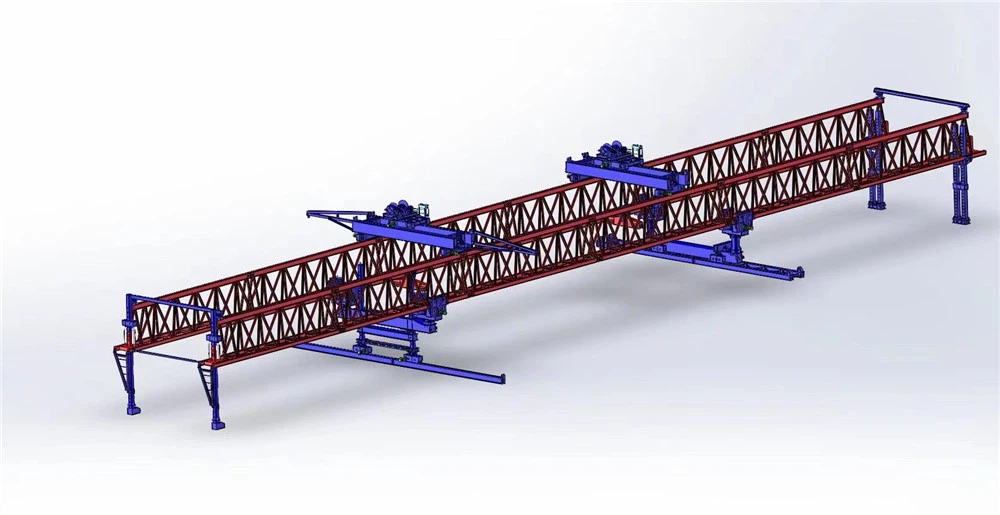

Advantages
🚧 Advantages
🏗️ 1. High Lifting Capacity
Capable of handling up to 150 tons per beam segment
Suitable for large-scale highway and railway bridge projects
Supports heavy precast concrete and steel girders
🚀 2. High Construction Efficiency
Rapid beam installation significantly reduces project time
Continuous erection process without large external cranes
Improves overall bridge construction speed
🎯 3. High Precision Positioning
Equipped with trolley and lateral adjustment systems
Ensures accurate beam alignment on bridge piers
Reduces installation errors and rework
🏗️ 4. Self-Launching Capability
Machine can move forward along already installed spans
No need for repeated dismantling or external lifting equipment
Ideal for long-distance bridge projects
🔒 5. High Safety Performance
Multiple safety systems including:
Overload protection
Anti-tilt monitoring
Limit switches
Wind speed alarms
Emergency stop systems
👉 Ensures safe operation in complex construction environments
⚙️ 6. Strong Adaptability
Suitable for various bridge types:
Highway bridges
Railway bridges
Viaducts and elevated roads
Can operate in mountainous, river, or urban environments
🔧 7. Reduced Labor and Equipment Cost
Eliminates need for multiple large cranes
Reduces manpower requirements
Lowers overall construction logistics cost
🌍 8. Modular & Easy Assembly
Designed with modular truss sections
Easy transport, assembly, and disassembly
Suitable for relocation between projects
⚖️ 9. Stable Structural Performance
High-strength steel truss ensures rigidity
Low deflection under full load conditions
Reliable operation even in long-span conditions
⚡ 10. Flexible Control System
PLC-controlled automation system
Supports:
Cabin operation
Remote control
Real-time monitoring of load and movement

Application
🚧 Applications
A 150 Ton Bridge Beam Launcher is widely used for the erection of precast girders and bridge beams in large-scale infrastructure projects. It is specifically designed for segmental bridge construction where precision, safety, and efficiency are critical.
🛣️ 1. Highway Bridge Construction
Installation of precast concrete girders for highways
Suitable for:
Multi-span bridges
Elevated expressways
Enables rapid construction with minimal traffic disruption
🚆 2. Railway Bridge Construction
Widely used in:
Conventional railway bridges
High-speed rail (HSR) projects
👉 Handles heavy and long prestressed concrete beams with high precision
🌉 3. Viaduct & Elevated Structures
Construction of:
Urban viaducts
Elevated roadways
Flyovers
👉 Ideal for dense urban environments where ground crane access is limited
🏗️ 4. Metro & Light Rail Projects
Installation of precast segments for:
Metro lines
Light rail transit (LRT) systems
👉 Ensures efficient erection in tight city spaces
🌄 5. Mountainous & Difficult Terrain Projects
Suitable for:
Valleys
Rivers
Uneven terrain
👉 Eliminates the need for large ground cranes in inaccessible areas
🌊 6. River & Coastal Bridge Construction
Used for bridges crossing:
Rivers
Lakes
Coastal areas
👉 Provides stable beam erection without heavy marine equipment
🔄 7. Long-Span Continuous Bridge Projects
Ideal for projects requiring:
Repetitive beam placement
Continuous launching operation
👉 Improves efficiency in long-distance bridge construction
⚙️ 8. Precast Segmental Construction
Handles:
Precast concrete segments
Box girders
T-beams
👉 Supports modern prefabricated construction methods

Production Procedure
🔧 1. Design & Engineering
Confirm project requirements:
Lifting capacity (150T)
Beam length and type
Span and working conditions
Perform:
Structural analysis (strength & stability)
Load calculations and deflection checks
Finite Element Analysis (FEA)
👉 Output:
General Arrangement (GA) drawings
Detailed fabrication drawings
Assembly and installation plans
🔩 2. Raw Material Procurement & Inspection
Select high-grade steel (e.g., Q345B / Q420)
Inspect materials for:
Mechanical properties
Thickness and dimensional accuracy
Surface defects
👉 Only certified materials proceed to fabrication
🔨 3. Steel Structure Fabrication
Cutting & Forming
CNC flame/plasma cutting of plates and profiles
Precision bending and shaping
Welding
Submerged Arc Welding (SAW) for main truss beams
CO₂/MIG welding for secondary structures
Assembly
Fabrication of:
Main truss girders
Support legs
Cross beams
👉 Ensures high strength and dimensional accuracy
🔍 4. Welding Inspection (Quality Control)
Non-Destructive Testing (NDT):
Ultrasonic Testing (UT)
Magnetic Particle Testing (MT)
Visual Inspection (VT)
👉 Detects internal and surface defects
⚙️ 5. Machining & Precision Processing
Machining of:
Wheel assemblies
Bearing housings
Pin shafts and connection joints
👉 Ensures alignment, smooth movement, and durability
🧩 6. Component Manufacturing
Production of key systems:
Lifting winches and trolley
Hydraulic cylinders and piping
Support mechanisms
Spreader beams
👉 Each component tested individually before assembly
🔗 7. Pre-Assembly (Factory Trial Assembly)
Partial or full assembly in factory
Check:
Structural alignment
Bolt connections
Fit-up accuracy
👉 Ensures smooth on-site installation
⚡ 8. Electrical & Hydraulic System Installation
Install:
PLC control system
Motors, cables, sensors
Hydraulic pumps, valves, pipelines
👉 Includes insulation, grounding, and leakage testing
🎨 9. Surface Treatment & Painting
Shot blasting (Sa2.5 standard)
Anti-corrosion primer coating
Final paint layer (marine-grade optional)
👉 Protects against harsh outdoor environments
🧪 10. Testing & Commissioning (Factory)
Functional Testing
Hoisting system operation
Trolley and travel movement
Load Testing
Static load test (125% rated load)
Dynamic load test (110% rated load)
System Testing
Hydraulic synchronization
Electrical control accuracy
👉 Ensures compliance with international standards
📦 11. Disassembly, Packing & Delivery
Modular disassembly for transport
Packaging of:
Structural components
Mechanical systems
Electrical parts
👉 Suitable for container or bulk shipment
🏗️ 12. On-Site Installation & Commissioning
Assembly of truss structure and supports
Installation of mechanical and electrical systems
Final alignment and calibration
👉 Includes test run and operator training
🔒 Quality Control Highlights
Full compliance with ISO / FEM / EN standards
Complete inspection records and certificates
Traceability of materials and welds
Strict QA/QC procedures at every stage


Workshop View
The company has installed an intelligent equipment management platform, and has installed 310 sets (sets) of handling and welding robots. After the completion of the plan, there will be more than 500 sets (sets), and the equipment networking rate will reach 95%. 32 welding lines have been put into use, 50 are planned to be installed, and the automation rate of the entire product line has reached 85%.


Hot Tags: 150t bridge beam launcher for highway railway girder erection, China 150t bridge beam launcher for highway railway girder erection manufacturers, suppliers, factory
You Might Also Like


Send Inquiry