







Grab Bucket Gantry Crane
Products Description
What is a Grab Bucket Gantry Crane?
A Grab Bucket Gantry Crane is a specialized gantry crane equipped with a motorized grab bucket instead of a standard hook. It is designed for efficiently handling loose, bulk materials by mechanically grabbing, lifting, transporting, and dumping them in a continuous, automated cycle.
Think of it as a mobile, high-capacity "mechanical hand" that can dig into a pile of material, scoop it up, move it, and release it precisely where needed.
Advantages
High Efficiency for Bulk Materials: Dramatically faster than manual labor, front-end loaders, or using a hook with a separate bucket. It automates the entire pick-and-place cycle.
Versatility: Can handle a wide range of dry bulk goods like grain, coal, sand, gravel, fertilizer, wood chips, and scrap metal.
Reduced Labor Costs: One operator can manage the entire loading, unloading, and stockpiling process.
Mobility: Covers a large storage area (e.g., a stockpile or barge), unlike fixed conveyors or elevators.
Precision Handling: Allows for precise stockpile management and accurate loading of hoppers or trucks.
How the Grab Cycle Works:
Opening & Lowering: The bucket is lowered onto the material pile with its jaws open.
Closing & Digging: The "Close" motor is activated, winding in the close ropes and pulling the jaws shut, digging into the material.
Lifting: Once full, both the "Hold" and "Close" motors work in unison to lift the bucket.
Transporting: The crane and trolley move to the dump point.
Dumping: The "Close" motor is reversed, releasing the close ropes. Gravity and the material's weight force the jaws to swing open, dumping the load.
Summary
A Grab Bucket Gantry Crane is a highly efficient, purpose-built bulk material handler. It transforms a labor-intensive process into a fast, one-person operation, making it an indispensable asset for agriculture, mining, recycling, and bulk logistics. Its integrated design is key to its productivity, but it comes with higher complexity and cost than a standard hook crane.
Place of Origin:Henan, China
Warranty:2 years
Weight (KG):60000 kg
Video outgoing-inspection:Provided
Machinery Test Report:Provided
Application:warehouses,factory and other place
Crane type:box type gantry crane
Travelling speed:20m/min
Lifting mechanism:Electric Hoist
Control method:Ground Control+ Remote Control (customized)
Working duty:A5
Working Temperature:-20~+40℃
Industrial voltage:380V50HZ3Phanse or other
Color:Customised
Customization:Accepted

Pictures & Components
Here is a detailed breakdown of the components of a Grab Bucket Gantry Crane.
1. Gantry Crane Structure (The Framework)
Main Girder(s):
Single Girder: Used for lighter capacities and shorter spans. More economical.
Double Girder: Preferred for heavy-duty applications, providing better hook height, rigidity, and capacity for larger grab buckets.

Legs (End Trucks):
Rail-Mounted: For precise movement over long distances in storage yards.
Rubber-Tired: For portability in smaller yards or multi-location use.
Runway System:
Rails: Heavy-duty steel rails for rail-mounted cranes.
Foundation: Reinforced concrete foundation for rail systems.
Long Travel Drives:
Motors, gearboxes, and wheels that move the entire crane along the runway.
2. Grab Bucket & Lifting System (The Core Mechanism)
Grab Bucket (Clamshell):
Jaws: Two or more hinged halves that close to scoop material. Made from high-strength, abrasion-resistant steel.
Head Assembly: The top section containing sheaves for rope routing.
Rope Guides: Ensure proper alignment of ropes with sheaves.
Types: Can be lightweight (for grain), heavy-duty (for ore/rock), or multi-tine (for scrap).
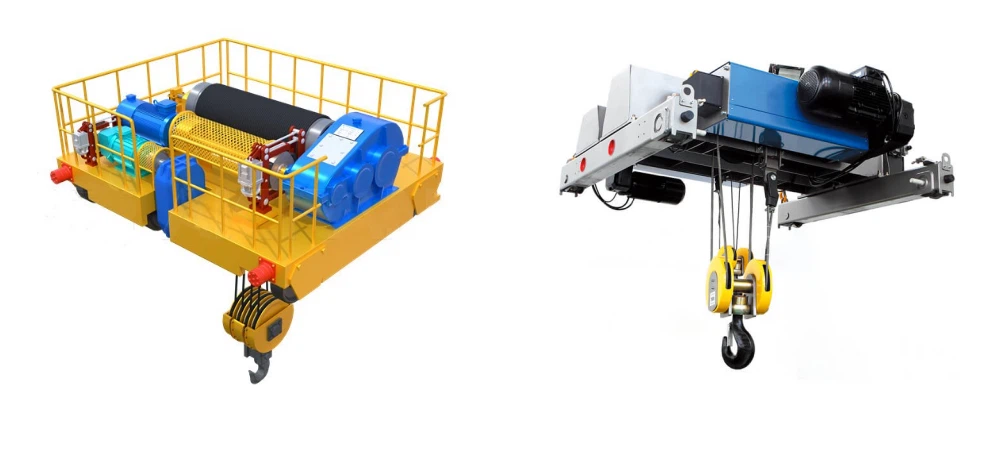
Specialized Hoist Unit:
Hold System:
Hold Rope Drum: Winds the ropes that support the entire grab assembly.
Hold Motor: Powers the lifting and lowering of the grab.
Close System:
Close Rope Drum: Winds the ropes that open and close the jaws.
Close Motor: Powers the opening and closing action.
Synchronization System: Electronically coordinates both motors for seamless operation.

Trolley Assembly:
Trolley Frame: Supports the hoist machinery.
Trolley Wheels: Run on rails on the main girder(s).
Trolley Drive: Motor and gears that move the trolley across the span.
Sheaves & Ropes:
Hold Ropes: Support the total weight of the grab and load.
Close Ropes: Control the jaw movement.
Sheaves (Pulleys): Guide the ropes from the drums to the grab bucket.

3. Power & Control System (The Brain and Nerves)
Power Supply:
Conductor Bar System: Preferred for rail-mounted cranes in large yards.
Cable Reel: Manages the power cable for the crane.
Control Panel:
PLC (Programmable Logic Controller): The brain that manages the complex synchronization between hold and close motions.
Contactors & Drives: Power components for motor control.
Protection Devices: Overload relays, circuit breakers.
Operator Interface:
Pendant Control Station: Hang-down button box.
Radio Remote Control: Allows operator freedom of movement for better visibility.

4. Support & Auxiliary Systems
Rope Guidance System:
Rope Guides and Deflectors: Ensure ropes spool correctly on drums and align with sheaves.
Weighing System:
Load Cells: Often integrated to measure the weight of material handled.
Dust Suppression:
Water Spray Systems: Sometimes added to reduce dust during material handling.
Safety Systems:
Limit Switches: For hoist, trolley, and gantry travel limits.
Anti-Collision Systems: For multiple cranes in same area.
Anemometer: Wind speed monitor for outdoor cranes.

.
Grab Bucket Operation Sequence:
Open & Lower: Grab is lowered with jaws open onto material
Close & Dig: Close motor pulls jaws shut, filling bucket
Lift: Both motors lift the loaded bucket
Transport: Crane and trolley move to target location
Dump: Close motor releases, jaws open from material weight

Key Technical Features:
Dual-Motor Design: Essential for grab operation
Synchronized Control: Precise coordination between systems
Heavy-Duty Construction: For abrasive materials
High Cycle Capability: Designed for frequent loading/unloading
This specialized component set makes grab bucket gantry cranes uniquely suited for bulk material handling, combining the mobility of a gantry crane with the automated loading/unloading capability of a grab system.


Sketch

Main technical

Advantages
Advantages of Grab Bucket Gantry Crane
This crane offers transformative benefits for bulk material handling, combining mobility with automated operation.
1. Unmatched Operational Efficiency
Fully Automated Cycle: The integrated grab system performs the complete process of digging, lifting, transporting, and dumping without any manual intervention or additional equipment.
Continuous Operation: Enables rapid, continuous cycling that dramatically outperforms manual methods or using separate machines for digging and moving.
High Throughput: Capable of moving large volumes of material quickly, making it ideal for high-capacity operations like ports and processing plants.
2. Significant Cost-Effectiveness
Drastic Labor Reduction: A single operator can manage the entire material handling process, eliminating the need for multiple workers and equipment operators.
Lower Operational Costs: Replaces the need for and associated costs of front-end loaders, excavators, and conveyor systems for many applications.
Reduced Infrastructure: Often requires less permanent infrastructure than complex conveyor systems.
3. Exceptional Operational Versatility
Multiple Material Handling: Can handle a wide range of dry bulk materials including grains, coal, sand, gravel, fertilizers, wood chips, and scrap metal.
Flexible Layouts: Available in both rail-mounted (for precise, high-capacity yard operations) and rubber-tired versions (for flexible, multi-area use).
Various Configurations: Can be designed with single or double girders to match specific capacity and span requirements.
4. Optimal Space Utilization
High-Density Storage: Enables efficient stacking and storage of bulk materials in compact areas.
Overhead Operation: Keeps floor space clear for other operations, vehicles, and storage.
Large Coverage Area: Can service extensive storage yards, docks, and processing areas from a single track system.
5. Enhanced Safety Features
Remote Operation: Operators typically control the crane from a safe distance using pendant stations or radio remote controls, minimizing exposure to dust and falling materials.
Reduced Manual Handling: Eliminates the need for workers to be in direct contact with materials during loading/unloading operations.
Stable Operation: The gantry design provides a stable platform for material handling, reducing spillage and accidents.
Application:
Applications of Grab Bucket Gantry Crane
This crane serves as a critical material handling solution across multiple industries that deal with bulk materials.
1. Agriculture and Grain Handling
Grain Elevators and Silos: Loading and unloading trucks and railcars, transferring grain between storage facilities.
Animal Feed Plants: Handling raw ingredients and finished feed products.
Seed Processing Facilities: Moving bulk seeds between processing stages and storage.
2. Mining and Aggregates
Sand and Gravel Operations: Stockpiling raw materials and loading out to trucks.
Coal Yards: Handling coal for power generation or export.
Aggregate Processing: Moving crushed stone, gravel, and other aggregates between processing stages and storage.
3. Recycling and Waste Management
Scrap Metal Yards: Handling and sorting ferrous and non-ferrous scrap materials.
Recycling Centers: Processing bulk recyclables like paper, cardboard, and plastics.
Waste Transfer Stations: Moving bulk waste materials for processing and transport.
4. Ports and Terminals
Bulk Cargo Handling: Loading and unloading bulk materials from ships and barges.
Transfer Operations: Moving materials between storage areas and transport vehicles.
Stockpile Management: Organizing and managing large-scale material storage in port areas.
5. Energy and Biomass
Biomass Power Plants: Handling wood chips, agricultural waste, and other biomass fuels.
Coal-Fired Plants: Moving coal from storage to processing facilities.
Cement Plants: Handling raw materials like limestone, clay, and additives.
Crane production procedure
The production procedure for a single beam traveling gantry crane involves several key stages, from design and material procurement to assembly, testing, and final delivery. Below is a step-by-step outline of the typical manufacturing process:
1. Design & Engineering
Customer Requirements Analysis: Determine lifting capacity, span, lifting height, duty cycle, and operating environment.
Structural Design:
Design the main girder (single box or I-beam structure).
Design end carriages (legs/wheels) and runway beams.
Select hoist/trolley type (electric or manual).
Load & Stress Calculations: Ensure compliance with standards (ISO, FEM, DIN, or ASME).
Electrical & Control System Design: Choose motors, brakes, limit switches, and control panels.
2. Material Procurement
Steel Plates & Profiles: High-quality Q235B/Q345B steel for main girders and supports.
Mechanical Components: Wheels, axles, bearings, gears, and couplings.
Electrical Components: Motors, cables, control panels, and safety devices.
3. Fabrication of Main Components
A. Main Girder Fabrication
Cutting: CNC plasma/oxy-fuel cutting for precision.
Welding: Automated submerged arc welding (SAW) for strong seams.
Straightening & Inspection: Ensure proper camber (pre-bend) and check for defects (UT/RT testing).
B. End Carriages & Legs
Frame Assembly: Welded steel construction with reinforced bracing.
Wheel & Bearing Installation: Machined wheels for smooth travel.
C. Hoist & Trolley
Pre-assembled Hoist: Electric chain hoist or wire rope hoist.
Trolley Frame: Fabricated to accommodate hoist movement.
4. Surface Treatment & Painting
Shot Blasting: Removes rust and improves paint adhesion.
Primer & Paint: Anti-corrosion coatings (epoxy + polyurethane).
5. Assembly
Girder & End Carriage Joining: Bolt or weld the main beam to legs.
Hoist/Trolley Installation: Mounted on the girder.
Electrical Wiring: Connect motors, controls, and safety devices.
6. Testing & Quality Control
Dimensional Inspection: Verify span, height, and alignment.
Load Testing:
Static Load Test: 125% of SWL (Safe Working Load).
Dynamic Load Test: 110% of SWL with operational checks.
Functional Tests: Travel, lifting, braking, and limit switch verification.
7. Disassembly & Packaging
For Shipment: Crane may be disassembled into modules (girder, legs, hoist).
Protective Packaging: Waterproof wrapping for sea transport.
8. Installation & Commissioning (On-Site)
Runway Preparation: Ensure level rails or ground support.
Reassembly: Bolt components together.
Final Testing: Operational checks under load.
9. Documentation & Delivery
Manual & Certificates: Include load test reports, CE/ISO certifications.
Training: Operator and maintenance guidance.

Workshop view:
The company has installed an intelligent equipment management platform, and has installed 310 sets (sets) of handling and welding robots. After the completion of the plan, there will be more than 500 sets (sets), and the equipment networking rate will reach 95%. 32 welding lines have been put into use, 50 are planned to be installed, and the automation rate of the entire product line has reached 85%.


Hot Tags: grab bucket gantry crane, China grab bucket gantry crane manufacturers, suppliers, factory, Gantry Crane, Electric Hoist Single Girder Gantry Crane, Single Girder Gantry Crane
You Might Also Like


Send Inquiry