







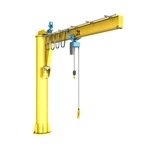


Electric Hoist Single Girder Gantry Crane
The single girder gantry crane is designed for light to medium-duty lifting applications in manufacturing, storage yards, and distribution centers. The crane is suitable for outdoor use and can handle a variety of materials including steel, concrete, lumber, and machinery.
The gantry crane is powered by electricity, and the hoist is operated by a handheld pendant or radio remote control. The crane is equipped with safety features such as overload protection, emergency stop buttons, and anti-collision sensors.
The single girder gantry crane can be customized to fit specific customer requirements, including different lifting capacities, spans, and heights. The crane is easy to install and maintain, and it is an affordable solution for lifting and moving heavy loads in a confined space.
- Capacity: 1t-32t
- Span length: 4-35m
- Lifting height: 6m, 9m, 12m,15m etc.
- Work duty: A3, A4, A5
- Raged voltage: 220V~580V, 50-60Hz, 3ph AC
- Work environment temperature: -25℃~+40℃, relative humidity ≤85%
- Crane control mode: Pendant control / Wireless remote control / Cabin control
- Reference Price Range: $2000-8000/set

Pictures & Components
1. Whole set crane
The Electric Hoist Single Girder Gantry Crane is a type of material handling equipment that is commonly used in industrial settings. It is designed to lift and transport heavy loads from one location to another within a facility.
This crane has a single girder that is supported by two legs that run on rails or wheels. The hoist used for lifting and lowering the load is electrically powered, allowing for smooth and precise movements. The lifting capacity of Electric Hoist Single Girder Gantry Crane ranges from 1 ton to 32 ton.
The crane can be operated either manually or through a radio remote control system. It is commonly used in areas such as manufacturing plants, warehouses, and factories where heavy materials need to be moved with precision and efficiency.
Overall, the Electric Hoist Single Girder Gantry Crane is a reliable and efficient material handling solution that can improve productivity and safety in industrial settings.

2. Main girder
The electric hoist single girder gantry crane main girder is the horizontal beam that runs the length of the gantry crane and supports the hoist and trolley system. It is typically made of steel and can be designed to withstand the weight capacity and span requirements of the specific application. The main girder is supported by two legs or columns, which are anchored to the ground and also provide stability to the crane during operation. The electric hoist, which is mounted on the trolley, moves along the main girder to lift and transport materials. The single girder design allows for efficient use of space and ease of maneuverability.

3. Electric Wirerope Hoist
An Electric Hoist Single Girder Gantry Crane with an Electric Wire Rope Hoist is a material handling equipment used to lift and move heavy loads in a confined area. The crane is designed with a single beam, which spans the width of the gantry and is supported at each end by vertical legs. The electric wire rope hoist is mounted on the beam and used to lift and lower loads. The crane is powered by electricity and can be operated using a controller. The capacity of the crane depends on the specifications and requirements of the user. It is widely used in factories, workshops, and warehouses for material handling applications.

4. Ground beam
1) The ground beam of an electric hoist single girder gantry crane is a structural component that serves as the base of the crane. It is essentially a horizontal beam that runs parallel to the ground and supports the primary load-bearing components of the crane.
2) The ground beam is typically made of strong, durable materials such as steel or concrete and is designed to withstand the weight and forces exerted by the gantry crane during operation. It is usually anchored to the ground using bolts or other fasteners to ensure stability and prevent any movement or shaking.
3) The ground beam is crucial for the safe and efficient operation of the electric hoist single girder gantry crane, as it provides a strong and stable foundation for the crane to operate from. It also helps distribute the weight of the crane and the loads it is carrying evenly, reducing the risk of structural damage or failure.
4) Overall, the ground beam is an essential component of any electric hoist single girder gantry crane, and it is critical that it is designed and constructed to high standards to ensure that it can withstand the rigors of heavy lifting and prolonged use.
5. Crane wheel
1) The high quality wheel set is made of 45# steel die forging, roughing, conditioning and finishing. The hardness of heat treatment is HB305 ~ 385, and the hardness of hardening layer at 18mm depth is not less than HB250. The wheel shaft is made of 45# steel, which is roughed, tempered and finished. The hardness of heat treatment is 250 ~ 280HB.
2) Electric Hoist Single Girder Gantry Crane Wheel refers to the wheel that is used to support the movement of Electric Hoist Single Girder Gantry Crane. This type of crane consists of a single girder structure supported at each end by a gantry. The Electric Hoist is mounted on the girder and moves along it, lifting and lowering loads. The wheels are the main component that facilitates the movement of the crane, allowing it to move horizontally along the gantry structure. The wheels are typically made from high-grade steel and are designed to withstand the weight of the crane and the loads it carries. The Electric Hoist Single Girder Gantry Crane Wheel must be maintained adequately to ensure smooth and efficient movement of the crane. Regular inspections must be carried out to identify any wear and tear, and the wheels must be replaced promptly to prevent any accidents or damage to the crane.

6. Crane hook
1) The electric hoist single girder gantry crane hook refers to the lifting hook that is an integral part of the crane system. This type of gantry crane is designed with a single girder and an electric hoist attached to it. The electric hoist is used to lift and lower heavy objects, while the gantry crane provides a stable and secure platform for the lifting operation.
2) The hook is typically attached to the electric hoist using a thick steel cable or chain. The hook is designed to support the weight of the object being lifted and must be strong enough to handle the weight of the load.
3) The electric hoist single girder gantry crane hook is commonly used in construction sites, manufacturing facilities, and other industrial applications where heavy loads need to be lifted and moved. These cranes are able to lift heavy loads with precision and speed, making them an ideal choice for many different industrial applications.

7. Motor
An electric hoist single girder gantry crane motor is a type of motor that provides power to drive the lifting and movement mechanisms of a single girder gantry crane with an electric hoist. This motor is typically mounted on the crane frame and uses electrical energy to convert it into mechanical energy required to move loads horizontally and vertically. The motor works in conjunction with the control system of the crane to ensure smooth operation and precise positioning of loads. The electric hoist and single girder gantry crane motor is commonly used in manufacturing facilities, warehouses, construction sites, and other locations that require the lifting and movement of heavy loads.

8. Sound and light alarm system and limit switch safety device
1) An electric hoist single girder gantry crane typically comes equipped with a sound and light alarm system as well as limit switch safety devices. The sound and light alarm system is designed to give warning signals when the crane is functioning in an abnormal manner or when there is a failure in any of its operating systems. This ensures that workers are alerted to possible danger and can take necessary precautions.
2) Limit switch safety devices are installed to prevent the crane from operating beyond its safe working limits. These switches detect the position of the crane and its load and prevent the crane from travelling beyond certain preset points. This helps to prevent accidents caused by overloading or lifting loads beyond the crane's capacity.
3) Both the sound and light alarm system and limit switch safety devices play an important role in maintaining a safe and secure workplace environment. These safety features help to prevent accidents and ensure the well-being of workers and the longevity of the equipment.
9. Safety Device
Electric Hoist Single Girder Gantry Crane is equipped with different safety devices to ensure the safe operation of the crane. Some of the essential safety devices are:
1) Overload protection device: It is a device that is installed to protect the crane from overloading. If the load exceeds the rated load, the crane automatically shuts down to prevent accidents.
2) Emergency stop button: It is a device that can stop the crane immediately in case of an emergency.
3) Limit switch: It is installed to prevent over-traveling of the hoist and to limit the crane's movement within a specific range.
4) Anti-collision device: It is a device that senses the proximity of the crane to other objects and automatically stops the crane to avoid any collision.
5) Anti-sway device: It is a device that prevents the load from swinging while in motion, ensuring that it remains stable.
6) Phase controller: It is a device that checks the power supply's phase sequence and will automatically stop the crane if the phase sequence is not correct.
7) Warning device: It is a device that warns people when the crane is in operation, such as flashing lights or loud sirens.
All these safety devices are essential for the safe operation of the Electric Hoist Single Girder Gantry Crane, and the crane operator must be trained to use them effectively.

10. Control Mode
Electric Hoist Single Girder Gantry Crane can be controlled through various modes. Here are some of them:
1) Pendant Control: This mode of control is the most common and simple way to operate the crane. In this mode, a pendant is connected to the crane through a cable. The operator uses the pendant to control the crane by pushing the buttons or switching on/off the functions as per the requirement.
2) Remote-Controlled: The crane can also be operated with a remote control. This enables the operator to control the crane from a distance without the need to be physically present at the crane location.
3) Radio Control: In some cases, radio control is used to operate the crane. This control mode is wireless and allows the operator to operate the crane from a safe distance.
4) Cabin Control: In some applications, the crane operator sits in a cabin attached to the crane, and the crane is operated through the cabin control system. This control mode gives the operator a complete view of the operation, and it is best suited for complicated and hazardous operations.
In conclusion, Electric Hoist Single Girder Gantry Crane can be controlled through various modes, depending on the application and operator's preference.

11. Sketch

Main Technical Data
|
Lift weight(T) |
5 |
10 |
16 |
20 |
|
Span(m) |
8/12/16/20/24 |
8/12/16/20/24 |
8/12/16/20/24 |
8/12/16/20/24 |
|
Lift height(m) |
6/9/12 |
6/9/12 |
6/9/12 |
6/9/12 |
|
Voltage |
380V/customize |
380V/customize |
380V/customize |
380V/customize |
Advantages
1. High Efficiency: An electric hoist single girder gantry crane can efficiently handle heavy loads with minimal effort on part of the operator.
2. Versatile: The crane is highly versatile and can be used in a variety of applications including manufacturing, construction, and material handling.
3. Cost-Effective: The crane is cost-effective because it requires less investment compared to other types of cranes such as double girder gantry cranes.
4. Easy to Operate: The electric hoist single girder gantry crane is easy to operate and requires minimal technical expertise to run.
5. Space-Saving Design: The crane has a space-saving design and can be easily installed in limited space.
6. Durability: The crane is highly durable and can withstand high levels of wear and tear, making it an ideal choice for industrial applications.
7. Ergonomic: The crane is designed with ergonomic features that ensure the operator can work comfortably for prolonged periods without experiencing fatigue.
8. Safety: The crane comes with a range of safety features such as limit switches and emergency stop buttons that ensure the safety of the operator and the load.
Application
Electric hoist single girder gantry cranes are commonly used in factories, warehouses, assembly workshops, construction sites, and other places where heavy lifting is required. They are suitable for lifting and moving goods of various weights and sizes, including but not limited to steel pipes, concrete slabs, machinery equipment, and containers.
Some specific applications for electric hoist single girder gantry cranes include:
1. Loading and unloading operations at docks and ports.
2. Lifting materials to heights during construction of buildings or bridges.
3. Handling of raw materials and finished products in manufacturing plants.
4. Moving heavy equipment and components in assembly lines.
5. Transporting goods in logistics centers and warehouses.
Overall, electric hoist single girder gantry cranes provide an efficient and reliable solution for heavy lifting applications, making them an essential component of various industries.
Crane Production Procedure
An overview of the production procedure of an Electric Hoist Single Girder Gantry Crane:
1. Design and Engineering: The first step is to design and engineer the crane according to the customer's requirements and specifications.
2. Material Selection: The materials for the crane are selected based on the design requirements, and the key components, such as the hoist, trolley, and girder, are manufactured and assembled.
3. Manufacturing Components: The components of the crane are fabricated, including the girder, end-carriages, and trolley frame.
4. Assembly of Components: The crane components are assembled, and the girder, end-carriages, and trolley frame are test-fit and welded to ensure structural integrity.
5. Installation of Hoist: The electric hoist and trolley are installed on the girder, and the electrical system is connected.
6. Painting: The crane is painted with a high-quality paint that resists corrosion and improves the crane's aesthetic appearance.
7. Inspection and Testing: The crane is thoroughly inspected and tested to ensure that it conforms to quality standards, safety regulations, and customer requirements.
8. Commissioning and Delivery: The crane is commissioned, and the customer is provided with the necessary training and documentation to operate and maintain the crane. Finally, the crane is delivered to the customer's site.

Workshop View
The company has installed an intelligent equipment management platform, and has installed 310 sets (sets) of handling and welding robots. After the completion of the plan, there will be more than 500 sets (sets), and the equipment networking rate will reach 95%. 32 welding lines have been put into use, 50 are planned to be installed, and the automation rate of the entire product line has reached.


Hot Tags: electric hoist single girder gantry crane, China electric hoist single girder gantry crane manufacturers, suppliers, factory, Single Girder Gantry Crane, Electric Hoist Single Girder Gantry Crane, Gantry Crane
Next
No InformationYou Might Also Like


Send Inquiry