







Rubber Tyre Gantry Crane
A Rubber Tyre Gantry Crane (RTG) is a specialized mobile gantry crane used primarily in container terminals, ports, and intermodal yards for stacking and handling shipping containers. Unlike rail-mounted gantry cranes (RMG), RTGs are equipped with rubber tires, allowing for greater mobility and flexibility in container yard operations.
Key Features
1. Mobility & Flexibility
Mounted on rubber tires, allowing easy movement within the yard without needing fixed rails.
Can be driven manually or automated (some models use GPS or optical guidance).
2. High Lifting Capacity
Typically handles 20 ft, 40 ft, 45 ft, and even 53 ft containers.
Lifting capacity ranges from 30 to 60 metric tons (including spreader weight).
3. Adjustable Span & Stacking Height
Can span 6+1 (6 rows + 1 truck lane) or 7+1 container rows.
Stacking capability of up to 5–6 containers high (depending on model).
4. Power Options
Diesel-electric (most common) – Uses a diesel generator to power electric motors.
Fully electric (ERTG – Electric RTG) – Powered via a cable reel or conductor bar system, reducing emissions.
Hybrid systems – Combine diesel and battery power for energy savings.
5. Steering & Maneuverability
90° or 180° steering for precise container handling.
Crab steering (diagonal movement) for better positioning.
Some models feature automated steering for optimized yard operations.
6. Spreader Options
Equipped with a twistlock spreader for secure container handling.
Can handle single or twin-lift (two 20 ft containers simultaneously).
7. Stability & Safety Features
Outriggers or stabilizers to prevent tipping during lifting.
Anti-collision systems with sensors and alarms.
Wind-resistant design (some have anemometers for high-wind alerts).
8. Automation & Smart Features (Advanced RTGs)
Automated stacking with remote control or AI-driven systems.
GPS/optical guidance for precise container placement.
Real-time monitoring via IoT sensors for predictive maintenance.
9. Eco-Friendly Options (ERTG & Hybrid RTGs)
Reduced CO₂ emissions compared to diesel-only models.
Regenerative braking to recover energy during lowering.
10. Applications
Container terminals (stacking, loading/unloading trucks).
Intermodal yards (transferring containers between trucks and trains).
Port back-up operations when STS (Ship-to-Shore) cranes are unavailable.

Parts & Components
A Rubber Tyre Gantry Crane (RTG) is a type of mobile gantry crane used primarily in container terminals for stacking and handling shipping containers. The key components of an RTG crane include:
1. Structural Components
Main Gantry Frame – The primary steel structure that spans the container stacks.
Legs (Supports) – Vertical columns that support the gantry beam (usually 4 legs for stability).
Cross Beams – Horizontal beams connecting the legs for structural integrity.
Top Girder (Bridge Girder) – The horizontal beam that carries the trolley and hoisting mechanism.
2. Mobility & Drive System
Rubber Tyres – Heavy-duty pneumatic or solid rubber tyres for mobility.
Wheels & Axles – Multiple wheel sets (usually 4 or 8) for movement along the yard.
Drive Motors – Electric or diesel-hydraulic motors for propulsion.
Steering System – Hydraulic or electric steering for maneuvering.
Braking System – Disc or dynamic brakes for stopping.
3. Lifting & Hoisting Mechanism
Trolley – Moves along the top girder to position the spreader.
Hoist Winch & Ropes – Lifts and lowers containers (wire ropes or chains).
Spreader – A twistlock mechanism that attaches to containers (can be fixed or telescopic for different sizes).
4. Power Supply System
Diesel Generator (for diesel-powered RTGs).
Electric Power (Cable Reel or Conductor Bar) – For electric RTGs (some use a sliding collector system).
Battery System (for hybrid or fully electric RTGs).
5. Control & Automation
Operator Cabin – Mounted on the crane for manual control.
Remote Control System – For semi-automated or automated operation.
Sensors & Cameras – For obstacle detection and positioning.
PLC & Control Panel – Manages crane movements and safety systems.
6. Safety & Auxiliary Systems
Anti-Collision System – Prevents collisions with other RTGs or obstacles.
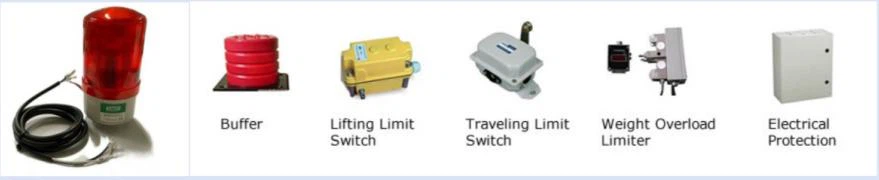
Limit Switches – Prevents over-hoisting or over-trolley travel.
Outriggers / Stabilizers – Used during lifting for additional stability.
Wind Brakes / Anchors – Secures the crane during high winds.
Fire Suppression System – Especially important for diesel-powered RTGs.
7. Optional Features
Automatic Stacking (ASC Interface) – For integration with automated terminals.
GPS / RFID Positioning – For precise container handling.
Hybrid Power Systems – Combining diesel and electric for fuel efficiency.

Sketch

Advantages
Rubber Tyred Gantry (RTG) cranes are widely used in container terminals and port operations due to their mobility and efficiency. Here are the key advantages of RTG cranes:
1. Mobility & Flexibility
Rubber tires allow easy movement between stacking lanes without fixed rails.
Can be repositioned quickly to adapt to changing container storage needs.
Ideal for yards with variable layouts.
2. High Stacking Capacity
Can stack containers 5-6 high (some models up to 8 high), maximizing yard space.
Efficiently handles multiple container rows in a block.
3. Cost-Effective
Lower initial investment compared to Rail-Mounted Gantry (RMG) cranes.
No need for permanent rail infrastructure, reducing setup costs.
4. Versatility
Can operate in different yard configurations (e.g., single or double lane operations).
Suitable for mixed cargo handling (containers, breakbulk, etc.).
5. Energy Efficiency (Hybrid & Electric Options)
Modern RTGs use diesel-electric or fully electric power, reducing fuel costs.
Some models feature regenerative braking to save energy.
6. Easy Integration with Other Equipment
Works well with reach stackers, straddle carriers, and terminal trucks.
Compatible with automated stacking systems (Automated RTGs – ARTG).
7. Reduced Ground Pressure
Rubber tires distribute weight evenly, minimizing damage to pavement compared to rail systems.
8. Quick Deployment
Can be relocated to different terminals or storage areas with minimal setup time.
9. Improved Productivity
Faster container handling compared to straddle carriers in dense stacking environments.
Can service multiple truck lanes efficiently.
10. Automation Compatibility
Can be upgraded to autonomous or semi-autonomous operation for smarter yard management.

Application
Rubber Tyre Gantry Crane (RTG) is a type of mobile gantry crane widely used in container terminals, intermodal yards, and port operations for stacking and handling shipping containers.
Container Terminals & Ports
Stacking containers in yard blocks (typically 1-over-3 or 1-over-5 high).
Loading/unloading containers from trucks and trailers.
Transferring containers between yard and other handling equipment like straddle carriers or reach stackers.
Intermodal Yards & Rail Terminals
Handling containers between trucks, trains, and storage areas.
Efficiently organizing containers for logistics operations.
Depot & Warehouse Operations
Managing container storage in freight depots.
Rearranging containers for customs inspections or repairs.
Temporary & Mobile Operations
Can be relocated to different yard areas as needed (unlike rail-mounted gantry cranes).
Used in temporary storage facilities or during port expansions.
Rubber tyre gantry cranes are essential in modern container handling due to their mobility, efficiency, and adaptability. They are particularly valuable in ports and logistics hubs where space optimization and flexible operations are crucial.

Production Procedure
The production procedure for a Rubber Tyred Gantry Crane (RTG) involves several stages, including design, material procurement, fabrication, assembly, testing, and commissioning. Below is a step-by-step outline of the typical RTG manufacturing process:
1. Design & Engineering
Conceptual Design: Determine crane specifications (span, lifting capacity, height, wheel configuration, etc.).
Detailed Engineering:
Structural design (bolstered by Finite Element Analysis - FEA).
Mechanical systems (hoisting, trolley, gantry travel).
Electrical & control systems (PLC, drives, sensors).
Safety systems (anti-collision, overload protection, emergency stops).
Approvals: Compliance with international standards (ISO, FEM, DIN, OSHA).
2. Material Procurement
Structural Steel: High-grade steel plates, beams, and profiles.
Mechanical Components: Wheels, axles, gears, wire ropes, drums, bearings.
Electrical Components: Motors, PLCs, VFDs (Variable Frequency Drives), cables, sensors.
Rubber Tyres & Bogies: Heavy-duty pneumatic or solid rubber tyres with steering mechanisms.
3. Fabrication of Components
A. Structural Fabrication
Cutting & Shaping: Plasma/Oxy-fuel cutting of steel plates.
Welding: Sub-assembly welding (girders, legs, end carriages).
Machining: Drilling, milling for precise component fitment.
Shot Blasting & Painting: Surface treatment for corrosion resistance.
B. Mechanical Assembly
Gantry Frame Assembly:
Upright legs, top beams, and end carriages are joined.
Trolley & Hoist Mechanism:
Installation of hoist winches, wire ropes, sheaves, and hooks.
Bogies & Tyres:
Mounting of rubber tyres, axles, and drive/steering mechanisms.
C. Electrical & Control Systems
Cabin & Control Panel: Operator cabin with joysticks/controls.
Wiring & Sensors: Installation of limit switches, encoders, and safety devices.
Power Supply: Diesel generator or electric cable reel system.
4. Assembly & Integration
Erection of Main Structure: Gantry legs and beams are assembled.
Mechanical Systems Integration: Trolley, hoist, and travel drives installed.
Electrical & Hydraulic Connections: Wiring, piping, and testing of circuits.
5. Testing & Quality Control
Factory Acceptance Tests (FAT):
Load testing (static & dynamic, typically 110% of SWL).
Functional tests (hoisting, trolley movement, gantry travel).
Safety system checks (anti-sway, overload, emergency stop).
Electrical & Control System Testing: PLC logic, automation, remote control (if applicable).
6. Disassembly & Transportation
Modular Breakdown: Crane is disassembled for shipping.
Packaging & Logistics: Components are shipped to the customer's site (port/terminal).
7. Site Erection & Commissioning
Reassembly: On-site erection by technicians.
Final Testing & Calibration:
Alignment checks, tyre pressure adjustment.
Trial runs with containers.
Operator Training: Safe operation and maintenance procedures.
8. Handover & Documentation
As-built Drawings & Manuals: Provided to the client.
Warranty & Support: Post-commissioning service agreements.

Workshop View


Hot Tags: rubber tyre gantry crane, China rubber tyre gantry crane manufacturers, suppliers, factory
Previous
Gantry Crane 120 TonsYou Might Also Like


Send Inquiry