










Precast Beam Lifting Gantry Crane
Products Description
A precast beam lifting gantry crane is a specialized lifting equipment used in construction and civil engineering projects to handle and install precast concrete beams, such as those used in bridges, viaducts, and building structures. These cranes provide high lifting capacity, stability, and precision for transporting and positioning heavy precast elements.
Key Features of a Precast Beam Lifting Gantry Crane:
High Load Capacity – Designed to lift heavy precast beams (ranging from tens to hundreds of tons).
Adjustable Span – The gantry can be customized to different spans to suit construction site requirements.
Sturdy Structure – Made of high-strength steel for durability and stability during lifting operations.
Precise Positioning – Equipped with electric or hydraulic hoists for accurate beam placement.
Mobility Options:
Fixed Gantry Cranes – Stationary, used in precast yards.
Mobile Gantry Cranes – Equipped with wheels or rails for movement along the construction site.
Safety Systems – Includes overload protection, anti-sway mechanisms, and emergency brakes.
Types of Precast Beam Lifting Gantry Cranes:
Single-Girder Gantry Crane – Light to medium lifting capacity, cost-effective.
Double-Girder Gantry Crane – Higher lifting capacity, more stable for heavy beams.
Rubber-Tired Gantry (RTG) Crane – Moves on rubber tires for flexible positioning.
Rail-Mounted Gantry Crane – Runs on tracks for precise movement in precast yards or bridge construction.
Core Components:Engine, Bearing, Gearbox, Motor, Gear
Place of Origin:Henan, China
Warranty:2 years
Weight (KG):50000 kg
Video outgoing-inspection:Provided
Machinery Test Report:Provided
Application:Outdoor
Keywords:Gantry Crane
Rated Loading Capacity:50Ton
Cross travelling speed:44.6m/min
Long travelling speed:47.1m/min
Control way:cabin
Power supply:Cable reel
Steel track:QU80
Power:3-phase AC 50HZ 380V

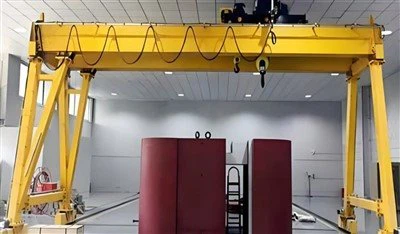
Pictures & Components
A precast beam lifting gantry crane consists of several key components that work together to ensure safe and efficient lifting, transportation, and installation of heavy precast concrete beams. Below is a detailed breakdown of its main components:
1. Main Gantry Structure (Bridge Girder & Legs)
Bridge Girder (Main Beam)
The horizontal beam that spans the work area, supporting the hoist and trolley.
Can be single-girder (lighter loads) or double-girder (heavy-duty lifting).
Support Legs (Columns)
Vertical structures that provide stability and transfer loads to the ground or rails.
Can be fixed-height or adjustable for different working conditions.
 |
 |
2. Hoisting Mechanism
Electric or Hydraulic Hoist
The lifting device (wire rope hoist or chain hoist) that raises and lowers the precast beam.
Lifting Hook & Spreader Beam
The hook attaches to the beam's lifting points, while a spreader beam ensures even load distribution to prevent damage.
  |
3. Trolley & Travel System
Trolley Assembly
Moves horizontally along the bridge girder to position the beam accurately.
Travel Motors & Wheels
Powered by electric or hydraulic motors for smooth movement.

4. End Carriages & Mobility System
Wheels or Crawlers
Rail-mounted gantry cranes run on tracks for precise movement.
Rubber-tired gantry cranes (RTG) use pneumatic wheels for flexibility.
Drive Motors & Brakes
Ensure controlled movement and prevent unintended shifts.

5. Power Supply System
Cable Reel or Diesel Generator
Electric gantry cranes may use a cable reel system or busbar power supply.
Mobile gantries might have a diesel engine for remote sites.

.
6. Control System
Operator Cabin or Remote Control
Can be operated from a cabin mounted on the crane or via wireless remote control.
Frequency Inverter (for Smooth Movement)
Reduces jerks during lifting and traveling.

7. Safety & Auxiliary Components
Limit Switches – Prevent over-travel of the hoist and trolley.
Overload Protection – Cuts off power if the load exceeds capacity.
Anti-Collision Sensors – Used when multiple cranes work in the same area.
Outriggers / Stabilizers – Provide extra support during lifting operations.
Wind-Resistant Devices – Important for outdoor use (e.g., bridge construction).

SKETCH

Main technical

Advantages
Precast beam lifting gantry cranes are widely used in construction due to their efficiency, safety, and adaptability. Here are their key advantages:
1. High Load Capacity & Stability
Designed to lift heavy precast beams (up to hundreds of tons) with stability.
Double-girder designs provide extra strength for large-scale projects.
2. Precise Positioning & Control
Equipped with smooth hoisting and trolley movement for accurate beam placement.
Remote control & automation options reduce human error.
3. Time & Labor Efficiency
Speeds up construction by quickly transporting and installing beams.
Reduces dependency on large mobile cranes, saving setup time.
4. Flexibility in Movement
Rail-mounted gantry cranes offer precise movement along tracks.
Rubber-tired gantry cranes (RTG) provide mobility without rails.
5. Cost-Effective Solution
Lower operational costs compared to crawler or tower cranes.
Can be relocated and reused for multiple projects.
6. Enhanced Safety Features
Overload protection, anti-sway systems, and emergency brakes prevent accidents.
Reduces manual handling risks for workers.
7. Adaptability to Site Conditions
Works well in confined spaces where large cranes cannot operate.
Can be customized for different beam lengths and weights.
Application
These cranes are essential in various construction scenarios, including:
1. Bridge Construction
Lifting and placing precast concrete girders for highway and railway bridges.
Used in segmental bridge construction for precise alignment.
2. Precast Concrete Factories
Handling and transporting precast beams, columns, and slabs within the plant.
Loading/unloading beams onto trucks for transportation.
3. Highway & Railway Projects
Installing precast U-beams, T-beams, and box girders for viaducts.
Used in flyover and metro rail construction.
4. Industrial & Building Construction
Erecting precast roof beams, floor slabs, and wall panels.
Useful in warehouses, factories, and large-span structures.
5. Port & Shipyard Applications
Handling heavy precast marine structures like piers and dock elements.
Crane production procedure
1. Design & Engineering
Requirement Analysis: Determine specifications, including span, height, duty cycle, and environmental conditions.
CAD Drawings & Load Calculations: Engineers design the crane structure, ensuring compliance with international safety standards like FEM, CMAA, or ISO.
Selection of Key Components: Includes double girders, end carriages, trolley mechanism, hoisting system, and electrical controls.
2. Material Procurement
Structural Steel: High-strength steel plates and beams for girders, legs, and supporting structures.
Hoisting Mechanism: Motor, gearbox, wire rope, and drum are sourced.
Electrical & Control Components: Inverters, limit switches, PLC, and control panels.
3. Fabrication of Structural Components
Double Girder Manufacturing
Cutting: Steel plates are cut into precise shapes.
Welding: Girders are welded using submerged arc welding (SAW) to ensure strength.
Machining: Precision machining for proper alignment of rails and trolley.
Legs & End Carriages
Welded and machined for smooth wheel and rail movement.
Installation of rail tracks for trolley motion.
4. Assembly of Mechanical & Hoisting Components
Trolley & Hoist System
Gearbox, motor, drum, rope guide, and safety brakes are assembled.
Wire rope is wound on the drum.
Drive Mechanism Installation
Motors and reducers are installed on the end carriages.
Wheels are assembled with proper alignment to ensure smooth movement.
5. Electrical System Installation
Control Panel Assembly: Includes VFD, contactors, and safety relays.
Wiring & Connections: Motor wiring, limit switches, and emergency stop system.
Remote Control & Cabin Installation: Depending on client requirements, either a radio remote control or operator cabin is installed.
6. Testing & Quality Control
Mechanical Testing:
Load testing with 1.25 times the rated capacity.
Checking trolley movement and hoisting performance.
Electrical Testing:
Verification of motor speeds, limit switches, and control panel operations.
Emergency brake function tests.
Safety Inspections:
Ensuring compliance with OSHA, ISO, or local safety regulations.
7. Surface Treatment & Painting
Sandblasting: Removes rust and prepares metal surfaces.
Priming & Painting: Corrosion-resistant epoxy primer followed by industrial-grade paint.
8. Packaging & Transportation
Component Packing: Each part is securely packed for transport.
Loading & Shipping: Loaded onto trucks or containers for delivery.
9. Installation & Commissioning
On-site Assembly: Main components are bolted and welded into place.
Final Testing: Load testing at the installation site to ensure full functionality.
Handover & Training: Operator training and final approval from the client.
10.Final Deliverables
Complete Gantry Crane System with operational manuals.
Warranty & After-Sales Support for long-term maintenance.

Workshop view:
The company has installed an intelligent equipment management platform, and has installed 310 sets (sets) of handling and welding robots. After the completion of the plan, there will be more than 500 sets (sets), and the equipment networking rate will reach 95%. 32 welding lines have been put into use, 50 are planned to be installed, and the automation rate of the entire product line has reached 85%.


Hot Tags: precast beam lifting gantry crane, China precast beam lifting gantry crane manufacturers, suppliers, factory
You Might Also Like




Send Inquiry