










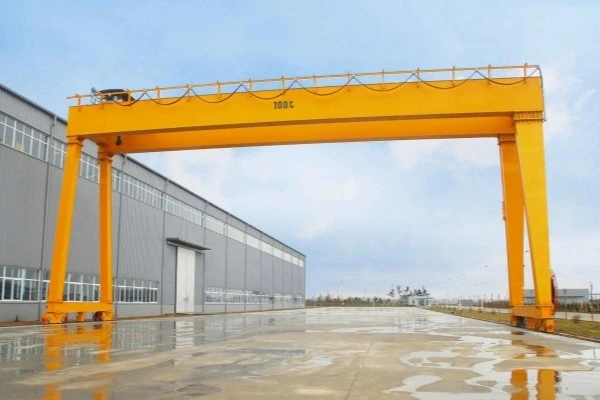


Ship Manufacture Gantry Crane
Products Description
Ship Manufacture Gantry Crane is a bridge-type crane whose bridge is supported on the ground track by legs on both sides. Its main beam is two parallel box beams or truss structures, which have large load-bearing capacity and stability. According to different classification standards, Ship Manufacture Gantry Crane can be divided into many types. According to the main beam structure, it can be divided into box beams and truss beams; according to the purpose, it can be divided into general cranes and special cranes; according to the lifting capacity, it can be divided into light, medium and heavy, etc.
Ship Manufacture Gantry Crane adopts two parallel main beam structures, which can withstand large loads and impact loads and is suitable for hoisting and handling of various heavy materials. Because the main beam is two parallel box beams or truss structures, the crane is more stable and reliable during operation, reducing shaking and swaying.
Ship Manufacture Gantry Crane are usually equipped with advanced control systems and operating interfaces, which can be easily controlled and operated by operators, improving work efficiency and safety. Ship Manufacture Gantry Crane can be customized and modified according to different use environments and requirements, such as adding windproof devices, overload protectors and other safety protection devices, which improves its adaptability and reliability.
4. As an important lifting equipment, Ship Manufacture Gantry Crane has the characteristics of strong carrying capacity, good stability, easy operation and strong adaptability, and has been widely used in industrial production, logistics warehousing and construction. With the continuous advancement of technology and the continuous expansion of application fields, the application prospects of Ship Manufacture Gantry Crane will be broader.
Warranty of core components:1 Year
Core Components:Gearbox, Motor, Gear
Condition:New
Warranty:2 years
Weight (KG):100000 kg
Feature:Gantry Crane
Application:warehouse, ports, yard, etc
Rated Lifting Moment:100kn
Control way:Ground Handle Control(push Button)
Capacity:10-600t
Material:Q235B/Q345B
Lifting speed:1-15m/min
Lifting mechanism:Electric Winch Trolley
Work Duty:A5-A6

Pictures & Components
1.Main beam
Main beam structure
1. Box beam structure: The box beam main beam is a common structural form, which is composed of upper and lower flange plates, web plates, stiffening ribs, etc. Its advantages are strong bearing capacity, high rigidity, and good stability, and it is suitable for the lifting and handling of various heavy materials.
2. Truss structure: The main beam of the truss structure is composed of multiple rods connected by nodes, which has the advantages of light weight, material saving, and good wind resistance. However, compared with the box beam structure, its manufacturing process is more complicated and the cost is higher.
3. Combined section beam structure: The main beam of the combined section beam structure combines the box beam and the truss structure to give full play to the advantages of both. The main beam of this structural form has both the bearing capacity and stability of the box beam structure and the lightweight and wind resistance of the truss structure.
.
Lifting System
Lifting mechanism composition
1. Motor: The lifting motor is the power source of the lifting system, which drives the drum to rotate to achieve the lifting and lowering of the goods. According to different needs, motors of different power and speed can be selected.
2. Reducer: The reducer is used to reduce the speed of the motor and increase the torque to meet the working requirements of the lifting mechanism. Common types of reducers include planetary gear reducers, worm gear reducers, etc.
3. Drum: The drum is one of the core components of the lifting mechanism, which lifts and lowers the goods by winding the wire rope. The drum is usually made of high-strength steel to ensure its load-bearing capacity and wear resistance.
4. Wire rope: The wire rope is an important transmission component of the lifting mechanism, which is used to connect the drum and the hook to transmit tension to lift the goods. The wire rope needs to be inspected and maintained regularly to ensure its safety and reliability.
5. Hook: The hook is a component that directly contacts the goods and is used to mount and fix the goods. The hook is usually made of high-strength steel and undergoes strict inspection and testing to ensure its load-bearing capacity and safety.
 |
 |
3.End carriage
1. Strong bearing capacity: As one of the important supporting parts of the crane, the end beam needs to bear the load and operation tasks of the entire crane. Therefore, the end beam needs to have sufficient bearing capacity to ensure the stability and safety of the crane.
2. Large rigidity: The end beam will deform when subjected to load. If the deformation is too large, it will affect the accuracy and stability of the crane. Therefore, the end beam needs to have greater rigidity to reduce the deformation.
3. Good stability: The end beam needs to remain stable and not sway during operation to ensure the safety and work efficiency of the crane. Therefore, the end beam needs to have good stability.
4. Strong adaptability: The end beam needs to be customized and modified according to different use environments and requirements, such as adding windproof devices, overload protectors and other safety protection devices to improve its adaptability and reliability.
 |
 |
4.Crane travelling mechanism
1. Motor: The crane motor is the power source of the crane mechanism, which drives the wheels to rotate to achieve the horizontal movement of the crane. According to different needs, motors of different power and speed can be selected.
2. Reducer: The reducer is used to reduce the speed of the motor and increase the torque to meet the working requirements of the crane mechanism. Common types of reducers include planetary gear reducers, worm gear reducers, etc.
3. Wheel: The wheel is one of the core components of the crane mechanism, directly in contact with the track and transmits power to achieve the horizontal movement of the crane. The wheel is usually made of high-strength steel to ensure its load-bearing capacity and wear resistance.
4. Drive shaft: The drive shaft is used to connect the motor, reducer and wheel, transmit power and achieve the horizontal movement of the crane. The drive shaft needs to have sufficient strength and rigidity to withstand large bending moments and shear forces.
5. Brake: The brake is an important safety protection device for the crane mechanism, which is used to quickly stop the operation of the crane in an emergency. Common types of brakes include electromagnetic brakes, hydraulic brakes, etc.
5.Trolley travelling mechanism
1. The trolley running motor is the power source of the trolley running mechanism, and the trolley moves by driving the wheels to rotate. According to different needs, motors of different power and speed can be selected. The reducer is used to reduce the speed of the motor and increase the torque to meet the working requirements of the trolley running mechanism. Common types of reducers include planetary gear reducers, worm gear reducers, etc. The wheel is one of the core components of the trolley running mechanism, which directly contacts the track and transmits power to achieve the movement of the trolley. The wheel is usually made of high-strength steel to ensure its load-bearing capacity and wear resistance.
2. The trolley running system adopts high-strength materials and advanced design technology, which can withstand large loads and impact loads, and is suitable for the lifting and handling of various heavy materials. Equipped with advanced control systems and operating interfaces, operators can easily control and operate, which improves work efficiency and safety. The trolley running system can remain stable and not sway during operation, ensuring the safety and accuracy of the goods. It can be customized and modified according to different use environments and requirements, such as adding windproof devices, overload protectors and other safety protection devices, which improves its adaptability and reliability.
6.Crane wheel
1. Wheels are usually made of high-strength steel, such as Q345, Q235, etc. These steels have high strength and toughness and can withstand large loads and impact loads. In some special cases, wheels can also be made of alloy steel to improve their wear resistance and corrosion resistance. With the continuous advancement of science and technology, the application of composite materials in the field of cranes has gradually increased. Composite wheels have the advantages of light weight, high strength, and corrosion resistance, but the cost is relatively high.
2. As one of the important supporting components of the crane, the wheel needs to bear the load and operation tasks of the entire crane. Therefore, the wheel needs to have sufficient load-bearing capacity to ensure the stability and safety of the crane. The wheel is in direct contact with the track and transmits power, so it needs to have good wear resistance to extend its service life and reduce maintenance costs. The wheel needs to remain stable and not sway during operation to ensure the safety and accuracy of the cargo. Therefore, the wheel needs to have good stability. The wheel can be customized and modified according to different use environments and requirements, such as adding windbreaks, overload protectors and other safety protection devices to improve its adaptability and reliability.

7.Crane Hook
1. The hook is usually made of high-strength steel, such as Q345, Q235, etc. These steels have high strength and toughness and can withstand large loads and impact loads. The hook can also be made of alloy steel to improve its wear resistance and corrosion resistance. The application of composite materials in the field of cranes is also gradually increasing. Composite hooks have the advantages of light weight, high strength, and corrosion resistance, but the cost is high.
2. As one of the core components of the crane, the hook needs to bear the weight of the entire cargo and the operating task. Therefore, the hook needs to have sufficient carrying capacity to ensure the safety and accuracy of the cargo. The hook is in direct contact with the cargo and transmits power, so it needs to have good wear resistance to extend its service life and reduce maintenance costs.
3. The hook is one of the important safety protection devices of the crane and needs to have reliable safety performance. Safety protection devices such as safety buckles can ensure that the cargo will not fall off during the lifting process, which improves the safety of the crane. The hook can be customized and modified according to different use environments and requirements, such as adding windproof devices, overload protectors and other safety protection devices to improve its adaptability and reliability.

Motor
1. AC asynchronous motor: AC asynchronous motor is a type of motor commonly used in Ship Manufacture Gantry Crane. It has the advantages of simple structure, reliable operation, and convenient maintenance, and is suitable for various working environments and load conditions.
2. DC motor: DC motor is also a type of motor commonly used in Ship Manufacture Gantry Crane. It has the advantages of good speed regulation performance and large starting torque, and is suitable for occasions that require precise control of speed and position.
3. Variable frequency speed regulation motor: Variable frequency speed regulation motor is a motor that can automatically adjust the speed according to work requirements. It has the advantages of energy saving and high efficiency, wide speed regulation range, and is suitable for occasions that require frequent speed regulation.

.
Sound and light alarm system & limit switch
1. Sound and light alarm system
Function: The sound and light alarm system can send an alarm to the operator through sound and light signals when the crane fails or is in an abnormal situation. This alarm method can quickly attract the attention of the operator and take timely measures to avoid accidents.
Composition: The sound and light alarm system is usually composed of an alarm, a control circuit, etc. The alarm can emit a high-decibel sound and a strong light signal to attract the attention of the operator. The control circuit is responsible for receiving the signal from the sensor and controlling the start and stop of the alarm.
2. Limit switch
Function: The limit switch is one of the important safety protection devices of the crane, which is used to limit the range of motion of the crane. When the crane moves to the set position, the limit switch will trigger and cut off the power supply to prevent the crane from continuing to move. This protection method can effectively avoid accidents caused by overloading, overwinding, etc. of the crane.
Installation location: The limit switch is usually installed on the running track or drum of the crane. According to different usage requirements and standards, the limit switch can be installed in different positions to ensure the safe operation of the crane.
Maintenance and maintenance: The limit switch needs to be inspected and maintained regularly to ensure its normal operation. The inspection contents include whether the switch contacts are in good condition, whether the spring is invalid, etc. If any fault or abnormality is found, it should be repaired or replaced in time.

10.Safety Devices
1. Limit switch
Function: The limit switch is used to limit the range of motion of the crane to prevent accidents caused by overloading, overwinding, etc. When the crane moves to the set position, the limit switch will trigger and cut off the power supply to prevent the crane from continuing to move.
Type: There are many types of limit switches, including mechanical and electronic. Mechanical limit switches realize the limit function through mechanical structures, and have the advantages of simple structure and high reliability; electronic limit switches realize the limit function through electronic components, and have the advantages of high sensitivity and fast response speed.
2. Buffer
Function: The buffer is used to absorb the impact force generated by the crane during operation and reduce damage to the crane structure and cargo. The buffer is usually installed at the end of the crane's running track or at the part connected to other equipment.
Type: There are many types of buffers, including rubber buffers, spring buffers, etc. Different types of buffers have different energy absorption effects and applicable ranges, and can be selected according to actual needs.
3. Windproof device
Function: The windproof device is used to prevent accidents such as overturning or slipping of the crane in windy weather. Windproof devices usually include track clamps, anchoring devices, etc.
Type: There are many types of windbreaks, including manual rail clamps, electric rail clamps, hydraulic anchors, etc. Different types of windbreaks have different clamping forces and applicable ranges, and can be selected according to actual needs.
11.Control Mode
1. Ground control
Definition: Ground control refers to the operator controlling the crane on the ground through a remote control or button station. This method is suitable for various working environments and load conditions, and has the advantages of simple and convenient operation.
Advantages: The ground control method can intuitively observe the position and movement status of the goods, which is convenient for the operator to perform precise control. At the same time, since the operator is on the ground, the risk of high-altitude operations can be avoided and safety can be improved.
2. Cab control
Definition: Cab control refers to the operator sitting in the cab on the crane and controlling the crane through a joystick or button. This method is suitable for occasions where frequent movement or adjustment of position is required, such as ports, docks, etc.
Advantages: The cab control method allows operators to work more comfortably and reduce fatigue. At the same time, since the operator is in the cab, it can avoid being affected by the external environment and improve safety. In addition, the cab can also be equipped with various instruments and display screens to facilitate operators to understand the working status of the crane in real time.
3. Remote control
Definition: Remote control refers to the transmission of operating instructions to the crane through wireless communication technology to achieve remote control of the crane. This method is suitable for working environments that are dangerous or not suitable for human entry, such as places with high temperature, toxic gases, etc.
Advantages: Remote control allows operators to control the crane in a safe place, avoiding the risk of direct contact with dangerous environments. At the same time, due to the use of wireless communication technology, centralized control and management of multiple cranes can be achieved to improve production efficiency.

12.Sketch

Main technical

Advantages
1. Easy operation: The Ship Manufacture Gantry Crane is equipped with an advanced control system and operating interface, which allows operators to easily get started. Through simple training, operators can master the operating skills of the crane.
2. Easy maintenance: All parts of the crane have been carefully designed and manufactured, and are easy to disassemble and replace. This greatly simplifies the maintenance process and reduces maintenance costs. At the same time, regular maintenance and care can also extend the service life of the crane.
3. Multiple safety protection: The Ship Manufacture Gantry Crane is equipped with a variety of safety protection devices, such as limit switches, buffers, wind protection devices, etc. These devices can quickly sound alarms and limit the range of motion of the crane in dangerous situations, thereby ensuring the safety of operators and equipment.
4. High-strength materials: The main components of the crane are made of high-strength steel with excellent tensile strength and wear resistance. This ensures that the crane is not easily deformed or damaged during long-term use, and improves the reliability of the equipment.
5. Save labor costs: The Ship Manufacture Gantry Crane can realize automatic control and intelligent management, reducing manual intervention and operation. This greatly reduces labor costs and improves production efficiency.
6. Improve work efficiency: The strong load-bearing capacity and high-efficiency performance of the crane make the lifting operation faster and more accurate. This shortens the operation time, improves work efficiency, and brings more economic benefits to the enterprise.
7. Reduce maintenance costs: Since each component of the crane has been carefully designed and manufactured, it is easy to disassemble and replace. This reduces the difficulty and cost of maintenance, allowing enterprises to use and maintain cranes more economically.
Application:
1. Heavy industry: Double girder gantry cranes play an important role in heavy industry, such as steel, shipbuilding, automobile manufacturing and other industries. These industries need to frequently lift heavy and large-sized goods, and the strong carrying capacity and efficient performance of double girder gantry cranes can meet their needs.
2. Light industry: In addition to heavy industry, double girder gantry cranes are also suitable for light industry, such as food, textile, electronics and other industries. Although the weight of goods in these industries is relatively light, the quantity is large, and efficient lifting equipment is required to improve production efficiency.
3. Port terminals: Double girder gantry cranes play an important role in port terminals, used for loading and unloading containers, bulk cargo, etc. Its strong carrying capacity and efficient performance can ensure that the goods are loaded and unloaded quickly and safely.
4. Warehouse management: In large warehouses, double girder gantry cranes are used for cargo handling, stacking and picking operations. Its automated control and intelligent management functions can improve the efficiency and accuracy of warehouse management.
5. Construction engineering: Double girder gantry cranes are used in construction engineering to lift building materials, components, etc. Its strong carrying capacity and stability can ensure the safety and accuracy of lifting operations.
6. Bridge construction: In bridge construction, Ship Manufacture Gantry Crane are used to lift bridge components, formwork, etc. Its high efficiency can shorten the construction period and improve the quality of the project.
7. Energy industry: Ship Manufacture Gantry Crane are also used in the energy industry, such as wind farms, hydropower stations, etc. These occasions require the lifting of large equipment and components, and Ship Manufacture Gantry Crane can meet their needs.
8. Aerospace: In the field of aerospace, Ship Manufacture Gantry Crane are used to lift aircraft parts, rocket components, etc. Its high precision and high reliability can ensure the safety and accuracy of lifting operations.
Crane production procedure
1. Design stage: Before the design stage, in-depth communication with customers is required to understand their specific needs and usage scenarios. This includes parameters such as lifting weight, span, lifting height, working environment, etc. According to the results of the demand analysis, preliminary design is carried out. This includes determining the overall structure, size, material, etc. of the crane. On the basis of the preliminary design, detailed design is carried out. This includes drawing detailed engineering drawings, calculating the strength and stiffness of each component, selecting appropriate materials and manufacturing processes, etc.
2. Material selection: According to the results of the detailed design, select appropriate materials. This includes steel, electrical components, hydraulic systems, etc.
3. Material procurement: Communicate with suppliers to purchase the required materials. Ensure that the quality and quantity of the materials meet the design requirements.
4. Material preparation: Inspect and pre-process the purchased materials. This includes checking the appearance quality, dimensional accuracy, chemical composition, etc. of the materials, and performing necessary cutting, grinding, rust removal, etc.
5. Cutting and cutting: Cutting and cutting are carried out according to the engineering drawings and the list of materials. This includes cutting the steel plate into the required size and shape to prepare for subsequent welding and assembly.
6. Welding and assembly: weld and assemble the cut steel plates. This includes welding and assembly of main beams, end beams, legs and other components. The welding quality and deformation need to be strictly controlled during the welding process to ensure the strength and rigidity of the components.
7. Processing and assembly: process and assemble the welded components. This includes drilling, milling, grinding and other processing procedures, as well as the installation of bearings, gears, drums and other components.
8. Inspection and commissioning: inspect the manufactured crane. This includes inspections of appearance quality, dimensional accuracy, welding quality and other aspects to ensure that the crane meets the design requirements and relevant standards. Debug the crane. This includes no-load tests, load tests, safety protection device tests, etc., to ensure that the various performance indicators of the crane meet the design requirements and use requirements.
9. Packaging and transportation: package the qualified cranes. This includes protecting the vulnerable parts and dustproof and waterproof treatment of the whole machine. Transport the packaged crane to the customer site. This includes choosing the appropriate transportation method and route to ensure that the crane is not damaged during transportation.

Workshop view
Material Inspection
Quality Inspection: Strict quality inspection is carried out on the purchased raw materials to ensure that they meet the design requirements and national standards.
Material Storage: Qualified materials are stored according to classification to prevent corrosion or damage.
Cutting and Forming
Steel Cutting: Use plasma cutting, laser cutting or flame cutting and other technologies to cut the steel according to the size of the design drawing.
Forming Processing: Form the steel plate through bending, rolling, welding and other processes to manufacture the main beam, end beam and other structural parts.
Welding
Component Welding: The cut and formed steel parts are welded into the main structures such as the main beam, end beam and trolley. The welding process needs to be strictly controlled to ensure the structural strength and welding quality.
Weld Inspection: Use non-destructive testing technology (such as ultrasonic testing, radiographic testing) to inspect the welds to ensure that there are no cracks or other defects.
Machining
Precision Machining: Precision machining is performed on the key components of the crane, such as wheel sets, bearing seats, pulleys, etc., to ensure their dimensional accuracy and surface quality.
Assembly of the whole machine
General assembly: On the basis of pre-assembly, the overall assembly of the crane is carried out, including the final installation of the main beam, end beam, lifting mechanism, walking mechanism, etc.
Commissioning and testing
Under dynamic conditions, the operating performance of the crane is tested, including the testing of lifting, walking, steering and other functions. The overall size of the assembled bridge crane is checked to ensure that all dimensions meet the design requirements.
Spraying and anti-corrosion treatment
Surface treatment Rust removal: Rust removal on the surface of the crane, common methods include sandblasting, pickling, etc. Primer spraying: Spray anti-corrosion primer on the treated surface to prevent metal oxidation and corrosion. Topcoat spraying Color spraying: Spray topcoat according to customer requirements or industry standards to give the crane a protective and decorative effect. Marking: After spraying, mark the crane's identification information in accordance with the specifications, such as model, rated load, etc.
Factory and installation
Packaging and transportation
Packaging protection: Protectively package the key components of the crane to prevent damage during transportation. Transportation arrangement: According to the equipment size and transportation conditions, select a suitable transportation method to transport the crane to the customer's site.
Acceptance and delivery
Customer acceptance
On-site acceptance: The customer conducts on-site acceptance of the crane according to the contract requirements and technical specifications to check the performance and quality of the equipment.
Problem rectification: If any problems are found, the manufacturer needs to rectify them in time to ensure that the equipment fully meets the customer's requirements. Delivery and use Operation training: The manufacturer usually trains the customer's operators to ensure that they can operate the crane correctly and safely.


Hot Tags: ship manufacture gantry crane, China ship manufacture gantry crane manufacturers, suppliers, factory
You Might Also Like



Send Inquiry