








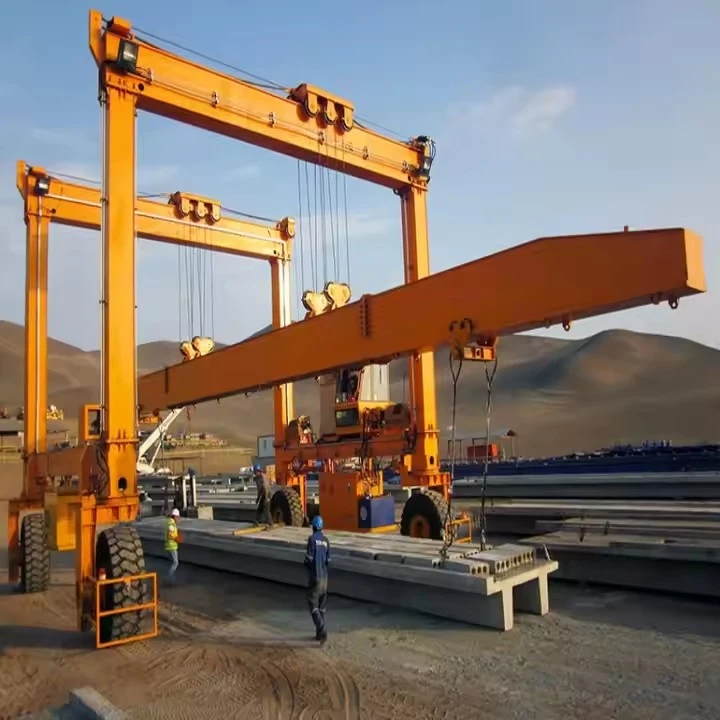


Rubber Tyre Double Girder Gantry Crane
Products Description
What is a Rubber Tyre Double Girder Gantry Crane?
A Rubber Tyre Double Girder Gantry Crane (RTG) is a large, self-supported gantry crane with a double girder bridge that is mounted on end trucks with rubber tires, allowing it to travel on paved surfaces without the need for fixed rails. It is a prime example of a Mobile Gantry Crane at a large scale.
Think of it as the "all-terrain vehicle" of the heavy-lifting world, combining the high capacity and rigidity of a double girder design with the flexibility of road-going mobility.
Advantages of Rubber Tyre Double Girder Gantry Cranes
High Mobility and Flexibility: The biggest advantage. It can be easily moved around a yard, between work sites, or repositioned as storage layouts change, without the cost of installing rails.
No Fixed Infrastructure Required: Eliminates the need for expensive and permanent concrete foundations and steel rails, reducing initial installation costs.
Excellent Maneuverability: With multiple steering modes, it can operate in tight spaces and position loads with high precision.
High Lifting Capacity: The double girder design allows it to handle very heavy loads, typically ranging from 20 tons to over 500 tons.
Suitable for Rough Terrain: Pneumatic tires can handle slightly uneven or rough yard surfaces better than a rail-mounted crane.
Quick Relocation: Ideal for job sites with a finite project timeline, as it can be driven to the next location or transported on a low-loader truck.
Comparison with Key Alternatives
| Feature | Rubber Tyre Gantry (RTG) | Rail-Mounted Gantry (RMG) |
|---|---|---|
| Mobility | High - travels on paved yard | Fixed - travels only on installed rails |
| Infrastructure | Low - requires only a good road surface | Very High - requires rails & foundations |
| Precision | Good (with skilled operator) | Excellent - guided by rails |
| Operating Cost | Higher (fuel, tire wear) | Lower (electric power) |
| Ideal For | Changing layouts, multiple sites | High-density, fixed-layout storage |
Conclusion: The Rubber Tyre Double Girder Gantry Crane is the ultimate choice when you need heavy-lift capability combined with the freedom of mobility. It sacrifices the absolute precision and efficiency of a rail-mounted system for the unparalleled flexibility to work anywhere in a yard or be relocated between job sites.
Lifting Capacity 320 tons
Span (Width) 3 - 12 meters (adjustable)
Lifting Height 3 - 10 meters
Working Class A3-A5 (light to medium duty)
Hoisting Speed 0.5 - 8 m/min (variable)
Main Beam Type Single/double girder (box-type)
Power Supply 220V/380V 3-phase or manual
Control Mode Pendant control/wireless remote
Hoist Type Electric chain hoist/wire rope hoist
Travel Drive Manual push or motorized
Corrosion Protection Hot-dip galvanized or marine-grade paint
Wind Resistance Up to Beaufort scale 6 (for outdoor use)
Operating Temp -20°C to +50°C

Pictures & Components
Here is a detailed breakdown of the components of a Rubber Tyre Double Girder Gantry Crane (RTG), a complex machine that combines structural strength with mobile power.
1. Primary Structural System (The Framework)
This is the crane's skeleton, built for heavy loads and mobility.
Double Main Girders: Two full-length, heavy-duty steel beams (typically box girders) that form the bridge. This design provides the necessary strength and rigidity for heavy loads and long spans.
End Frames (Legs): The vertical structures at each end of the girders. They are tall and robust to provide adequate lifting height and stability. Each end frame is part of a...
Bogey Assembly: A chassis-like unit at the bottom of each leg that houses the axles, wheels, and often the drive motors.
Gantry Platform & Walkways: A structural platform on top of the bridge provides access for maintenance. The Operator's Cab is typically mounted on one of the end frames for optimal visibility.

2. Motion & Power System (The Muscles and Heart)
This is what sets the RTG apart, making it self-sufficient and mobile.
Self-Contained Power Unit:
Diesel Engine: The primary power source for most RTGs, located on the gantry platform.
Generator: Converts the engine's mechanical power into electrical power.
Power Pack Alternative: Some modern RTGs use a large battery-electric power pack or can be connected to an external electric grid via a cable reel.
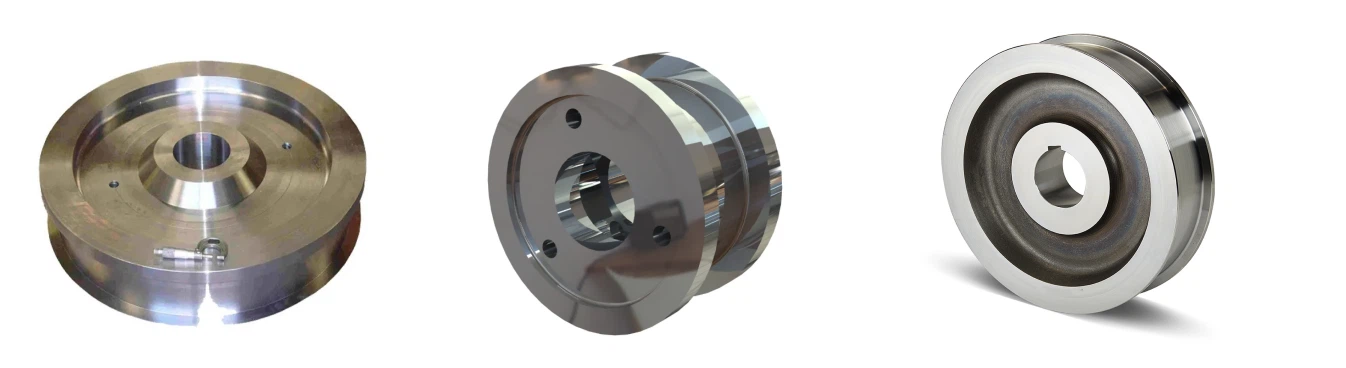
Rubber Tyre Assembly:
Wheels & Tires: Multiple pairs of heavy-duty, high-pressure pneumatic or solid rubber tires. A typical RTG has 4 or 8 wheels per leg.
Axles & Bearings: Heavy-duty axles designed to handle the immense weight and dynamic loads.
Travel Drive System:
Travel Motors: Electric motors (powered by the generator) mounted on the bogey assembly, driving the wheels.
Gearboxes & Brakes: Transmit power to the wheels and provide holding and emergency braking.
Steering System:
Hydraulic Rams or Electric Actuators: Push and turn the entire bogey assembly.
Steering Controller: Allows the operator to select different steering modes (e.g., 90° cross travel, diagonal, circular).
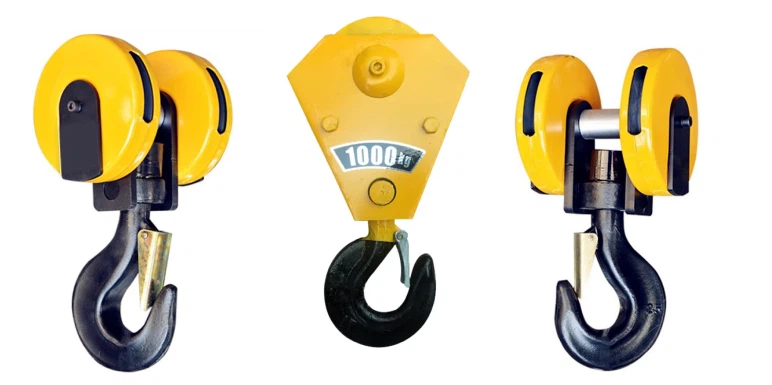
Lifting System:
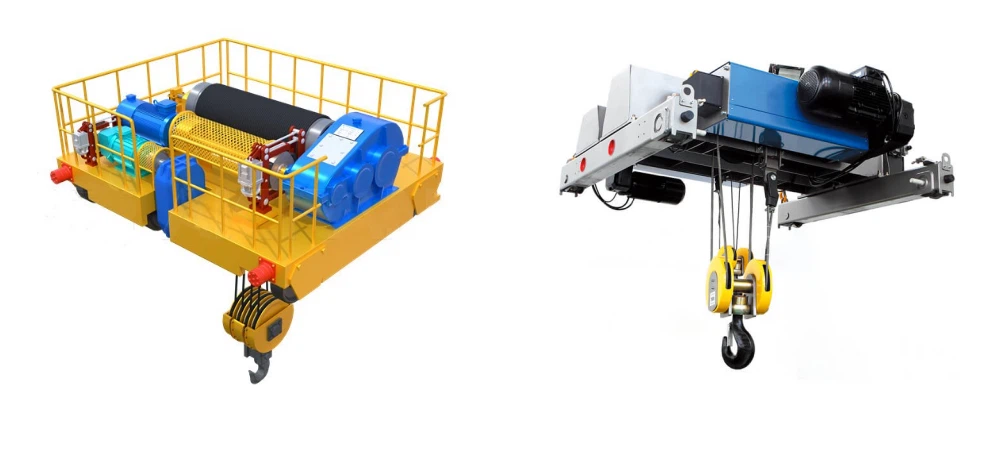
Main Hoist Unit: A heavy-duty electric hoist with one or multiple motors, a wire rope drum, and disc brakes.
Trolley: The unit that carries the hoist and travels along rails on top of the double girders.
Trolley Drive: The motor, wheels, and gearbox that move the trolley back and forth across the span.
Spreader (for container handling): An attachment that locks onto shipping containers.

3. Control & Safety Systems (The Nerves and Reflexes)
Operator Control Stations:
Main Cab: A climate-controlled, elevated cab on the leg for primary operation.
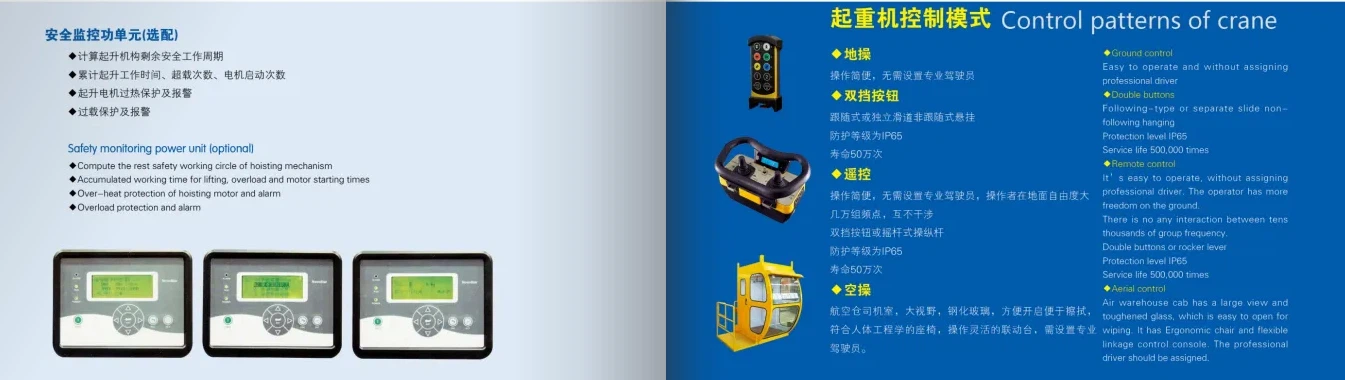
Mobile Radio Remote Control: Allows an operator to control the crane from the ground, providing better visibility for specific tasks.
Steering Control System: A sophisticated module that manages the complex steering of multiple wheel sets.

Critical Safety Devices:
Load Moment Indicator (LMI): Monitors the load weight and crane stability to prevent overloading and tipping.
Anti-Collision System: Uses sensors or radar to detect and prevent collisions with other RTGs or obstacles.
Anemometer & Wind Speed Indicator: Alarms or shuts down operations if wind speeds exceed safe limits.
Tire Pressure Monitoring System (TPMS): Crucial for ensuring all tires are properly inflated to maintain stability.
Outriggers or Stabilizers: Hydraulic jacks that extend to the ground to stabilize the crane during lifting, especially for critical or maximum-capacity lifts.
Warning Lights & Sirens: Alert personnel of crane movement.

Key Differentiators from Rail-Mounted Cranes
| Component | Rail-Mounted Gantry (RMG) | Rubber Tyred Gantry (RTG) |
|---|---|---|
| Travel System | Flanged steel wheels on fixed rails | Rubber tires on paved surface |
| Power Source | Typically external electrification (conductor bar) | Self-contained Diesel Generator or Power Pack |
| Steering | Guided by rails; no steering required | Complex multi-mode steering system |
| Infrastructure | Requires heavy rail runway and foundation | Requires a strong, level paved surface |
| Stability | Inherently stable on rails | Requires outriggers and LMI for critical lifts |
Conclusion: Every component of a Rubber Tyre Double Girder Gantry Crane is engineered for mobile, heavy-duty performance. The integration of a double-girder structure, a self-contained power plant, a robust rubber-tire travel system, and a sophisticated steering and safety package makes it an incredibly versatile but complex piece of equipment, essential for modern port and heavy-industrial yards.
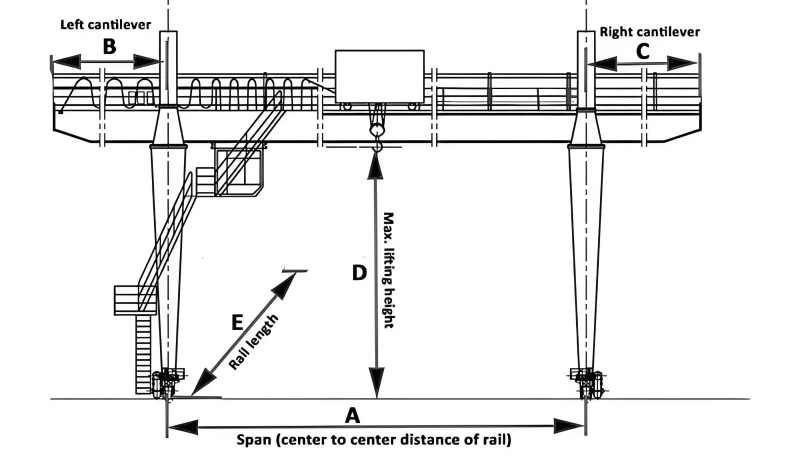
SKETCH
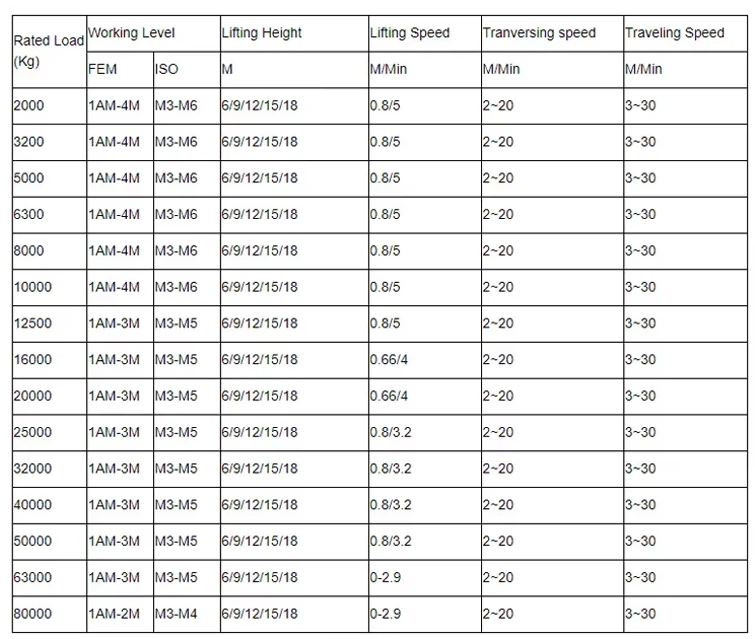
Main technical
Advantages
Advantages of Rubber Tyre Double Girder Gantry Cranes
The primary benefits of RTGs stem from their unique combination of a double-girder's strength and the flexibility of rubber-tired mobility.
1. Exceptional Mobility and Flexibility
This is the single greatest advantage. An RTG is not confined to a fixed track.
Yard-Wide Freedom: It can travel freely across any suitably paved surface, allowing it to adapt to changing storage patterns and work zones dynamically.
Multi-Site Capability: A single crane can serve multiple, dispersed work areas within a large facility or be relocated between different sites as needed.
2. Elimination of Fixed Infrastructure
Lower Initial Investment: Avoids the high cost of designing and installing reinforced concrete foundations and steel rails required for rail-mounted cranes.
Rapid Deployment: Can be commissioned and put to work as soon as the ground surface is prepared, significantly speeding up project timelines.
Minimal Site Disruption: Ideal for existing operational sites where extensive civil works for rail installation would be disruptive.
3. Superior Maneuverability
Multiple Steering Modes: Capabilities like 90° cross travel, diagonal, and circle steering allow the crane to navigate and position loads with precision in congested areas.
Precise Load Spotting: The ability to maneuver freely in any direction enables operators to place loads exactly where needed.
4. High Lifting Capacity and Rigidity
Heavy-Duty Performance: The double-girder design provides the structural integrity to handle loads from 20 tons to over 500 tons.
Excellent Hook Height: The hoist trolley runs between the girders, offering maximum lifting height under the hook, which is essential for stacking tall items like shipping containers.
5. Self-Contained and Independent Operation
On-Board Power: Typically powered by a diesel engine-generator set, making it completely independent of external power sources and ideal for remote or outdoor yards.
Rapid Relocation: Can be driven under its own power to a new location on-site or transported via trailer to a completely different job site.
Application
Applications of Rubber Tyre Double Girder Gantry Cranes
RTGs are the go-to solution for heavy lifting applications that require mobility over a large, paved area. Their unique blend of power and flexibility makes them indispensable in several key industries.
1. Port Container Terminals (Intermodal Yards)
Primary Application: This is the most common use for RTGs. They are the workhorses for stacking, sorting, and moving shipping containers from the quay to the storage yard and onto trucks or trains.
Why it's a Perfect Fit: Their mobility allows for highly efficient use of yard space, and their high capacity and lifting height are specifically designed for container handling.
2. Heavy Equipment and Fabrication Shops
Moving Large Weldments: Transporting massive, partially assembled structures between welding stations.
Machinery Installation: Positioning large machine tools, presses, and industrial equipment.
Why it's a Perfect Fit: The combination of high capacity and precise maneuverability is essential for handling valuable and heavy components safely.
3. Major Construction Sites
Precast Concrete Erection: Placing large concrete elements like bridge girders, wall panels, and double-tee slabs.
Steel Structure Assembly: Lifting and positioning steel beams and trusses for buildings and bridges.
Why it's a Perfect Fit: The ability to travel over the site and be available for the project's duration is invaluable for erecting large components.
4. Precast Concrete Production Yards
Handling Products: Moving finished concrete products like pipes, beams, and septic tanks from casting beds to storage or loading areas.
Why it's a Perfect Fit: The RTG can cover a large yard area, serving multiple production and storage lines efficiently without fixed infrastructure.
5. Shipbuilding and Dry Docks
Block Assembly: Moving and assembling large prefabricated sections of a ship's hull.
Component Handling: Lifting engines, propellers, and other heavy ship parts.
Why it's a Perfect Fit: It provides a mobile heavy-lift solution where the use of fixed cranes is limited by the evolving shape and location of the ship under construction.
6. Power Generation and Maintenance
Turbine and Transformer Handling: Installing and maintaining turbines, generators, and large transformers in power plants and substations.
Why it's a Perfect Fit: Offers a temporary but powerful lifting solution for maintenance outages or new installations without the need for permanent crane infrastructure.
Crane production process
The production of a Rubber Tyre Double Girder Gantry Crane (RTG) is a complex process that blends heavy steel fabrication, precise machining, and sophisticated electrical and hydraulic system integration. It typically occurs in a specialized heavy engineering workshop.
Here is a detailed breakdown of the production process, from design to testing.
Phase 1: Design & Engineering
This is the foundational phase where the crane is conceived and specified.
Client Requirements Analysis: Engineers work with the client to determine key parameters: lifting capacity, span, lifting height, power type (diesel/electric/hybrid), and specific operational needs.
Structural Design & Calculation: Using CAD (Computer-Aided Design) software, the structural components are designed. This includes:
Girder Design: Calculating the size, thickness, and internal stiffening of the double box girders to withstand the load and span without excessive deflection.
End Frame & Leg Design: Ensuring the legs can handle the compressive forces and dynamic loads.
Stability Analysis: Verifying the crane's stability against tipping, especially critical for a rubber-tyred machine.
Mechanical & Electrical System Design: Detailed designs for the hoist, trolley, travel drives, steering system, and power pack are created. Electrical schematics and control panel layouts are developed.
Regulatory Compliance: The design is verified to comply with international standards like ISO, FEM, DIN, or CMAA.
Phase 2: Material Procurement & Preparation
Raw Material Sourcing: Procurement of primary materials:
Steel Plates: High-quality, graded steel plates (e.g., Q235B, Q345B) of various thicknesses for the main girders and structures.
Structural Sections: I-beams, channels, and angles for bracing and supports.
Mechanical Components: Wheels, axles, bearings, gearboxes, wire ropes, and hooks.
Electrical Components: Motors, PLCs, variable frequency drives (VFDs), sensors, and cabling.
Hydraulic Components: Pumps, cylinders, and valves for the steering system.
Material Preparation: Steel plates are shot-blasted to remove rust and mill scale, and then primer-painted for corrosion protection before fabrication.
Phase 3: Fabrication & Machining
This is the core manufacturing phase, often happening in parallel for different subsystems.
1. Main Girder Fabrication:
Cutting: Steel plates are cut to size using CNC plasma or flame cutting machines for precision.
Welding: Plates are welded together to form the large box girders. This is done on automated welding stations or by highly skilled welders. Internal stiffening diaphragms are welded at intervals to prevent buckling.
Stress Relieving: The completed girders undergo heat treatment in a large furnace to relieve internal stresses caused by welding, preventing future distortion and ensuring dimensional stability.
Machining: The surfaces where the trolley rails will be mounted are often machined to ensure they are perfectly flat and parallel.
2. End Truck & Bogie Assembly Fabrication:
The legs and end frames are fabricated from steel plates and sections.
The bogie frames (which house the axles) are built and machined to accept the wheel assemblies and travel motors.
3. Trolley and Hoist Assembly:
The trolley frame is fabricated.
The hoist machinery-including the motor, gearbox, drum, and brakes-is assembled onto the frame as a unit.
The trolley travel wheels and drive motor are installed.
4. Power Pack and Cab:
The diesel engine and generator (or electric power pack) are mounted on a skid or a dedicated platform on the main girder.
The operator's cab is fabricated, wired, and fitted with controls and glass.
Phase 4: Sub-Assembly & Pretesting
Before the final erection, key subsystems are assembled and tested individually.
Bogie Assembly: Axles, wheels, tires, travel motors, and gearboxes are assembled onto the bogie frame. The steering cylinders are connected.
Trolley-Hoist Test: The assembled trolley and hoist are tested on a temporary stand. The hoist is run to check for noise, vibration, and brake function.
Power Pack Test: The engine-generator set is run to ensure it produces the correct voltage and frequency.
Control Panel Check: The main control panel is wired and powered up for a preliminary functional test.
Phase 5: Final Erection & Integration
This is where the crane physically takes shape.
Positioning: The main girders are placed on large supports in the assembly area.
Leg Attachment: The end trucks (with the bogie assemblies attached) are lifted by a large overhead crane and bolted or welded to the main girders.
Trolley Installation: The complete trolley and hoist assembly is lifted onto the rails on top of the double girders.
Mechanical Integration: The power pack, cab, and all walkways and ladders are installed.
Phase 6: Electrical & Control System Installation
Cable Laying: All power and control cables are run along the girders and down the legs to the travel and steering motors.
Sensor Installation: Limit switches, anti-collision sensors, anemometers, and the Load Moment Indicator (LMI) system are installed and connected.
Final Wiring: The main control panel is connected to all motors and sensors.
Phase 7: Commissioning & Testing (Factory Acceptance Test)
This is the most critical quality assurance phase, conducted before disassembly for shipment.
No-Load Test: All crane functions are operated without a load:
Hoist, trolley, and gantry travel are tested at various speeds.
Steering modes are verified.
All limit switches and emergency stops are confirmed to be functional.
Static Load Test: The crane is positioned over a solid foundation. A test load (125% of the rated capacity) is lifted just off the ground and held for a period to check for structural deformation and brake holding capacity.
Dynamic Load Test: A test load (110% of the rated capacity) is lifted and put through all operational motions-hoisting, trolley travel, and gantry travel-to simulate real-world working conditions.
LMI and Safety System Calibration: The Load Moment Indicator is calibrated to ensure accuracy. All other safety devices are verified.

Workshop view:
The company has installed an intelligent equipment management platform, and has installed 310 sets (sets) of handling and welding robots. After the completion of the plan, there will be more than 500 sets (sets), and the equipment networking rate will reach 95%. 32 welding lines have been put into use, 50 are planned to be installed, and the automation rate of the entire product line has reached 85%.




Hot Tags: rubber tyre double girder gantry crane, China rubber tyre double girder gantry crane manufacturers, suppliers, factory
You Might Also Like


Send Inquiry