







Port Container Gantry Cranes
Products Description
Types of Port Container Gantry Cranes:
Ship-to-Shore (STS) Cranes
Used for transferring containers between ships and the dock.
Feature long booms to reach across large vessels.
High lifting capacity (typically 40–100+ tons).
Rail-Mounted Gantry (RMG) Cranes
Move on fixed rails within the terminal yard.
Used for stacking containers in storage areas.
Rubber-Tired Gantry (RTG) Cranes
Mobile cranes that operate in container yards.
Run on rubber tires for flexibility in movement.
Key Differences Between STS, RTG, and RMG Cranes
| Component | STS Crane (Ship-to-Shore) | RTG (Rubber-Tired Gantry) | RMG (Rail-Mounted Gantry) |
|---|---|---|---|
| Mobility | Rails along quay | Rubber tires (yard) | Fixed rails (yard) |
| Lifting Capacity | 40–100+ tons | 30–50 tons | 30–50 tons |
| Automation | High (AI/remote ops) | Moderate (some automated) | High (automated yards) |
Features & Capabilities:
Lifting Capacity: 40–100+ tons (some ultra-large cranes handle even more).
Outreach: Up to 72 meters (to service mega-ships like those with 24+ container rows).
Automation: Many modern cranes are semi or fully automated (e.g., remote-controlled or AI-driven).
Speed: Hoisting speeds up to 180 ft/min, trolley travel at 240 ft/min.
Place of Origin:Henan, China
Warranty:1 Year
Weight (KG):2000 kg
Video outgoing-inspection:Provided
Machinery Test Report:Provided
Keywords:gantry crane
Color: Customized
Size: Customized
Design: computer optimization design
Safety: High flexible flat cable power
Application: construction industrial,workshop,warehouse
Working class: A3-A8
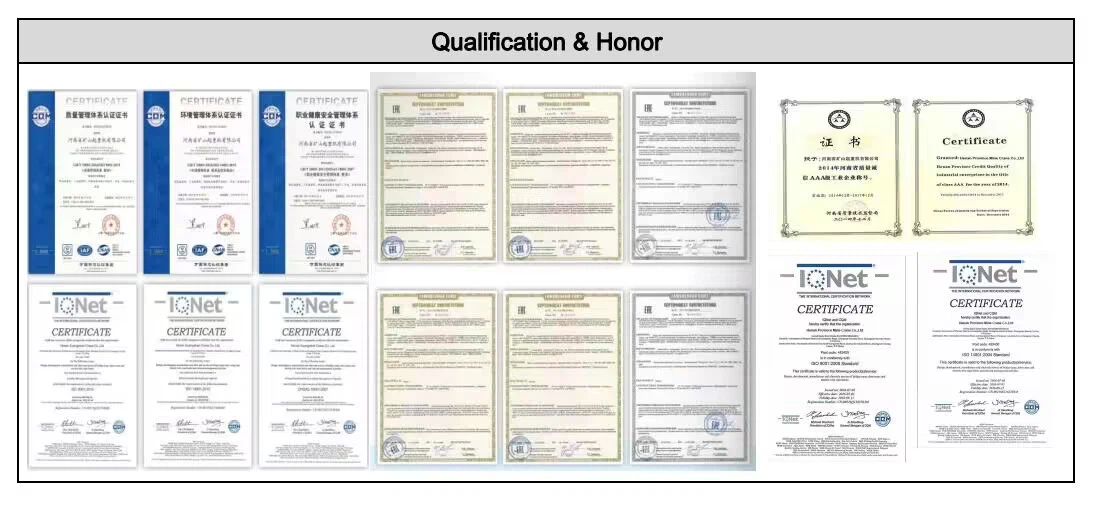
Certification: ISO,CE,BV,S GS,TUV
Power Source: 380~480V,customized

Pictures & Components
Port container gantry cranes, especially Ship-to-Shore (STS) cranes, consist of several critical components that work together to ensure efficient container handling. Below is a detailed breakdown of their key parts:
1. Structural Components
A. Boom (Outreach Arm)
Function: Extends over the vessel to load/unload containers.
Types:
Fixed Boom: Standard design with a set outreach.
Adjustable Boom: Can be raised/lowered to accommodate different ship sizes.
Outreach Range: Typically 20–72 meters (to reach ultra-large container ships).

B. Gantry Frame (Portal Structure)
Supports the entire crane and allows movement along rails.
Landside & Waterside Legs: Provide stability; some cranes have A-frame supports for extra strength.
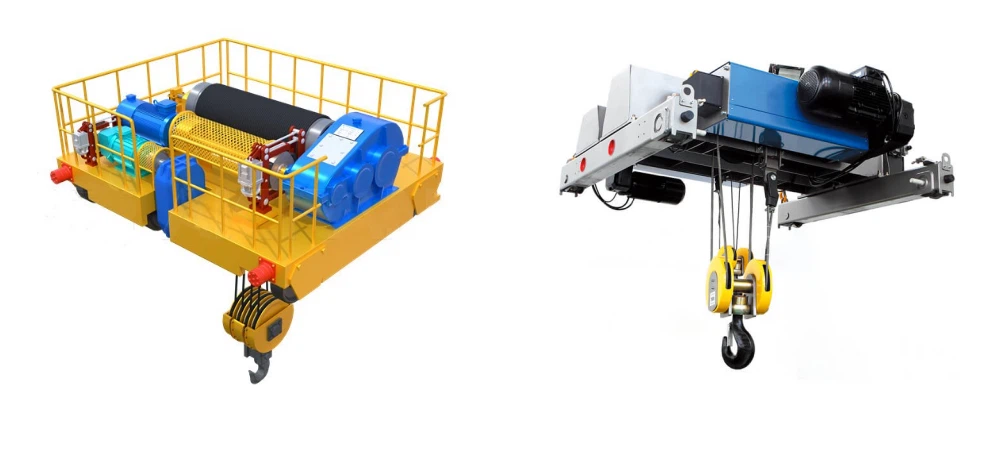
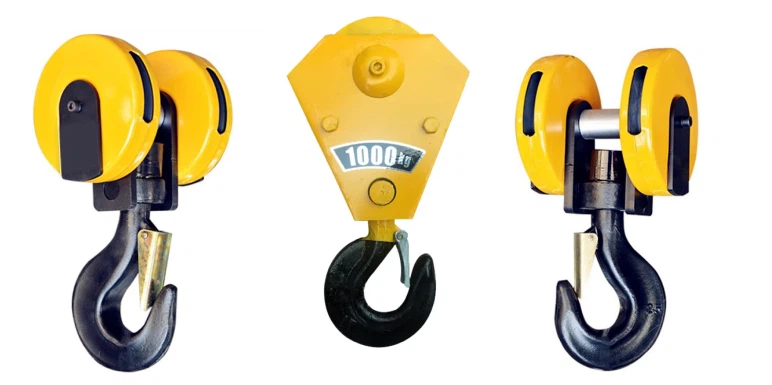
C. Trolley & Hoist System
Trolley: Moves horizontally along the boom to position the spreader.
Hoist Mechanism: Raises/lowers containers using wire ropes or chains.
Lifting Speed: Up to 180 ft/min (55 m/min) for efficient operations.
D. Spreader (Container Lifter)
Function: Locks onto containers using twistlocks.
Types:
Fixed Spreader: Handles one container size (e.g., 20ft or 40ft).
Telescopic Spreader: Adjusts to different lengths (20ft, 40ft, 45ft).
Twin/Lift Spreader: Can lift two 20ft containers simultaneously.

2. Mobility & Drive Systems
A. Rail System
STS cranes move on parallel rails along the quay.
Drive Mechanism: Powered by electric motors (AC/DC) with anti-collision systems.
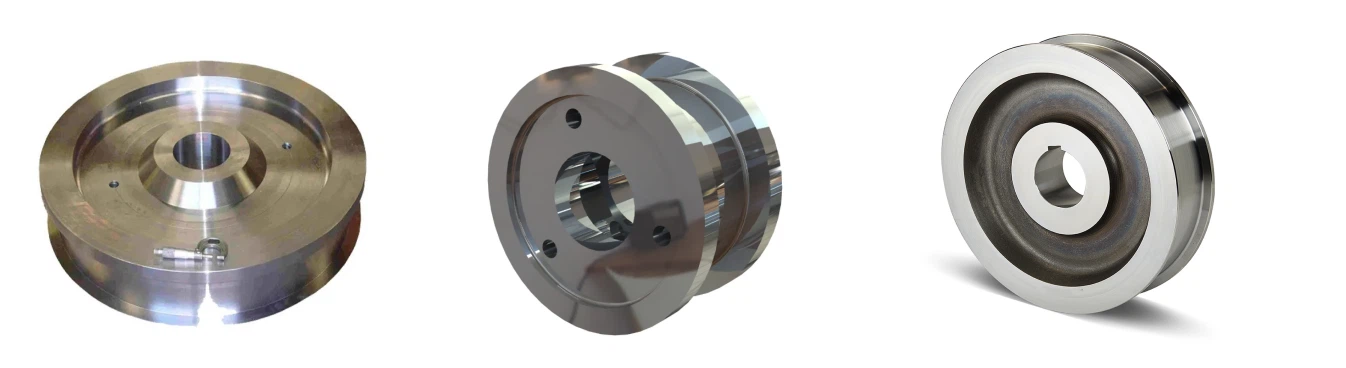
B. Wheels & Bogies
Distribute the crane's weight and ensure smooth movement.
Some cranes use hydraulic systems for alignment adjustments.
3. Power & Control Systems
A. Power Supply
Cable Reel System: Delays electricity through trailing cables.
Alternative: Some cranes use diesel generators or battery backups.
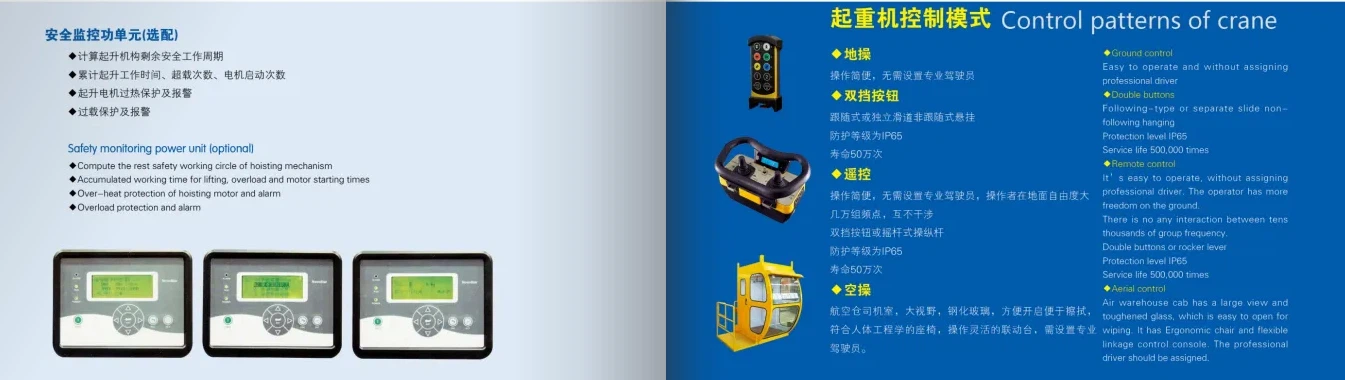
B. Operator Cabin
Located on the crane for direct visibility.
Equipped with joysticks, screens, and automation controls.
Modern cranes may have remote-control stations or AI-assisted operations.
C. Automation & Sensors
LIDAR/Cameras: Detect container positions and obstacles.
PLC Systems: Control movements for precision.
Anti-Sway Tech: Reduces container swing during transit.

.
4. Safety & Auxiliary Components
A. Braking Systems
Emergency brakes for sudden stops.
Anemometers to detect high winds and halt operations if necessary.
B. Lights & Alarms
Warning signals for movement and lifting.
Flashing beacons for visibility in low light.
C. Ladders & Maintenance Platforms
Allow technicians to access mechanical/electrical parts for servicing.

5. Specialized Attachments (Optional)
Reefer (Refrigerated Container) Handlers: Extra power slots for cooling units.
Weighing Systems: Measure container weight during lifting.
Laser Guidance: For automated stacking in terminals.
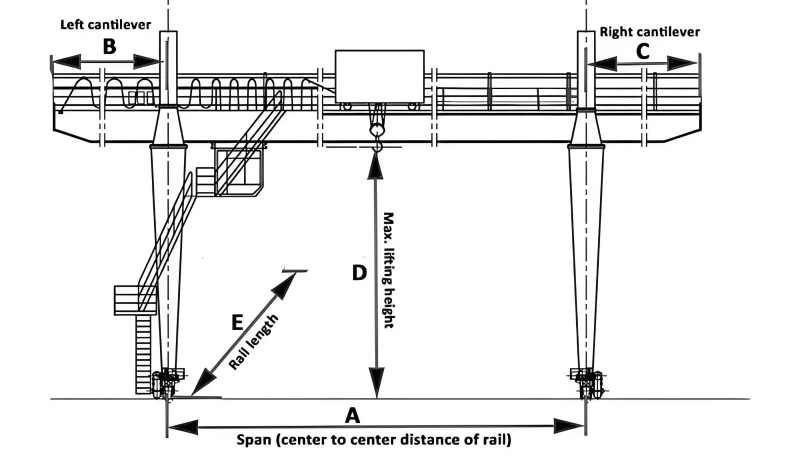
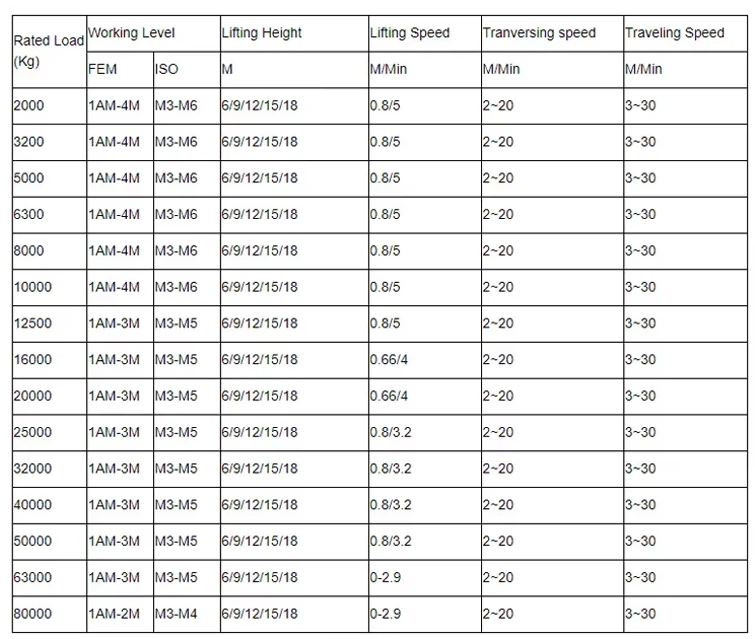
SKETCH
Main technical
Advantages
Unmatched Efficiency
Capable of handling 30-50+ container moves per hour
Cycle times as low as 2-3 minutes per container
Simultaneous hoisting and trolley movement for optimal productivity
Mega-Ship Compatibility
Outreach up to 72 meters to service ultra-large container vessels
Lifting heights exceeding 50 meters above quay level
Capacity to handle ships carrying 24,000+ TEUs
Operational Flexibility
Adjustable boom systems for different vessel profiles
Interchangeable spreaders for various container types/sizes
Capability to work in tandem with yard equipment
Advanced Automation
Remote operation capabilities
Computer-assisted positioning systems
Integration with terminal operating systems (TOS)
Enhanced Safety Features
Anti-collision systems
Load monitoring and overload protection
Automated storm securing systems
Environmental Benefits
Regenerative power systems
Electric operation options
Reduced carbon footprint compared to manual systems
Application
Primary Applications:
Container Terminal Operations
Primary tool for ship-to-shore container transfers
Essential for mainline vessel servicing
Critical for maintaining port productivity and vessel turnaround times
Intermodal Connections
Direct transfer to yard gantry cranes (RMGs/RTGs)
Interface with straddle carriers and shuttle trucks
Connection point for landside transport modes
Specialized Cargo Handling
Oversized and project cargo movements
Reefer container operations
Dangerous goods container handling
Port Development Projects
Enabling infrastructure for new mega-terminals
Key equipment for port expansion projects
Technology showcase for smart port initiatives
Emergency and Special Operations
Disaster relief cargo handling
Military logistics support
Special vessel loading scenarios
Emerging Applications:
Automated Container Terminals
Integration with automated guided vehicles (AGVs)
Interface with automated stacking cranes
Central component in lights-out terminal operations
Green Port Initiatives
Electrification projects
Energy recovery systems
Low-emission port operations
Data Collection Hub
Container tracking and tracing
Performance monitoring
Predictive maintenance data collection
Crane production procedure
1. Design and Engineering
Requirement Analysis
Understand the client's specifications (load capacity, span, height, working environment, etc.).
Determine operational parameters: lifting height, travel speed, working frequency, etc.
Preliminary Design
Create conceptual designs and 3D models.
Choose materials based on strength and environmental conditions.
Detailed Engineering
Develop detailed engineering drawings (structural components, mechanisms, electrical systems).
Perform stress and fatigue analysis to ensure safety.
2. Material Procurement
Source high-quality materials, including:
Steel plates and profiles for structural components.
Motors, gearboxes, and other mechanical parts.
Electrical systems and control components.
Inspect materials to ensure compliance with quality standards.
3. Fabrication
Structural Component Fabrication
Cut, weld, and assemble the steel structures (main girder, cantilever arms, legs, etc.).
Ensure precise alignment and dimensions.
Perform surface treatment (e.g., shot blasting, painting) for corrosion protection.
Mechanical Assembly
Assemble mechanical parts (trolley, hoist, wheels, etc.).
Install motors, gearboxes, and drive systems.
Electrical Assembly
Install electrical components (control panels, cables, sensors).
Wire and connect the system to ensure functionality.
4. Quality Inspection
Material Inspection
Verify material certification and conduct tests (e.g., tensile tests).
Structural Inspection
Inspect weld quality (e.g., ultrasonic testing).
Ensure dimensional accuracy and surface finishing.
Assembly Inspection
Check alignment and functionality of all parts (mechanical and electrical).
Load Testing
Conduct static and dynamic load tests to ensure safe operation.
5. Factory Acceptance Testing (FAT)
Conduct a comprehensive trial run, including:
Full load and overload tests.
Functionality of all safety devices (e.g., limit switches, emergency brakes).
Smooth operation of trolley, hoist, and crane travel.
Document results and obtain client approval.
6. Disassembly and Packing
Disassemble the crane into transportable sections.
Pack components securely to prevent damage during transportation.
Label and prepare a packing list for efficient reassembly.
7. Transportation
Deliver the crane components to the installation site using appropriate transportation methods.
8. Installation and Commissioning
On-Site Assembly
Assemble structural components and mechanical systems.
Install electrical systems and control panels.
Calibration and Testing
Recalibrate the crane system for site-specific conditions.
Perform on-site load testing to verify performance.
9. Handover
Provide training to the client's personnel on safe operation and maintenance.
Deliver technical documentation (user manual, maintenance guide, certificates).
Obtain final approval and acceptance from the client.
10. After-Sales Support
Offer warranty services and maintenance support.
Provide spare parts and technical assistance as needed.

Workshop view:
The company has installed an intelligent equipment management platform, and has installed 310 sets (sets) of handling and welding robots. After the completion of the plan, there will be more than 500 sets (sets), and the equipment networking rate will reach 95%. 32 welding lines have been put into use, 50 are planned to be installed, and the automation rate of the entire product line has reached 85%.



Hot Tags: port container gantry cranes, China port container gantry cranes manufacturers, suppliers, factory
Previous
Rail-Mounted Gantry (RMG) CranesYou Might Also Like


Send Inquiry