










Rail Mounted Gantry Crane
Products Description
Key Features of a Rail Mounted Gantry Crane
1. Structural Design
Double or Single Girder Configuration (double girder preferred for heavy loads).
Fixed or Adjustable Legs (depending on workspace requirements).
High-strength steel construction (weather-resistant for outdoor use).
2. Movement System
Steel Wheels on Fixed Rails (for smooth, guided movement).
Electric Drive Motors (AC/DC, with variable frequency control).
Rail Clamps & Anti-Drift Brakes (prevents unintended movement).
3. Lifting Mechanism
Hoist & Trolley System (wire rope or chain hoist, 10–500+ tons).
Spreader Beams, Magnets, or Grabs (for containers, steel coils, etc.).
Automated Positioning (optional for container handling).
4. Control & Safety Systems
Cabin, Pendant, or Remote Control.
Overload Protection, Limit Switches, Emergency Stop.
Anti-Collision & Laser Guidance Systems (for automated operations).
Comparison: Rail Mounted vs. Rubber-Tired Gantry (RTG) Cranes
| Feature | Rail Mounted Gantry (RMG) | Rubber-Tired Gantry (RTG) |
|---|---|---|
| Mobility | Fixed rails, straight path | Moves freely on paved ground |
| Load Capacity | 10–500+ tons | 5–100 tons |
| Precision | High (guided movement) | Moderate (manual steering) |
| Stability | Excellent (wind-resistant) | Less stable in high winds |
| Automation | Easily automated | Limited automation |
| Maintenance | Lower (rails reduce wear) | Higher (tire replacements) |
| Cost | Higher initial investment | Lower upfront cost |
Best For:
RMG → Heavy-duty, high-precision, long-term operations (ports, steel plants).
RTG → Flexible, short-term projects needing mobility.
Lifting Capacity: 30 metric tons (30,000 kg)
Span: 10m–35m (customizable)
Lifting Height: 6m–20m (adjustable)
Hoist Type: Double-girder with electric wire rope hoist (QD-type)
Travel System: Motorized (rail-guided or rubber-tired)
Wheel Type: Steel wheels (for rails) / Pneumatic tires (floor use)
Control System: Cabin-operated or remote control
Power Supply: 380V/50Hz (3-phase)
Structural Steel: Q345B (high-strength) with corrosion-resistant coating

Pictures & Components
A rail mounted gantry crane consists of carefully engineered components working together for heavy-load handling. Here's a detailed technical breakdown:
1. Main Structural Framework
Girders (Bridge Beams)
Primary load-bearing structure (box-type or truss design)
Typically double girder configuration for capacities >50 tons
Fabricated from high-grade steel (Q345B or equivalent)
End Carriages (Leg Assemblies)
Rigid welded steel construction with reinforced bracing
Height ranges from 8m to 40m depending on application
Incorporate ladder access and maintenance platforms
Cross Beams & Diagonal Bracing
Ensure structural integrity against torsional forces
Adjustable designs available for variable span requirements

2. Rail Travel System
Rail Track Components
QU80-QU120 heavy-duty crane rails (per DIN536/EN13674)
Steel rail clips and fishplates for secure joining
Embedded rail options for floor-flush installations
Wheel Assemblies
Forged steel wheels with hardened treads (Ø400-1200mm)
Double-flange design for precise rail guidance
Timken/Koyo taper roller bearings with automatic lubrication
Drive Units
AC frequency-controlled motors (15-200kW)
Hardened gear reducers (sealed for life lubrication)
Fail-safe electromagnetic brakes (dual-circuit)
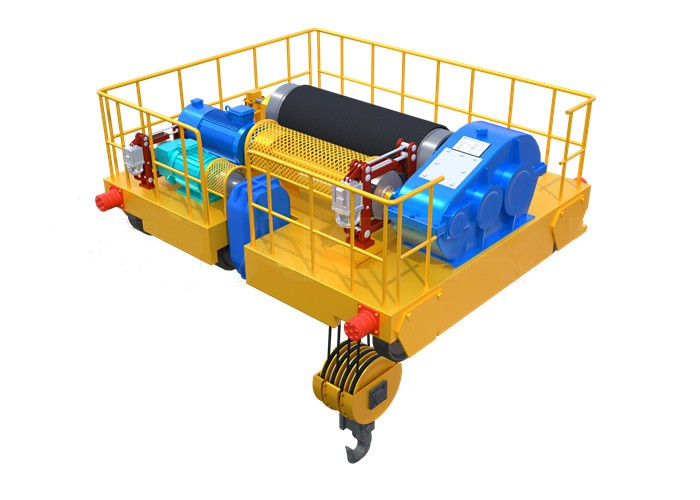 |
 |
3. Hoisting Mechanism
Main Hoist
Wire rope hoist (DIN 15020 standard)
4/6 rope reeving for heavy loads
Class FEM M6 or M7 duty rating
Auxiliary Hoist (Optional)
20-30% of main hoist capacity
Independent trolley for secondary operations
Trolley System
Motorized cross-travel with anti-sway control
Closed-loop vector drive for precise positioning
Full enclosure with walkway for maintenance
 |
 |
4. Electrical Systems
Power Delivery
Conductor bar system (IP54 rated)
Festoon cable management for long travel
Emergency backup power option
Control Systems
Siemens/ABB PLC-based control
VFD for all motion axes
CAN bus communication network
Operator Interfaces
Pendant station (IP65 rated)
Cabin control (air-conditioned)
Remote radio control (2.4GHz FHSS)

5. Safety Systems
Load Monitoring
Digital load moment indicator (10:1 accuracy)
Dual-path overload protection
Movement Safety
Absolute encoder position feedback
Anti-collision laser scanners
Rail end buffers (hydraulic/polyurethane)
Emergency Systems
UPS-backed emergency stop circuit
Manual release for brake systems
Storm locking devices (for outdoor use)

6. Specialized Options for Marble Handling
Vacuum Lifter Integration
Multi-pad system with 360° rotation
Automatic vacuum monitoring
Emergency backup power for lifters
Slab Handling Attachments
C-frame spreader beams
Adjustable width slab clamps
Non-marring contact surfaces
Dust Protection
IP65 rated electrical components
Bearing seals with positive air purge
Self-cleaning wheel flanges

7. Foundation & Rail System
Track Installation
Concrete foundation with anchor bolts
Rail alignment within ±2mm over 100m
Insulated rail joints for signaling
Support Structures
Reinforced concrete sleepers
Adjustable rail fastening system
Expansion joints for thermal movement
.
Technical Specifications Example
| Parameter | Typical Range |
|---|---|
| Capacity | 10-500 metric tons |
| Span | 10-50 meters |
| Lifting Height | 6-30 meters |
| Travel Speed | 5-40 m/min (VFD controlled) |
| Hoisting Speed | 0.5-10 m/min (dual-speed) |
| Work Duty | FEM 2m-3m (heavy duty) |
| Power Supply | 380V/415V 50Hz 3-phase |

This comprehensive component system ensures reliable operation in demanding environments like:
Stone slab handling facilities
Port container terminals
Heavy fabrication shops
Steel mill service areas

SKETCH

Main technical

Advantages
1. High Load Capacity (10–500+ Tons)
Designed for heavy-duty lifting (containers, steel coils, marble slabs, etc.).
Double-girder construction ensures superior strength compared to rubber-tired gantry cranes (RTGs).
2. Exceptional Stability & Safety
Fixed rails prevent lateral movement, reducing accidents.
Anti-sway technology ensures smooth load handling.
Wind-resistant design (critical for outdoor operations like ports).
3. Precise Movement & Automation-Ready
Guided rail system allows accurate positioning (±5mm).
Easily automated with PLC controls, laser guidance, and RFID tracking (common in smart ports).
4. Long Lifespan & Low Maintenance
Steel rails reduce wheel wear, lowering maintenance costs.
Corrosion-resistant coatings extend durability in harsh environments (ports, steel mills).
5. Energy Efficiency
Regenerative braking reduces power consumption.
Variable Frequency Drives (VFDs) optimize motor performance.
6. Customizable for Specialized Needs
Adjustable spans (10–50m+) to fit different workspaces.
Multiple lifting attachments (spreaders, magnets, vacuum lifters).
Explosion-proof options for hazardous areas.
Application:
1. Ports & Container Terminals (Most Common Use)
Stacking and moving shipping containers (1–4 high).
Loading/unloading from ships to trucks/trains.
Automated RMGs with OCR (Optical Character Recognition) for smart logistics.
2. Steel & Metal Industries
Handling steel coils, slabs, and beams.
Transporting molten metal ladles (with reinforced safety systems).
3. Marble & Stone Processing
Lifting & positioning large marble/granite blocks.
Moving slabs between cutting, polishing, and storage areas.
Vacuum lifters prevent damage to delicate stone surfaces.
4. Heavy Machinery & Manufacturing
Assembling wind turbines, ship parts, and industrial equipment.
Handling large molds in foundries.
5. Power Plants & Construction
Installing turbines, boilers, and prefabricated structures.
Handling concrete segments in bridge construction.
6. Railway & Logistics Hubs
Loading/unloading heavy cargo from trains.
Warehouse slab storage systems.
Crane production procedure
1. Design and Planning
Demand Analysis: According to customer needs and usage scenarios, a detailed demand analysis is carried out to determine the specifications, load, span, lifting height, etc. of the crane.
Engineering Design: Engineers use CAD and other design software to carry out detailed design, including structural, mechanical, electrical and other aspects to ensure that the design meets relevant standards and specifications.
2. Material Procurement
Material Selection: Select appropriate steel, motors, control systems and other components according to design requirements.
Supplier Screening: Screen suppliers of materials and components to ensure the quality and reliability of materials.
3. Processing and Manufacturing
Cutting and Forming: Cut, weld, bend and other processes on steel to form main beams, end beams and other structural components.
Machining: Precision machining of key components, such as turning, milling, drilling, etc., to ensure that the size and accuracy meet the design requirements.
Surface Treatment: Spray, galvanize or rust-proof metal parts to enhance corrosion resistance and aesthetics.
4. Assembly
Component Assembly: Assemble the main beam, end beam, trolley, lifting mechanism and other components to form a complete crane structure.
Installation of electrical system: Install electrical equipment such as motors, control cabinets, sensors, limit switches, etc. to ensure the normal operation of the electrical system.
5. Debugging and testing
Preliminary debugging: Carry out preliminary debugging of the crane to check the coordination and operation of each component.
Load test: Carry out load test to ensure the safety and stability of the crane under rated load, and test the functions of safety devices such as overload protection and limit switches.
Performance test: Test the performance indicators of the crane such as lifting speed, running speed, braking effect, etc. to ensure that they meet the design requirements.
6. Quality inspection
Quality inspection: Carry out a comprehensive quality inspection of the crane, including appearance, size, performance, etc., to ensure compliance with relevant standards.
Safety assessment: Carry out safety assessment to ensure the normal operation of all safety devices and systems.
7. Delivery and installation
Packaging and transportation: Pack qualified cranes and prepare them for transportation to the customer site.
On-site installation: Carry out on-site installation according to customer requirements, including basic production and equipment debugging.
Training and handover: Train operators to ensure that they master the operation methods and safety precautions of the equipment and complete the handover work.


Workshop view
Material Inspection
Quality Inspection: Strict quality inspection is carried out on the purchased raw materials to ensure that they meet the design requirements and national standards.
Material Storage: Qualified materials are stored according to classification to prevent corrosion or damage.
Cutting and Forming
Steel Cutting: Use plasma cutting, laser cutting or flame cutting and other technologies to cut the steel according to the size of the design drawing.
Forming Processing: Form the steel plate through bending, rolling, welding and other processes to manufacture the main beam, end beam and other structural parts.
Welding
Component Welding: The cut and formed steel parts are welded into the main structures such as the main beam, end beam and trolley. The welding process needs to be strictly controlled to ensure the structural strength and welding quality.
Weld Inspection: Use non-destructive testing technology (such as ultrasonic testing, radiographic testing) to inspect the welds to ensure that there are no cracks or other defects.
Machining
Precision Machining: Precision machining is performed on the key components of the crane, such as wheel sets, bearing seats, pulleys, etc., to ensure their dimensional accuracy and surface quality.
Assembly of the whole machine
General assembly: On the basis of pre-assembly, the overall assembly of the crane is carried out, including the final installation of the main beam, end beam, lifting mechanism, walking mechanism, etc.
Commissioning and testing
Under dynamic conditions, the operating performance of the crane is tested, including the testing of lifting, walking, steering and other functions. The overall size of the assembled bridge crane is checked to ensure that all dimensions meet the design requirements.
Spraying and anti-corrosion treatment
Surface treatment Rust removal: Rust removal on the surface of the crane, common methods include sandblasting, pickling, etc. Primer spraying: Spray anti-corrosion primer on the treated surface to prevent metal oxidation and corrosion. Topcoat spraying Color spraying: Spray topcoat according to customer requirements or industry standards to give the crane a protective and decorative effect. Marking: After spraying, mark the crane's identification information in accordance with the specifications, such as model, rated load, etc.
Factory and installation
Packaging and transportation
Packaging protection: Protectively package the key components of the crane to prevent damage during transportation. Transportation arrangement: According to the equipment size and transportation conditions, select a suitable transportation method to transport the crane to the customer's site.
Acceptance and delivery
Customer acceptance
On-site acceptance: The customer conducts on-site acceptance of the crane according to the contract requirements and technical specifications to check the performance and quality of the equipment.
Problem rectification: If any problems are found, the manufacturer needs to rectify them in time to ensure that the equipment fully meets the customer's requirements. Delivery and use Operation training: The manufacturer usually trains the customer's operators to ensure that they can operate the crane correctly and safely.


Hot Tags: rail mounted gantry crane, China rail mounted gantry crane manufacturers, suppliers, factory
You Might Also Like


Send Inquiry