










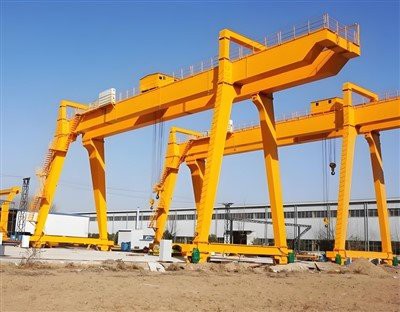
Remote Control Container Gantry Crane
Product Introduction
Key Features
1. Wireless Remote Control System
Radio remote control (up to 100m range) for safe, flexible operation.
IP-rated waterproof & dustproof for harsh environments (e.g., ports, rainy conditions).
Emergency stop & anti-interference for enhanced safety.
2. High-Efficiency Container Handling
Spreaders (Twistlocks) – Automatic or manual for 20ft, 40ft, 45ft containers.
Lifting Capacity – Typically 20–60 tons (single container handling).
Hoisting Speed – Adjustable (10–30 m/min) for fast loading/unloading.
3. Robust Structural Design
Double-girder construction for heavy-duty stability.
Corrosion-resistant coating (epoxy paint or galvanized) for marine environments.
Wheel & Rail System – Some models run on tracks for limited movement.
4. Smart Safety Features
Overload protection (load limiter).
Anti-sway & collision avoidance systems.
Limit switches (upper/lower height control).
5. Power Options
Electric (3-phase AC) – Most common for ports.
Diesel/hydraulic – For remote locations without grid power.
Types of Remote Control Gantry Cranes for Containers
1. Fixed-Position Container Gantry Crane
Stationary, bolted to a foundation.
Used in small ports, warehouses, or rail yards.
2. Rail-Mounted Gantry Crane (RMG)
Moves on parallel rails for stacking containers in terminals.
High automation possible (semi-automated RMGs).
3. Rubber-Tired Gantry Crane (RTG)
Mobile on rubber tires, used in container yards.
Often hybrid (diesel + electric) for flexibility.
Rated Loading Capacity:5 ton, 10 TON, 100 ton, customized, 16/3.2 ton, 20/5 ton, 32/5 ton, 50/10 ton
Max. Lifting Height:40m, customized
Span:35m or clients' demands
Warranty:1 Year
Weight (KG):50000 kg
Core Components:PLC, Engine, Bearing, Gearbox, Motor, Pressure vessel, Gear, Pump
Control way:Cab, wireless remote control or customized

Pictures & Components
1. Structural Components
A. Main Girder (Bridge)
Function: Primary load-bearing structure spanning the work area
Types:
Single girder (for lighter loads <20 tons)
Double girder (heavy-duty, 20-60+ tons)
Material: High-grade steel with corrosion-resistant coating
B. Legs/Supports
Fixed legs: Permanently mounted to foundation
Adjustable legs: Allow for height variation
Outriggers: Provide additional stability for wider spans
C. End Carriages
House the wheels/travel mechanisms
Include buffers/bumpers for impact protection

2. Lifting & Handling Components
A. Hoisting Mechanism
Electric wire rope hoist (most common)
Capacity: 20-60 tons
Speed: 5-30 m/min (variable frequency control)
Chain hoist (for lighter applications)
B. Spreader (Container Lifter)
Types:
Fixed (20'/40'/45' containers)
Telescopic (adjustable for different sizes)
Rotating (for container positioning)
Twistlock mechanism: Automatic or manual locking
C. Trolley System
Cross-travel mechanism along girder
Motorized drive with frequency control
Includes anti-sway technology


3. Movement & Travel Systems
A. Travel Drives
Rail-mounted: Steel wheels on tracks
Rubber-tired: For RTG variants
Drive motors: AC frequency-controlled
B. Braking System
Emergency brakes
Service brakes
Anti-drift protection
 |
 |
 |
4. Remote Control System
A. Transmitter Unit
IP67 rated waterproof handheld
100-300m operating range
Emergency stop button
Load display interface
B. Receiver Unit
Mounted on crane structure
Signal processing unit
Fail-safe circuitry
C. Control Interfaces
Hoist speed control
Trolley traverse
Gantry travel
Spreader functions
 |
 |
 |
5. Safety & Monitoring Systems
A. Load Monitoring
Load cells
Overload protection
Anti-collision systems
B. Limit Switches
Hoisting upper/lower limits
Trolley end stops
Travel limits
C. Environmental Protection
Wind speed monitors
Lightning protection
Emergency power-off

.
6. Electrical Systems
A. Power Supply
380V/480V 3-phase AC
Cable reel or festoon system
Backup power options
B. Control Cabinet
PLC control system
Variable frequency drives
Circuit protection
C. Lighting & Alarms
Strobe warning lights
Audible alarms
Emergency lighting

7. Optional Add-ons
Automated positioning systems
Container weighing systems
Remote diagnostics
Camera systems for blind spots
Anti-sway control

SKETCH

Main technical

Advantages
1. Enhanced Safety
Operator stays at ground level, avoiding hazardous elevated positions
Emergency stop function allows immediate shutdown from remote
Collision avoidance systems prevent accidents with other equipment
2. Improved Operational Efficiency
Faster container handling with precise wireless controls
Multi-function operation (hoisting, traversing, spreading) from single remote
Better visibility as operator can position themselves optimally
3. Cost Savings
Eliminates cabin infrastructure (reducing structural costs)
Lower energy consumption compared to cabin-operated cranes
Reduced manpower - one operator can manage multiple cranes
4. Flexibility & Adaptability
Operators can move freely to maintain best visibility angles
Easy to retrofit existing gantry cranes with remote systems
Programmable controls allow customized operation patterns
5. Harsh Environment Operation
Waterproof/dustproof remotes (IP67 rated) work in rain/snow
No exposed operator in extreme temperatures or hazardous zones
Corrosion-resistant components for marine environments
Application:
1. Port Terminals & Harbors
Ship-to-shore container transfers
Stacking operations in container yards
Truck loading/unloading at gates
2. Intermodal Facilities
Rail-to-truck container transfers
Depot operations for empty containers
Cross-docking operations
3. Logistics Warehouses
High-density container storage
Loading/unloading from trucks
Container sorting systems
4. Specialized Operations
Military logistics bases
Offshore supply terminals
Disaster relief container handling
5. Manufacturing Facilities
Heavy component handling in factories
Prefabricated construction yards
Bulk material handling
Crane production procedure
1. Design and Engineering
Detailed Engineering: Develop detailed engineering drawings and specifications, including the main beam, hoist, trolley, end carriages, and other components.
Simulation and Modeling: Use computer-aided design (CAD) and simulation tools to model the crane's performance and optimize its design.
2. Material Selection
Material Specifications: Select high-quality materials that meet the requirements for strength, durability, and heat resistance. Common materials include high-strength steel, alloys, and specialized coatings.
Procurement: Source materials from approved suppliers, ensuring they meet the necessary quality and certification standards.
3. Component Fabrication
Cutting and Shaping: Cut and shape raw materials into the required components, such as beams, columns, and brackets. This may involve processes like plasma cutting, laser cutting, and machining.Welding and Assembly: Weld components together to form the crane's structural elements. This includes welding the main beam, end carriages, and other load-bearing parts.
4. Assembly
Sub-Assembly: Assemble individual components, such as the hoisting system, trolley, and end carriages, into sub-assemblies. This involves fitting parts together and ensuring proper alignment.Main Assembly: Combine sub-assemblies to construct the complete crane structure. This includes mounting the hoist and trolley on the main beam, attaching the end carriages, and installing the control systems.
5. Integration of Systems
Electrical Systems: Install electrical components, including motors, control panels, wiring, and sensors. Ensure that the crane's electrical systems are properly integrated and tested.
Control Systems: Implement and configure control systems, such as programmable logic controllers (PLCs), remote controls, and safety devices. Verify that the control systems function correctly and are calibrated.
6. Testing and Quality Assurance
Pre-Operational Testing: Conduct pre-operational tests to check the crane's functionality, including load testing, operational testing of the lifting and traveling mechanisms, and control system checks.
Safety Testing: Verify that safety features, such as limit switches, alarms, and emergency stops, are working correctly and meet safety standards.
Inspection: Perform a detailed inspection of the crane's structure and components to ensure compliance with design specifications and quality standards.
7. Final Adjustments and Calibration
Fine-Tuning: Make any necessary adjustments to optimize the crane's performance and ensure smooth operation. This may include calibrating sensors, adjusting controls, and fine-tuning the lifting system.
Documentation: Prepare and review documentation, including operation manuals, maintenance guides, and safety instructions.
8. Delivery and Installation
Transport: Arrange for the transport of the crane to the installation site, ensuring that it is handled and shipped safely to prevent damage.
Installation: Oversee the installation of the crane at the customer's facility, including assembly, alignment, and connection to power sources and control systems.
Training: Provide training for operators and maintenance personnel to ensure they are familiar with the crane's operation and safety procedures.
9. Commissioning and Handover
Commissioning: Conduct final commissioning tests to verify that the crane operates correctly under real-world conditions and meets performance specifications.
Handover: Officially hand over the crane to the customer, providing all necessary documentation, including certificates of compliance, warranty information, and maintenance schedules.

Workshop view
Material Inspection
Quality Inspection: Strict quality inspection is carried out on the purchased raw materials to ensure that they meet the design requirements and national standards.
Material Storage: Qualified materials are stored according to classification to prevent corrosion or damage.
Cutting and Forming
Steel Cutting: Use plasma cutting, laser cutting or flame cutting and other technologies to cut the steel according to the size of the design drawing.
Forming Processing: Form the steel plate through bending, rolling, welding and other processes to manufacture the main beam, end beam and other structural parts.
Welding
Component Welding: The cut and formed steel parts are welded into the main structures such as the main beam, end beam and trolley. The welding process needs to be strictly controlled to ensure the structural strength and welding quality.
Weld Inspection: Use non-destructive testing technology (such as ultrasonic testing, radiographic testing) to inspect the welds to ensure that there are no cracks or other defects.
Machining
Precision Machining: Precision machining is performed on the key components of the crane, such as wheel sets, bearing seats, pulleys, etc., to ensure their dimensional accuracy and surface quality.
Assembly of the whole machine
General assembly: On the basis of pre-assembly, the overall assembly of the crane is carried out, including the final installation of the main beam, end beam, lifting mechanism, walking mechanism, etc.
Commissioning and testing
Under dynamic conditions, the operating performance of the crane is tested, including the testing of lifting, walking, steering and other functions. The overall size of the assembled bridge crane is checked to ensure that all dimensions meet the design requirements.
Spraying and anti-corrosion treatment
Surface treatment Rust removal: Rust removal on the surface of the crane, common methods include sandblasting, pickling, etc. Primer spraying: Spray anti-corrosion primer on the treated surface to prevent metal oxidation and corrosion. Topcoat spraying Color spraying: Spray topcoat according to customer requirements or industry standards to give the crane a protective and decorative effect. Marking: After spraying, mark the crane's identification information in accordance with the specifications, such as model, rated load, etc.
Factory and installation
Packaging and transportation
Packaging protection: Protectively package the key components of the crane to prevent damage during transportation. Transportation arrangement: According to the equipment size and transportation conditions, select a suitable transportation method to transport the crane to the customer's site.
Acceptance and delivery
Customer acceptance
On-site acceptance: The customer conducts on-site acceptance of the crane according to the contract requirements and technical specifications to check the performance and quality of the equipment.
Problem rectification: If any problems are found, the manufacturer needs to rectify them in time to ensure that the equipment fully meets the customer's requirements. Delivery and use Operation training: The manufacturer usually trains the customer's operators to ensure that they can operate the crane correctly and safely.


Hot Tags: remote control container gantry crane, China remote control container gantry crane manufacturers, suppliers, factory
You Might Also Like



Send Inquiry