










European Style Double Girder Gantry Crane
Products Description
Overview:
A European-style double girder gantry crane combines the robust structure of traditional gantry cranes with advanced European crane technology and design principles. It features two main girders (horizontal beams) supported by legs that run on ground-level rails, forming a gantry-like structure.
Key Features:
Double Girder Design:
Two parallel girders allow for increased load capacity and greater span.
Enhanced stability and rigidity, suitable for heavy-duty operations.
European Technology:
Compact structure with optimized headroom.
Use of FEM (Federation of European Material Handling) standards for efficiency and safety.
Often equipped with advanced motors (e.g., ABB, SEW), variable frequency drives (VFDs), and intelligent control systems.
Lifting Mechanism:
Typically utilizes a European-style electric wire rope hoist or winch trolley.
Smooth and precise lifting with low noise and energy consumption.
Structure:
Made of high-strength, low-alloy steel for durability and reduced self-weight.
Modular design for ease of maintenance and transportation.
Control System:
Options for cabin, pendant, or wireless remote control.
PLC-based systems for intelligent operation and fault diagnostics.
Safety Features:
Overload protection, emergency stop, limit switches, anti-collision systems.
Wind-proof and storm anchor devices for outdoor use.
Applications:
Manufacturing Plants
Shipyards
Steel Yards
Container Yards
Construction Sites
Railway and Transport Hubs
Advantages:
High lifting capacity (can exceed 100 tons depending on design).
Energy-efficient operation.
Low maintenance due to superior European components.
Ideal for wide-span, outdoor, or semi-outdoor applications.
Enhanced safety and automation options.
Core Components:Gearbox, Motor
Place of Origin:Henan, China
Warranty:2 years
Weight (KG):22600 kg
Video outgoing-inspection:Provided
Machinery Test Report:Provided
Application:Widely
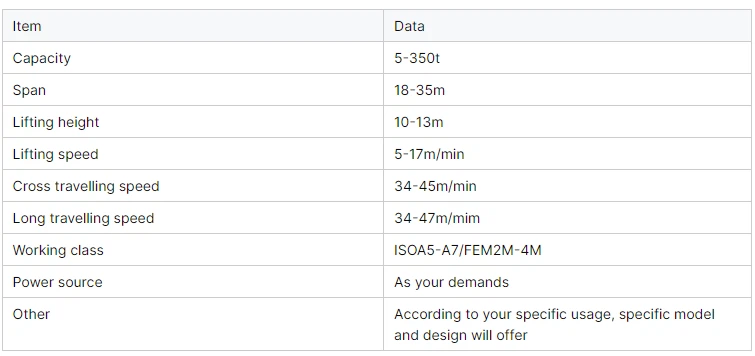
cantilever length:0-15m
Trolley running speed:20-40M/MIN
Working system:A5-A7
Lifting speed:5-15M/MIN
Crane running speed:30-50M/MIN
Control method:cabin control/wire rope remote control
Color:Request
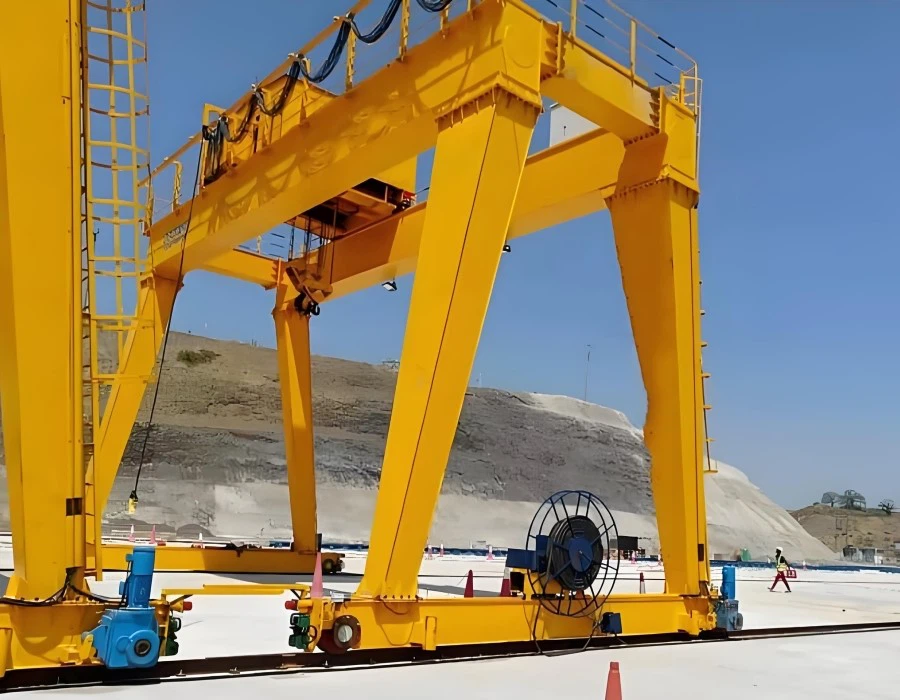
Pictures & Components
1.Double Main Girders
Function: The primary horizontal load-bearing structures.
Design: Welded box or truss structure using high-strength steel.
Advantage: High rigidity, allowing for large spans and heavy lifting.
Legs (Support Structure)
Function: Support the main girders and connect them to the end carriages.
Types: A-frame or L-type (for better clearance and loading efficiency).
Design: Designed to withstand vertical and horizontal forces.

Crane Trolley (Lifting Trolley)
Function: Houses the hoisting mechanism and travels along the girders.
European Style: Compact, lightweight, and equipped with a low-headroom electric wire rope hoist.
Features: High lifting accuracy, dual-speed or variable frequency control.
Hoisting Mechanism
Function: Lifts and lowers the load.
Components: Motor, drum, wire rope, hook block.
Design: European brands often use energy-efficient motors with precise speed control.
 |
 |
3.End Carriages (Crane End Beams)
Function: Support the girders and house the wheels that run along the ground rails.
Components: Travel motors, wheels, buffers, anti-derailment devices.
Feature: Equipped with gear motors and frequency inverters for smooth travel.
 |
 |
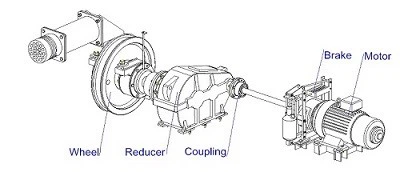
4.Drive System
Includes: Motors, gearboxes, brakes, and wheels.
Type: Often uses three-in-one drive systems (motor + brake + gearbox).
Control: Variable frequency drives (VFDs) for soft start/stop and speed regulation.
5.Trolley travelling mechanism
1) Structural composition
1. Trolley Frame
Main Body: The main structural framework that supports all other components. It is usually made of steel or other heavy-duty metals to bear the load.
Brackets and Cross Members: Reinforce the structure and provide additional stability.
2. Travel Wheels and Axles
Travel Wheels: Mounted on the trolley frame, these wheels move along the rail system of the crane bridge.
Axles: Connect the travel wheels and allow them to rotate smoothly while supporting the load.
3. Drive Mechanism
Electric Motor: The primary power source that drives the wheels.
Gearbox and Transmission: Transfers power from the motor to the wheels, enabling movement. Some systems may use a direct drive, while others utilize a chain, belt, or gear train.
Brake System: Ensures safe stopping and holding of the trolley when stationary. It can be mechanical, electromagnetic, or hydraulic.
4. Track and Rail System
Rails on the Bridge: The surface on which the trolley wheels travel. These are often mounted on the top or bottom of the crane bridge.
Rail Supports: Secure the rails and maintain alignment over the entire length of the crane.
5. Electrical and Control Systems
Wiring and Cable System: Supplies power from the crane's power source to the motor, brake, and control units.
Control Panel: Interface for the operator to control the movement of the trolley.
Limit Switches and Sensors: Used to monitor the position and travel limits of the trolley to prevent over-travel and collisions.
6. Load Handling Mechanism
Hoist or Lifting Device: Typically mounted on the trolley to handle the load.
Hoist Frame and Hooks: The part that interfaces directly with the load.
Wire Rope or Chain: Used for lifting and lowering the load.
7. Structural Reinforcements and Supports
Side Plates and Stiffeners: Added to strengthen the trolley frame and minimize deflection or twisting.
Support Brackets: Reinforce attachment points for components like the motor and gearbox.
2) Function of the trolley operating mechanism
1. Horizontal Movement
The trolley moves along the crane's beam, enabling it to transport the hoist and payload to different locations within the crane's working span.
This allows the crane to cover a wide area in a workshop, warehouse, or manufacturing facility.
2. Load Transportation
The trolley carries the hoist and lifting equipment, which are essential for lifting and lowering loads.
It moves the hoist in a way that ensures the load can be positioned accurately over the desired area for lifting, lowering, or placing.
3. Flexibility and Efficiency
By enabling the trolley to travel along the crane's span, the mechanism improves the overall efficiency of lifting operations. This allows workers to transport goods quickly and safely across the width of the work area.
The system typically incorporates a motor-driven mechanism for smooth and controlled movement.
4. Drive System and Components
The trolley travelling mechanism usually consists of a drive unit, which can be electric or sometimes manual, depending on the crane design.
Wheels or rollers mounted on the trolley allow it to move along the rail or beam with minimal friction.
Motors and gears are commonly used to drive the trolley, providing controlled acceleration and deceleration to avoid sudden movements that could potentially damage equipment or pose safety risks.
5. Safety and Control
Advanced trolley travelling mechanisms include safety features like limit switches, which stop the trolley at the end of its travel path to prevent it from running off the track.
Modern systems may also have sensors or automated control mechanisms that enhance safety by detecting obstructions and automatically stopping or slowing down the movement.
6. Coordination with Other Crane Movements
The trolley's movement is coordinated with the hoisting mechanism and crane girder movement (if applicable) for efficient, three-dimensional operation (i.e., up/down, forward/backward, and side-to-side movements).
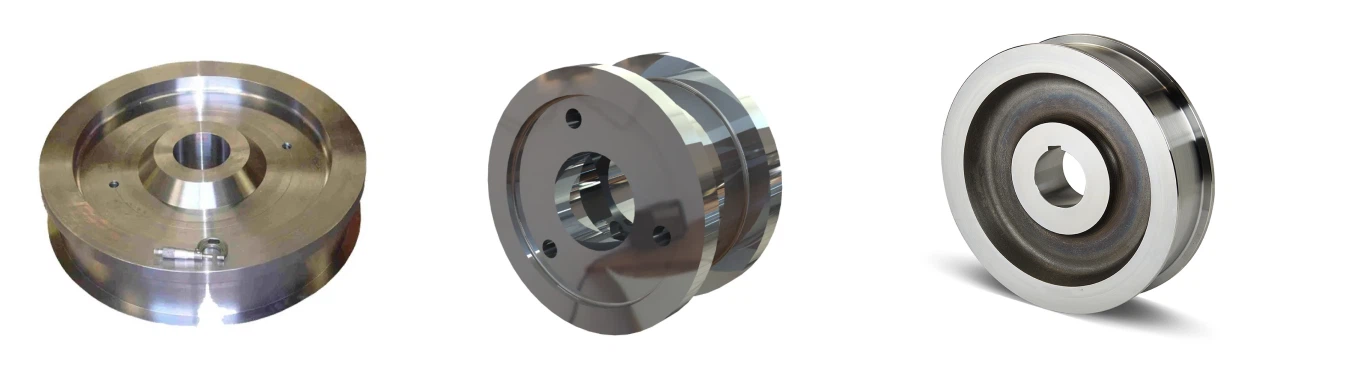
6.Crane wheel
1) Function of wheels
The crane wheels are designed to support the load of the gantry crane structure and facilitate its smooth movement across the rails. They play a crucial role in ensuring that the crane operates with stability and precision.
2) Design requirements
The wheels usually have a flange on the side to keep them on the rail, preventing derailment. Some wheels are designed with a tapered profile to accommodate wear and maintain stability over time.These wheels are typically made from high-strength materials such as forged steel or cast steel to handle the heavy loads and stresses encountered during operation. The surface may be hardened or treated to improve wear resistance and durability.
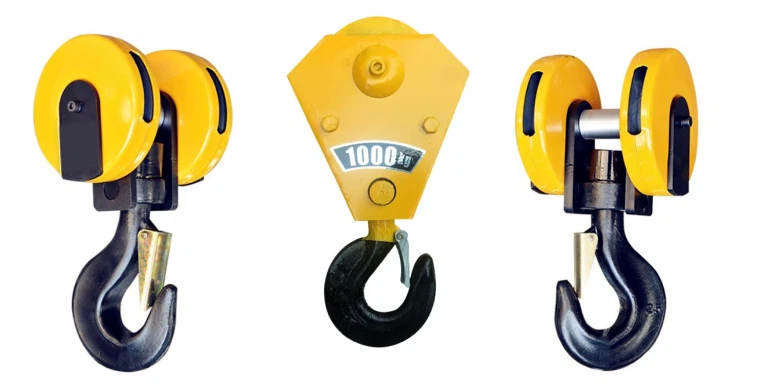
7.Crane Hook
1)A crane hook used in an indoor gantry crane is an essential component designed for lifting and carrying loads.The crane hook is attached to the hoist mechanism of the gantry crane, allowing it to lift and move heavy items.It typically features a sturdy, high-strength steel construction capable of supporting the maximum load capacity of the crane.Most crane hooks are designed with a safety latch or mechanism to secure the load during lifting and prevent accidental dislodging.
2) Specifications:
Load Capacity: Varies according to the crane's design, from several hundred kilograms to tens of tons.
Material: Typically forged or cast steel with high tensile strength to resist bending and breaking.
Safety Features: Latches or safety hooks are incorporated to prevent accidental release, and may include features like locking pins or manual/automatic mechanisms..
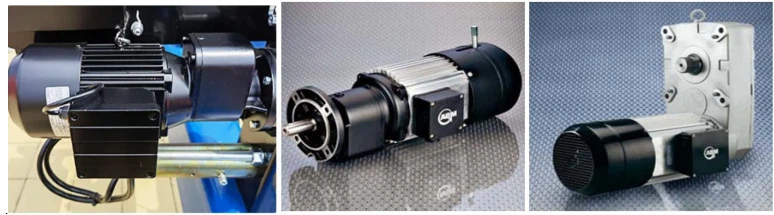
Motor
1) The motor of an indoor gantry crane is a crucial component for its operation. It provides the necessary power to move the crane's hoist, trolley, and bridge along their respective tracks. The choice of motor depends on several factors, including the crane's load capacity, speed requirements, and application specifics..
2) The motor should be powerful enough to handle the crane's maximum load and provide adequate torque for lifting and horizontal movement.Common power ratings range from a few kilowatts (kW) to several hundred kW, depending on the crane's size and capacity.Motors typically come with built-in braking systems to ensure safety during lifting and to prevent the load from dropping when power is cut.Electromagnetic brakes or mechanical brakes are often used to secure the motor when it stops.
3) Motors can be fitted with variable frequency drives (VFDs) to enable adjustable speed control. This is useful for fine-tuning lifting operations and ensuring smooth starts and stops.For precise movements, some gantry cranes use dual-speed motors, allowing for both low and high-speed operation.The motor should be designed for durability, with sealed bearings and minimal maintenance requirements to reduce operational downtime.
Regular inspection and maintenance are essential to prolong the life of the motor and avoid costly failures.
.
Sound and light alarm system & limit switch
1) Sound and light alarm system
A sound and light alarm system for an indoor gantry crane is designed to enhance safety by providing visual and audible warnings to operators and personnel in the vicinity. This system helps prevent accidents by alerting people when the crane is in use or approaching critical points of operation.
Sound Alarm (Horn or Siren):Types: Electric horns, sirens, or buzzers.Purpose: To provide an audible warning when the crane is operating, moving, or approaching a hazardous area.
Volume: Must be loud enough to be heard over ambient noise in the workspace, but not so loud as to cause hearing damage or discomfort.
2) Limit switch
A limit switch on an indoor gantry crane is a safety device that is used to control and restrict the movement of the crane's hoist, trolley, or bridge. It ensures that the crane operates within designated safe boundaries and prevents over-travel that could damage the equipment, cause operational malfunctions, or pose safety risks to personnel and other equipment in the area.
Key Functions of a Limit Switch on an Indoor Gantry Crane:
Over-Travel Protection: Stops the crane's movement when it reaches its maximum allowable travel limits, preventing the crane from moving past its design boundaries.
Position Feedback: Provides feedback to the control system to indicate the current position of the crane's components, such as the hoist or trolley.
Emergency Cutoff: Acts as an emergency stop to shut down the movement if any malfunction occurs, helping prevent accidents and damage.

10.Safety Devices
1) 1. Overload Protection
Overload Limiters: These devices prevent the crane from lifting weights that exceed its rated capacity, ensuring that the crane operates within safe limits.
Load Cells: Installed to monitor and measure the weight of the load being lifted and trigger alarms or shutdowns when an overload is detected.
2. Emergency Stop Button
Emergency Stop Switch: Provides a quick way to halt the crane's movement in case of an emergency, preventing potential accidents and damage.
3. Anti-Collision Systems
Bumper Sensors: These sensors detect nearby objects or structures and activate a braking mechanism to avoid collisions.
Proximity Sensors: Help detect if the crane is approaching a dangerous area and prevent movement when it's unsafe.
4. Limit Switches
End-of-Travel Limit Switches: Automatically stop the crane when it reaches the end of its track to prevent damage to the crane or surrounding structures.
Height Limit Switches: Ensure the hook or hoist does not move beyond a predetermined height, protecting against lifting items too high.
5. Signal and Warning Systems
Warning Lights: Alert nearby personnel when the crane is in operation.
Audible Alarms: Produce sounds to indicate when the crane is moving or approaching an area that requires caution.
Horn and Bell Systems: Used for signaling operators and nearby workers of the crane's movements.
6. Remote Control and Safety Locks
Wireless Remote Controls: Allow operators to control the crane from a safe distance.
Safety Lock Mechanisms: Ensure the crane cannot be operated unintentionally or by unauthorized personnel.
7. Anti-Sway Devices
Sway Prevention Systems: Minimize load swinging by using dampers or control algorithms that stabilize the load during movement.
8. Brake Systems
Emergency Brakes: Automatically activate in the event of a power failure or when a sudden stop is needed.
Manual Brakes: Used for additional control when stopping or securing the crane during non-operation periods.
11.Control Mode
1)1. Manual Control Mode
Description: Operated by a crane operator using a handheld pendant or joystick.
Features: The operator has direct control over the crane's movement, including the hoist, trolley, and gantry movement.
Use Case: Suitable for tasks that require detailed handling and adjustments, such as lifting or moving delicate items.
2. Remote Control Mode
Description: Allows the operator to control the crane using a wireless remote control.
Features: Enhances mobility for the operator, enabling them to manage the crane from a distance.
Use Case: Useful for improving safety and efficiency in environments where the operator needs to move around the crane's area.
3. Automatic Control Mode
Description: The crane operates autonomously based on pre-programmed settings or commands.
Features: Includes the use of sensors, cameras, and software that guide the crane through its tasks with minimal human input.
Use Case: Ideal for high-precision operations or repetitive tasks where the same movements are required consistently.
4. Semi-Automatic Control Mode
Description: Combines manual operation with automated functions.
Features: The operator can initiate or guide the crane but relies on automated systems for certain movements, like positioning or speed adjustments.
Use Case: Used when operators need assistance with repetitive tasks but still require oversight.
5. Joystick or Panel Control Mode
Description: Operated using a control panel or joystick that manages all crane functions.
Features: Offers more precise control over the crane's operations, often used in applications requiring complex or multi-directional movements.
Use Case: Common for cranes in areas where manual operation is preferred but requires more fine-tuned control.

12.Sketch

Main technical
Advantages
Here are the main advantages of a European-style double girder gantry crane, which make it stand out from traditional gantry cranes:
✅ Advantages of European-Style Double Girder Gantry Crane:
1. Compact & Lightweight Design
Optimized structure reduces dead weight.
Smaller dimensions allow more working space and lower building height.
Easier installation and lower transport cost.
2. High Efficiency & Performance
Uses advanced motors and gearboxes (often with variable frequency drives).
Smooth start/stop, stable operation, and precise load handling.
Higher lifting speeds and better productivity.
3. Low Maintenance & Long Service Life
Modular components designed for durability and easy replacement.
Fewer mechanical wear parts.
Lubricated-for-life gearboxes and maintenance-free components in some models.
4. Energy Saving
Efficient motors (e.g., IE2 or IE3 class) reduce power consumption.
Frequency converters reduce energy during acceleration and deceleration.
Lightweight design means less energy is needed for crane movement.
5. Advanced Control Systems
Programmable logic controllers (PLC) for smart operation.
Optional features: anti-sway system, automatic positioning, and fault diagnostics.
Remote control capability improves operator safety and flexibility.
6. Enhanced Safety Features
Load sensors, limit switches, anti-collision systems, and emergency brakes.
Wind-proof and storm anchoring for outdoor operation.
Anti-derailment devices and travel protection.
7. Customizable & Modular
Can be tailored to specific working environments (indoor, outdoor, hazardous areas).
Easily upgraded with optional features like cameras, air-conditioned cabins, or IoT monitoring systems.
Modular components make repair and part replacement fast and cost-effective.
8. Compliance with International Standards
Designed according to FEM, DIN, and ISO standards.
Globally recognized performance, quality, and safety levels.
📈 In Summary:
A European-style double girder gantry crane offers greater precision, efficiency, reliability, and safety-ideal for modern material handling needs in demanding industries like shipbuilding, steel, logistics, and manufacturing.
Application
1. Manufacturing and Assembly:
Production Facilities: Indoor gantry cranes facilitate the movement of heavy parts and components during production and assembly processes.
Assembly Lines: They can transport components between different sections of an assembly line efficiently, improving productivity.
2. Warehousing and Storage:
Stock Management: Used to move and organize heavy or bulky items within a warehouse, maximizing space and optimizing workflow.
Loading and Unloading: Gantry cranes assist in loading and unloading materials from trucks or storage areas.
3. Maintenance and Repair:
Heavy Equipment Servicing: In maintenance shops or service centers, they are used to lift and maneuver heavy machinery or parts for repairs.
Parts Handling: They assist in moving large parts, such as engines or mechanical assemblies, to and from maintenance areas.
4. Construction:
Building Projects: Ideal for indoor construction sites where lifting heavy building materials, equipment, or prefabricated sections is needed.
Storage of Materials: Help organize building materials and tools within a confined space.
5. Shipping and Packaging:
Production Line Support: In packaging facilities, indoor gantry cranes are used for moving heavy packages or containers to shipping areas.
Custom Handling: They can be configured to handle specific packages or products with specialized attachments.
6. Industrial Plants and Factories:
Heavy Industry: Common in plants dealing with steel, metals, machinery, or any heavy industrial products.
Quality Control and Inspection: Used to move large items to different areas for inspection or testing.
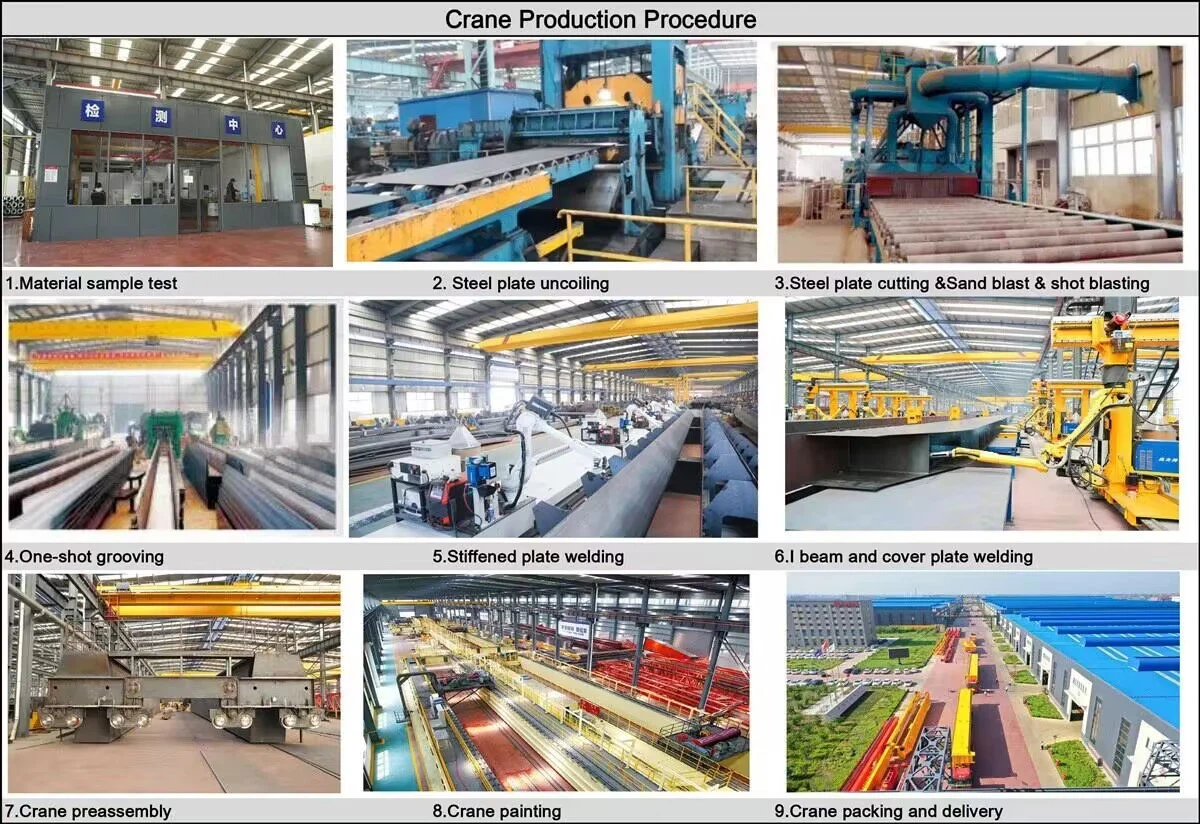
Crane production procedure
1.1. Design and Planning
Initial Design: Engineers create a design based on specifications, such as load capacity, span, lifting height, and usage environment.
Structural Analysis: Software tools and manual calculations are used to ensure the crane can handle the anticipated load and operating conditions.
Bill of Materials (BOM): A comprehensive list of all required materials is prepared to facilitate procurement and planning.
2. Material Preparation
Selection: Quality steel, typically low-carbon or alloy steel, is selected for the main structural components.
Cutting and Shaping: Materials are cut and shaped according to design specifications using CNC machines, laser cutters, or other precision tools.
3. Welding and Assembly
Frame Assembly: The main frame is welded together. This includes the gantry structure, cross beams, and end beams.
Reinforcements: Additional supports or stiffeners are welded as required to ensure stability.
Inspection: Welds are inspected visually and using non-destructive methods like ultrasonic or X-ray tests to check for defects.
4. Machining and Precision Work
Drilling and Tapping: Holes for bolts and other fasteners are drilled and tapped.
Grinding and Finishing: Any rough edges are smoothed to ensure safety and proper fit.
Precision Fitting: Components such as wheels, axles, and hoist mechanisms are assembled and tested for proper alignment and fit.
5. Installation of Electrical and Control Systems
Wiring: Electrical wiring is installed to power the hoist, motors, and control panels.
Control Systems: The crane's control system, including pendant controllers, remote controls, and safety interlocks, is mounted and integrated.
Testing: The electrical system is tested to ensure there are no faults and all components function correctly.
6. Lifting Mechanism and Hoist Installation
Hoist Assembly: The hoist is mounted onto the crane's main structure.
Drive System: The drive system, which includes motors and gearboxes, is installed and aligned.
Test Runs: Initial test runs are conducted to check the hoist's operation and ensure smooth movement without any anomalies.
7. Surface Treatment
Cleaning: The entire crane is cleaned of any debris or residue.
Painting/Coating: The crane is painted or coated with a protective layer to prevent rust and corrosion. This can include primers and top coats.
Curing: The coating is cured using heat if required, to enhance durability.
8. Final Assembly and Integration
Component Assembly: Final components like bumpers, limit switches, and safety features are attached.
System Integration: All parts, including the electrical and mechanical systems, are connected and double-checked for compatibility.
Calibration: The crane's control systems are calibrated for load balance and precision.
9. Testing and Quality Assurance
Static Load Testing: The crane is tested under a static load, which is usually its maximum rated capacity, to ensure it can handle the weight without issues.
Dynamic Load Testing: The crane is operated under dynamic conditions, lifting and moving loads to ensure smooth performance.
Safety Checks: Safety features, such as emergency stops and limit switches, are verified.
Final Inspection: The entire system undergoes a thorough inspection, including mechanical, electrical, and safety checks.
10. Documentation and Handover
Certification: The crane is certified to meet local and international safety standards.
Manuals and Documentation: User manuals, maintenance guides, and certificates of compliance are prepared.
Handover: The crane is formally handed over to the customer, including training on its use and maintenance.
11. Shipping and Installation
Disassembly (if needed): Parts are disassembled for transportation if the crane is too large.
Packing: Components are securely packed to prevent damage during transport.
On-Site Installation: The crane is assembled and installed at the client's location, with final checks performed to ensure it is ready for use.
This procedure ensures that indoor gantry cranes are manufactured to be safe, reliable, and meet the required performance specifications for industrial applications.
Workshop view:
The company has installed an intelligent equipment management platform, and has installed 310 sets (sets) of handling and welding robots. After the completion of the plan, there will be more than 500 sets (sets), and the equipment networking rate will reach 95%. 32 welding lines have been put into use, 50 are planned to be installed, and the automation rate of the entire product line has reached 85%.




Hot Tags: european style double girder gantry crane, China european style double girder gantry crane manufacturers, suppliers, factory, Single Girder Overhead Travelling Crane, Magnetic Overhead Crane, Electromagnetic Overhead Crane, Eot Crane, Forged Part, Ladle Foundry and Casting Steel Mill Overhead Crane
Previous
100 Tons Mg Gantry CraneYou Might Also Like


Send Inquiry