










Rail Container Gantry Crane
Products Description
Key Features of Rail-Mounted Gantry Cranes
1. Rail-Based Movement System
Runs on parallel steel rails embedded in the yard, allowing precise movement along container stacks.
Can span 6–12 container rows and stack 4–6 tiers high.
2. High Load Capacity & Efficiency
Lifts 30–50 tons (single-container handling) or up to 100+ tons (twin-lift models).
Faster cycle times compared to RTGs due to smoother rail movement.
3. Automation & Smart Technology
Automated stacking cranes (ASCs) use AI, GPS, and RFID for unmanned operations.
Remote-controlled via operator cabins or ground control stations.
4. Energy Efficiency
Regenerative braking recaptures energy during lowering.
Electric-powered (no diesel emissions), reducing operational costs.
5. Safety & Reliability
Anti-collision sensors prevent accidents with other cranes.
Wind-resistant design (anemometer-controlled braking).
Comparison: RMG vs. RTG Cranes
| Feature | Rail-Mounted Gantry (RMG) | Rubber-Tired Gantry (RTG) |
|---|---|---|
| Mobility | Fixed rails (high precision) | Moves on rubber tires (flexible) |
| Automation | Highly automated | Mostly manual/semi-auto |
| Energy Use | Electric (energy-efficient) | Diesel or hybrid |
| Load Capacity | 30–100+ tons | 30–50 tons |
| Maintenance | Lower (fewer moving parts) | Higher (tire wear) |
Core Components:Bearing, Gear, Gearbox, Motor
Place of Origin:Henan, China
Warranty:1 Year
Weight (KG):2000 kg
Video outgoing-inspection:Provided
Machinery Test Report:Provided
Keywords:gantry crane
Color: Customized
Size: Customized
Design: computer optimization design
Safety: High flexible flat cable power
Application: construction industrial,workshop,warehouse
Working class: A3-A8
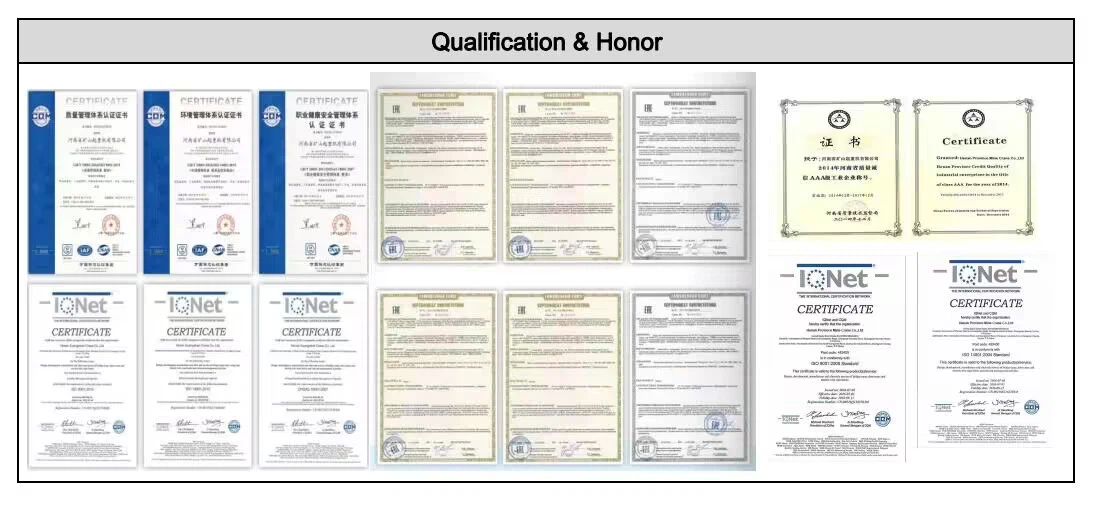
Certification: ISO,CE,BV,S GS,TUV
Power Source: 380~480V,customized

Pictures & Components
1. Structural Framework
Main Girder (Bridge)
Single or double box girder construction (typically 40-100m span)
Fabricated from high-grade steel (S355/S460) with corrosion-resistant coatings
Designed for ISO container profiles (20'/40'/45'/53' lengths)

Support Legs
Two or four vertical columns with reinforced knee braces
Height clearance: 15-25m (for stacking 4-6 high containers)
Equipped with ladder access and maintenance platforms
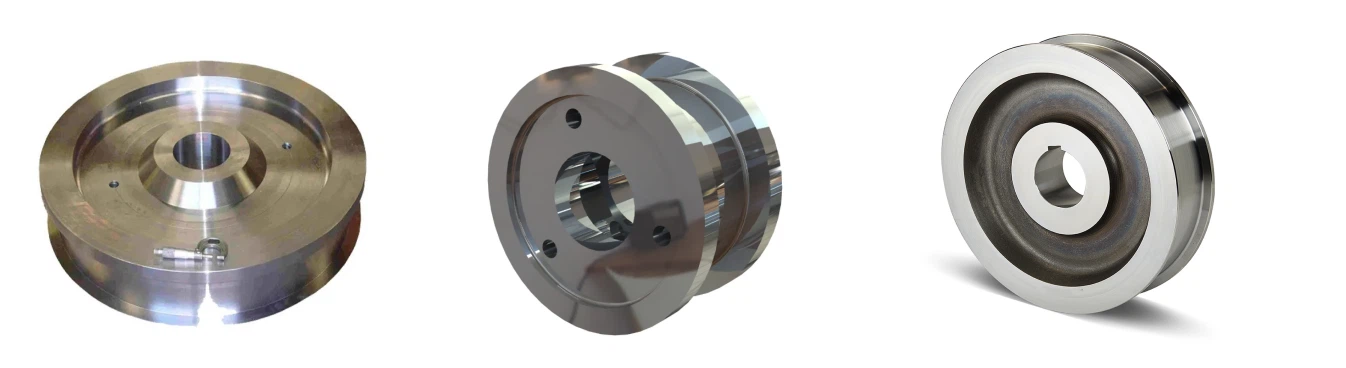
End Carriages
Heavy-duty steel frames housing drive mechanisms
8-16 wheels per crane (dual-flanged steel wheels)
Wheel load capacity: 25-50 tons per wheel
2. Motion Systems
Travel Drive System
4-8 AC frequency-controlled motors (15-45 kW each)
Planetary gear reducers (ratio ~1:100)
Rail clamps for parking (hydraulic or mechanical)
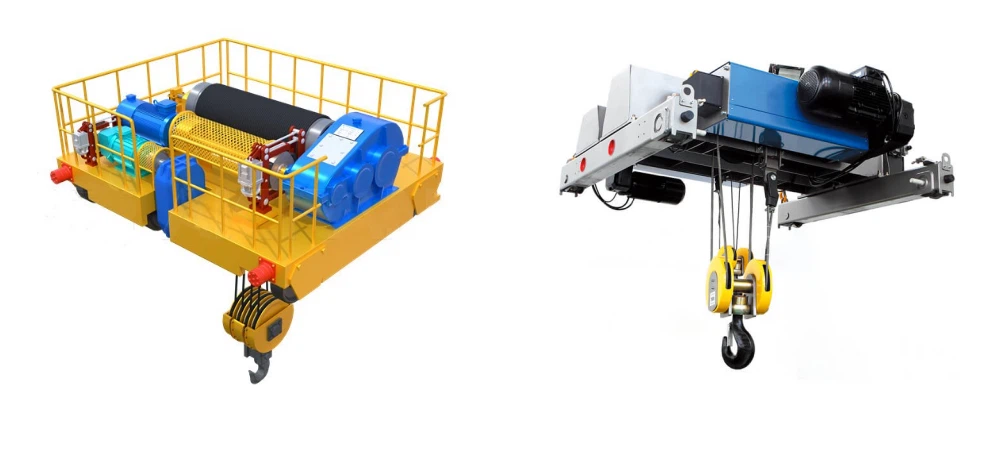
Trolley System
Low-profile design with 4-8 running wheels
Servo-controlled transverse movement (speed: 30-60 m/min)
Festoon cable management system

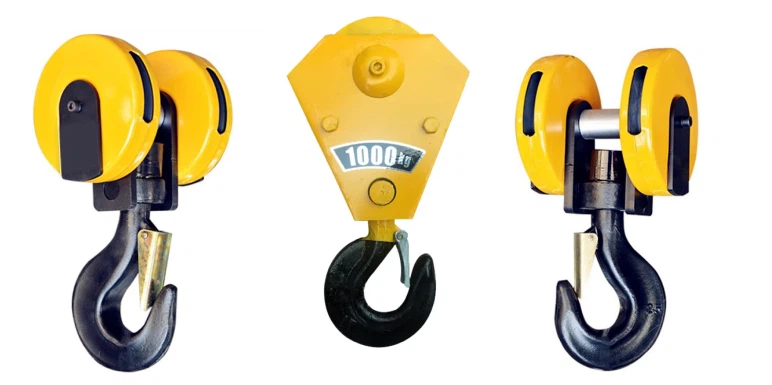
Lifting Mechanism
Wire rope hoist (4/6/8 falls) or hydraulic lift
20-60 ton capacity spreader (twistlock or vacuum type)
Anti-sway control system (Laser/IMU-based)
3. Electrical & Control Systems
Power Supply
480V-690V 3-phase AC via conductor bars or cable reels
Backup diesel generator (for critical operations)
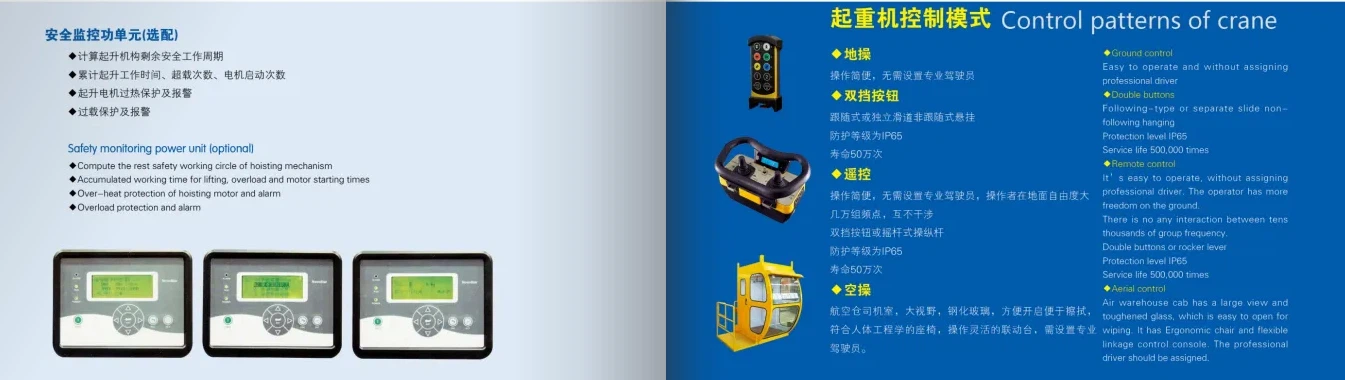
Control Components
Siemens/ABB PLC with PROFIBUS communication
HMI touchscreen in operator cabin
Remote radio control (2.4GHz frequency hopping)
Automation Features
OCR (Optical Character Recognition) for container ID
Laser scanning for position detection
Automated path planning software
4. Rail Infrastructure
Running Rails
QU100/QU120 crane rails (UIC 60/ASCE 136)
Welded joints with expansion allowances
Rail inclination: 1:20 to 1:40 gradient
Foundation System
Reinforced concrete beams (1.5-3m depth)
Rail fastening: elastic clip systems (Pandrol type)
Conductivity bonding for earthing

5. Safety Systems
Load Monitoring
Strain gauge load cells (±0.5% accuracy)
Overload cut-off at 110% SWL
Collision Prevention
Laser scanners (10-30m range)
Radar-based anti-collision (for multiple RMGs)
Environmental Protection
Wind speed anemometer (cut-off at 20m/s)
Lightning protection system (IEC 62305)
.
6. Specialized Container Handling Attachments
Spreader Types
Fixed frame (20'/40')
Telescopic (20'-53')
Twin-lift (2x20')
Rotating (for sideways container placement)
Ancillary Tools
Container top handlers
Bulk material grabs
Coil lifting beams

Technical Specifications Comparison
| Parameter | Small RMG | Medium RMG | Large RMG |
|---|---|---|---|
| Span | 30m | 50m | 80m+ |
| Lifting Capacity | 30t | 50t | 100t (twin-lift) |
| Stack Height | 3-over-1 | 5-over-2 | 6-over-3 |
| Power Consumption | 80kW | 150kW |
300kW |
SKETCH
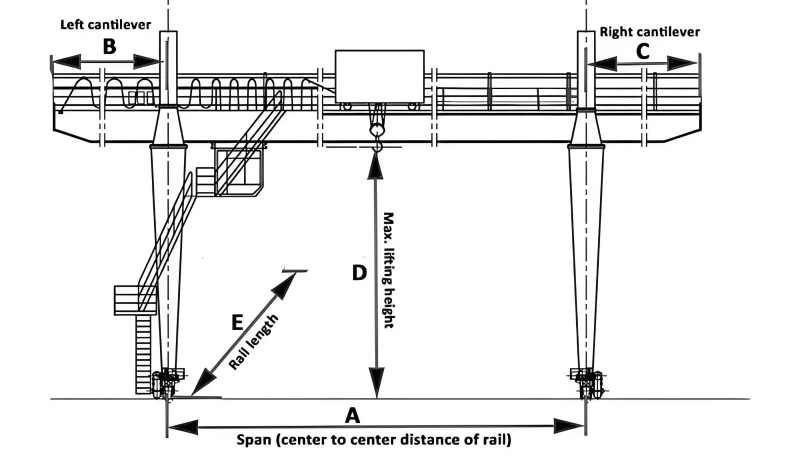
Main technical
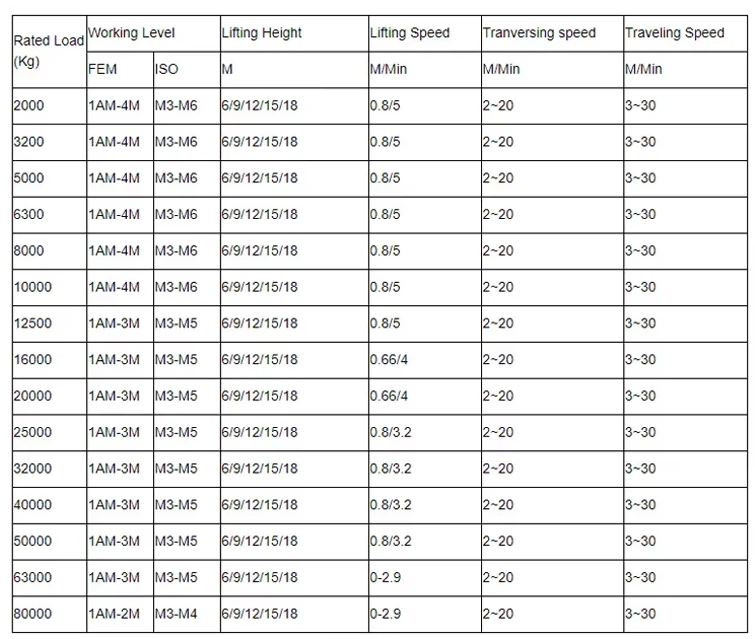
Advantages
Key Advantages of RMG Cranes
Superior Operational Efficiency
Achieve 25-35 moves/hour (vs. 15-20 for RTGs)
Precision rail guidance enables ±5mm positioning accuracy
Dual-cycle operations (simultaneous pickup/placement)
Enhanced Automation Capabilities
Fully automated models reduce labor costs by 60%
Integrated OCR (Optical Character Recognition) systems
Auto-stacking algorithms optimize yard space utilization
Energy & Cost Savings
Regenerative power systems recover 15-20% of energy
Electric operation cuts fuel costs by $150,000+/year vs. diesel RTGs
Longer lifespan (25+ years vs. 15 for RTGs)
High-Density Storage
Stack heights up to 6 containers (18m)
Narrow rail gauge allows tighter spacing (5.5m between rows)
Overhead clearance eliminates ground obstacles
Improved Safety
Autonomous collision avoidance (LiDAR+radar)
Container sway control (<0.5° deviation)
Storm-proof designs withstand 200km/h winds
Application
Primary Applications
Container Terminals
High-volume ports (5,000+ TEUs/day)
Intermodal transfer hubs (ship-to-rail operations)
Example: Shanghai Yangshan Port's automated RMG system handles 16 million TEUs/year
Inland Ports & Dry Ports
Rail-to-truck transloading facilities
Cross-docking operations
Specialized for 53' domestic containers
Automated Storage Yards
Lights-out operations with remote monitoring
Block stacking configurations
Integrated with AGV systems
Specialized Cargo Handling
Heavy-lift projects (up to 100t)
Refrigerated container management
Dangerous goods storage zones
Crane production procedure
1. Design and Engineering
Requirement Analysis
Understand the client's specifications (load capacity, span, height, working environment, etc.).
Determine operational parameters: lifting height, travel speed, working frequency, etc.
Preliminary Design
Create conceptual designs and 3D models.
Choose materials based on strength and environmental conditions.
Detailed Engineering
Develop detailed engineering drawings (structural components, mechanisms, electrical systems).
Perform stress and fatigue analysis to ensure safety.
2. Material Procurement
Source high-quality materials, including:
Steel plates and profiles for structural components.
Motors, gearboxes, and other mechanical parts.
Electrical systems and control components.
Inspect materials to ensure compliance with quality standards.
3. Fabrication
Structural Component Fabrication
Cut, weld, and assemble the steel structures (main girder, cantilever arms, legs, etc.).
Ensure precise alignment and dimensions.
Perform surface treatment (e.g., shot blasting, painting) for corrosion protection.
Mechanical Assembly
Assemble mechanical parts (trolley, hoist, wheels, etc.).
Install motors, gearboxes, and drive systems.
Electrical Assembly
Install electrical components (control panels, cables, sensors).
Wire and connect the system to ensure functionality.
4. Quality Inspection
Material Inspection
Verify material certification and conduct tests (e.g., tensile tests).
Structural Inspection
Inspect weld quality (e.g., ultrasonic testing).
Ensure dimensional accuracy and surface finishing.
Assembly Inspection
Check alignment and functionality of all parts (mechanical and electrical).
Load Testing
Conduct static and dynamic load tests to ensure safe operation.
5. Factory Acceptance Testing (FAT)
Conduct a comprehensive trial run, including:
Full load and overload tests.
Functionality of all safety devices (e.g., limit switches, emergency brakes).
Smooth operation of trolley, hoist, and crane travel.
Document results and obtain client approval.
6. Disassembly and Packing
Disassemble the crane into transportable sections.
Pack components securely to prevent damage during transportation.
Label and prepare a packing list for efficient reassembly.
7. Transportation
Deliver the crane components to the installation site using appropriate transportation methods.
8. Installation and Commissioning
On-Site Assembly
Assemble structural components and mechanical systems.
Install electrical systems and control panels.
Calibration and Testing
Recalibrate the crane system for site-specific conditions.
Perform on-site load testing to verify performance.
9. Handover
Provide training to the client's personnel on safe operation and maintenance.
Deliver technical documentation (user manual, maintenance guide, certificates).
Obtain final approval and acceptance from the client.
10. After-Sales Support
Offer warranty services and maintenance support.
Provide spare parts and technical assistance as needed.

Workshop view:
The company has installed an intelligent equipment management platform, and has installed 310 sets (sets) of handling and welding robots. After the completion of the plan, there will be more than 500 sets (sets), and the equipment networking rate will reach 95%. 32 welding lines have been put into use, 50 are planned to be installed, and the automation rate of the entire product line has reached 85%.



Hot Tags: rail container gantry crane, China rail container gantry crane manufacturers, suppliers, factory
You Might Also Like


Send Inquiry