








Quay Double Girders Gantry Crane
Product Introduction
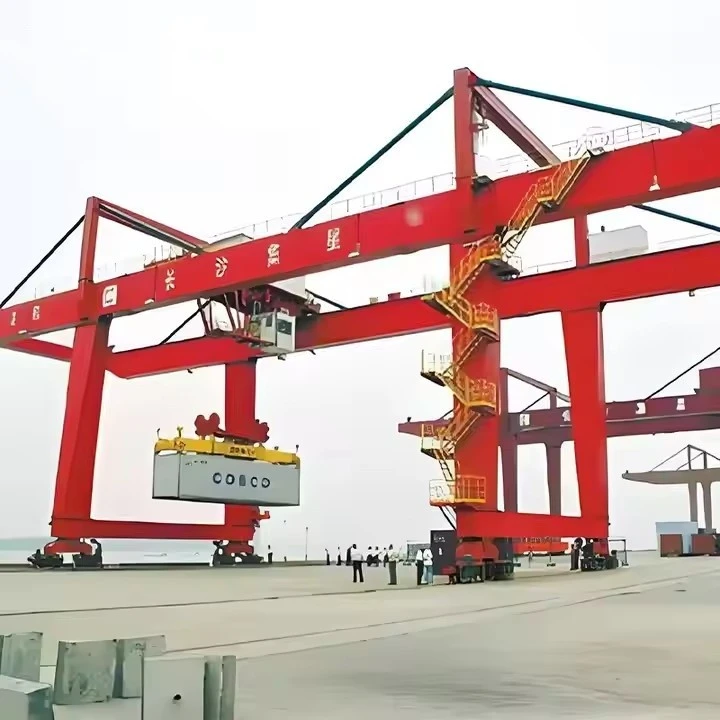
A Quay Double Girder Gantry Crane is a heavy-duty lifting machine designed for port terminals, shipyards, and industrial docks, where high-capacity and long-span lifting operations are required. These cranes are built with two parallel girders (instead of a single girder) for enhanced strength, stability, and load capacity, making them ideal for handling containers, bulk cargo, and heavy machinery.
✅ Container Terminals – Stacking and moving shipping containers.
✅ Shipbuilding & Repair – Handling heavy ship components.
✅ Bulk Material Handling – Loading/unloading coal, ore, and grain.
✅ Heavy Industry – Lifting large machinery in factories.
Comparison with Alternatives
| Feature | Double Girder Gantry Crane | Single Girder Gantry Crane | Overhead Bridge Crane |
|---|---|---|---|
| Max Capacity | 800+ tons | 20 tons | 500 tons |
| Span Range | 10–100m+ | 5–30m | 5–40m |
| Lifting Height | Up to 50m+ | <20m | <30m |
| Portability | Rail/Rubber-tired options | Fixed or light mobile | Fixed (workshop use) |
| Best For | Ports, heavy industry | Small warehouses | Factories, assembly lines |
Rated Loading Capacity:5 ton, 10 TON, 100 ton, customized, 16/3.2 ton, 20/5 ton, 32/5 ton, 50/10 ton
Max. Lifting Height:40m, customized
Span:35m or clients' demands
Warranty:1 Year
Weight (KG):20000 kg
Core Components:PLC, Engine, Bearing, Gearbox, Motor, Pressure vessel, Gear, Pump
Control way:Cab, wireless remote control or customized

Pictures & Components
A Quay Double Girder Gantry Crane consists of several key structural and mechanical components that work together to ensure safe and efficient heavy-load handling in ports, shipyards, and industrial terminals. Below is a detailed breakdown of its major components:
1. Main Structural Components
A. Girders (Bridge Beams)
Double girders (top or box-type construction) provide superior strength and rigidity.
Made of high-strength welded steel to withstand heavy loads (up to 800+ tons).
Designed with corrosion-resistant coatings for marine environments.
.
B. Legs & End Carriages
Fixed or adjustable legs support the girders and distribute the load.
End carriages house wheels or rails for movement (rail-mounted or rubber-tired).
C. Crane Runway & Rails
Heavy-duty rails guide the crane's movement (for rail-mounted models).
Rubber tires (for RTG cranes) allow mobility in container yards.

2. Lifting & Motion Components
A. Hoist & Trolley System
Electric wire rope hoist or chain hoist for vertical lifting.
Trolley moves horizontally along the girders for load positioning.
May include twin hoists for tandem lifting.
B. Spreader (For Container Handling)
Twistlock spreader (20ft/40ft/45ft) for secure container gripping.
Automatic spreaders (with RFID/optical sensors) in modern cranes.
C. Crab Unit (Drive Mechanism)
Contains motors, gearboxes, and brakes for trolley movement.


3. Drive & Power Systems
A. Travel Drives
Motors & gearboxes for longitudinal movement (along rails).
Frequency-controlled drives for smooth acceleration/deceleration.
B. Power Supply
Festoon systems (cable reels) or conductor bars for electricity.
Diesel generators (for rubber-tired gantry cranes).
 |
 |
 |
4. Control & Safety Systems
A. Operator Cabin or Remote Control
Enclosed cabin with ergonomic controls (joysticks, touchscreens).
Radio remote control for flexible operation.
B. Safety Devices
Overload limiters (prevents exceeding rated capacity).
Anti-collision systems (laser/ultrasonic sensors).
Emergency stop buttons and wind alarms.
C. Automation Features (Optional)
PLC-based control for programmed movements.
Auto-landing & anti-sway systems for precision.
 |
 |
 |
5. Auxiliary Components
Anemometer (wind speed monitor).
Lighting & warning alarms (for night operations).
Ladders & maintenance platforms for servicing.

.
Comparison of Key Components in Different Models
| Component | Standard Duty (e.g., 10–50t) | Heavy Duty (e.g., 100–800t) |
|---|---|---|
| Girders | Box girders (welded steel) | Reinforced box girders (thicker steel) |
| Hoist Type | Single electric hoist | Twin hoists (redundancy/safety) |
| Drive System | AC frequency control | Hydraulic-assisted drives |
| Control | Manual/Pendant control | Fully automated (PLC + remote) |


SKETCH
Main technical

Advantages
Higher Load Capacity & Stability
Double girders provide greater structural strength than single girders, enabling load capacities from 3 to 800+ tons.
Ideal for heavy container stacks, ship parts, and bulk cargo.
Longer Span & Greater Coverage
Spans typically 10–60m (some models exceed 100m), allowing wide-area operations in ports and shipyards.
Reduces the need for multiple cranes in large terminals.
Enhanced Durability for Harsh Environments
Corrosion-resistant coatings (epoxy, galvanization) protect against saltwater damage.
Reinforced steel construction withstands high winds (Beaufort Scale 8–10) and heavy-duty cycles.
Precision & Automation Capabilities
Anti-sway systems ensure stable load handling.
Automated trolley & spreader controls (PLC-based) improve efficiency in container terminals.
Optional remote control & AI-driven tracking for unmanned operations.
Flexibility in Mobility Options
Rail-mounted (RMG): Best for fixed container yards.
Rubber-tired (RTG): Mobile for multi-lane operations.
Semi-gantry: Adaptable to uneven terrain.
Safety & Compliance
Overload limiters, anti-collision sensors, and emergency brakes meet ISO, FEM, and OSHA standards.
Wind-resistant designs enhance operational safety in coastal areas.
Application:
1. Ports & Container Terminals
Container stacking & unloading (20ft, 40ft, 45ft boxes).
Ship-to-shore (STS) cargo transfer for faster vessel turnaround.
Intermodal freight handling (between ships, trucks, and trains).
2. Shipbuilding & Repair Yards
Lifting ship engines, hull sections, and propellers (up to 500+ tons).
Precise positioning for dry dock operations.
3. Bulk Material Handling
Loading/unloading coal, ore, grain, and cement in bulk terminals.
Equipped with grabs or magnets for loose cargo.
4. Heavy Industry & Construction
Moving prefabricated bridge segments, wind turbine blades, and industrial machinery.
Used in power plants, steel mills, and offshore platforms.
5. Logistics & Warehousing
Large-scale warehouse gantry systems for heavy palletized goods.
Military/defense logistics for handling oversized equipment.
Crane production procedure
1. Design and Engineering
Detailed Engineering: Develop detailed engineering drawings and specifications, including the main beam, hoist, trolley, end carriages, and other components.
Simulation and Modeling: Use computer-aided design (CAD) and simulation tools to model the crane's performance and optimize its design.
2. Material Selection
Material Specifications: Select high-quality materials that meet the requirements for strength, durability, and heat resistance. Common materials include high-strength steel, alloys, and specialized coatings.
Procurement: Source materials from approved suppliers, ensuring they meet the necessary quality and certification standards.
3. Component Fabrication
Cutting and Shaping: Cut and shape raw materials into the required components, such as beams, columns, and brackets. This may involve processes like plasma cutting, laser cutting, and machining.Welding and Assembly: Weld components together to form the crane's structural elements. This includes welding the main beam, end carriages, and other load-bearing parts.
4. Assembly
Sub-Assembly: Assemble individual components, such as the hoisting system, trolley, and end carriages, into sub-assemblies. This involves fitting parts together and ensuring proper alignment.Main Assembly: Combine sub-assemblies to construct the complete crane structure. This includes mounting the hoist and trolley on the main beam, attaching the end carriages, and installing the control systems.
5. Integration of Systems
Electrical Systems: Install electrical components, including motors, control panels, wiring, and sensors. Ensure that the crane's electrical systems are properly integrated and tested.
Control Systems: Implement and configure control systems, such as programmable logic controllers (PLCs), remote controls, and safety devices. Verify that the control systems function correctly and are calibrated.
6. Testing and Quality Assurance
Pre-Operational Testing: Conduct pre-operational tests to check the crane's functionality, including load testing, operational testing of the lifting and traveling mechanisms, and control system checks.
Safety Testing: Verify that safety features, such as limit switches, alarms, and emergency stops, are working correctly and meet safety standards.
Inspection: Perform a detailed inspection of the crane's structure and components to ensure compliance with design specifications and quality standards.
7. Final Adjustments and Calibration
Fine-Tuning: Make any necessary adjustments to optimize the crane's performance and ensure smooth operation. This may include calibrating sensors, adjusting controls, and fine-tuning the lifting system.
Documentation: Prepare and review documentation, including operation manuals, maintenance guides, and safety instructions.
8. Delivery and Installation
Transport: Arrange for the transport of the crane to the installation site, ensuring that it is handled and shipped safely to prevent damage.
Installation: Oversee the installation of the crane at the customer's facility, including assembly, alignment, and connection to power sources and control systems.
Training: Provide training for operators and maintenance personnel to ensure they are familiar with the crane's operation and safety procedures.
9. Commissioning and Handover
Commissioning: Conduct final commissioning tests to verify that the crane operates correctly under real-world conditions and meets performance specifications.
Handover: Officially hand over the crane to the customer, providing all necessary documentation, including certificates of compliance, warranty information, and maintenance schedules.

Workshop view
Material Inspection
Quality Inspection: Strict quality inspection is carried out on the purchased raw materials to ensure that they meet the design requirements and national standards.
Material Storage: Qualified materials are stored according to classification to prevent corrosion or damage.
Cutting and Forming
Steel Cutting: Use plasma cutting, laser cutting or flame cutting and other technologies to cut the steel according to the size of the design drawing.
Forming Processing: Form the steel plate through bending, rolling, welding and other processes to manufacture the main beam, end beam and other structural parts.
Welding
Component Welding: The cut and formed steel parts are welded into the main structures such as the main beam, end beam and trolley. The welding process needs to be strictly controlled to ensure the structural strength and welding quality.
Weld Inspection: Use non-destructive testing technology (such as ultrasonic testing, radiographic testing) to inspect the welds to ensure that there are no cracks or other defects.
Machining
Precision Machining: Precision machining is performed on the key components of the crane, such as wheel sets, bearing seats, pulleys, etc., to ensure their dimensional accuracy and surface quality.
Assembly of the whole machine
General assembly: On the basis of pre-assembly, the overall assembly of the crane is carried out, including the final installation of the main beam, end beam, lifting mechanism, walking mechanism, etc.
Commissioning and testing
Under dynamic conditions, the operating performance of the crane is tested, including the testing of lifting, walking, steering and other functions. The overall size of the assembled bridge crane is checked to ensure that all dimensions meet the design requirements.
Spraying and anti-corrosion treatment
Surface treatment Rust removal: Rust removal on the surface of the crane, common methods include sandblasting, pickling, etc. Primer spraying: Spray anti-corrosion primer on the treated surface to prevent metal oxidation and corrosion. Topcoat spraying Color spraying: Spray topcoat according to customer requirements or industry standards to give the crane a protective and decorative effect. Marking: After spraying, mark the crane's identification information in accordance with the specifications, such as model, rated load, etc.
Factory and installation
Packaging and transportation
Packaging protection: Protectively package the key components of the crane to prevent damage during transportation. Transportation arrangement: According to the equipment size and transportation conditions, select a suitable transportation method to transport the crane to the customer's site.
Acceptance and delivery
Customer acceptance
On-site acceptance: The customer conducts on-site acceptance of the crane according to the contract requirements and technical specifications to check the performance and quality of the equipment.
Problem rectification: If any problems are found, the manufacturer needs to rectify them in time to ensure that the equipment fully meets the customer's requirements. Delivery and use Operation training: The manufacturer usually trains the customer's operators to ensure that they can operate the crane correctly and safely.


Hot Tags: quay double girders gantry crane, China quay double girders gantry crane manufacturers, suppliers, factory
You Might Also Like


Send Inquiry