










150 Tons Bridge Lancher Machine
A 150-ton Bridge Launching Machine refers to a major piece of heavy equipment used to erect prefabricated bridge segments (girders, box beams, etc.) into their final position on piers and abutments.

Core Function
The primary purpose of a 150-ton bridge launcher is to lift, transport, and precisely place heavy prefabricated concrete or steel bridge components, typically weighing up to 150 tons (metric tons, ~165 US tons), during the construction of viaducts, overpasses, and highway bridges.
Key Design Parameters & Performance Specifications
| Parameter | Specification |
|---|---|
| Lifting Capacity (per girder) | 120 Metric Tons |
| Maximum Span (Pier to Pier) | 50 meters (Typical), customizable up to 60m |
| Minimum Curve Radius | 2,000 meters (can be designed for tighter radii) |
| Maximum Supported Grade | ±4% |
| Lifting Hoists | 2 x Main Hoists (typically 120-ton capacity each) |
| Hoist Lifting Speed | 0-5 m/min (variable speed control) |
| Trolley Traversing Speed | 0-10 m/min (variable speed control) |
| Main Beam Launching Speed | 0-5 m/min (variable speed control) |
| Machine Self-Propelling Speed | 0-5 m/min (variable speed control) |
| Control System | Centralized PLC with frequency control for all motions. Remote control operation. |
| Power Supply | 380V / 50Hz / 3 Phase (or as per project requirement) |

Pictures & Components
1. Main Structural Steel Structure (The "Bones & Muscles")
This is the primary load-bearing framework that directly handles the 150-ton segments.
Main Gantry/Gantry Frame: The primary overhead steel truss or box girder structure that spans the width of the bridge deck and often part of the constructed span. It provides the traveling path for the lifting trolley and supports all other components.
Front Support (Nose or Cantilever Support): Extends over the pier where the next segment will be placed. It often includes adjustable legs to align with the new pier.
Rear Support (Main Support): Anchors the gantry on the already constructed deck or previous pier. It distributes the machine's weight and reaction forces.
Lifting Beam/Spreader Beam: A robust, often adjustable beam that connects to the segment lifting points via rods or cables. It ensures the segment is lifted evenly and without undue stress.
Trolley (Traversing Cart): The moving unit that runs along rails on the main gantry. It houses the winches or hydraulic cylinders for vertical lifting and horizontal movement of the segment.
Temporary Stay / Backstay Towers (if applicable): For balanced cantilever launching or when launching over long spans, these temporary towers provide additional stability and moment resistance.
2. Hydraulic & Mechanical Drive Systems (The "Muscles & Sinews")
These systems provide the precise force and movement for all operations.
Lifting Hydraulic Jacks/Cylinders: High-capacity, synchronized hydraulic cylinders (usually at least two, often four) mounted on the trolley. They provide the vertical lifting force (150+ tons).
Segment Adjustment Jacks: Smaller, multi-directional (often 3 or 4-axis) hydraulic jacks mounted on the lifting beam or trolley. They allow for fine-tuning the segment's position in all directions (vertical, lateral, longitudinal, and rotation) before permanent connection.
Gantry Propulsion System:
Propulsion Hydraulic Jacks: Push-pull cylinders that "walk" the entire gantry structure forward to the next work position after a segment is placed.
Clamping Devices: Hydraulic clamps that grip the bridge deck or pier to provide a reaction point for the propulsion jacks.
Winch System: In some designs, electric or hydraulic winches with high-strength wire ropes are used for lifting instead of direct hydraulic cylinders.
Hydraulic Power Unit (HPU): The heart of the hydraulic system, consisting of diesel or electric motor-driven pumps, reservoirs, valves, filters, and cooling systems. It generates and regulates the high-pressure hydraulic fluid flow.
3. Control & Monitoring Systems (The "Brain & Nerves")
Ensures precision, synchronization, and safety.
Main Programmable Logic Controller (PLC): The central computer that automates and sequences all movements (lifting, trolley travel, gantry launch).
Synchronization Control System: Critical for lifting. It ensures all lifting jacks move in perfect unison to keep the segment level, preventing dangerous tilting or overstress. This is often done via laser sensors or encoders with feedback loops to the PLC.
Operator Control Cabin/Remote Control: A protected cabin on the gantry or a wireless remote control station from which the operator oversees all operations.
Monitoring & Safety Sensors:
Load Cells: Installed in the lifting system to measure and display the actual load on each jack (preventing overload).
Inclinometers: Monitor the level of the segment and the gantry itself.
Limit Switches & Position Encoders: Provide precise positioning data for all moving parts.
Anemometer: Measures wind speed; operations are halted if limits are exceeded for safety.
4. Auxiliary & Support Systems (The "Support System")
Electrical System: Generators, distribution panels, cable reels, and lighting for night work.
Safety Systems: Guardrails, access ladders, platforms, emergency stop buttons, and fall protection systems for personnel.
Epoxy Application System (for segmental bridges): A metered system to apply the epoxy resin layer between match-cast segments before joining.
Temporary Post-Tensioning Equipment: Stressing jacks and pumps for applying temporary bars or tendons to hold segments in place during the launching phase until the permanent tendons are stressed.
Surveying & Alignment Targets: Mounting points for prisms or targets used by surveyors with total stations to achieve the precise final bridge geometry.

Sketch
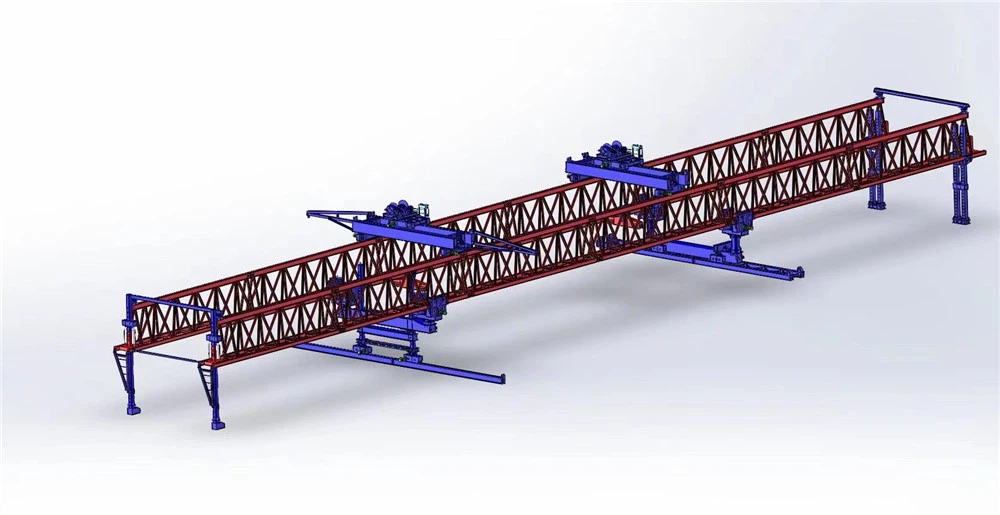

Advantages
Here are the key advantages of a 150-ton Bridge Launcher Machine:
1. Efficiency & Speed
Rapid Cycle Time: It can install one or multiple bridge segments (girders, box beams, U-beams) in a matter of hours, dramatically accelerating project timelines.
Continuous Operation: The launching, lifting, positioning, and lowering processes are semi- or fully-automated, minimizing idle time.
Parallel Workfronts: While the launcher works on superstructure erection, other crews can simultaneously work on substructure (piers, abutments) and ground-level activities.
2. Safety
Reduced High-Risk Work: Minimizes the need for workers to perform tasks at great heights or in precarious positions under suspended loads.
Controlled Environment: Most operations are performed from the secure platform of the launcher itself or via remote control.
Less Crane Dependency: Reduces the risks associated with large mobile cranes operating on unstable or congested ground.
3. Precision & Quality
Accurate Placement: Hydraulic systems with computer-controlled guidance allow for millimeter-precise placement of heavy girders.
Consistent Results: The machine performs repetitive tasks with identical parameters, ensuring uniformity in the erected structure.
Minimized Human Error: The automated processes reduce potential errors in alignment and positioning.
4. Versatility & Adaptability
Handles Various Beam Types: Can typically launch Pre-stressed Concrete (PSC) I-girders, U-beams, and steel girders up to its 150-ton capacity.
Adapts to Geometry: Modern launchers can handle curves, gradients, and complex alignments common in modern highways and railways.
Different Construction Methods: Can be used for span-by-span erection, balanced cantilever assembly (with modifications), and even for launching launching gantries for incremental launching.
5. Economic Advantages
Lower Labor Costs: Requires a smaller, specialized crew compared to traditional methods involving multiple cranes and ground teams.
Reduced Rental Fleet: Eliminates the need for a fleet of large-capacity mobile cranes and their associated transport, setup, and operating costs.
Faster Project Completion: Leads to earlier opening and return on investment, which often outweighs the machine's high initial or rental cost.
Material Optimization: Enables the use of longer, heavier prefabricated spans, which can be more economical.
6. Site Accessibility & Minimal Ground Disruption
Operates from Completed Deck: The launcher builds out ahead of itself, requiring only minimal ground access for beam delivery. This is a massive advantage in challenging terrain:
Over Valleys/Rivers: No need for massive ground-based crane pads or temporary trestles.
Over Existing Infrastructure: Can launch bridges over busy roads, railways, or sensitive ecosystems with minimal disruption below.
In Soft or Confined Sites: Avoids the need for extensive ground preparation for heavy cranes.
7. Reduced Environmental Impact
Smaller Worksite Footprint: Concentrates activity along the bridge alignment.
Less Ground Disturbance: Minimizes soil compaction, vegetation clearing, and habitat disruption beneath the bridge.
Lower Noise and Dust Pollution compared to methods requiring extensive ground-based plant and machinery.

Application
Critical Considerations for Application
Bridge Geometry: Best suited for constant depth superstructures and straight or constant radius curves. Sharp curves and variable depths are very challenging.
Alignment & Profile: Requires precise engineering to control the deflections and stresses during the launch. A launching nose is crucial.
Reaction Structure: The abutment from which launching occurs must be designed to withstand the massive horizontal thrust forces (hundreds of tons).
Temporary Supports/Piers: Piers may need to be strengthened temporarily to handle the launch forces, which differ from final service loads.
Weight & Friction Management: The 150-ton capacity must account for the total weight of the launched structure and the friction on sliding surfaces. Special launching lubricants (e.g., PTFE-stainless steel interfaces) are used.
Expert Engineering & Crew: Requires highly specialized planning, real-time monitoring, and an experienced crew.
Conclusion
The application of a 150-ton bridge launcher machine is a sophisticated engineering solution for efficiently, safely, and precisely constructing medium-span bridges in challenging environments. Its value is highest in projects where minimizing disruption below the bridge-whether to traffic, ecology, or community-is a primary concern, and where the bridge geometry allows for the incremental launching method. It turns a major civil engineering challenge into a controlled, factory-like process.

Production Procedure
Project: Production of a 150-Ton Bridge Launching Machine
1. Definition & Design Phase
Client Requirements Analysis: Confirm key parameters: max span length, beam weight (150 tons), beam type (pre-cast concrete, steel girder), curve radius, bridge gradient, working environment (wind, seismic conditions).
Conceptual & Detailed Design:
Structural Design: Finite Element Analysis (FEA) of main girders, front/rear supports (legs), lifting trolley, and connection points for stress, deflection, and stability.
Mechanical Design: Design of lifting system (winches, hoists), propulsion system (hydraulic or electric crawlers), hydraulic systems, and safety devices.
Electrical & Control System Design: Design of PLC-based control system, frequency drives for motors, sensors (position, load, inclination), and operator cabin interface.
Design Review & Approval: All designs are reviewed by internal and client/third-party engineers. Final manufacturing drawings and bill of materials (BOM) are released.
2. Procurement & Material Preparation Phase
Major Steel Procurement: Purchase of high-quality structural steel plates (Q345B or equivalent), profiles (I-beams, channels), and steel pipes for the main framework.
Key Component Procurement: Source specialized components:
Hydraulic cylinders (for lifting/steering)
High-torque hydraulic or electric motors
Gearboxes
Winches and wire ropes
PLC, sensors, electrical cabinets
Crawler tracks or wheels (if required)
Material Preparation: Steel plates are cut to size using CNC plasma/oxy-fuel cutting machines. All parts are marked with identification codes.
3. Fabrication & Machining Phase
Main Girder Fabrication: The twin box girders or truss girders are fabricated in sections.
Sub-assembly of web and flange plates.
Full welding in dedicated jigs to control distortion.
Non-Destructive Testing (NDT): Ultrasonic Testing (UT) or Radiographic Testing (RT) on critical welds.
Shot blasting and primer painting.
Support Leg Fabrication: Fabrication of front and rear legs with vertical adjustment mechanisms. Integration of hydraulic climbing/pin systems.
Lifting Trolley Fabrication: Construction of the traversing trolley frame that runs on the main girder. Integration points for winches/sheaves.
Machining of Critical Parts: Precision machining of connection pin holes, mating surfaces for bearings, and gear mounting interfaces to ensure dimensional accuracy.
4. Assembly & Integration Phase (In Factory)
Pre-Assembly (Stage-wise):
Assemble main girders on supports to check alignment and fit-up.
Assemble the support legs with their hydraulic cylinders.
Mount the crawler units or propulsion systems.
Assemble the lifting trolley and install winches, wire ropes, and sheaves.
Hydraulic System Integration: Install hydraulic power unit (HPU), valve banks, piping, and cylinders. Conduct pressure tests for leaks.
Electrical System Integration: Install electrical cabinets, wire all motors, sensors, and controls to the operator cabin. Cable management is crucial.
Painting: Apply final corrosion-resistant paint systems in specified colors.
5. Factory Acceptance Testing (FAT)
Visual & Dimensional Inspection: Verify assembly against drawings.
Functional Tests (No Load):
Propulsion system: Move entire gantry forward/backward.
Lifting trolley: Traverse along the girder.
Support leg operation: Raise/lower and simulate pinning.
All limit switches and emergency stops.
Load Testing (Critical):
Static Load Test: Lift a test weight equivalent to 110-125% of rated capacity (165-187.5 Tons). Hold for a sustained period. Measure girder deflection and check for permanent deformation.
Dynamic Load Test: Lift and move test weight (~100-130% of rated load) to simulate operational stresses.
Safety System Tests: Test overload protection, anti-collision systems, and emergency descent procedures.
Client Review: Client witnesses FAT and signs off before disassembly for shipment.
6. Dismantling, Packaging & Shipment
The machine is systematically dismantled into transportable modules (girder segments, legs, trolley, etc.).
All components are carefully packaged, with sensitive parts (hydraulic, electrical) protected from moisture and impact.
Components are marked for easy identification. A detailed packing list is created.
Transported to the client's bridge construction site via heavy-duty trucks/flatcars.
7. Erection & Commissioning on Site
Site Preparation: Foundation preparation for assembly (if required).
Erection: Using mobile cranes, the machine is re-assembled on the bridge abutment or deck according to erection drawings.
Site Commissioning & Load Test: Re-check all functions. Often, a final site load test is performed using the actual bridge beams or calibrated weights to verify performance under real conditions.
Operator Training: Comprehensive training for the client's crew on operation, daily checks, maintenance, and troubleshooting.
8. Quality & Safety Assurance (Throughout)
Standards Compliance: Design and fabrication follow relevant standards (e.g., EN 13001, FEM, GB, ASME, client specifications).
Documentation: As-built drawings, manuals, FAT reports, load test certificates, and material certifications are delivered.
Risk Management: Hazard identification and mitigation at each stage.


Workshop View
The company has installed an intelligent equipment management platform, and has installed 310 sets (sets) of handling and welding robots. After the completion of the plan, there will be more than 500 sets (sets), and the equipment networking rate will reach 95%. 32 welding lines have been put into use, 50 are planned to be installed, and the automation rate of the entire product line has reached 85%.


Hot Tags: 150 tons bridge lancher machine, China 150 tons bridge lancher machine manufacturers, suppliers, factory
You Might Also Like


Send Inquiry