



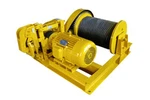




Industrial Electric Winch
An Industrial Electric Winch is a powerful lifting and pulling device designed for heavy-duty applications. Equipped with an electric motor, it provides efficient and reliable operation for moving heavy loads in construction, mining, shipyards, warehouses, and various industrial settings.
Capacity: 1-1200ton
Rope length: 6-2500m
Lifting height:customized according to clients' site conditions
Raged voltage: 220V~690V, 50-60Hz, 3ph AC
Protection class: IP54 IP55
Crane control mode: Pendantcontrol / Remote control / Cabin control

Pictures & Components
1. Whole set winch components
A whole set of industrial electric winch components typically includes the following:
1. Electric Motor
Provides power to the winch.
Can be AC or DC, depending on the application.
Comes in different power ratings based on load capacity.
2. Gearbox (Reducer)
Reduces the motor speed and increases torque.
Common types: planetary, helical, or worm gear reducers.
3. Drum
Cylindrical part where the wire rope or cable is wound.
Designed for even spooling and high durability.
4. Wire Rope or Steel Cable
Used for pulling or lifting loads.
Comes in various diameters and lengths.
5. Brake System
Ensures safety by holding the load when power is off.
Includes electromagnetic brakes, hydraulic brakes, or mechanical brakes.
6. Clutch (Optional)
Used to engage or disengage the drum from the motor.
7. Control System
Includes push-button pendant control, remote control, or PLC control.
Used to operate the winch safely.
8. Frame & Base
Heavy-duty structure to support the winch components.
9. Limit Switches & Safety Devices
Prevents over-travel of the drum and enhances safety.

2. Limit switch safety device
A limit switch is a crucial safety device in an industrial electric winch that prevents overtravel, ensuring safe and efficient operation. It automatically stops the winch when a predefined position is reached, protecting both the equipment and personnel.
Functions of a Limit Switch in an Industrial Electric Winch
Prevents Overlifting & Overlowering – Stops the winch when the load reaches the highest or lowest point.
Enhances Safety – Reduces the risk of accidents due to excessive movement.
Protects Equipment – Prevents mechanical damage by stopping operation beyond safe limits.
Improves Efficiency – Automates stopping points, reducing manual monitoring.
Types of Limit Switches Used in Winches
Rotary Limit Switch – Works based on drum rotations and stops at preset turns.
Lever-Type Limit Switch – Activated when a moving part physically contacts the switch lever.
Proximity Limit Switch – Uses sensors to detect the position without physical contact.
Electromechanical Limit Switch – Uses electrical contacts to cut off power when activated.

3. Safety device
Industrial electric winches are equipped with various safety devices to ensure safe operation and prevent accidents. Here are some common safety features:
1. Emergency Stop Button
Allows immediate shutdown of the winch in case of an emergency.
2. Overload Protection
Prevents the winch from lifting loads beyond its rated capacity by using load limiters or torque limiters.
3. Limit Switches
Upper and lower limit switches stop the winch automatically when the hook reaches its highest or lowest position, preventing over-travel.
4. Brake System
Electromagnetic or Mechanical Brakes: Ensures the load remains in position when power is cut off.
Failsafe Brakes: Engage automatically in case of power failure.
5. Thermal Protection
Overheat protection for the motor to prevent damage due to excessive temperature.
6. Anti-Two-Block Device (ATB)
Prevents the hook block from colliding with the winch drum, which could cause cable damage or failure.
7. Slack Rope Detector
Detects loose or slack cables and stops the winch to prevent improper operation.
8. Safety Clutch
Prevents sudden overloading and protects the gearbox and motor.
9. Wire Rope Guide and Drum Guards
Helps keep the wire rope aligned correctly on the drum and prevents rope slippage or entanglement.
10. Remote Control & Wireless Control
Reduces the risk to operators by allowing them to control the winch from a safe distance.
11. Anti-Sway System (for advanced winches)
Helps stabilize the load and reduces unwanted swinging.

4. Sketch

Main technical data

Advantages
An industrial electric winch is a powerful lifting and pulling device used in construction, manufacturing, marine, and mining industries. It offers several advantages over manual or hydraulic winches, making it a preferred choice for heavy-duty operations. Here are some key benefits:
1. High Efficiency & Power
Electric winches provide consistent and reliable performance with strong pulling capacity.
They require minimal human effort compared to manual winches.
2. Easy Operation
Simple push-button controls make operation straightforward.
Many models come with remote control options for safer handling.
3. Cost-Effective
Lower maintenance costs compared to hydraulic systems.
No need for fuel or hydraulic fluid, reducing operational expenses.
4. Environmentally Friendly
Produces no emissions, making it a cleaner option than fuel-powered alternatives.
Operates quietly compared to diesel or hydraulic winches.
5. Safety Features
Equipped with overload protection, emergency stop functions, and automatic braking systems.
Reduces the risk of accidents caused by sudden failures.
6. Versatility
Can be used for various applications such as lifting, towing, and positioning heavy loads.
Suitable for warehouses, shipyards, construction sites, and industrial plants.
7. Consistent Performance
Provides smooth and controlled pulling/lifting operations.
No performance fluctuations due to fuel or fluid variations, as seen in hydraulic systems.

Application
Industrial electric winches are widely used across various industries for lifting, pulling, and positioning heavy loads. Here are some of their key applications:
1. Construction Industry
Lifting construction materials like steel beams, cement bags, and machinery.
Hoisting scaffolding and structural components.
Pulling loads at construction sites.
2. Marine & Shipbuilding
Anchoring and mooring ships.
Towing boats and handling cargo on docks.
Deploying and retrieving nets in fishing operations.
3. Mining Industry
Transporting heavy materials in underground and open-pit mining.
Lifting ore and equipment from deep shafts.
Pulling conveyor belts and machinery.
4. Warehousing & Logistics
Moving heavy cargo in storage facilities.
Loading and unloading goods from trucks and containers.
Positioning large crates or industrial components.
5. Manufacturing Industry
Lifting and assembling heavy machinery parts.
Handling raw materials in production plants.
Assisting in the operation of automated production lines.
6. Oil & Gas Industry
Supporting drilling operations by lifting drilling equipment.
Pulling and positioning pipelines.
Assisting in offshore and onshore oil rig operations.
7. Railway & Transportation
Moving railcars and heavy components.
Assisting in maintenance and repair of railway tracks.
Loading and unloading heavy cargo at depots.
8. Power Plants & Utility Maintenance
Hoisting transformers and other electrical equipment.
Assisting in maintenance of power lines and substations.
Pulling cables for power transmission projects.

production procedure
Here's an outline of the Production Procedure of an Industrial Electric Winch:
1. Design & Engineering
Requirement analysis from clients (load capacity, power source, speed, etc.).
CAD modeling and structural analysis.
Electrical and mechanical component selection.
2. Material Procurement
Sourcing high-quality raw materials like steel, motors, gears, and electrical components.
Quality inspection of materials before production.
3. Cutting & Machining
Cutting steel plates and shafts to size using laser or plasma cutting.
CNC machining of gears, shafts, and drum components.
Welding and assembly of structural parts.
4. Motor & Gearbox Assembly
Installation of the electric motor according to specifications.
Gearbox assembly and lubrication for smooth operation.
5. Electrical System Installation
Wiring of control panels, limit switches, and remote-control systems.
Motor testing and integration with safety mechanisms.
6. Painting & Surface Treatment
Anti-corrosion treatment (sandblasting, primer coating).
Final painting or powder coating for durability.
7. Assembly & Integration
Assembling all components, including drum, motor, gearbox, and electrical system.
Aligning and securing all parts properly.
8. Quality Control & Testing
Load testing to ensure rated capacity.
Electrical safety tests (insulation resistance, voltage check).
Functionality tests (speed, braking, emergency stop).
9. Packaging & Shipping
Disassembly of large parts for easy transport.
Protective packaging with wooden crates or steel frames.
Shipment according to customer's destination.

Workshop View
The company has installed an intelligent equipment management platform, and has installed 310 sets (sets) of handling and welding robots. After the completion of the plan, there will be more than 500 sets (sets), and the equipment networking rate will reach 95%. 32 welding lines have been put into use, 50 are planned to be installed, and the automation rate of the entire product line has reached.


Hot Tags: industrial electric winch, China industrial electric winch manufacturers, suppliers, factory
Previous
Outdoor Electric WinchNext
Motorized WinchYou Might Also Like


Send Inquiry