










LZ Electric Single-Girder Bridge Crane
Products Description
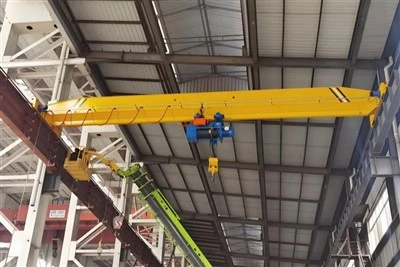
Main Structure & Working Principle
The LZ crane's specialized design includes the following:
Dedicated Grab Bucket Mechanism: It uses two electric hoists working in coordination. One handles lifting/lowering, while the other controls the opening/closing of the grab bucket. This enables a fully operational cycle: Grasp → Lift → Travel → Dump.
Rigid Metal Structure: The main girder typically uses a U-channel or box girder design for excellent rigidity. The main girder connects to the end carriages using high-strength bolts, facilitating transport and on-site assembly.
Reliable Drive System: The travel motors for the crane and trolley feature soft start, low noise, and smooth acceleration/deceleration. The motors usually have built-in disc brakes for reliable stopping power.
Advantages & Limitations
Advantages:
High Cost-Effectiveness: Simple structure, light self-weight, lower building load requirements, and lower initial and long-term maintenance costs.
Significant Efficiency: Dramatically improves the handling efficiency of bulk materials like coal, mineral powder, fertilizer, cement, slag, and sludge.
Customizable: Easily tailored to specific material density, site space, capacity, and span requirements.
Limitations:
Duty Class Restriction: Compared to double-girder cranes, its capacity for continuous heavy-duty operation is limited. Not ideal for frequent, high-intensity work cycles.
Adaptability Restriction: Strictly prohibited for use in environments with flammable, explosive, or corrosive gases, or for handling molten metal.
Selection & Application Notes
Choose LZ Type for: handling bulk materials in warehouses, stockyards, or general industrial workshops where high mobility and low cost are priorities.
Match Grab Bucket Size: Select the bucket capacity based on the bulk density of the material (e.g., 1.5m³ for coal vs. 0.75m³ for iron ore). Overloading reduces service life.
Avoid Heavy-Duty Cycles: If your project requires continuous 24/7 operation at rated load, consider a double-girder or heavier-duty crane instead.
Safety First: Never use the crane beyond its rated working class or in prohibited hazardous environments.
Rated Lifting Capacity 2 tons – 20 tons (Common: 3t, 5t, 10t)
Grab Bucket Capacity 0.75 m³, 1.5 m³, 2.5 m³ (selected based on material density)
Span (Rail Gauge) 7.5 m – 31.5 m (customizable)
Lifting Height 6 m – 30 m (18 m is common)
Duty Class A3 – A5 (Suitable for light to medium duty)
Lifting Speed Approx. 16 m/min

Pictures & Components
Main Girder
The primary load-bearing structure of the crane.
Supports the trolley, hoisting mechanism, and lifted materials.
End Carriages (End Trucks)
Installed at both ends of the main girder.
Equipped with wheels and drive units for crane travel.
 |
 |
Hoisting Mechanism
Provides vertical lifting and lowering motion.
Consists of a motor, reducer, drum, wire rope, and grab bucket.
Grab Bucket
Used for handling bulk materials such as coal, ore, sand, gravel, and grain.
Available in various capacities and configurations.
 |
 |
Trolley Traveling Mechanism
Moves the grab bucket horizontally along the main girder.
Includes trolley frame, wheels, motor, and transmission system.
Crane Traveling Mechanism
Drives the entire crane along the runway rails.
Comprises motors, reducers, wheels, and brakes.

Safety Protection Devices
Overload limiter
Hoisting limit switch
Travel limit switch
Buffers
Emergency stop button
Electromagnetic brake
.
Operator Control Device
Pendant control
Wireless remote control
Cabin control (optional)

Sketch

Main technical

Advantages
The primary strengths of the LZ crane lie in its simple, lightweight design and its purpose-built efficiency for bulk materials.
High Cost-Effectiveness
Lower Initial Investment: Due to its relatively simple single-girder structure, the LZ crane has a much lower manufacturing cost compared to double-girder or heavy-duty cranes, making it an excellent choice for businesses with budget constraints.
Reduced Infrastructure Costs: Its lighter self-weight results in lower wheel loads on the building's support pillars, which can reduce the cost of the runway and building structure itself.
Space-Saving & Lightweight Design
Compact Structure: The single-girder design is compact and has low building height requirements, making it ideal for installation in existing workshops or facilities with limited space.
Low Dead Weight: The crane's light weight is a key feature, contributing to lower energy consumption and less wear and tear on the runway system.
Efficient Bulk Material Handling
High Operational Efficiency: The crane is designed for "fully automatic grabbing" of materials. The grab bucket can open, close, lift, and travel in a coordinated cycle, dramatically increasing the efficiency of loading, unloading, and transferring loose bulk materials compared to manual labor or hook-based cranes.
Reduced Manual Labor: Automating the grabbing and dumping process eliminates the need for strenuous and time-consuming manual shoveling or handling of bulk goods.
Simple Installation & Maintenance
Easy to Install and Commission: The modular design and bolted connections between the main girder and end carriages simplify on-site assembly and installation.
Low Maintenance Requirements: The simple structure and high degree of parts standardization (especially with widely-used CD1/MD1 hoists) mean that maintenance is straightforward and finding spare parts is easy.
Low Long-Term Costs: The combination of durable components and simple maintenance leads to a low total cost of ownership over the crane's operational life.
Reliable & User-Friendly Operation
Proven Technology: The crane uses well-established components like conical rotor motors with integrated brakes, which provide reliable starting torque and safe stopping.
Smooth and Quiet Performance: Features like soft-start motors ensure smooth acceleration and deceleration, reducing stress on the mechanical structure and operating with low noise levels.
Flexible Control Options: The crane can be operated from the ground via a wired pendant or a wireless remote control, or from an optional cabin, offering flexibility for different working environments and operator preferences.
Application:
The LZ crane is specifically designed for environments where loose, bulk materials need to be moved frequently. Its main applications include:
Heavy Industrial Settings:
Steel & Metallurgy Plants: Handling raw materials like iron ore, coke, and slag.
Power Plants & Coal Yards: Grabbing and moving coal for boilers or handling ash and slag pits.
Chemical & Petrochemical Facilities: Transporting bulk chemicals, fertilizers, and raw materials.
Material Processing & Storage:
Mines & Quarries: Loading and moving ore, minerals, and stone.
Construction Material Plants: Handling cement, sand, and aggregates.
Warehouses & Stockyards: General bulk material storage and retrieval operations for goods like grain or industrial salts.
Waste & Water Treatment:
Settling Ponds & Sludge Pools: A common application is grabbing and removing sludge, slurry, and other wet waste products from沉淀池 (sedimentation tanks) or炉渣池 (slag pools).
Shipbuilding, Aerospace & General Manufacturing: For handling raw bulk materials used in these industries, such as sand for casting or scrap metal.
Crane production procedure
The production process of a single-girder bridge crane mainly revolves around its core component-the main girder-and generally follows these steps:
Raw Material Processing: Incoming steel plates, I-beams, and other profiles are inspected and rust-removed. Then, precise markings are made according to the design drawings to prepare for cutting.
Main Girder Manufacturing:
Cutting and Pre-fabrication of Camber: Profiles are cut and the required camber is pre-fabricated. This is a crucial process to prevent the crane from "sag" under heavy loads.
Assembly and Welding: Main girder, sub-girder, and other components are assembled and spot-welded in a strict sequence to ensure structural strength.
End Beam and Other Component Manufacturing: End beams, railings, and other components are manufactured using materials such as channel steel and machined to ensure dimensional accuracy.
Overall Assembly: The main girder, end beams, electric hoist, trolley traveling mechanism, and electrical system are assembled together to complete the overall machine assembly.
Inspection and Testing: Comprehensive quality inspection and static and dynamic load tests are conducted to ensure all performance standards are met before disassembly, packaging, or shipment of the entire machine.

Workshop view:
The company has installed an intelligent equipment management platform, and has installed 310 sets (sets) of handling and welding robots. After the completion of the plan, there will be more than 500 sets (sets), and the equipment networking rate will reach 95%. 32 welding lines have been put into use, 50 are planned to be installed, and the automation rate of the entire product line has reached 85%.


Hot Tags: lz electric single-girder bridge crane, China lz electric single-girder bridge crane manufacturers, suppliers, factory, Single Girder Overhead Crane, Single Girder Overhead Travelling Crane
You Might Also Like


Send Inquiry