








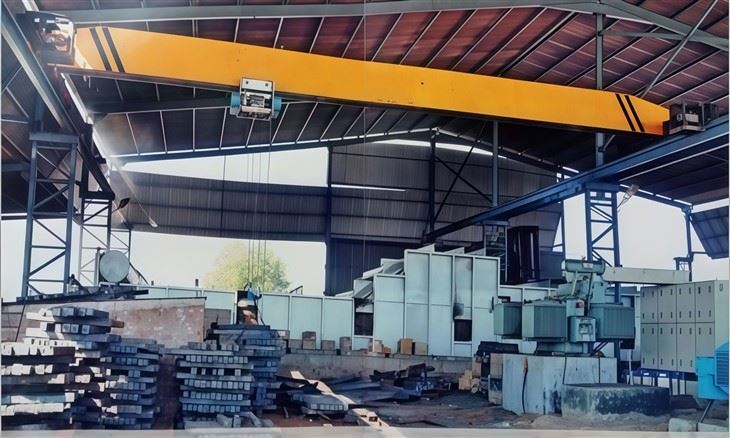

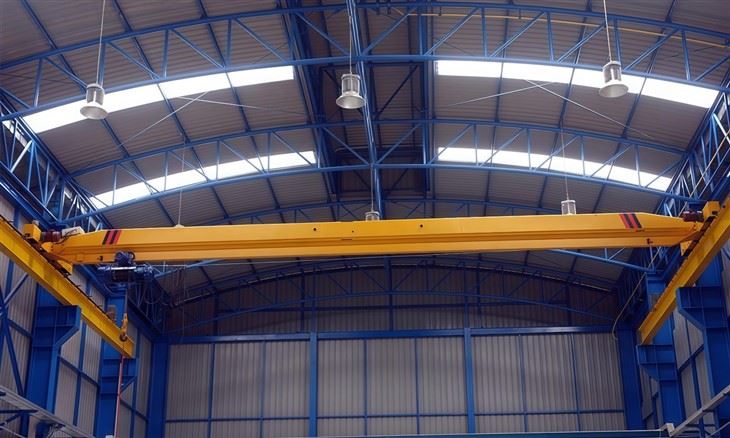


15Ton Single Girder Overhead Crane
A 15-ton single girder overhead crane is a common industrial lifting solution designed for medium-duty material handling tasks. Here's a detailed breakdown of its features, components, and applications:
Key Features:
Capacity: 2 metric tons (2,000 kg).
Single Girder Design: One main beam (usually an I-beam or box girder) supporting the hoist and trolley, making it lighter and more cost-effective than double-girder cranes.
Span: Typically ranges from 5 to 22.5 meters (customizable based on workshop width).
Lifting Height: Usually 6–18 meters (adjustable per requirements).
Duty Class: Generally A3 (Moderate Duty) or A4 (Heavy Duty) based on usage frequency.

Pictures & Components
A 15-ton single girder overhead crane is a common lifting solution for light to medium-duty applications in workshops, warehouses, and industrial facilities. Its main components include:
1. Bridge (Main Girder)
The single girder (usually an I-beam or box-type structure) spans the width of the bay and supports the hoist and trolley.
Made of high-strength steel for durability and load-bearing capacity.
2. End Trucks (End Carriages)
Located at both ends of the girder, these house the wheels that allow the crane to move along the runway beams.
Include drive mechanisms (motors, brakes, and gearboxes) for longitudinal travel.

3. Hoist Unit
The electric hoist (chain hoist or wire rope hoist) is mounted on a trolley for vertical lifting.
Includes a motor, brake, gearbox, drum/chain sprocket, and hook block.
Common types: Chain hoist (e.g., CD1/MD1 type) or Wire rope hoist.

4. Trolley (Traveling Mechanism)
Moves the hoist along the length of the girder (cross travel).
Can be motorized (for powered movement) or manual push-type (for lighter use).

5. Runway Beams
Support the entire crane structure and are typically mounted on building columns or freestanding support structures.
Include rails for smooth crane movement.

6. Electrical System
Control panel – Manages crane operations (lifting, traversing, and traveling).
Pendant control / Radio remote control – Allows the operator to control the crane.
Limit switches – Prevent over-travel of the hoist and trolley.
Power supply system – Uses festoon system, cable reels, or bus bars for electrification.
7. Safety Components
Overload limiter – Prevents lifting beyond 2-ton capacity.
Emergency stop button – For immediate shutdown.
Bumpers / buffers – Absorb impact at the ends of the runway.

8. Supporting Structure (Optional)
Runway columns & braces (if not attached to an existing building structure).

12. Sketch

Main Technical Data


Advantages
A 15 ton single girder overhead crane is a versatile and cost-effective lifting solution widely used in workshops, warehouses, and small industrial facilities. Here are its key advantages:
1. Cost-Effective
Lower initial cost compared to double girder cranes due to simpler design and fewer components.
Reduced installation and maintenance expenses.
2. Space-Saving Design
Compact structure with a single girder, making it ideal for facilities with limited headroom.
Requires less workshop space compared to double girder cranes.
3. Lightweight & Easy to Install
Lighter construction reduces the load on the building structure.
Faster installation with pre-assembled components.
4. Energy Efficiency
Uses a wire rope hoist or chain hoist, which consumes less power compared to larger cranes.
5. Smooth & Precise Operation
Electric hoist ensures smooth lifting and precise load positioning.
Suitable for light to medium-duty applications (e.g., assembly lines, material handling).
6. Low Maintenance
Fewer moving parts result in minimal wear and tear.
Easy inspection and servicing.
7. Customizable Options
Adjustable span, lifting height, and speed to match specific needs.
Can be manual (hand-pushed) or motorized (end carriage travel).
8. Safe & Reliable
Equipped with overload protection, limit switches, and emergency stop functions.
Complies with industry safety standards.
9. Wide Application Range
Ideal for factories, warehouses, workshops, garages, and logistics centers.
Handles loads up to 2 tons efficiently.
Conclusion
The 2 ton single girder overhead crane is an economical, space-saving, and efficient lifting solution for light to medium-duty applications. Its simplicity, reliability, and low maintenance make it a popular choice in various industries.
Application
A 15 ton single girder overhead crane is a versatile and cost-effective lifting solution widely used in various industries for material handling. Here's an overview of its key applications, features, and benefits:
Applications of a 15-Ton Single Girder Overhead Crane
Manufacturing Plants
Moving raw materials, finished products, or machinery components.
Assembly line operations for precise positioning of parts.
Warehouses & Logistics
Loading/unloading goods from trucks.
Transporting pallets, containers, or heavy packages.
Workshops & Repair Shops
Lifting engines, heavy equipment, or metal parts.
Supporting maintenance and repair tasks.
Construction Sites
Handling construction materials (steel beams, concrete blocks).
Assisting in prefab structure assembly.
Steel & Metal Industries
Moving coils, sheets, or metal bars.
Supporting forging and stamping processes.
Power Plants & Substations
Installing or servicing heavy electrical equipment (transformers, generators).
Automotive Industry
Lifting vehicle parts, engines, or chassis during production.
Types Of Cranes For Different Working Conditions

Crane Production Procedure
The production procedure for a 2-ton single girder overhead crane involves several key stages, from design to final testing. Below is a step-by-step outline of the typical manufacturing process:
1. Design & Engineering
Customer Requirements Analysis: Determine span, lifting height, power supply (voltage/frequency), and duty cycle (FEM/ISO classification).
CAD Modeling: Create 3D designs and structural calculations for the girder, end carriages, hoist, and runway.
Material Selection: Choose appropriate steel grades (e.g., Q235B for girder, Q345 for high-stress parts) and components (motors, brakes, wire ropes).
2. Material Procurement
Main Beams: Purchase steel plates/channels for the girder (commonly box-type or I-beam design for 2-ton capacity).
End Carriages: Acquire wheels, axles, and housings (typically fabricated from welded steel).
Hoist & Trolley: Source or manufacture electric hoist (chain or wire rope), trolley frame, and gears.
Electrical Components: Motors (main hoist, traverse), limit switches, control pendants, and wiring.
3. Fabrication
A. Main Girder Production
Cutting: Steel plates are cut to size via CNC plasma/oxy-fuel cutting.
Welding: Assemble the box girder using submerged arc welding (SAW) for high-strength joints.
Straightening: Heat treatment or mechanical pressing to eliminate warping.
Drilling: Bolt holes for end carriage connections.
B. End Carriages
Frame Assembly: Weld steel sections to form the carriage structure.
Wheel Installation: Mount double-flanged wheels (for runway rails) and connect to drive motors if powered.
C. Hoist & Trolley
Frame Welding: Fabricate trolley frame to match girder width.
Assembly: Mount hoist unit, gears, and brakes; ensure alignment.
4. Surface Treatment
Shot Blasting: Clean steel surfaces to remove rust/scale.
Priming/Painting: Apply anti-corrosion primer and topcoat (e.g., epoxy paint).
5. Electrical System Integration
Wiring: Install power cables, control systems, and safety devices (e.g., overload limiters).
Motor Calibration: Adjust brake torque and motor settings per duty cycle.
6. Assembly & Testing
Girder-End Carriage Joining: Bolt or weld the girder to end carriages.
Runway Installation: Mount crane on runway beams (if supplied).
Load Testing:
No-Load Test: Check travel, lifting, and limit switches.
Static Load Test: 125% of rated capacity (2.5 tons) for 10 minutes.
Dynamic Load Test: 110% capacity (2.2 tons) with repeated movements.
7. Inspection & Certification
Dimensional Checks: Verify span, lift height, and alignment.
Safety Compliance: Ensure adherence to standards (ISO 9001, FEM, ASME B30.17, or local regulations).
Documentation: Provide test reports, manuals, and CE/other certifications.
8. Packaging & Delivery
Disassembly (if needed): Separate girder, end carriages, and electrical parts for shipping.
Protection: Waterproof wrapping for outdoor storage/transit.

Workshop View
The company has installed an intelligent equipment management platform, and has installed 310 sets (sets) of handling and welding robots. After the completion of the plan, there will be more than 500 sets (sets), and the equipment networking rate will reach 95%. 32 welding lines have been put into use, 50 are planned to be installed, and the automation rate of the entire product line has reached.


Hot Tags: 15ton single girder overhead crane, China 15ton single girder overhead crane manufacturers, suppliers, factory, Single Girder Overhead Crane, Single Girder Overhead Travelling Crane
You Might Also Like


Send Inquiry