










Overhead Crane And Conveyor
Products Description
Overhead Crane And Conveyor is a common material handling equipment, mainly used in workshops, warehouses, docks and other places to help lift and move goods horizontally. It has a compact structure, easy operation and is suitable for a variety of environments. It is efficient, safe and economical.
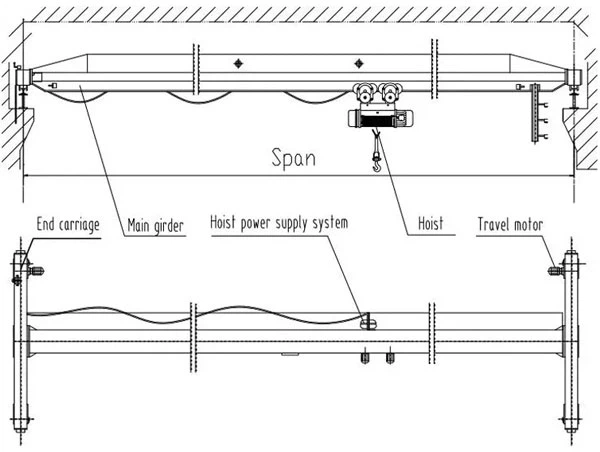
Overhead Crane And Conveyor consists of a single main beam, end beam, lifting system (hook, pulley), drive device and electrical system. The structure is relatively simple and easy to install and maintain. Compared with double-beam bridge crane, single-beam design is lighter and suitable for the handling of small and medium-sized loads. It is usually used for a load range of 5-20 tons and a span of 7.5-31.5 meters.
The equipment can be installed on a separate lifting rail according to user needs, or it can be suspended on the existing building structure, occupying a small space. Due to the light weight of the equipment, the motor power is small, the energy consumption is low, and it can work continuously for a long time, with high efficiency. This crane is equipped with a variety of safety protection devices, such as overload protection, limit protection, emergency stop device, etc., to ensure safety during operation.
4. Compared with double-beam bridge cranes, Overhead Crane And Conveyor have lower costs and are especially suitable for small and medium-sized enterprises. Due to its compact structure and less space occupation, it is suitable for sites with limited space. It can be customized according to specific usage requirements to adapt to a variety of working environments.
Warranty of core components:1 Year
Core Components:Engine, Bearing, Gearbox, Motor, Gear, Main beam, End beam, Electric system
Warranty:1 Year
Weight (KG):30000 kg
Feature:Bridge Crane
Condition:New
Rated Lifting Moment:As your demand
Max. Lifting Load:customized
Span:10.5-31.5m
Max. Wheel Pressure:74-780KN
Steel products:Q235B(-20℃-40℃),Q345E(-40℃-40℃)
Power Source:3 Phase 380V 50hz
Type:single girder overhead crane
Working class:A3~A4

Pictures & Components
1.Main beam
1) Structural form of main beam
The main beam of a Overhead Crane And Conveyor usually has two main forms:
I-beam (I-beam): This main beam uses I-beam or welded steel plates to form an I-shaped structure. I-beams have good bending and torsion resistance, can withstand large loads, and are light in weight. They are often used in light and medium-sized cranes.
Box beam: The box beam is a closed cross-section structure welded from steel plates, shaped like a rectangular box. Compared with the I-beam, the box beam has stronger torsion and bending resistance, is suitable for cranes with larger spans or heavy loads, and has a stronger structure, but the manufacturing cost is relatively high.
2) Material of the main beam
The main beam is generally made of high-strength structural steel plates or steel sections to ensure its load-bearing capacity and durability. Commonly used steels are:
Q235B steel: has good plasticity, toughness and welding properties, and is suitable for cranes with ordinary loads.
Q345B steel: has higher strength, is suitable for cranes with medium and heavy loads, and can also maintain good toughness in low temperature environments.
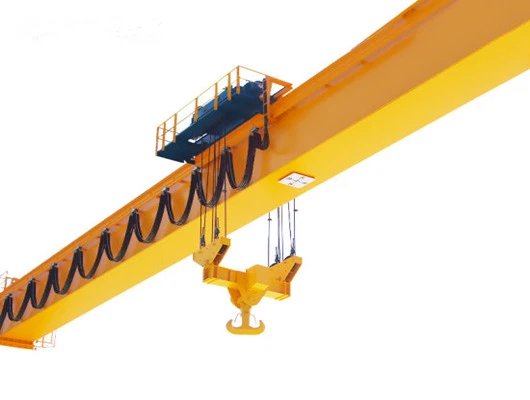
Lifting System
Technical parameters of the lifting system
1) Lifting capacity: The maximum load-bearing capacity of the lifting system, which is usually determined according to the design standard of the crane. For example, the common lifting capacity of a Overhead Crane And Conveyor is 1 ton to 20 tons.
2) Lifting speed: The speed at which the goods are lifted, usually between 5-20 meters per minute, and the specific speed is adjusted according to the model and load of the electric hoist. Some cranes are equipped with a two-speed electric hoist that can switch the lifting speed as needed, taking into account efficiency and precision.
3) Lifting height: The maximum vertical height to which the lifting system can lift the goods, the common lifting height is 6 meters to 30 meters, which can be customized according to specific application requirements.
4) Working level: According to the frequency of use and load conditions of the crane, the working level of the lifting system is generally A3 to A5 (medium frequency of use). The lifting system with a high working level is designed to be more durable and suitable for higher-intensity operations.
 |
 |
3.End carriage
1) Support and fixation: The main function of the end beam is to support the main beam and electric hoist and other components, and fix the entire crane on the track through the wheels to ensure its smooth operation. It not only carries the weight of the crane, but also the weight of the hoisted object.
2) Horizontal movement: The end beam moves horizontally along the lifting track through the drive motor and the wheel group, allowing the Overhead Crane And Conveyor to move freely in the working area. This horizontal movement enables the crane to quickly switch working areas between different positions, greatly improving the operating efficiency.
3) Guidance and balance: The end beam is designed to be symmetrical at both ends to ensure smooth operation during the crane's movement and avoid side slipping or tilting. The guiding function of the end beam ensures that the crane runs in a straight line on the track without deviating from the established trajectory.
4) Shock absorption and buffering: In order to prevent the crane from experiencing a severe impact when it runs to the end of the track, buffer devices such as rubber buffer blocks or spring buffers are usually installed on the end beam. These devices can effectively reduce the impact force and protect the safety of the crane and the building structure.
 |
 |
4.Crane travelling mechanism
Working principle of the crane running mechanism
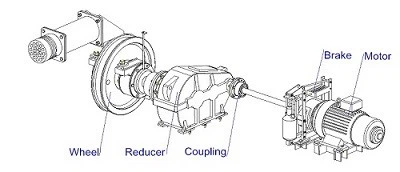
1) Start and run:When the operator sends a command through the controller, the motor starts, the reducer converts the high-speed rotation of the motor into a low-speed and high-torque output, and the drive wheel starts to rotate. The wheel group drives the crane along the track by contacting the track.
2) Speed control: The crane running mechanism usually has a single-speed or dual-speed operation mode:
Single-speed drive: The motor runs at a fixed speed, which is suitable for conventional lifting operations.
Dual-speed drive: Equipped with a dual-speed motor, it can switch between high and low speeds as needed, which is suitable for operating scenarios that require precise positioning or frequent start and stop.
Braking and stopping: When the operator releases the run button or the operation stops, the braking system will immediately take effect, and the brake will lock the wheel through electromagnetic action to prevent the crane from continuing to slide under inertia. The limit device is automatically triggered when the crane approaches the end of the track, forcing the crane to stop moving to ensure safety.
5.Trolley travelling mechanism
1) Safety device of the trolley running mechanism
Anti-derail device: The trolley is usually equipped with an anti-derail device to prevent it from derailing from the main beam track due to external force or track abnormality during operation. This device can ensure that the trolley runs smoothly and safely on the track.
Emergency stop device: The trolley running mechanism is equipped with an emergency stop button, which can quickly stop the movement of the trolley when the operator encounters an emergency to ensure the safety of the operation.
Overload protection: The trolley motor is usually equipped with an overload protection device. When the load exceeds the design range of the trolley or abnormal conditions such as motor overheating occur, the overload protection will automatically cut off the power supply to prevent equipment damage or accidents.
2) Maintenance of the trolley running mechanism
Regular lubrication: The wheel group, bearings, gears and other transmission parts of the trolley need to be lubricated regularly to reduce friction, extend the life of the parts, and ensure the smooth operation of the trolley.
Track inspection: Regularly check the wear of the trolley running track to ensure that the track surface is smooth and unobstructed to avoid poor operation or derailment of the trolley due to uneven tracks or debris.
Electrical system maintenance: Regularly check the motor, limit devices, brakes and cable systems to ensure the normal operation of the electrical system and avoid downtime or accidents due to electrical failures.
6.Crane wheel
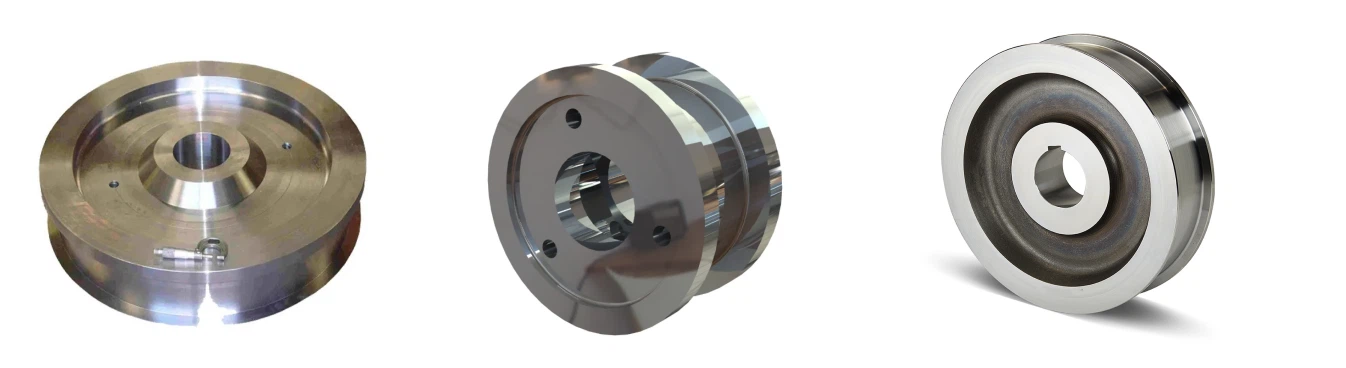
1) Types of wheels
Crane wheels: Trolley wheels are installed at both ends of the end beam of the crane, responsible for supporting the weight of the entire crane and moving along the track on the ground or on the bracket. Trolley wheels usually consist of two pairs of wheels, one pair is the driving wheel, driven by the motor, and the other pair is the driven wheel, passively following the driving wheel.
Trolley wheels: Trolley wheels are installed at the bottom of the trolley frame, used to support the trolley and its lifting mechanism, and move along the track on the main beam. Similar to the trolley wheels, the wheel set of the trolley also consists of a driving wheel and a driven wheel.
2) Composition materials of wheels
Wheels are usually made of high-strength, wear-resistant materials to ensure that they can withstand long-term high-load operation and avoid rapid wear due to friction. Commonly used wheel materials include:
Forged steel: Forged steel wheels have extremely strong wear resistance and impact resistance, suitable for cranes with heavier loads and frequent use.
Cast steel: Cast steel wheels have a lower manufacturing cost, but their wear resistance is slightly inferior to forged steel, suitable for cranes with medium loads.
Alloy steel: Alloy steel wheels are suitable for high-intensity working conditions by adding special alloy elements to the steel to further improve its strength and wear resistance.
7.Crane Hook
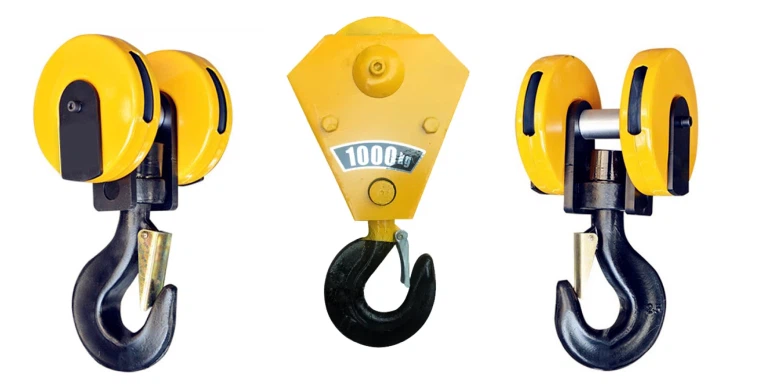
Working principle of hook
Grab the load: The opening of the hook is aligned with the lifting point of the load, and the load is usually hung on the hook mouth by wire rope, sling or chain. The anti-drop device will ensure that the load does not accidentally fall off during the lifting process.
Vertical lifting: The hook is connected to the hoist of the crane through the wire rope or chain of the lifting mechanism. When the operator starts the lifting mechanism, the wire rope is wound or unwound, driving the hook and the load to rise and fall vertically. The rotation function of the hook can adjust the direction when the load is raised or lowered, so as to control the direction of the object more flexibly.
Release the load: When the load is raised to the specified position, the operator can release the load by manipulating the anti-drop device of the hook, so that it can land safely or be installed in place.
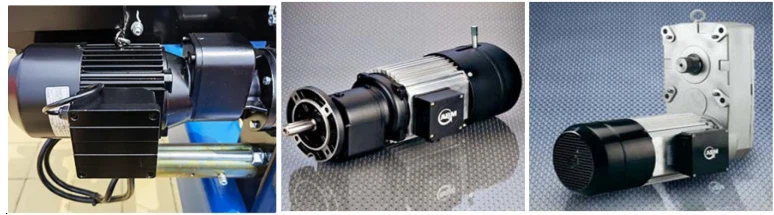
Motor
Classification of motors
1) Hoisting motor: The hoisting motor is an important driving unit of a Overhead Crane And Conveyor, responsible for lifting and lowering the load. It drives the wire rope drum to rotate through a reducer to achieve the lifting and lowering of the load. The hoisting motor usually requires a large starting torque to provide sufficient power when the load is lifted, and has good braking performance to ensure that the load can remain stable when it stops.
2) Crane running motor: The trolley running motor is used to drive the crane to move horizontally on a large-span track. It is usually installed on the end beam of the crane and achieves horizontal movement by driving the trolley wheels. The starting and stopping of the trolley running motor requires smoothness to reduce shaking and improve operating accuracy.
3) Trolley running motor: The trolley running motor is responsible for driving the trolley to move on the track on the main beam, and is usually used in conjunction with the lifting mechanism to enable the crane to cover the entire working area. The response speed and operating accuracy of the trolley running motor are crucial to the operational flexibility of the crane.
.
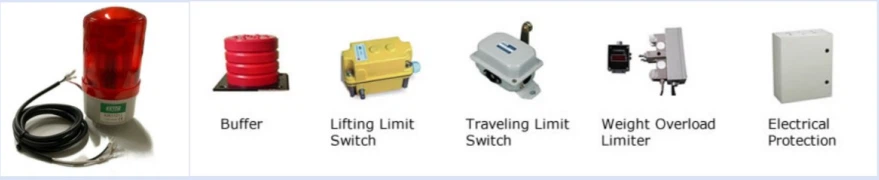
Sound and light alarm system & limit switch
1) The sound and light alarm system usually consists of the following parts:
Sound alarm: It emits an audible alarm, usually a high-pitched buzzer or siren, to attract the attention of people around. The volume of the alarm can be adjusted according to the size of the ambient noise to ensure that it can still be clearly heard in a noisy workplace.
Light alarm: It alerts the operator to danger by emitting a strong flash or a continuous light. Light alarms usually use red or yellow flashing lights to ensure that they can be clearly seen under various lighting conditions.
Control system: The sound and light alarm system is automatically triggered by the crane's control system. The system will start when the following situations occur: overload or overload, the crane enters the limit position (such as the trolley, car or hook reaches the end of the stroke), the equipment is abnormal or fails, and the emergency stop occurs.
2) Working principle of limit switch
The limit switch is usually a mechanical or electronic sensor. It monitors the position of each operating part of the crane by contact or non-contact. When a part (such as the trolley, car, hook) contacts the limit switch, the switch will cut off the power supply of the corresponding motor, stop running, or send a signal to the control system for processing. Some limit switches have a "secondary limit" function, that is, when the operation is not stopped after the first limit is triggered, the secondary limit will force power off to ensure the safety of the equipment.
10.Safety Devices
1) Overload protection device: The overload protection device is used to monitor the load of the crane. When the load exceeds the set value, the device will automatically cut off the power supply of the crane or sound an alarm to prevent equipment damage or accidents caused by overload.
2) Limit switch: The limit switch is used to prevent the various moving parts of the crane from exceeding the safe stroke to ensure that there are no accidents during the operation of the equipment.
3) Sound and light alarm system: When the crane is overloaded, the limit switch is triggered or other abnormal conditions occur, the sound and light alarm system will sound an alarm to alert the operator and surrounding personnel.
4) Braking device: The braking device is used to control the movement of the crane to ensure that the equipment can be stopped quickly and stably when it is necessary to stop.
5) Windproof device: The windproof device is used to prevent the crane from overturning or losing control in a windy environment, especially when working outdoors.
6) Emergency stop device: In an emergency, the operator can quickly stop all operations of the equipment through the emergency stop device to avoid accidents.
7) Safety device: The safety device is used to prevent accidental hook drop or fall caused by equipment failure or external factors.
8) Monitoring system: The monitoring system is used to monitor the operating status of the crane in real time, detect and handle faults in a timely manner, and ensure equipment safety.
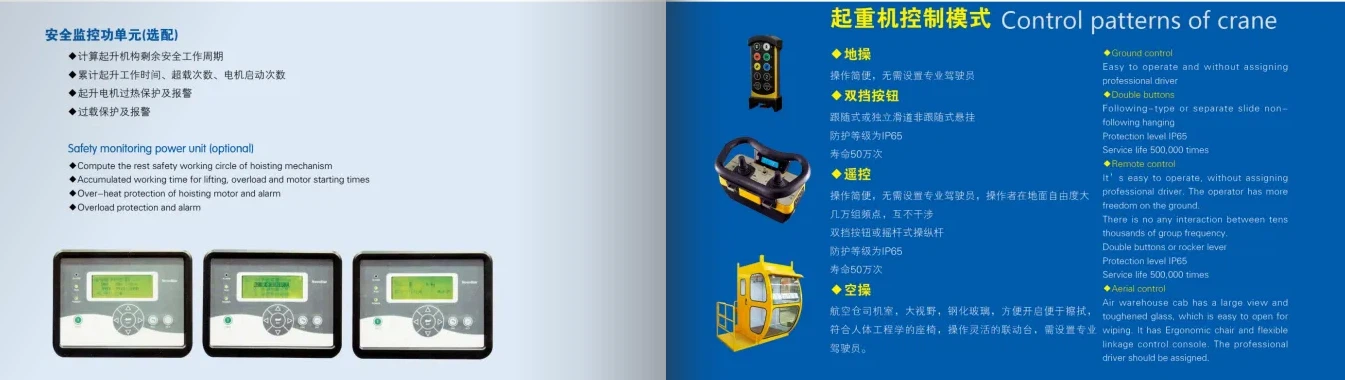
11.Control Mode
1) Ground control: Ground control is one of the most common control methods. The operator controls the various functions of the crane through a control panel set on the ground. It is simple to operate and easy to use. It is suitable for small-scale and low-height lifting operations.
2) Remote control: Remote control controls the crane through wireless devices, allowing the operator to operate the crane at a certain distance. It is flexible to operate and allows the operator to observe the load and surrounding environment at a safe distance. It reduces safety hazards caused by improper operator position.
3) Automatic control: The automatic control system realizes the automatic operation of the crane through preset programs and sensors. It improves work efficiency and reduces the need for manual operation. It reduces human errors and improves operational safety.
4) Centralized control: The centralized control method is usually used in large crane systems, and the operation of multiple cranes is centrally managed through the control room. It improves operational efficiency and facilitates the scheduling and management of multiple equipment. It can monitor the status of the equipment in real time and detect and handle faults in time.
Sketch
Main technical

Advantages
1. Simple structure: The single-beam structure is relatively simple, easy to manufacture and install, and can reduce production and maintenance costs.
2. High space utilization: Due to its compact design, it can effectively utilize space and is suitable for use in environments with limited space.
3. Light weight: The single-beam design makes the overall weight of the crane lighter, which can reduce the foundation burden and energy consumption of the equipment.
4. Flexible operation: Overhead Crane And Conveyor are generally equipped with electric hoists, have good operational flexibility, and are suitable for various lifting operations.
5. Strong adaptability: The lifting height, span and load capacity can be adjusted according to specific needs, and are suitable for a variety of industries and environments.
6. Smooth operation: Due to the stability of its design, the crane has little vibration during operation and can smoothly lift and move heavy objects.
7. Simple maintenance: The structure is relatively simple, maintenance and maintenance are convenient, and maintenance costs and time are reduced.
8. Economic efficiency: Compared with other types of cranes, Overhead Crane And Conveyor have lower investment and operating costs and are suitable for use by small and medium-sized enterprises.
Application:
1. Manufacturing: In the automotive, machinery, electronics and other industries, Overhead Crane And Conveyor are used to move and assemble heavy parts.
2. Warehousing and logistics: In warehouses, Overhead Crane And Conveyor help move, stack and pick up goods to improve warehousing efficiency.
3. Construction engineering: On construction sites, they are mainly used to lift building materials (such as steel beams, concrete components) and equipment.
4. Metallurgical industry: In places such as steel plants, Overhead Crane And Conveyor are used to move furnace materials, castings and finished products to improve production efficiency.
5. Mining: In mining operations, they are used to move ores, equipment and other heavy objects to improve operation safety and efficiency.
6. Shipbuilding and maintenance: Used for assembly and repair of ships, moving heavy objects, and ensuring smooth operation.
7. Light industry: In industries such as textiles, food processing and pharmaceuticals, they are used for material handling and production line coordination.
8. Power industry: In power plants and substations, they are mainly used for equipment installation, maintenance and overhaul.
9. Workshops and production lines: In various production workshops, single-girder bridge cranes are used to improve the efficiency of material handling.
Crane production procedure
1. Demand analysis and design:
Determine customer needs, including the specifications, load capacity, span and lifting height of the crane.
Carry out engineering design according to the needs, including preliminary design and detailed design, and draw technical drawings.
2. Material procurement: According to the design requirements, purchase the required materials, such as steel, welding materials, electrical components, etc.
3. Cutting and processing: Cut, process and shape the purchased materials to make the main structural parts of the crane (such as bridge, legs, beams, etc.).
4. Welding and assembly: Weld the cut and processed parts to form the main structure of the crane. Install other accessories, such as the crane's electric hoist, drive device, control system, etc.
5. Electrical assembly: Install the electrical system, including motors, control cabinets, sensors, etc., to ensure the normal connection of electrical components.
6. Testing and debugging: Test run the assembled crane and check the working status of each system to ensure that it meets the design requirements. Adjust and calibrate system parameters to ensure the safety and stability of the crane.
7. Quality inspection: Carry out strict quality inspection, including appearance inspection, dimension measurement, strength test, etc., to ensure that the product meets national standards and customer requirements.
8. Packaging and transportation: Pack qualified cranes and prepare to transport them to the location specified by the customer.
9. Installation and commissioning: Install and commission the crane at the customer's site to ensure that the equipment can operate normally.
10. Training and delivery: Train the customer's operators to ensure that they can operate and maintain the equipment proficiently. Formal delivery of the crane, provide relevant technical information and warranty services.

Workshop view:
The company has installed an intelligent equipment management platform, and has installed 310 sets (sets) of handling and welding robots. After the completion of the plan, there will be more than 500 sets (sets), and the equipment networking rate will reach 95%. 32 welding lines have been put into use, 50 are planned to be installed, and the automation rate of the entire product line has reached 85%.

Workshop view
Material Inspection
Quality Inspection: Strict quality inspection is carried out on the purchased raw materials to ensure that they meet the design requirements and national standards.
Material Storage: Qualified materials are stored according to classification to prevent corrosion or damage.
Cutting and Forming
Steel Cutting: Use plasma cutting, laser cutting or flame cutting and other technologies to cut the steel according to the size of the design drawing.
Forming Processing: Form the steel plate through bending, rolling, welding and other processes to manufacture the main beam, end beam and other structural parts.
Welding
Component Welding: The cut and formed steel parts are welded into the main structures such as the main beam, end beam and trolley. The welding process needs to be strictly controlled to ensure the structural strength and welding quality.
Weld Inspection: Use non-destructive testing technology (such as ultrasonic testing, radiographic testing) to inspect the welds to ensure that there are no cracks or other defects.
Machining
Precision Machining: Precision machining is performed on the key components of the crane, such as wheel sets, bearing seats, pulleys, etc., to ensure their dimensional accuracy and surface quality.
Assembly of the whole machine
General assembly: On the basis of pre-assembly, the overall assembly of the crane is carried out, including the final installation of the main beam, end beam, lifting mechanism, walking mechanism, etc.
Commissioning and testing
Under dynamic conditions, the operating performance of the crane is tested, including the testing of lifting, walking, steering and other functions. The overall size of the assembled bridge crane is checked to ensure that all dimensions meet the design requirements.
Spraying and anti-corrosion treatment
Surface treatment Rust removal: Rust removal on the surface of the crane, common methods include sandblasting, pickling, etc. Primer spraying: Spray anti-corrosion primer on the treated surface to prevent metal oxidation and corrosion. Topcoat spraying Color spraying: Spray topcoat according to customer requirements or industry standards to give the crane a protective and decorative effect. Marking: After spraying, mark the crane's identification information in accordance with the specifications, such as model, rated load, etc.
Factory and installation
Packaging and transportation
Packaging protection: Protectively package the key components of the crane to prevent damage during transportation. Transportation arrangement: According to the equipment size and transportation conditions, select a suitable transportation method to transport the crane to the customer's site.
Acceptance and delivery
Customer acceptance
On-site acceptance: The customer conducts on-site acceptance of the crane according to the contract requirements and technical specifications to check the performance and quality of the equipment.
Problem rectification: If any problems are found, the manufacturer needs to rectify them in time to ensure that the equipment fully meets the customer's requirements. Delivery and use Operation training: The manufacturer usually trains the customer's operators to ensure that they can operate the crane correctly and safely.


Hot Tags: overhead crane and conveyor, China overhead crane and conveyor manufacturers, suppliers, factory
You Might Also Like


Send Inquiry