










High Level Slewing Overhead Crane With Carrier Beam

High Level Slewing Overhead Crane With Carrier Beam

High Level Slewing Overhead Crane With Carrier Beam

High Level Slewing Overhead Crane With Carrier Beam

High Level Slewing Overhead Crane With Carrier Beam
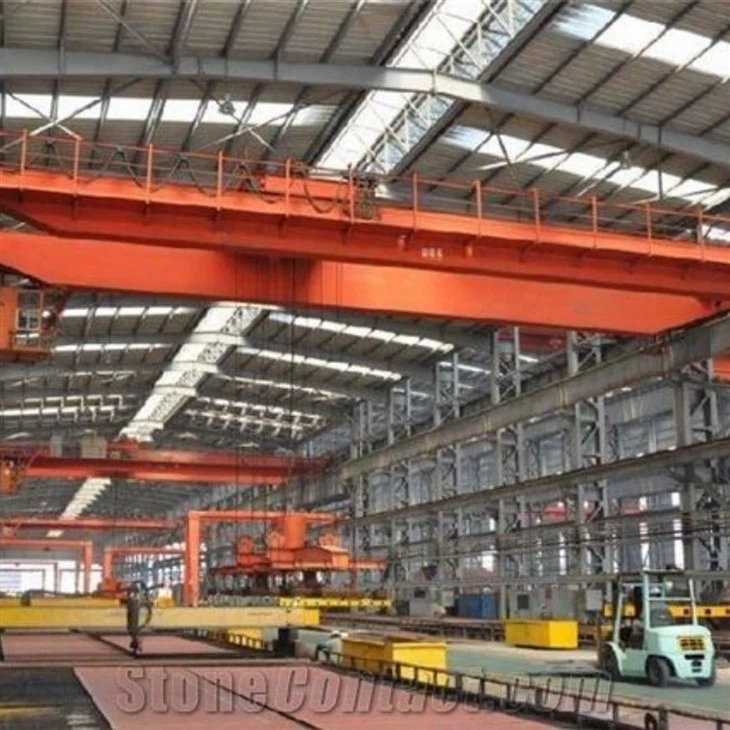
High Level Slewing Overhead Crane With Carrier Beam

High Level Slewing Overhead Crane With Carrier Beam
High Level Slewing Overhead Crane With Carrier Beam
A high-level slewing overhead crane with a carrier beam is a specialized type of crane used primarily in industrial environments for handling heavy loads. It combines the features of an overhead crane with the added flexibility of slewing (rotating) motion and the use of a carrier beam for enhanced load handling. Here's a brief overview:
1. Overhead Crane
Structure: The crane typically runs on elevated tracks or rails attached to the walls or ceiling of a facility. It spans the width of the workspace and moves horizontally along the tracks.
Movement: It can move longitudinally along the facility and transversely (side-to-side) with the hoist attached to the carrier beam, allowing for full spatial control over the load.
2. Slewing Mechanism
Rotation: The slewing function allows the crane or part of the crane (usually the carrier beam) to rotate around a vertical axis. This feature gives the crane more maneuverability for precise load positioning, especially in restricted or tight spaces.
Applications: It is particularly useful in applications requiring rotational movement to position loads without needing to shift the entire crane.
3. Carrier Beam
Load Handling: The carrier beam is a horizontal beam that carries the load via hooks, magnets, or other attachments. It can handle long or bulky items that require more balanced load distribution, such as steel plates, large machinery parts, or containers.
Stability: The beam allows for even weight distribution, preventing load tilting and making handling safer and more stable.
4. Advantages
Precision: With the slewing feature and carrier beam, the crane offers precise control for positioning heavy or awkwardly shaped loads.
Efficiency: High-level overhead cranes are typically used in large industrial settings (e.g., steel mills, shipyards, and warehouses) for lifting heavy loads quickly and safely.
Safety: Enhanced safety features like anti-sway systems, load monitoring, and fail-safe brakes ensure safe operation when handling large or complex loads.

Pictures & Components
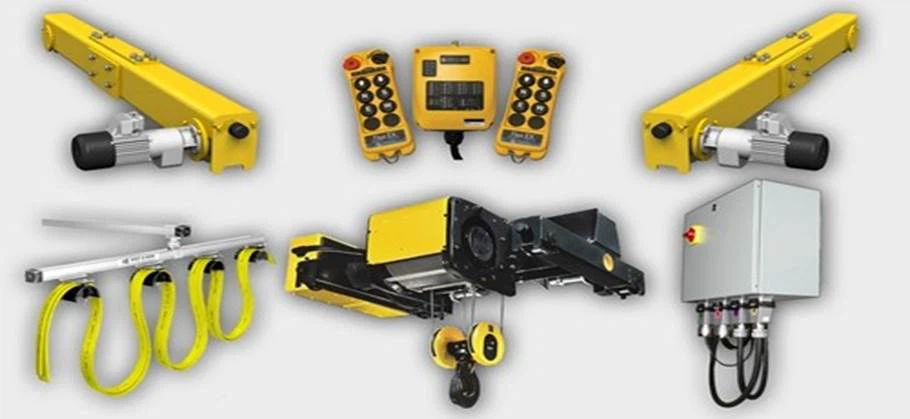
A high-level slewing overhead crane with a carrier beam is composed of several critical components that enable it to operate effectively in industrial applications. Here's a breakdown of the key components:
1. Bridge or Girder
Function: The bridge, also known as the girder, is the main horizontal structure that spans the width of the workspace. It is mounted on tracks or rails and carries the trolley and carrier beam.
Types: It can be a single-girder or double-girder configuration depending on the load requirements.

2. Crane Rails/Runways
Function: These are the rails mounted on the support structures (often on the ceiling or high columns) that guide the movement of the crane along the length of the facility.
Materials: Made of high-strength steel to ensure smooth, stable motion under heavy loads.
3. Trolley
Function: The trolley moves along the length of the bridge and carries the hoisting mechanism. It enables transverse (side-to-side) movement of the load.
Design: Typically designed with wheels that run along the girder or bridge structure.
4. Hoist
Function: The hoist is the lifting mechanism that raises and lowers the load. It is mounted on the trolley and connected to the load via ropes, chains, or slings.
Types: It can be a wire rope hoist or chain hoist, depending on load capacity.

5. Carrier Beam (Spreader Beam)
Function: The carrier or spreader beam is a horizontal beam suspended from the hoist, used to lift long, heavy, or unwieldy loads. It distributes the weight evenly and prevents tilting or instability.
Attachments: Often equipped with hooks, slings, magnets, or clamps to securely hold loads like steel plates, large machinery, or containers.
6. Slewing Mechanism
Function: The slewing mechanism allows the carrier beam to rotate around a vertical axis. This rotation provides enhanced flexibility in positioning loads without moving the entire crane.
Control: The slewing function is controlled electrically or hydraulically and can be a continuous or limited rotation, depending on the design.
7. End Trucks (Carriages)
Function: The end trucks are mounted on both ends of the bridge and are responsible for moving the entire bridge along the crane runway. They typically consist of wheels or bogies.
Power Source: Driven by electric motors that control the longitudinal movement of the crane.
8. Control System
Function: The control system allows the operator to manage all crane movements-lifting, lowering, trolley travel, bridge travel, and slewing.
Options: Can be operated via a pendant control, wireless remote, or a cabin where the operator sits.
Features: Modern systems are equipped with safety features like overload protection, anti-sway technology, and emergency stop buttons.

9. Electric Motors
Function: Various electric motors drive different parts of the crane, including the hoist, trolley, and bridge. The motors ensure smooth and reliable movement of the crane components.
Power: High-torque motors are used to lift heavy loads and handle complex motions like slewing.

10. Braking System
Function: The braking system ensures the crane stops safely and holds the load securely in place during operations or emergencies.
Types: Often includes fail-safe brakes for added safety in case of power failure or malfunction.
11. Power Supply System
Function: Provides the necessary electrical power to the crane's motors and control systems.
Components: May include a conductor bar, festoon system, or cable reel to supply power to the moving components of the crane.
12. Limit Switches and Sensors
Function: Limit switches and sensors ensure safe operation by preventing the crane from moving beyond its operational limits. They stop the trolley or hoist from exceeding specific travel distances or lifting too heavy a load.
Types: Include travel limit switches, load sensors, and height limiters.
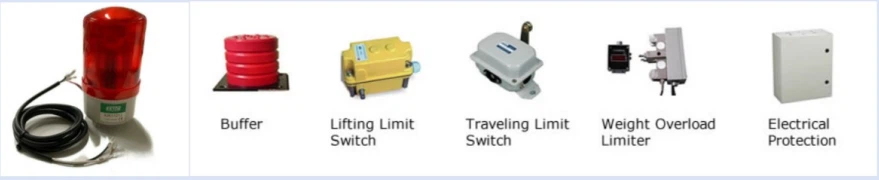
13. Safety Devices
Anti-sway Technology: Reduces load swing during operation, enhancing safety and precision.
Overload Protection: Ensures that the crane does not lift loads exceeding its rated capacity, preventing accidents.
Emergency Stop: Allows the operator to halt all crane movements immediately in case of an emergency.

12. Sketch

Main Technical Data
|
Lifting capacity |
5t+5t; 7.5t+7.5t; 10t+10t; 16t+16t |
||
|
Lifting height |
up to 20m |
||
|
Span (Standard) |
10.5-31.5m |
||
|
Speed |
Hoisting |
Slow |
1 m/min |
|
Fast |
15 m/min |
||
|
crab |
4-40 m/min |
||
|
Crane |
10-100 m/min |
||
|
Working system |
A5~A6 |
||
Advantages
A high-level slewing overhead crane with a carrier beam offers several advantages that make it highly effective for industrial applications requiring heavy-duty load handling, precision, and flexibility. Below are some of the key advantages:
1. Enhanced Maneuverability
Slewing Mechanism: The slewing (rotating) capability of the crane allows for greater maneuverability, making it possible to rotate loads around a vertical axis. This is particularly beneficial in environments where space is limited or where loads need to be positioned precisely without having to move the entire crane.
Precision Handling: The combination of slewing motion and transverse trolley movement allows the operator to position loads with high precision, improving operational efficiency and reducing the time taken for load handling.
2. Efficient Load Distribution
Carrier Beam: The carrier (spreader) beam ensures even distribution of the load, particularly for long, bulky, or awkwardly shaped items. This prevents load tilting and enhances stability, making it ideal for handling large objects such as steel plates, beams, machinery, or containers.
Balanced Lifting: By distributing the load over multiple lifting points (via hooks, clamps, magnets, etc.), the carrier beam reduces the risk of damaging the load or the crane during handling.
3. Increased Load Capacity
Heavy-Duty Design: High-level overhead cranes are designed to handle very heavy loads, often in the range of several tons, depending on the crane's specifications. The slewing feature adds versatility in handling complex loads while maintaining high load capacities.
Stability for Heavy Loads: The carrier beam provides additional support for handling heavy and long objects that might otherwise be unstable if lifted from a single point.
4. Improved Safety
Anti-Sway Systems: Modern high-level slewing overhead cranes are often equipped with anti-sway technology, which reduces load swing during movement, making operations safer. This feature is especially important when lifting loads at high speeds or moving them across large distances.
Overload Protection: These cranes typically feature advanced safety systems, including overload protection, which ensures that the crane does not lift loads exceeding its capacity. This minimizes the risk of accidents and equipment damage.
Emergency Stop: The presence of emergency stop systems ensures that the crane can be halted instantly in case of malfunction or danger, further improving workplace safety.
5. Optimized for Space-Constrained Environments
Slewing in Tight Spaces: The crane's ability to rotate its load without moving the entire bridge or trolley makes it ideal for use in space-constrained environments such as warehouses, workshops, or assembly lines where large overhead movement may not be feasible.
Full Area Coverage: Overhead cranes, combined with slewing motion, provide full spatial coverage of the work area, allowing for flexible load handling without needing multiple cranes or repositioning equipment frequently.
6. Versatility for Various Load Types
Adaptability: The use of a carrier beam allows the crane to handle a wide range of loads, including long materials, irregularly shaped objects, or multiple smaller items in one lift. With adjustable attachments such as magnets, clamps, or slings, the crane can be adapted for different industries (e.g., steel production, shipyards, logistics).
Customizable Attachments: The carrier beam can be fitted with different lifting tools depending on the specific requirements of the task, making it suitable for various lifting applications.
7. Increased Productivity
Speed and Efficiency: The high precision and flexibility of movement, combined with the ability to handle heavy and complex loads, allow for faster operations. This improves overall productivity, as the crane can perform multiple tasks in less time with greater accuracy.
Reduced Downtime: The enhanced load stability and safety features reduce the likelihood of accidents or equipment breakdowns, leading to lower downtime and maintenance requirements.
8. Cost-Effective Long-Term Solution
Durability: High-level overhead cranes are built with robust materials and components designed to withstand heavy use over long periods. Their durability makes them a cost-effective solution for industries that require frequent and reliable material handling.
Low Maintenance: With proper maintenance, these cranes can provide years of service with minimal downtime, reducing long-term operational costs.
9. Improved Operator Control
Advanced Control Systems: The crane can be operated using advanced control systems such as pendant controls, wireless remote controls, or operator cabins, depending on the specific needs of the application. These systems allow the operator to manage crane movement with high precision, ensuring that loads are handled safely and efficiently.
Automation: Many modern high-level slewing cranes can be equipped with automation systems for repetitive tasks, further enhancing operational efficiency and reducing the need for manual intervention.
10. Reduced Floor Congestion
Overhead Design: As an overhead crane, it does not take up valuable floor space, unlike other material handling equipment such as forklifts or gantry cranes. This results in less congestion on the work floor, leading to safer and more organized workspaces.
Conclusion
The high-level slewing overhead crane with a carrier beam provides unmatched versatility, safety, and efficiency in handling heavy or complex loads. Its advanced features, including the slewing mechanism, balanced load distribution via the carrier beam, and precise control systems, make it an ideal solution for industries requiring robust, reliable material handling equipment.
Application
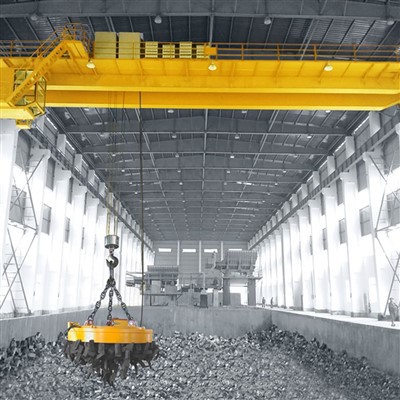
An electromagnetic overhead crane is a type of crane that uses an electromagnet to lift and move heavy materials. It is typically used in industrial settings, such as factories, construction sites, and ports, where large and heavy materials need to be transported quickly and efficiently.
Some common applications of electromagnetic overhead cranes include:
1. Steel mills: Electromagnetic cranes are used to transport raw materials, such as scrap metal, to be processed in steel mills. They can also move finished products, such as sheet metal or steel beams, for storage and shipping.
2. Heavy equipment production: Electromagnetic cranes can move large components of heavy equipment, such as engines or hydraulic systems, between workstations on the production line.
3. Ports and shipping: Electromagnetic cranes are used to load and unload shipping containers and cargo from ships and trucks.
4. Recycling centers: Electromagnetic cranes are used to lift and move large volumes of scrap metal or other recyclable materials to be sorted and processed.
5. Aerospace industry: Electromagnetic cranes are used to handle large components of aircraft, such as wings or engines, during manufacturing and assembly.
Overall, electromagnetic overhead cranes are a versatile and powerful tool used in a variety of industrial settings to move heavy materials quickly and efficiently.
Crane Production Procedure
The production procedure for an electromagnetic overhead crane is as follows:
1. Design: The first step in producing an electromagnetic overhead crane is to design it according to the client's requirements. This involves determining the crane's lifting capacity, span, and any other specific requirements.
2. Fabrication: Once the design is finalized, the fabrication process begins. The fabrication process involves cutting, welding, and assembling the various parts of the crane.
3. Electrical wiring: After the fabrication process, electrical wiring is added to the crane. This includes the installation of the electromagnetic brakes, control panel, power circuit, and other electrical components.
4. Testing: Once the crane is fully assembled, it undergoes rigorous testing to ensure optimal performance. This includes load testing, functional testing, and electrical testing.
5. Delivery and installation: After testing, the crane is ready for delivery and installation. The installation process involves positioning the crane on the overhead rails and connecting it to the power and control systems.
6. Commissioning: Once the crane is installed, it undergoes thorough commissioning procedures to verify its optimal performance. This involves running several tests and adjustments to ensure that the crane meets the specified requirements.
7. Andover: After commissioning, the crane is handed over to the client for use. The client is provided with training on how to operate the crane safely and effectively.
8. Overall, the production procedure for an electromagnetic overhead crane is a complex process that requires precision, expertise, and quality assurance. The aim is to produce a reliable and capable crane that can meet the needs of the client and ensure optimal efficiency in material handling.

Workshop View
The company has installed an intelligent equipment management platform, and has installed 310 sets (sets) of handling and welding robots. After the completion of the plan, there will be more than 500 sets (sets), and the equipment networking rate will reach 95%. 32 welding lines have been put into use, 50 are planned to be installed, and the automation rate of the entire product line has reached 85%.


Hot Tags: high level slewing overhead crane with carrier beam, China high level slewing overhead crane with carrier beam manufacturers, suppliers, factory, Upper Rotary Electromagnetic Bridge Crane, Electromagnetic Overhead Crane, Magnetic Overhead Crane, Electromagnetic Overhead Crane with Rotary Carrier Beam
You Might Also Like




Send Inquiry