








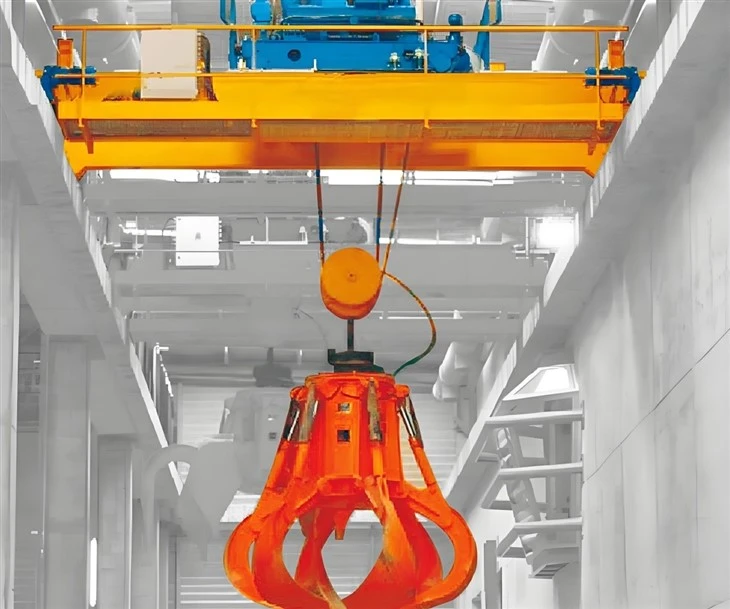


Grab Bucket Eot Crane
Grab bucket eot crane typically consists of a bridge, runway, hoisting mechanism, grab bucket, and trolley system. The grab bucket is designed to open and close automatically, allowing it to pick up and release materials easily.
One of the significant advantages of grab bucket eot crane is its ability to handle multiple material types quickly and efficiently. It can be designed with optional features such as a rotating grab bucket, advanced safety features, and remote control operation.
Grab bucket eot cranes are available in various configurations, including single girder, double girder, and gantry crane designs. The capacity and specifications of these cranes can be customized to meet specific operational requirements based on the application and desired production output.
In summary, Grab bucket eot cranes are an essential tool for any operation that requires efficient bulk material handling. Its advanced features, reliable performance, and customizable design make it an ideal solution for various industrial applications.
- Capacity: 5-800/50ton
- Span length: 4-35m
- Lifting height: 3-50m
- Work duty: A4, A5, A6,A7
- Raged voltage: 220V~690V, 50-60Hz, 3ph AC
- Work environment temperature: -25℃~+50℃, relative humidity ≤85%
- Crane control mode: Floor control / Remote control / Cabin room

Pictures & Components
1. Whole set crane
1. Main Components of Grab Bucket EOT Crane
✅ Bridge Structure (Girder) – The main framework that supports the crane. Can be single girder or double girder.
✅ Grab Bucket – A mechanical or hydraulic bucket used for grabbing bulk materials. Can be four-rope, motor-driven, or hydraulic type depending on application.
✅ Hoisting Mechanism – Includes hoist motor, drum, wire rope, and pulley system for lifting and lowering the grab bucket.
✅ Trolley Mechanism – Moves the hoist and grab bucket along the bridge girder.
✅ Crane Traveling Mechanism – Allows the entire crane to move along the rail tracks.
✅ Control System – Includes cabin control, remote control, or pendant control for crane operation.
✅ Electrical System – Powers the motors and controls various functions of the crane.

2. Main girder
The main girder of a grab bucket EOT (Electric Overhead Traveling) crane is the primary structural component that supports the lifting mechanism, including the grab bucket and hoisting system. It plays a crucial role in ensuring the stability, strength, and efficiency of the crane.
Key Features of the Main Girder
Structure & Design
Typically a box girder or I-beam girder design for high strength and durability.
Designed to handle dynamic loads from the grab bucket operation.
Made of high-quality steel to withstand heavy loads and harsh working environments.
Load Bearing Function
Supports the trolley and hoisting mechanism, allowing it to move horizontally.
Ensures even load distribution across the crane structure.
Integration with Other Components
Connected to end carriages that move along the crane runway.
Houses the rail system on which the trolley moves.
Supports the grab bucket hoist, which is used to lift and transport bulk materials like sand, coal, ore, or grain.
Customization & Application
The main girder design varies based on the lifting capacity, span, and working conditions.
Commonly used in ports, power plants, steel mills, and bulk material handling industries.
3. Lifting System
The lifting system of a grab bucket EOT (Electric Overhead Traveling) crane is designed to efficiently handle bulk materials like coal, sand, gravel, and minerals. It consists of several key components:
1. Hoisting Mechanism
Main Hoist Motor: Powers the lifting system.
Wire Rope Drums: Wind and unwind steel wire ropes to lift or lower the grab bucket.
Gearbox & Brake System: Ensures controlled movement and safety during lifting.
2. Grab Bucket
Mechanical Grab: Uses wire ropes to open and close the bucket (double-rope or four-rope type).
Hydraulic Grab: Uses hydraulic cylinders for grabbing action.
Electric Grab: Uses an integrated motorized system for operation.
3. Trolley Mechanism
Trolley Frame: Moves along the bridge girder.
Traverse Motor & Wheels: Allows the grab to move laterally.
4. Electrical Control System
PLC Control: Provides precise control over lifting, lowering, and opening/closing of the grab.
Variable Frequency Drive (VFD): Ensures smooth acceleration and deceleration.
Limit Switches & Sensors: Prevents overloading and ensures operational safety.
5. Supporting Structure
Bridge Girder: Supports the trolley and lifting mechanism.
End Carriages & Wheels: Enable crane movement along the runway.

4. End Carriages
End carriages of a grab bucket EOT (Electric Overhead Traveling) crane are crucial components that support and enable the movement of the crane along the runway beams. These end carriages consist of wheels, bearings, and drive systems that facilitate smooth and controlled motion.
Key Features of End Carriages in Grab Bucket EOT Cranes
Structure
Made of high-strength steel to withstand heavy loads and dynamic forces.
Rigid design to ensure stability and durability.
Wheels and Bearings
Equipped with high-quality wheels (forged or cast) running on rails.
Bearings are designed for heavy-duty operations and long service life.
Drive System
Powered by motors and gearboxes for controlled movement.
Uses frequency inverters for smooth acceleration and deceleration.
Alignment & Stability
Proper alignment ensures smooth travel and reduces wear on rails.
Anti-skewing mechanisms prevent misalignment during movement.
Safety Features
End stops and buffers to prevent over-travel.
Rail sweeps and safety brakes for emergency stops.


5. Crane traveling mechanism
The crane traveling mechanism of a grab bucket EOT (Electric Overhead Traveling) crane is an essential part of the crane's movement system. It is designed to move the crane along the horizontal axis of the crane's runway or rail track. Here's an overview of how the crane traveling mechanism works:
1. Travel Mechanism Components:
Motors: The crane typically uses electric motors to drive the traveling mechanism. These motors are connected to the wheels, which roll on the crane runway or rail.
Wheels: The crane is mounted on a set of wheels, typically flanged, which run along the rails or tracks on the crane runway.
Drive System: The motor drives a gearbox, which transmits power to the wheels. The drive system can either be direct (where the motor is connected directly to the wheels) or via a chain/belt.
End Trucks (or Trolleys): The crane is supported on the end trucks that house the traveling mechanism. These end trucks move along the crane's bridge or runway rails.
2. Movement of the Grab Bucket EOT Crane:
The grab bucket EOT crane can move horizontally along the tracks by the traveling mechanism, enabling it to cover large areas.
The operator can control the crane's travel speed and direction (forward or backward) using a control panel or remote control.
The traveling mechanism is designed to handle high loads while ensuring smooth movement of the crane to pick up and deposit the grab bucket in desired locations.
3. Types of Crane Travel Mechanisms:
Single Girder Cranes: In this type, only one girder supports the crane's load and the traveling mechanism is simpler and more cost-effective.
Double Girder Cranes: This mechanism is used for heavy-duty applications. Two parallel girders support the traveling mechanism and allow for higher lifting capacities.
Top Running or Under Running: In top-running cranes, the crane runs on the top of the runway rails, while under-running cranes run along the bottom of the rails.
4. Speed and Control:
The traveling speed of the crane is adjustable, depending on the motor and the application requirements.
The control system can allow precise positioning to ensure the grab bucket is accurately positioned for loading or unloading tasks.
5. Safety Features:
Limit Switches: To prevent the crane from traveling beyond the permissible limits.
Brakes: Powerful braking systems to stop the crane safely and prevent unintended movement.
6. Trolley traversing mechanism
- The trolley traversing mechanism of a grab bucket Electric Overhead Traveling (EOT) crane is a crucial component responsible for the horizontal movement of the crane along the track or rail system. This mechanism ensures that the crane can travel across the length of the workspace to position itself properly for lifting and transporting materials.
- Key Components:
- Trolley: The trolley is the part of the crane that carries the grab bucket or other lifting attachments. It is mounted on the crane bridge and moves horizontally along the crane rails.
- Motors: The mechanism is powered by electric motors that provide the necessary movement to the trolley. The motor typically drives a gear system that is connected to the trolley's wheels or rail systems.
- Drive Mechanism:
- Gearbox and Couplings: The motor is connected to a gearbox, which controls the speed and torque for the horizontal movement of the trolley.
- Wheels and Rails: The trolley runs on a set of rails on the bridge of the crane. The wheels mounted on the trolley follow the rails, allowing it to move back and forth.
- Chain or Rope Drive: In some systems, a chain or rope is used to connect the motor and the trolley. This can be a more flexible method, especially for cranes that need to cover longer distances or where space is constrained.
- Traversing Controls: The system is controlled by a control panel or remote control, allowing the operator to adjust the trolley's speed, direction, and positioning. In more advanced systems, automated control systems or sensors may be used to improve accuracy and efficiency.
- Structural Support: The trolley traversing mechanism is supported by the crane's bridge or gantry structure. The structural integrity of the crane ensures the smooth operation of the trolley without undue vibration or wear on the rails.
- Operation:
- When the crane operator activates the trolley traverse mechanism, the motor drives the wheels or chain, moving the trolley horizontally along the rail system.
- The movement of the trolley is synchronized with the movement of the grab bucket, enabling it to position the bucket directly above the load.
- The system typically has limit switches or sensors to prevent over-travel at both ends of the crane's rail system, ensuring that the trolley does not go beyond its intended travel range.
- Importance:
- Precision: The trolley mechanism ensures precise positioning of the grab bucket for efficient loading or unloading.
- Speed and Efficiency: It allows the crane to quickly cover large areas, reducing downtime and increasing productivity.
- Safety: Proper design and maintenance of the trolley traversing mechanism are vital to ensure safe operation and to avoid accidents caused by malfunctions.
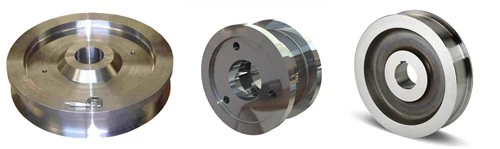
7. Crane wheel
- The crane wheel of a grab bucket EOT (Electric Overhead Traveling) crane is an essential part of the crane's hoisting mechanism. It is responsible for guiding the movement of the crane along the rails of the crane runway, enabling precise positioning of the grab bucket during operation.
- Here's a breakdown of the key functions and aspects of the crane wheel in an EOT crane with a grab bucket:
- Structure: The crane wheel is typically made of high-strength steel or alloy material, designed to withstand heavy loads and the continuous wear and tear from rail contact.
- Function: It allows the crane to travel along the runway rails, supporting the crane's weight and the grab bucket's load while maintaining balance and stability.
- Types:
- Drive wheels: These wheels are connected to the motorized drive mechanism, which moves the crane along the tracks.
- Idler wheels: These are the non-motorized wheels that help to stabilize the crane and support its weight.
- Rail Interaction: The wheels are designed with a flange that fits into the rails, ensuring smooth and safe movement. The flanged design also prevents the crane from derailing.
- Wear & Tear: Regular inspection and maintenance are necessary for crane wheels to ensure they remain in optimal condition. Wear can occur from the crane's heavy loads, causing the wheels to degrade over time. This is especially important in environments where the crane operates continuously, such as in port facilities, factories, or warehouses.
8. Crane hook &Grab Bucket
- A crane hook is a metal device attached to a crane used for lifting and moving heavy objects. It is typically designed to hold and secure the load, providing a safe and efficient way to lift materials.
- A grab bucket is a type of mechanical device used with cranes, especially in EOT (Electric Overhead Traveling) cranes, for handling bulk materials like coal, sand, gravel, or scrap metal. The grab bucket consists of two jaws or "grabs" that open and close, allowing it to collect and transport loose materials. It is usually operated by a hydraulic or electric system, offering precise control over the load.
- Together, the crane hook and grab bucket allow for efficient handling of heavy, bulk cargo, particularly in industries such as construction, mining, and ports. The hook lifts the grab bucket into position, and the grab bucket itself is used to scoop up and transport the materials.


9. Motor
- Hoisting Motor: This motor controls the up-and-down movement of the grab bucket. It lifts and lowers the bucket depending on the load, often using a rope or chain system.
- Travelling Motor: This motor moves the crane along the rails on the structure. It controls the horizontal motion of the crane, allowing it to move from one location to another.
- Slewing Motor: In some EOT cranes, the motor responsible for rotating the crane structure or the hoist mechanism is the slewing motor. This is more common in cranes with a rotating boom or arm.
- Grab Bucket Motor (if applicable): For cranes with a motorized grab bucket, a motor is often attached to the bucket mechanism, which opens and closes the bucket to grip the load. These motors are typically hydraulic or electric and may be connected to a drum or winch system.

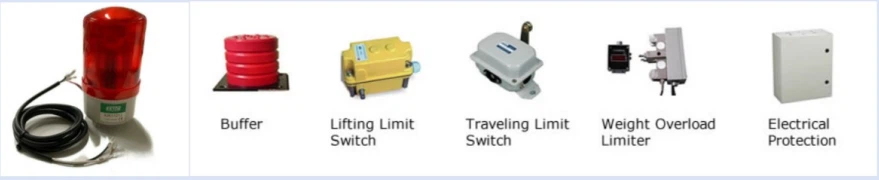
10. Sound and light alarm system & limit switch& safety parts
The sound and light alarm system and limit switches are critical safety components in an EOT (Electric Overhead Traveling) crane with a grab bucket. These systems work to ether to enhance the safety of crane operations, prevent accidents, and ensure smooth functioning. Here's how they operate:
- Sound and Light Alarm System
Purpose: This system provides an audible and visible warning to operators and nearby personnel when the crane is in operation or when specific safety limits are being approached or exceeded.
Components:
Sound Alarm: Typically a buzzer or siren that emits a sound when certain conditions are met, such as when the crane is moving, lifting, or nearing a limit.
Light Alarm: A flashing light or indicator that alerts nearby people visually, especially in noisy environments where sound alarms might be less effective.
- Limit Switches for Grab Bucket:
Purpose: Limit switches are installed to protect the crane from moving beyond certain predefined limits. They automatically stop or control the movement of the crane or its grab bucket when these limits are reached.
Types of Limit Switches:
Overload Limit Switch: Ensures the grab bucket does not exceed its safe load capacity.
Height Limit Switch: Prevents the crane or grab bucket from moving too high or low, avoiding collisions with structures or other equipment.
End-of-Travel Limit Switch: Stops the crane or grab bucket at the end of its travel path to prevent damage from over-traveling.
Operation:
The limit switch detects when a specific part of the crane (e.g., the grab bucket or trolley) reaches a predefined position or threshold.
When this position is reached, the limit switch sends a signal to stop or alter the motion of the crane to prevent damage to the equipment or risk to personnel.
11. Safety devices
1. Limit Switches
Hoist Limit Switch: Ensures that the hook or grab bucket does not travel beyond the maximum safe height.
Travel Limit Switch: Prevents the crane from traveling beyond its designated operating track.
2. Overload Protection
Overload Warning System: Warns the operator if the crane is carrying a load beyond its rated capacity. Some cranes automatically cut off power or stop further movement when the limit is exceeded.
3. Emergency Stop Button
An emergency stop button allows the crane operator to instantly cut power to the crane, halting all movements in case of an emergency.
4. Anti-Sway Mechanism
This system helps to minimize the swinging motion of the grab bucket when lifting or lowering heavy loads, which could pose a safety hazard.
5. Brake Systems
Service Brakes: Used for regular stopping during normal operations.
Emergency Brakes: Activated during emergencies to stop the crane immediately in case of a failure.
6. Load Indicator
A load indicator provides real-time monitoring of the weight being lifted, ensuring the crane doesn't exceed its safe lifting capacity.
7. Crane Safety Monitoring System
Integrated monitoring systems that display key data, such as load weight, boom position, and operational status, and alert the operator if anything goes wrong.
8. Wind Speed Indicator
Monitors the wind speed in outdoor environments, warning the operator if the wind speed exceeds safe operating limits for lifting or moving heavy loads.
9. Emergency Power-Off (EPO)
This system cuts off electrical power to all crane functions in case of a severe malfunction or emergency situation.
10. Safety Locking Devices
Ensures the grab bucket is securely locked when not in use or during maintenance. These locking devices prevent accidental releases or movements.
11. Operator Safety Cabin
The crane may be equipped with a safety cabin or operator's cage that provides protection from falling debris or equipment failure.
12. Warning Alarms and Lights
Visual or audible alarms and lights alert operators and ground personnel to crane movements or other potential hazards.
12. Control Mode
1. Pendant Control
Operator controls the crane using a wired pendant hanging from the crane.
Provides basic control for lifting, lowering, trolley movement, and bridge travel.
Suitable for smaller capacity cranes or where precision is not a major concern.
2. Remote Control (Radio Control)
Uses a wireless remote controller to operate the crane.
Enhances safety by allowing the operator to work from a safe distance.
Commonly used in hazardous or high-risk environments.
3. Cabin Control
Operator sits inside a dedicated control cabin mounted on the crane.
Offers better visibility and is ideal for heavy-duty applications.
Suitable for continuous operations, such as in ports, steel plants, and waste handling facilities.
4. Semi-Automatic Control
Combines manual control with pre-programmed operations.
Improves efficiency by automating repetitive movements.
Used in bulk material handling like coal, ore, and grain.
5. Fully Automatic Control
The crane operates without human intervention, following pre-set programs.
Uses sensors, PLC (Programmable Logic Controller), and SCADA systems for precision.
Common in automated warehouses, waste-to-energy plants, and bulk material storage.

13. Sketch

Main Technical Data

Advantages
1. High Efficiency in Bulk Handling
Designed for continuous and automated material handling, reducing manual labor.
Capable of handling large volumes of material quickly and efficiently.
2. Cost-Effective Operations
Reduces labor costs by minimizing manual handling.
Less material wastage due to precise grabbing and controlled unloading.
3. Versatility
Suitable for multiple industries, including mining, steel, ports, and waste management.
Can handle various types of bulk materials.
4. Customization & Automation
Available in various configurations (single/double girder, four-rope, or hydraulic grab).
Can be automated for higher accuracy, reducing human error.
5. Strong Lifting Capacity
Can lift heavy loads efficiently.
Designed for high-duty cycles, ensuring continuous operation in demanding environments.
6. Improved Workplace Safety
Reduces manual intervention, minimizing accident risks.
Equipped with safety features like overload protection, emergency stop, and anti-sway technology.
7. Long Service Life & Durability
Made from high-strength materials for longevity.
Requires low maintenance compared to conventional material handling methods.
Application
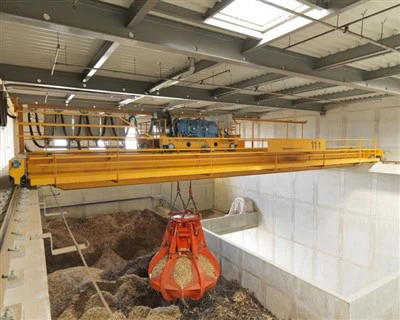
- Port Handling: Grab bucket cranes are widely used in ports to load and unload bulk commodities such as coal, iron ore, grain, and other raw materials from ships to trucks or storage areas.
- Steel Plants: In steel production plants, grab bucket cranes are used to handle scrap metal, slag, and other heavy materials that need to be moved efficiently during the production process.
- Construction: These cranes can also be used in construction sites to transport bulk construction materials like sand, gravel, or cement.
- Mining Operations: In mining, grab bucket EOT cranes help in handling extracted minerals or ores, often in large volumes.
- Warehouses and Storage Yards: Used for efficiently moving large quantities of materials or bulk goods within a storage facility or yard.
- Power Plants: These cranes can be employed in coal handling systems, where they are used to move coal from storage piles to the power plant's combustion units.
Crane Production Procedure
1. Design and Planning
Design Specifications: The crane is designed based on the specific requirements (e.g., load capacity, span, lifting height, and grab bucket specifications).
Engineering and Drafting: The design includes detailed drawings and structural calculations, ensuring the crane meets all regulatory standards.
Material Selection: High-strength steel, alloy steel, and other materials are selected based on the crane's load capacity and environmental conditions.
2. Procurement of Materials
Raw materials such as steel beams, structural steel, motors, electrical components, and grab buckets are procured.
Components like motors, control panels, and electrical equipment are sourced from specialized suppliers.
3. Fabrication of Crane Structure
Cutting and Shaping Steel: Steel beams and plates are cut to the required dimensions based on the design.
Welding and Assembly: The crane's main structure (e.g., bridge, trolley, and end beams) is welded and assembled. The welds are inspected to ensure structural integrity.
4. Manufacturing the Grab Bucket
Bucket Design: The grab bucket is designed to fit the specific needs of the crane (e.g., capacity, material handling).
Fabrication of the Bucket: Steel plates are cut, shaped, and welded to form the bucket. The grab mechanism (e.g., hydraulic or rope-operated jaws) is integrated into the design.
Testing the Bucket: The grab mechanism is tested to ensure it operates smoothly and can hold the required load.
5. Installation of Crane Components
Hoisting Mechanism: The hoist drum, cables, and lifting hook (or grab bucket) are installed.
Electrical Wiring: The electrical system is set up, including motors, control panels, and safety sensors.
Control System Setup: The crane's control system is installed and programmed, allowing operators to control the crane remotely.
6. Assembly of the Crane
Bridge Assembly: The main bridge, consisting of two end beams and the connecting trolley rails, is assembled.
Trolley and Hoisting Mechanism: The trolley is mounted on the rails, and the hoisting mechanism is connected to the bridge.
Grab Bucket Mounting: The grab bucket is securely attached to the hoisting mechanism, with any necessary hydraulic or rope systems installed.
7. Testing and Inspection
Load Testing: The crane is tested with progressively heavier loads to ensure it operates safely under maximum capacity.
Electrical Testing: All electrical systems are tested for functionality, safety, and efficiency.
Safety Checks: Features like limit switches, emergency stop buttons, and anti-collision devices are checked.
Grab Bucket Testing: The grab bucket is tested for proper functioning, including opening/closing mechanisms and weight capacity.
8. Final Adjustments
Any issues identified during the testing phase are corrected, and final adjustments are made to the crane's performance.
The crane's alignment, balance, and smooth operation are checked again.

Workshop View
The company has installed an intelligent equipment management platform, and has installed 310 sets (sets) of handling and welding robots. After the completion of the plan, there will be more than 500 sets (sets), and the equipment networking rate will reach 95%. 32 welding lines have been put into use, 50 are planned to be installed, and the automation rate of the entire product line has reached 85%.


Hot Tags: grab bucket eot crane, China grab bucket eot crane manufacturers, suppliers, factory, Grab Overhead Crane, Grab Bucket Overhead Crane
Previous
No InformationYou Might Also Like



Send Inquiry