










Hook Double Girder Overhead Crane
Products Description
Key Features
Lifting Capacity: Ranges from 5T to 80T (standard models), with specialized cranes like the QDY series reaching 70T for steel mills.
Span: Typically 10.5–31.5m, extendable to 37.5m for large industrial applications.
Lifting Height: Up to 24m (standard) or 36m (customized for steel mills).
Control Methods:
Wireless remote control or cabin control.
Frequency conversion for smooth speed adjustment.
Safety Features:
Overload limiters, dual brakes, and anti-collision systems.
Low headroom design to maximize workspace efficiency.
Technical Specifications
| Parameter | Details |
|---|---|
| Materials | Main girders use Q235B/Q345 steel for durability. |
| Motors | Heavy-duty motors (60% ED) with brands like Siemens/Schneider. |
| Wire Rope | 2160N/mm² galvanized steel, maintenance-free. |
| Work Temperature | -25°C to 60°C. |
| Duty Class | M3–M8 (A3–A7) for high-frequency operations. |
Core Components:Bearing, Gearbox, Motor, Pump
Place of Origin:Henan, China
Warranty:1 Year
Weight (KG):2000 kg
Video outgoing-inspection:Provided
Machinery Test Report:Provided
Design:Double beam
Effectiveness:high efficiency
Operating speed:High speed operation
Stability:Anti-swing function
Color:Optional
Power Source:110V/220V/230V/380V/440V,customized
Span:7.5-31.5m

Pictures & Components
A Hook Double Girder Overhead Crane consists of several key components that work together to ensure safe and efficient lifting operations. Below is a detailed breakdown of its main parts:
1. Bridge Girders (Main Beams)
Function: Primary load-bearing structure spanning the crane runway.
Material: Typically made of Q235B/Q345B steel for high strength.
Design: Box-type or truss structure to minimize deflection (1/700–1/1000 of span).
Features:
Reinforced for heavy loads (up to 80T or more).
May include anti-corrosion coatings for harsh environments.
 |
 |
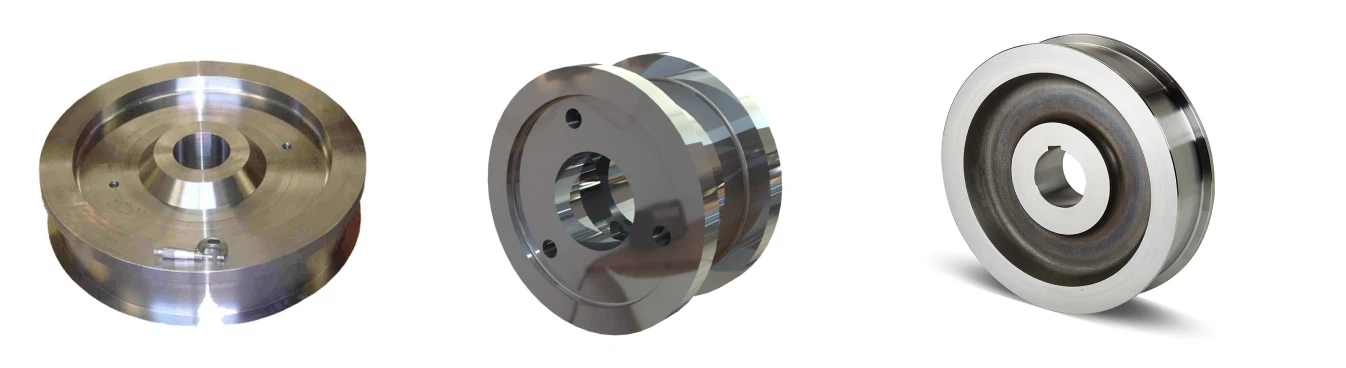
2. End Trucks (End Carriages)
Function: Support the bridge girders and enable crane movement along the runway rails.
Components:
Wheels: Forged steel or alloy, often heat-treated for durability.
Drive Motors: AC/DC motors with brakes for controlled movement.
Buffers: Rubber or hydraulic shock absorbers to prevent collisions.
 |
 |
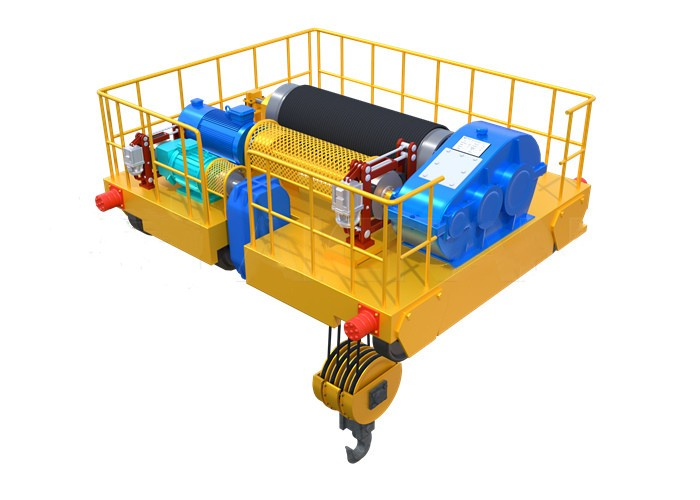
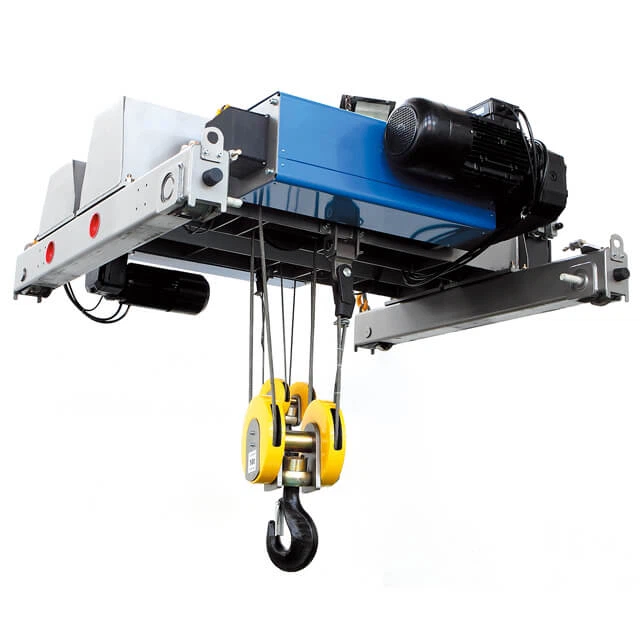
3. Hoist & Trolley Assembly
Function: Lifts, lowers, and moves loads horizontally along the girders.
Types:
Electric Wire Rope Hoist: Common for heavy-duty lifting (e.g., 10T–80T).
Chain Hoist: Used for lighter loads or compact spaces.
Key Parts:
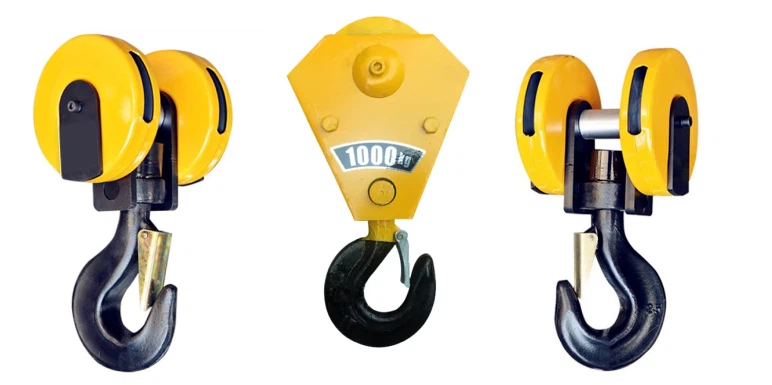
Hook: Forged steel, swivel-type for load stability (e.g., 80T hook with safety latch).
Drum/Wheel: Holds the wire rope or chain.
Motor & Gearbox: Provides lifting power (e.g., IP55-rated for dust/water resistance).
Brake System: Fail-safe brakes for emergency stops.
4. Runway System
Function: Supports the crane's travel along the building structure.
Components:
Runway Beams: Steel I-beams or box sections, anchored to building columns.
Rail Tracks: P43/P50 steel rails for smooth movement.
Rail Clamps: Secure rails to beams and prevent misalignment.
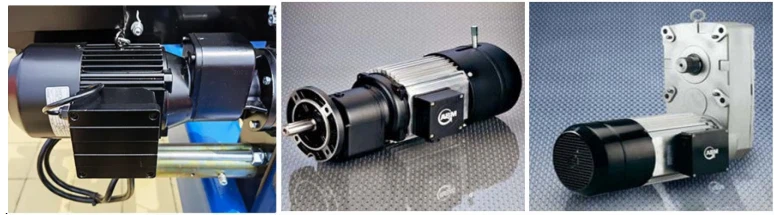
5. Electrical & Control Systems
Power Supply:
Festoon System (cable reels) or Conductor Bars (busbars) for electricity.
Control Methods:
Pendant Control: Wired handheld remote.
Radio Remote: Wireless operation (up to 100m range).
Cabin Control: Operator cabin with joysticks and monitoring panels.
Safety Devices:
Limit Switches: Prevent over-travel of hoist/trolley.
Overload Protector: Cuts power if load exceeds capacity.
Anti-Collision Sensors: For multi-crane environments.

6. Auxiliary Components
Ladders & Platforms: For maintenance access.
Lighting: LED work lights for visibility.
Lubrication System: Automatic greasing for wheels/gears.
.
Comparison: Double vs. Single Girder Components
| Component | Double Girder Crane | Single Girder Crane |
|---|---|---|
| Girders | Two girders (higher load capacity) | Single girder (lighter loads) |
| Hoist Position | Mounted on top of girders (greater hook height) | Underhung (lower headroom) |
| Cost | Higher initial cost | More economical |

Maintenance Tips
Daily Checks: Inspect hooks, brakes, and wire ropes for wear.
Lubrication: Grease wheels, gears, and bearings regularly.
Load Testing: Perform annual tests to verify safety limits.
SKETCH

Main technical

Advantages:
Advantages of Hook Double Girder Overhead Cranes
Higher Load Capacity & Stability
Designed for heavy-duty lifting (typically 5T–80T, with specialized models up to 300T for shipbuilding applications) .
Dual girders distribute weight evenly, reducing deflection (span ratio of 1/700–1/1000) compared to single-girder designs.
Space Efficiency
Low headroom design minimizes vertical space usage, maximizing workspace under the crane.
European-style models feature compact dimensions and reduced wheel pressure, allowing smaller workshop designs.
Advanced Control & Safety
Options include frequency conversion for smooth speed adjustment and wireless remote/cabin control.
Safety features: overload limiters, galvanized steel wire ropes (2160N/mm²), anti-collision systems, and self-adjusting brakes.
Durability & Low Maintenance
Q235B/Q345B steel construction with C3–C5 corrosion-resistant coatings for harsh environments.
Modular design with FEM/ISO-compliant components ensures long service life.
Customization Flexibility
Adjustable parameters: span (10.5–31.5m), lifting height (up to 36m), and hoist types (electric trolley, winch, or open drum).
Application:
Key Applications
Industrial Manufacturing
Steel mills, foundries, and heavy machinery workshops for handling raw materials and large components.
Ports & Logistics
Loading/unloading heavy cargo, containers, and bulk materials.
Energy & Construction
Hydropower plants for dam construction and turbine installation.
Shipbuilding for lifting hull sections and equipment (e.g., 70T cranes for steel ladles).
Specialized Environments
High-temperature areas (e.g., foundries) with heat-resistant modifications.
Explosion-proof variants for chemical or mining industries.
Comparison with Single-Girder Cranes
| Feature | Double Girder | Single Girder |
|---|---|---|
| Load Capacity | Up to 80T+ | Typically ≤20T |
| Hook Height | Higher (top-mounted hoist) | Lower (underhung hoist) |
| Cost | Higher initial investment | More economical |
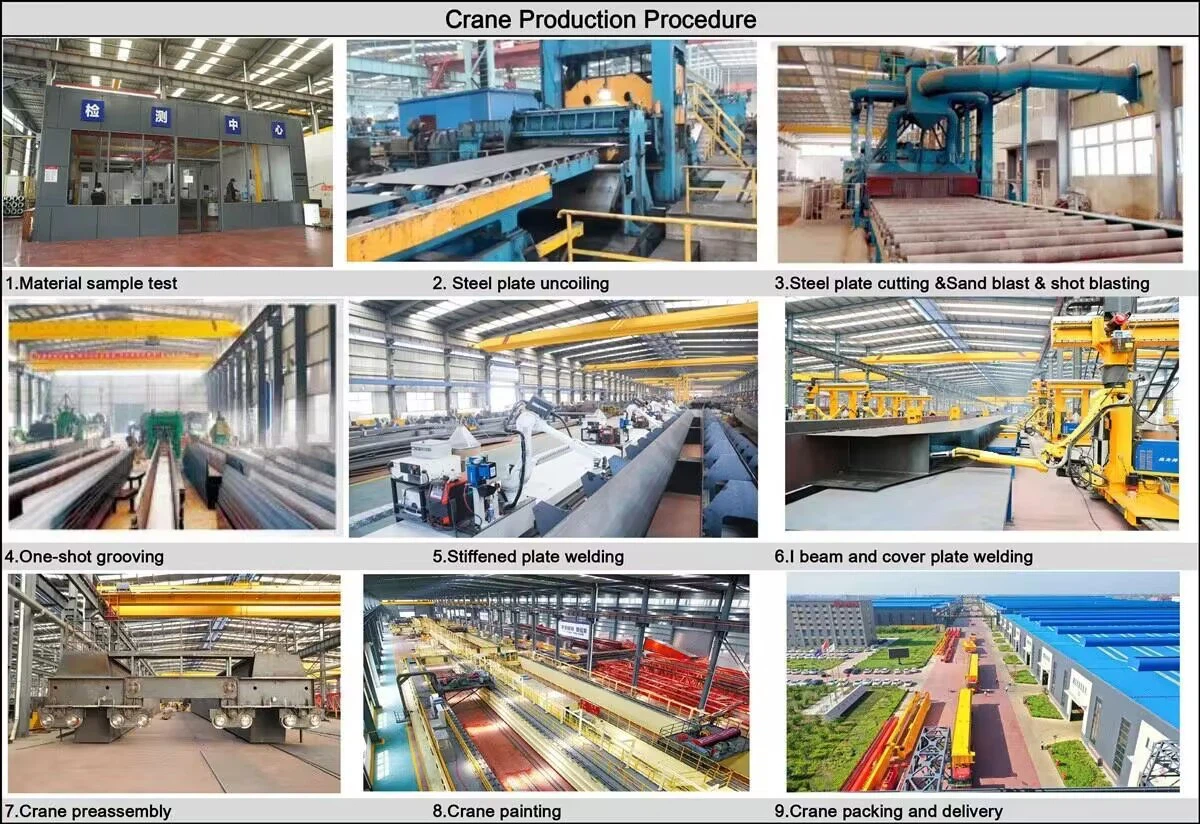
Crane production procedure
The production procedure for a 50-ton double beam overhead crane involves several key stages, from design to final testing. Below is a step-by-step outline of the typical manufacturing process:
1. Design & Engineering
Requirements Analysis: Determine client specifications (span, lifting height, duty cycle, power supply, etc.).
CAD Modeling: Create 3D models and detailed drawings for structural and mechanical components.
Load Calculations: Verify strength, deflection, and stability under dynamic/static loads.
Regulatory Compliance: Ensure adherence to standards (ISO, FEM, DIN, ANSI, or CMAA).
2. Material Procurement
Main Beams: Steel plates (Q235B/Q345B) for welded box girders or rolled sections.
End Carriages: Fabricated from steel profiles for rigidity.
Hoist & Trolley: Procure or manufacture components (gearbox, motor, wire rope, hooks, brakes).
Electricals: Motors, control panels, festoon/cable reels, limit switches.
3. Fabrication of Main Components
A. Double Girder Fabrication
Cutting & Welding: Steel plates are cut (laser/plasma) and welded into box girders.
Annealing: Stress-relieving to prevent distortion.
Machining: Drilling holes for connections and machining rail surfaces.
B. End Carriages
Assembly: Wheels, buffers, and drive mechanisms are mounted.
Alignment: Ensure parallel tracks for smooth movement.
C. Hoist & Trolley
Assembly: Gearbox, motor, drum, and brake systems are integrated.
Load Testing: Pre-testing of hoisting mechanism.
4. Surface Treatment
Shot Blasting: Clean surfaces for paint adhesion.
Priming & Painting: Anti-corrosion coatings (epoxy/zinc-rich).
5. Electrical System Installation
Wiring: Install power/signal cables along the crane bridge.
Control Panel: Fit VFDs (for variable speed), overload protectors, and PLCs (if automated).
Safety Devices: Limit switches, emergency stop, and overload protection.
6. Assembly & Integration
Erection: Girders are joined to end carriages; trolley and hoist are mounted.
Alignment: Verify wheel track parallelism and rail clearances.
Lubrication: Apply grease to gears, bearings, and moving parts.
7. Testing & Inspection
A. Factory Acceptance Tests (FAT)
No-Load Test: Run trolley/hoist across full span at all speeds.
Load Test:
Static Test: 125% rated load (50 ton → 62.5 ton) for 10 minutes.
Dynamic Test: 110% load (55 ton) with repeated lifts/movements.
Safety Checks: Verify brakes, limit switches, and emergency stops.
B. Final Inspection
Dimensional accuracy, weld quality, and electrical safety.
8. Disassembly & Packaging
Labeling: Mark components for easy onsite reassembly.
Protection: Waterproof wrapping for shipping.
9. Onsite Installation & Commissioning
Rail Alignment: Ensure runway rails are level and parallel.
Reassembly: Erect girders, install electricals, and calibrate.
Final Testing: Repeat load tests under client supervision.
10. Documentation & Handover
Manuals: Operation, maintenance, and parts manuals.
Certificates: Test reports, material certifications, and compliance documents.
Workshop view:
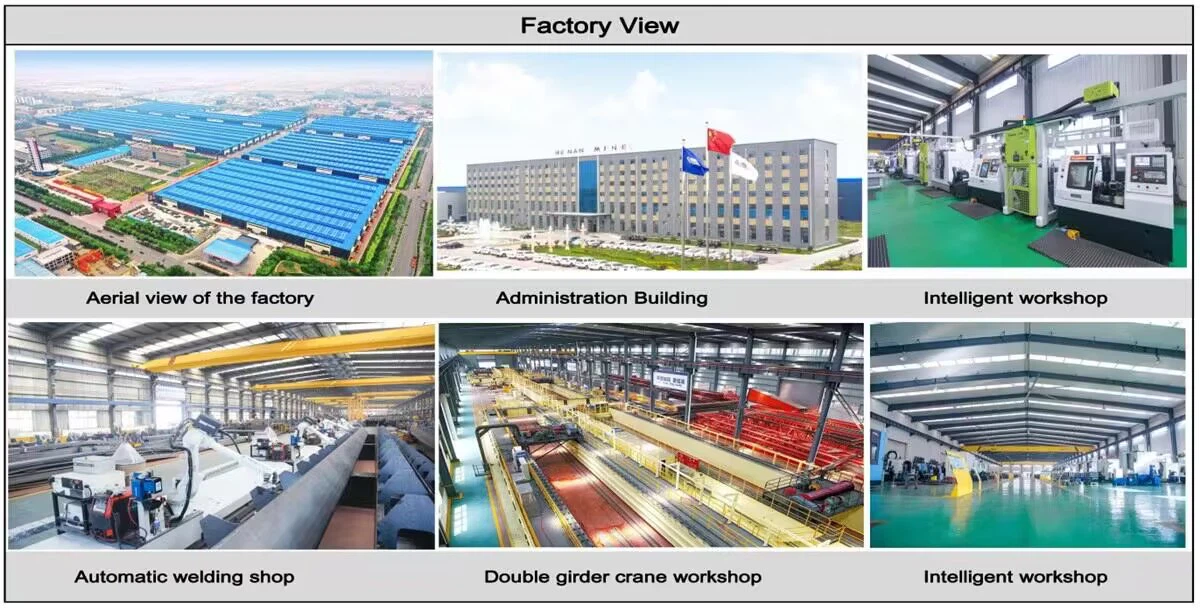
The company has installed an intelligent equipment management platform, and has installed 310 sets (sets) of handling and welding robots. After the completion of the plan, there will be more than 500 sets (sets), and the equipment networking rate will reach 95%. 32 welding lines have been put into use, 50 are planned to be installed, and the automation rate of the entire product line has reached 85%.


Hot Tags: hook double girder overhead crane, China hook double girder overhead crane manufacturers, suppliers, factory, Double Girder Overhead Travelling Crane, Double Girder Overhead Crane
You Might Also Like


Send Inquiry