







150ton Counterweight Bridge Launching Girder
A counterweight bridge launching girder is a type of bridge construction equipment used to install precast bridge segments over obstacles like rivers, roads, or valleys.
150-ton refers to its lifting capacity, meaning it can handle bridge segments up to 150 tons.
Counterweight system means it uses heavy weights (often steel blocks or concrete) to balance the girder while lifting heavy segments, preventing tipping or structural overload.
Unlike self-balancing girders that actively adjust via hydraulics, counterweight systems use passive weight distribution to maintain stability.

Core Function
The primary purpose of a 180ton bridge launcher is to lift, transport, and precisely place heavy prefabricated concrete or steel bridge components, typically weighing up to 180 tons (metric tons, ~165 US tons), during the construction of viaducts, overpasses, and highway bridges.
Key Design Parameters & Performance Specifications
| Parameter | Specification |
|---|---|
| Lifting Capacity (per girder) | 150 Metric Tons |
| Maximum Span (Pier to Pier) | 50 meters (Typical), customizable up to 60m |
| Minimum Curve Radius | 2,000 meters (can be designed for tighter radii) |
| Maximum Supported Grade | ±4% |
| Lifting Hoists | 2 x Main Hoists (typically 120-ton capacity each) |
| Hoist Lifting Speed | 0-5 m/min (variable speed control) |
| Trolley Traversing Speed | 0-10 m/min (variable speed control) |
| Main Beam Launching Speed | 0-5 m/min (variable speed control) |
| Machine Self-Propelling Speed | 0-5 m/min (variable speed control) |
| Control System | Centralized PLC with frequency control for all motions. Remote control operation. |
| Power Supply | 380V / 50Hz / 3 Phase (or as per project requirement) |

Pictures & Components
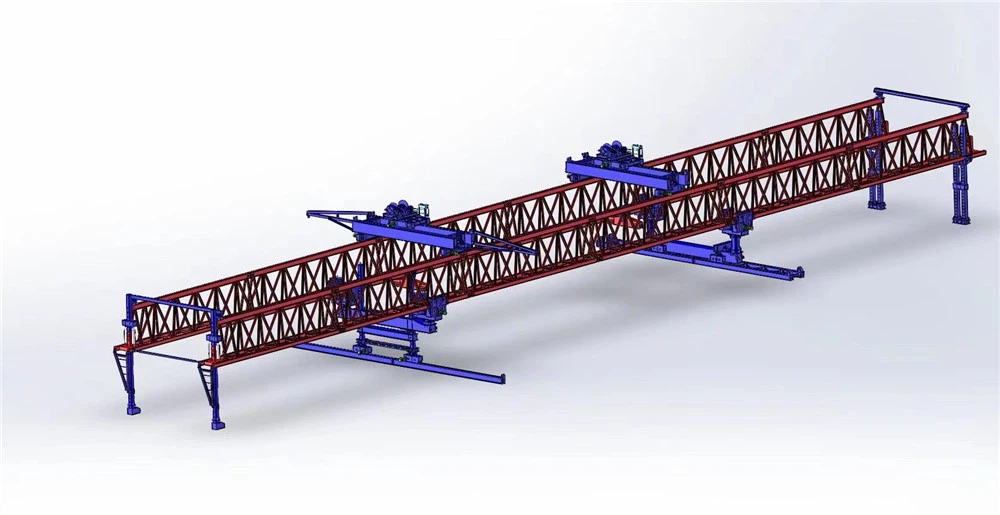
1. Main Girder (Bridge Frame)
Description: The long horizontal beam that spans the bridge piers.
Function: Supports the weight of the bridge segments and transfers loads to the support carriages.
Notes: Typically made of high-strength steel; designed to resist bending and torsion from the heavy segments.
2. Counterweight System
Description: Heavy blocks (steel or concrete) attached to the girder.
Function: Balances the girder during lifting and segment placement to prevent tipping.
Notes: Counterweights are adjustable depending on segment weight and span; they are crucial for stability during launching.
3. Lifting Mechanism
Components: Hydraulic jacks, hoists, or winches mounted on the girder.
Function: Lifts precast bridge segments from the transport vehicle or staging area and positions them onto the piers.
Notes: Must handle 150-ton segments safely with precise vertical control.
4. Launching Mechanism
Components: Hydraulic pushers, rails, or rollers that allow the girder to move forward span by span.
Function: Enables incremental launching of the bridge without removing the girder from its track.
Notes: Critical for long-span bridges where continuous movement is required.
5. Support Carriages / Bogies
Description: Wheeled or tracked units at the ends of the girder.
Function: Support the combined weight of the girder, counterweights, and bridge segment.
Notes: Often adjustable for pier height differences and to maintain level alignment.
6. Control Cabin / Control Panel
Description: Cabin or panel with joysticks, buttons, and displays.
Function: Operates lifting, launching, and movement systems safely.
Notes: Some systems have remote or semi-automated control with sensors monitoring tilt, load, and movement.
7. Safety Devices
Components: Load sensors, tilt sensors, limit switches, emergency stops.
Function: Prevents overload, tipping, or unsafe operation during lifting and launching.
Notes: Redundant safety features are critical when handling 150-ton segments.
8. Auxiliary Systems
Power Supply: Diesel engine, generator, or electric motors for hydraulics and hoists.
Walkways / Access Platforms: For operators and maintenance personnel.
Hydraulic Piping / Wiring: Connect lifting and counterweight adjustments to control systems.

Sketch

Advantages
1. Handles Extremely Heavy Loads
Can lift and place bridge segments weighing up to 150 tons, making it ideal for long-span or high-capacity bridges.
Reduces the need for multiple cranes or heavy scaffolding.
2. Stability Through Counterweights
Counterweights balance the girder during lifting and launching, preventing tipping.
Ensures safe operation even with asymmetrical or heavy loads.
Unlike self-balancing systems, counterweights provide passive stability, reducing complex hydraulic adjustments.
3. Reduces Need for Temporary Supports
Can launch segments without extensive scaffolding or falsework.
Useful for rivers, valleys, highways, or urban areas, where ground-based support is impractical.
4. Works in Challenging Terrain
Operates over areas where cranes cannot reach, like water bodies or congested urban zones.
Support carriages distribute weight efficiently over bridge piers.
5. High Precision
Counterweight system ensures smooth and stable lifting, reducing risk of misalignment.
Critical for precast segmental bridges, where precision placement is required.
6. Safety
Counterweight reduces overturning risks.
Typically integrated with load sensors, tilt alarms, and limit switches.
Provides mechanical redundancy-even if hydraulic adjustments fail, counterweights maintain balance.
7. Efficiency
Enables continuous segment launching, shortening construction time.
Reduces labor and equipment costs, as fewer cranes and scaffolds are needed.
8. Versatility
Can be used for curved, straight, or variable-span bridges.
Counterweights can be adjusted depending on span length and segment weight.

Application
1. Highway Bridges
Lifting and placing precast segments for long-span or multi-span highway bridges.
Reduces the need for temporary scaffolding, minimizing traffic disruption during construction.
2. Railway Bridges
Suitable for heavy railway bridges, including high-speed rail.
Can lift long, heavy precast segments without obstructing train lines.
3. River and Canal Crossings
Ideal for bridges over water bodies, eliminating the need for in-water supports.
Minimizes environmental impact on rivers, canals, and wetlands.
4. Viaducts and Elevated Expressways
Used for long elevated sections, such as urban flyovers or expressways.
Can continuously launch segments along multi-span viaducts.
5. Urban and Congested Areas
Works in tight spaces where cranes or scaffolding cannot be used.
Reduces construction footprint, important in dense urban zones.
6. Curved or Variable-Span Bridges
Capable of handling complex bridge geometries, including curved alignments.
Counterweights are adjustable to maintain balance on uneven spans.
7. Remote or Difficult Terrain
Bridges in mountainous or forested regions where conventional cranes cannot operate.
The girder can launch segments over valleys or uneven ground.

Production Procedure
Absolutely! Here's a detailed, step-by-step production procedure for a 150-ton counterweight bridge launching girder, covering everything from design to on-site installation:
1. Design & Planning
Load Analysis: Determine segment weight (up to 150 tons), span length, and support pier positions.
Structural Design:
Main girder design to resist bending, torsion, and shear.
Counterweight sizing and positioning to ensure stability during lifting and launching.
Mechanism Design:
Lifting system (hydraulic jacks, winches, or hoists).
Launching system (pushers, rollers, or sliding rails).
Safety Planning: Include load sensors, tilt sensors, limit switches, and emergency stops.
2. Material Preparation
Steel for Main Girder: High-strength steel plates or I-beams.
Counterweight Material: Steel blocks or concrete blocks of calculated weight.
Hydraulic Components: Cylinders, pumps, hoses, and valves.
Electrical Components: Motors, sensors, wiring, and control panels.
3. Fabrication of Components
Main Girder:
Cut, shape, and weld steel plates to form the girder structure.
Add stiffeners and reinforcement plates for heavy loads.
End Trucks / Bogies:
Weld frames and attach wheels/bearings for smooth movement on piers.
Counterweight Frames:
Fabricate supports for counterweight blocks.
Ensure adjustability for different segment weights and spans.
Lifting Mechanism:
Assemble hydraulic jacks, hoists, or winches.
Mount them on the girder with proper alignment.
4. Sub-Assembly
Attach end trucks, counterweight frames, and lifting mechanisms to the main girder.
Install trolleys or sliding systems for segment movement.
Preliminary checks for alignment and mechanical fit.
5. Control System Installation
Install control cabin, pendant, or remote control system.
Connect hydraulic, electrical, and sensor systems.
Integrate limit switches, overload protection, and emergency stops.
6. Testing & Calibration
No-Load Test: Move girder along piers, operate trolley, lifting and launching without load.
Load Test: Lift a 150-ton test segment or equivalent load.
Counterweight Test: Verify that counterweights properly balance the load and prevent tipping.
Safety Checks: Check limit switches, brakes, tilt sensors, and emergency stops.
7. Surface Protection
Clean steel surfaces.
Apply anti-corrosion paint or coating to main girder, end trucks, and counterweight frames.
8. Shipping & On-Site Assembly
Disassemble girder if necessary for transport.
Reassemble on-site over piers.
Adjust counterweights according to span length and segment weight.
9. Final Commissioning
Test lifting, launching, and segment placement with real bridge segments.
Verify stability, control systems, and safety devices.
Hand over for actual bridge construction.


Workshop View
The company has installed an intelligent equipment management platform, and has installed 310 sets (sets) of handling and welding robots. After the completion of the plan, there will be more than 500 sets (sets), and the equipment networking rate will reach 95%. 32 welding lines have been put into use, 50 are planned to be installed, and the automation rate of the entire product line has reached 85%.


Hot Tags: 150ton counterweight bridge launching girder, China 150ton counterweight bridge launching girder manufacturers, suppliers, factory
You Might Also Like


Send Inquiry