








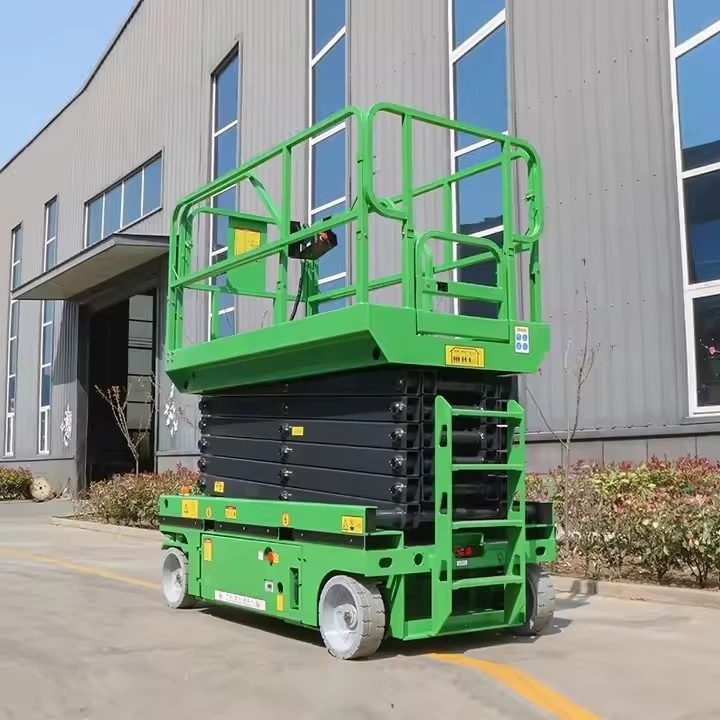


5ton-14m Hydraulic Scissor Lift Platform
Products Description
A 5-ton, 14-meter (approx. 46-foot) hydraulic scissor lift is a substantial piece of aerial work equipment. Its components can be categorized into several major systems.
Key Specifications
Capacity: 5 tons (10,000 lbs / approx. 5,000 kg)
Maximum Working Height: 14 meters (46 ft) - This is the platform height + a person's reach.
Platform Height: Typically 12-13 meters (39-43 ft) to the platform floor.
Lift Travel: Usually 10-12 meters (33-39 ft) of vertical scissor lift.
Key Components
1. Structural System (The Frame & Platform)
Platform (Deck): The work area. Includes a heavy-duty, anti-skid steel floor, often with a trap door for through-floor access. Rated for 5-ton (10,000 lbs) distributed load.
Platform Rails/Toeboards: Guardrails (often 42" high with a mid-rail) that surround the platform for operator safety. They are typically foldable or removable for transport and storage.
Gate: A self-closing gate at the entry point to the platform.
Scissor Arms (Lift Mechanisms): Multiple pairs of high-tensile steel, crisscrossed arms that provide the vertical motion. The number of stages (e.g., 2, 3, or 4) determines the lift height. Pivot points use heavy-duty pins and bronze bushings.
Base Frame (Chassis): The rigid, welded steel foundation that supports the entire machine. Houses the drive system, hydraulic tank, and often the batteries.
Outriggers/Stabilizers: Extendable legs (manual or hydraulic) that provide a wider, more stable footprint during operation, crucial for a 5-ton capacity at full height.
2. Power & Drive System
Power Source:
Electric: Common for indoor/clean use. Uses a 48V, 72V, or 80V DC battery bank (lead-acid or lithium-ion).
Engine-Powered: Diesel or LPG/propane engine for outdoor/rough terrain use. Provides greater power and extended runtime.
Hybrid: Combines a battery with an engine-driven charger for flexibility.
Drive Motors & Axles: Electric motors power the drive wheels (usually two-wheel drive). Includes a mechanical or hydraulic braking system.
Steering System: Can be rear-wheel steer, front-wheel steer, or all-wheel steer (often selectable). Uses hydraulic cylinders or electric actuators.
Tires: Choice of solid cushion (non-marking polyurethane) for indoors, or pneumatic (air-filled) for rough terrain and outdoors.
3. Hydraulic System (The "Lifting" Force)
Hydraulic Pump: The heart of the system. Can be electrically driven (DC motor) or mechanically driven by an engine. Creates the fluid flow and pressure.
Lift Cylinder(s): One or more single or double-acting hydraulic cylinders connected to the scissor arms. They extend to lift the platform.
Control Valves: A critical bank of valves, including:
Main Directional Control Valve: Controlled by the operator's "Up/Down" handle.
Velocity Fuse (Descent Valve): A safety device that locks hydraulic flow if a hose ruptures, preventing uncontrolled descent.
Pilot Check Valves: Hold the lift cylinder in position when stopped.
Hydraulic Reservoir (Tank): Stores the hydraulic fluid. Includes a filter, breather cap, and often a sight glass.
Hoses & Fittings: High-pressure hydraulic lines that connect all components.
4. Control & Electrical System
Control Boxes: One on the platform and one at ground level (on the base). Contain the logic controller, contactors, and fuses.
Platform Controls: A pendant or panel with buttons/switches for: Up/Down, Drive Forward/Reverse, Horn, Emergency Stop, and sometimes platform tilt.
Ground Controls: A key-switch and buttons (usually on the chassis) to lower the platform in an emergency or for setup. The key often enables/disables the machine.
Proportional Control: For smooth operation, the drive and steer functions are often proportional (the harder you push, the faster it goes).
Sensors & Safety Devices: Limit switches (upper/lower travel), tilt sensors, overload sensors, and pressure sensors.
5. Safety Systems (Critical for High Reach)
Mechanical Stops: Physical blocks that prevent over-extension of the scissor arms.
Manual Descent System: A hand pump or release valve to lower the platform during a power failure.
Pothole Protection: Covers or guards on the outriggers/scissor pivot points to prevent failure if the base frame contacts an obstruction.
Audible Alarm: Sounds when the lift is in motion or raised.
Emergency Stop (E-Stop) Buttons: Located on both control panels to cut all power.
Fall Arrest Anchor Points: D-rings on the platform for attaching personal fall protection lanyards (mandatory in many regions at this height).
6. Optional & Ancillary Components
Pothole Protector (Shoes): Large steel plates that attach to outriggers for soft ground.
Platform Extensions/Stingers: Manual or hydraulic extensions to increase platform reach or size.
Tiltable Platform: A deck that can tilt (often up to 20 degrees) for working on sloped surfaces like roofs.
Insulated Platform: For working near live electrical lines (often labeled as "Dielectric").
Lighting Kit: LED work lights for the platform and for ground travel.
Battery Charger: For electric models.
Key features
1. Load & Height Specifications
Maximum Load Capacity: 5,000 kg (5 tons).
Platform Height: 14 meters (vertical travel from ground to maximum elevation).
Platform Size: Typically large (e.g., 2.5m x 1.2m or custom) to accommodate heavy loads and personnel.
2. Structural & Mechanical Features
Scissor Mechanism: High-strength steel scissor arms for stable vertical lift.
Hydraulic System: Powerful hydraulic cylinder(s) with proportional control for smooth ascent/descent.
Steel Platform Deck: Anti-slip flooring, often with safety kickplates and guardrails.
Outriggers/Stabilizers: Extendable outriggers for enhanced stability at height.
3. Power & Mobility
Power Options:
Electric (battery) for indoor/quiet use.
Diesel for rough outdoor terrain.
Hybrid (dual power) for flexibility.
Drive System: Usually self-propelled with variable speed control (forward/reverse).
Maneuverability: Steer wheels (often with a tow mode) for precise positioning.
4. Safety Systems
Emergency Stop Buttons: On platform and base.
Safety Gates: Guardrail gates with interlock sensors.
Overload Protection: Prevents operation beyond rated capacity.
Hydraulic Safety Valves: Prevent free-fall in case of hose failure.
Pothole Protection: On outriggers to prevent ground instability.
Tilt Alarm: Warns of operating on uneven surfaces.
Manual Descent: Backup hand pump for emergency lowering.
5. Control & Operation
Dual Controls: Both platform and ground-level control panels.
Proportional Hydraulics: Smooth acceleration/deceleration.
Battery Indicator & Hour Meter: For maintenance tracking.
key applications
Here are its key applications, broken down by industry and use case:
1. Industrial Manufacturing & Maintenance
Heavy Machinery Installation & Repair: Ideal for positioning heavy parts (motors, gearboxes, pumps) onto assembly lines or during maintenance of large industrial machines.
Plant & Overhead Maintenance: Accessing overhead cranes, conveyor systems, piping, ductwork, lighting, and sprinkler systems in factories and warehouses. Its capacity allows it to carry tools and replacement parts.
Warehouse Operations: In facilities with very high racking (14m is ideal for 4-5 level selective racking), it's used for stocking, picking, and performing structural or fire system maintenance.
2. Construction & Steel Erection
Pre-Cast Concrete Installation: Lifting and positioning heavy pre-cast concrete panels, beams, and other components.
Steelwork: Assisting in the bolting and welding of steel beams, trusses, and purlins at height. The platform can hold multiple workers, their tools, and equipment.
Facade & Glazing Work: Installing heavy curtain wall panels, windows, and exterior cladding materials on medium-rise buildings.
Interior Fit-Outs: Efficient for installing heavy HVAC units, ductwork, electrical panels, and signage in atriums or high-ceiling commercial spaces.
3. Power Generation & Utilities
Power Plant Maintenance: Essential for work on turbines, boilers, transformers, and switchgear within power plants (thermal, hydro, nuclear).
Substation Work: Safely elevating personnel and heavy equipment for maintenance of high-voltage equipment and structures.
Wind Turbine Maintenance: Often used for internal component access and external work on the nacelle or tower of onshore turbines.
4. Aviation & Aerospace
Aircraft Maintenance: Perfect for work on regional jets, military aircraft, and larger commercial aircraft (like the Boeing 737 or Airbus A320 series). It provides stable, high-reaching access to wings, tail sections, engines, and fuselage for heavy repair tasks, painting, and inspection.
Hangar Maintenance: Servicing hangar doors, lighting, and fire suppression systems at great heights.
5. Shipping & Heavy Transport
Shipbuilding & Repair: Accessing superstructures, hulls, and cargo holds for welding, painting, and fitting heavy components.
Port Machinery Maintenance: Repairing ship-to-shore cranes, rubber-tired gantry (RTG) cranes, and other heavy port equipment.
Railcar & Locomotive Repair: Providing access to the tops and sides of freight cars and engines.
6. Infrastructure & Civil Works
Bridge Inspection & Repair: Reaching underneath decks and to the sides of piers and abutments while carrying necessary jackhammers, grinders, and welding gear.
Tunnel & Dam Maintenance: Working on lighting, ventilation, safety systems, and concrete surfaces in large-scale infrastructure.
Advantages
1. High Capacity & Robust Performance
5-Ton Load Capacity: This is its defining feature. It can safely lift massive loads-such as pallets of materials, heavy machinery, multiple workers with tools, or bundled construction supplies-in a single cycle. This eliminates the need for multiple lifts or manual handling of heavy items at height, drastically improving efficiency and safety.
Stable Platform for Heavy Work: The scissor mechanism and heavy-duty design provide an exceptionally stable and vibration-damped platform, even at full load and height. This is crucial for precision work like machinery installation, steel fitting, or handling fragile heavy items.
2. Significant Working Height & Large Platform
14m Platform Height: Provides a safe working reach of approximately 14-15 meters (46-49 feet). This covers a wide range of multi-story industrial tasks, including:
Factory ceiling maintenance (lights, sprinklers, HVAC).
Steel structure construction and painting.
Warehouse racking maintenance and loading.
Shipbuilding and large assembly hangars.
Spacious Platform Area: The platform is typically large enough (e.g., 2.5m x 1.2m or larger) to accommodate multiple workers, tools, and materials comfortably, promoting productivity.
3. Productivity & Efficiency Advantages
Eliminates Scaffolding: For repetitive or mobile tasks, it saves the enormous time and labor cost of erecting and dismantling scaffolding.
Horizontal Mobility: Equipped with drivable capabilities (usually rough-terrain models), it can be easily repositioned by the operator on the platform while elevated, creating a "mobile work station." This is a massive advantage for long linear tasks like piping, welding, or cladding.
Fast Cycle Times: Hydraulic systems provide smooth, relatively fast lifting and lowering compared to manual alternatives, getting workers and materials to the work zone quickly.
4. Safety & Operational Advantages
Superior Stability: The wide outriggers (on rough-terrain models) or the large chassis provide a very stable base, preventing tipping. The scissor mechanism itself is inherently stable.
Integrated Safety Features: Standard features include:
Guardrails & Toeboards: Full perimeter protection.
Pothole Protection (on some models): Safety bars that prevent lowering if an obstruction is detected.
Emergency Descent System: Allows manual lowering in case of power failure.
Tilt/Alarm System: Alerts the operator if the platform becomes unstable.
Compliance: Meets international safety standards (like ANSI/SAIA A92.20, EN 1495).
5. Versatility & Adaptability
Rough-Terrain vs. Indoor Models:
Rough-Terrain (RT): Has large pneumatic tires, 4-wheel drive, and outriggers for use on challenging outdoor sites (construction, yards).
Smooth Electric (SE): Quiet, zero-emission, and compact for indoor factory/warehouse use.
Platform Customization: Can often be fitted with options like:
Foldable/Drop Gates: For easy loading from a forklift.
Tool Trays & Material Racks.
Specialized Power Outlets (110V/220V, pneumatic) for tools.
6. Power & Environmental Options
Hydraulic Power: Provides smooth, powerful, and controllable lifting force. Modern systems are efficient and reliable.
Dual & Green Power: Many models offer dual power (diesel for outdoors, electric for indoors) or are fully electric, reducing emissions and noise for sensitive environments.
Parameters table

Pictures


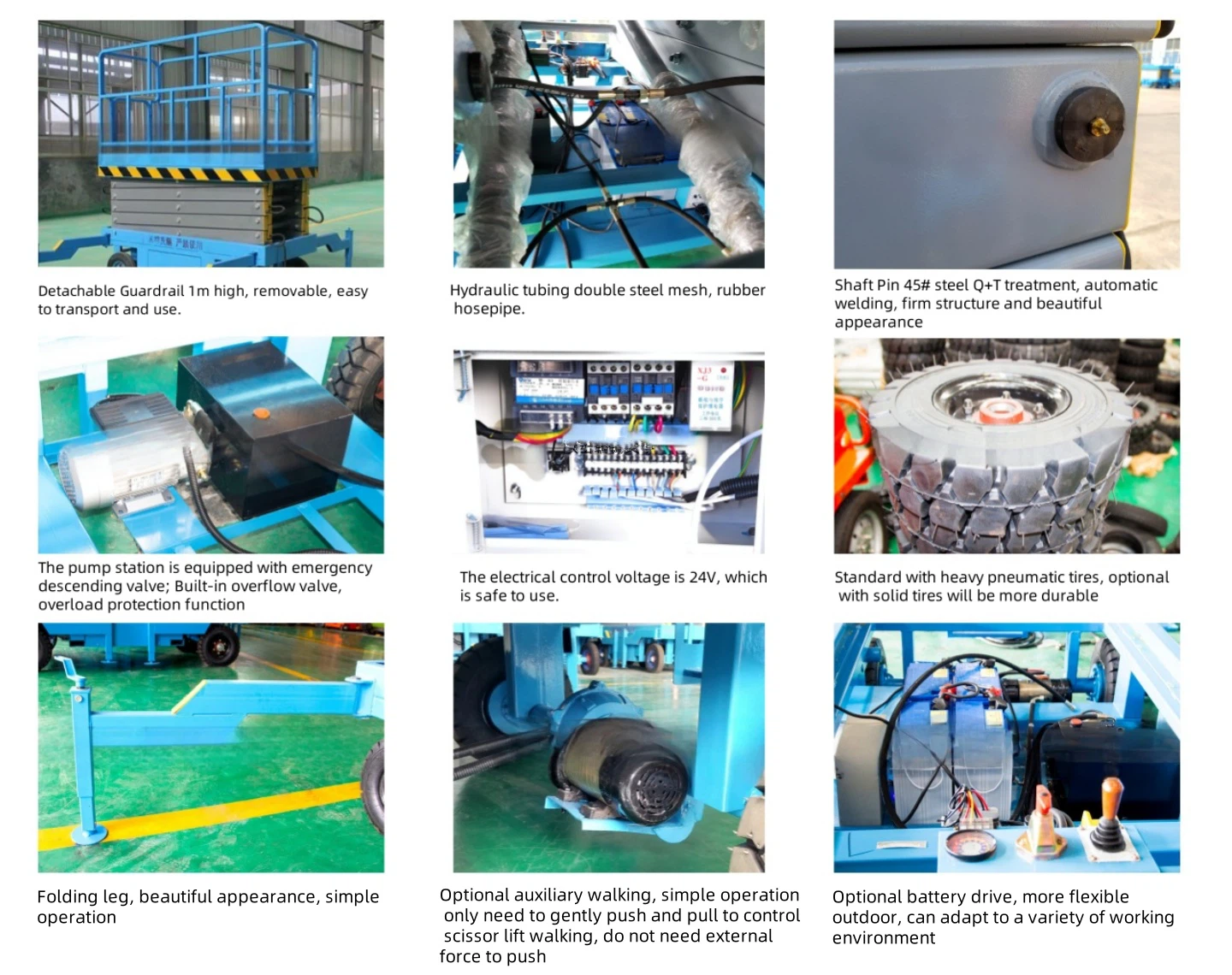
Parts Details

Product production process
The production process of a 15-ton hydraulic scissor lift platform involves several key stages, from design and material selection to assembly and testing. Below is a detailed breakdown of the manufacturing process:
1. Design & Engineering
Conceptualization: Define specifications (load capacity, lift height, platform size, power source, etc.).
CAD Modeling: Use 3D design software (SolidWorks, AutoCAD) to create detailed schematics.
Structural Analysis: Finite Element Analysis (FEA) to ensure strength and stability under load.
Hydraulic System Design: Calculate cylinder size, pump capacity, and valve requirements.
2. Material Procurement
Steel Selection: High-grade steel (Q235B/Q345B) for the scissor arms, platform, and base.
Hydraulic Components: Pumps, cylinders, hoses, and valves from certified suppliers.
Electrical Components: Motors, control panels, sensors, and wiring.
Other Materials: Polyurethane or rubber wheels, safety rails, and non-slip decking.
3. Cutting & Fabrication
Laser/Plasma Cutting: Precision cutting of steel plates for scissor arms, platform, and base.
Bending & Welding:
Scissor arms are bent and welded into X-shaped linkages.
Platform and base frames are welded for structural integrity.
Surface Treatment:
Sandblasting to remove rust and impurities.
Primer and paint coating (powder coating for durability).
4. Hydraulic System Assembly
Cylinder Installation: Mount hydraulic cylinders to the scissor mechanism.
Pump & Motor Setup: Install hydraulic pump, electric/diesel power unit, and hoses.
Valve & Control Integration: Fit control valves, pressure relief valves, and manifolds.
5. Electrical & Control System Installation
Wiring: Connect motors, limit switches, and emergency stop buttons.
Control Panel: Install push-button or remote controls for lifting/lowering.
Safety Devices: Add overload sensors, tilt alarms, and emergency descent valves.
6. Mechanical Assembly
Scissor Mechanism Assembly: Connect scissor arms with pivot bolts and bearings.
Platform Mounting: Secure the platform to the top of the scissor structure.
Outriggers/Stabilizers: Attach if required for additional stability.
7. Testing & Quality Control
Load Testing: Verify 15-ton capacity with incremental weights (125% overload test).
Hydraulic Pressure Test: Check for leaks and system stability.
Cycle Testing: Repeated lifting/lowering to ensure smooth operation.
Safety Checks: Verify emergency stop, tilt sensors, and manual lowering function.
8. Finishing & Packaging
Final Paint Touch-Up: Ensure corrosion resistance.
Labeling & Branding: Add safety labels, capacity plates, and logos.
Packaging: Protect with plastic wrap or wooden crates for shipping.
9. Certification & Documentation
Compliance: Ensure adherence to ANSI, OSHA, or CE standards.
User Manuals: Provide operation and maintenance guides.
Warranty & Support: Finalize after-sales service terms.
Workshop view:
The company has installed an intelligent equipment management platform, and has installed 310 sets (sets) of handling and welding robots. After the completion of the plan, there will be more than 500 sets (sets), and the equipment networking rate will reach 95%. 32 welding lines have been put into use, 50 are planned to be installed, and the automation rate of the entire product line has reached 85%.


Hot Tags: 5ton-14m hydraulic scissor lift platform, China 5ton-14m hydraulic scissor lift platform manufacturers, suppliers, factory
You Might Also Like


Send Inquiry