







Wall Mounted Crane
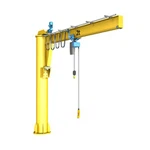
A Wall Mounted Crane is a space-saving lifting solution designed for workplaces with limited floor space. Unlike traditional floor-standing cranes, this type of crane is fixed to a wall or a vertical support structure, allowing for efficient material handling without occupying valuable ground area.

Key Features
A Wall mounted crane is a type of jib crane that is fixed to a wall or building column, allowing for efficient lifting and movement of materials within a workspace. Here are its key features:
1. Space-Saving Design
Mounted on a wall or column, eliminating the need for floor space.
Ideal for confined work areas where floor cranes are impractical.
2. High Load Capacity
Typically designed to lift loads ranging from 250 kg to 5 tons.
Customizable based on specific lifting requirements.
3. Rotation & Coverage
Offers 180° to 200° rotation, depending on the model.
Covers a semi-circular working area for better material handling.
4. Easy Installation & Maintenance
Can be mounted on existing building structures.
Requires minimal maintenance compared to overhead cranes.
5. Versatile Applications
Commonly used in workshops, warehouses, assembly lines, and manufacturing facilities.
Suitable for repetitive lifting tasks and localized material handling.
6. Smooth & Precise Operation
Can be operated manually or with an electric hoist for efficiency.
Provides controlled and precise load positioning.
7. Cost-Effective Solution
More affordable than gantry or overhead cranes.
Reduces labor costs by enhancing productivity.

Parts & Components
A Wall mounted crane is a type of jib crane that is attached to a building's wall or column, allowing it to lift and move loads in a specific area without requiring a floor-mounted support structure. Here are the main components of a wall-mounted crane:
1. Jib Arm (Boom)
The horizontal beam that extends from the wall or column.
It supports and guides the hoist and trolley.
Can be a straight beam or an articulating arm for greater flexibility.
2. Wall Bracket or Mounting Structure
Attaches the crane securely to the wall or a structural column.
Ensures stability and load-bearing capacity.
May include reinforcement plates or brackets.
3. Trolley
Moves along the jib arm to position the hoist.
Can be manual push-pull, geared, or motorized.
4. Hoist
Lifts and lowers the load.
Can be electric, pneumatic, or manual (chain hoist).
Equipped with a lifting hook for attaching loads.
5. Rotation Mechanism
Allows the jib arm to rotate for better load positioning.
Rotation can be manual (push/pull) or motorized.
6. End Stops
Prevents the trolley from moving beyond the safe operating range of the jib arm.
7. Control System
Used to operate the hoist and trolley.
Can be push-button pendant, radio remote control, or wired control.
8. Power Supply
Provides electricity to the hoist and motorized components.
Includes a power cable system, festoon system, or conductor bars.

Parameters

Sketch

Advantages
A Wall mounted crane is a type of jib crane that is attached to a wall or vertical column, allowing it to lift and move loads efficiently within a specific work area. Here are the key advantages of using a wall-mounted crane:
1. Space-Saving Design
Unlike floor-mounted cranes, a wall-mounted crane does not require a foundation or floor space, making it ideal for facilities with limited space.
2. Cost-Effective
Since it does not require a floor-mounted support structure, installation costs are lower compared to freestanding jib cranes or overhead cranes.
3. High Efficiency & Productivity
Provides quick and easy lifting, reducing manual labor and increasing workplace efficiency.
Supports fast material handling within a fixed workstation.
4. Increased Safety
Helps prevent workplace injuries by reducing the need for manual lifting.
Improves load control, minimizing the risk of accidents.
5. Easy Installation & Maintenance
Simple installation process as it is mounted on an existing wall or column.
Requires minimal maintenance compared to larger crane systems.
6. Versatile Applications
Commonly used in manufacturing, warehouses, assembly lines, and maintenance workshops.
Suitable for handling medium to light loads in confined spaces.

Application
A Wall mounted crane is a type of jib crane that is attached to a wall or vertical structure, allowing it to lift and move loads within a limited workspace. These cranes are commonly used in industrial settings where floor space is limited.
Applications of Wall-Mounted Cranes
Manufacturing Plants
Used for lifting and positioning heavy components during assembly.
Supports workstations for welding, machining, and fabrication.
Workshops & Maintenance Facilities
Ideal for moving tools, engines, and other equipment in repair shops.
Helps in lifting heavy machinery parts during maintenance.
Warehouses & Storage Areas
Assists in loading and unloading pallets or materials.
Facilitates the movement of goods between racks and workstations.
Automotive Industry
Used in car repair workshops for lifting engines and other vehicle parts.
Helps in assembling automotive components.
Shipbuilding & Marine Industry
Lifts ship components and machinery in confined dock areas.
Assists in equipment maintenance onboard ships.
Textile & Paper Industries
Moves large rolls of fabric or paper efficiently.
Supports production processes that require material handling.
Steel & Metalworking Industry
Handles heavy steel plates, pipes, and metal parts.
Used in cutting, welding, and assembly processes.

Production Procedure
The production procedure of a wall-mounted crane involves several key steps, from design to final assembly and quality inspection. Here's an overview of the process:
1. Design & Engineering
Determine the crane's specifications (load capacity, span, lifting height, and movement range).
Create detailed engineering drawings and 3D models.
Perform structural calculations to ensure safety and compliance with international standards (e.g., FEM, ISO, or CMAA).
2. Material Procurement
Source high-quality steel for the main components (beam, columns, and supports).
Procure motors, hoists, wire ropes, electrical components, and fasteners.
Ensure materials meet quality standards through incoming inspection.
3. Cutting & Shaping
Cut steel plates and profiles to required dimensions using CNC cutting machines, laser cutting, or plasma cutting.
Bend or shape components as needed for assembly.
4. Welding & Fabrication
Weld the main components (wall brackets, beams, and supports) according to the design.
Perform non-destructive testing (NDT) on critical weld joints to check for defects.
Conduct stress-relieving processes if required.
5. Machining
Drill precise holes for bolts, brackets, and electrical wiring.
Machine components such as bearing seats and motor mounting points for accurate fitting.
6. Surface Treatment & Painting
Perform sandblasting to remove rust and impurities.
Apply primer and anti-corrosion coatings.
Paint with durable industrial coatings to withstand harsh environments.
7. Electrical System Installation
Install electrical components, including motors, limit switches, control panels, and wiring.
Test electrical connections to ensure functionality and safety.
8. Assembly & Pre-Testing
Assemble the crane structure, hoist, and electrical systems.
Conduct pre-testing to verify alignment, movement, and operation.
9. Load Testing & Quality Inspection
Perform load tests to confirm lifting capacity and safety.
Check mechanical, electrical, and control systems for proper operation.
Ensure compliance with safety standards before shipment.
10. Packaging & Delivery
Disassemble parts if required for transportation.
Pack components securely with protective materials.
Arrange logistics for delivery to the installation site.
11. Installation & Commissioning
Install the crane at the customer's facility.
Perform on-site testing, calibration, and final commissioning.
Provide training for operators on safe usage and maintenance.

Workshop View
Henan Mine Crane Co., Ltd has implemented a smart equipment management platform and deployed 310 sets of handling and welding robots. Upon the fulfillment of the initiative, the total number of sets will exceed 500, achieving a 95% equipment networking rate. Currently, 32 welding lines are operational, with plans to install an additional 50. The overall automation rate for the entire product line has already reached 85%.


Hot Tags: wall mounted crane, China wall mounted crane manufacturers, suppliers, factory
Previous
Wall Jib CraneYou Might Also Like


Send Inquiry