







Traveling Gantry Cranes
Products Description
Why Choose a Traveling Gantry Crane?
✔ More flexible than fixed cranes
✔ Stronger than mobile cranes for repetitive tasks
✔ Safer than forklifts for oversized loads
Choosing the Right Traveling Gantry Crane
Load Capacity (1 ton to 500+ tons).
Span & Height (Customizable for workspace).
Traveling Speed (Manual, electric, or variable speed).
Power Supply (Electric, hydraulic, or manual).
Environment (Indoor, outdoor, explosion-proof).
Types of Traveling Gantry Cranes
| Type | Features | Best For |
|---|---|---|
| Single Girder | Lightweight, cost-effective, easy assembly. | Workshops, small factories, indoor use. |
| Double Girder | Higher capacity, more stable, longer spans. | Heavy industries, shipyards, steel plants. |
| Semi-Gantry Crane | One leg on a rail, the other on the ground. | Uneven workspaces, outdoor applications. |
| Rubber-Tired (Mobile) | No rails needed, moves freely on wheels. | Construction sites, temporary setups. |
| Adjustable Height | Telescopic legs for variable lifting heights. | Warehouses with changing storage needs. |
Place of Origin:Henan, China
Warranty:2 years
Weight (KG):60000 kg
Video outgoing-inspection:Provided
Machinery Test Report:Provided
Application:warehouses,factory and other place
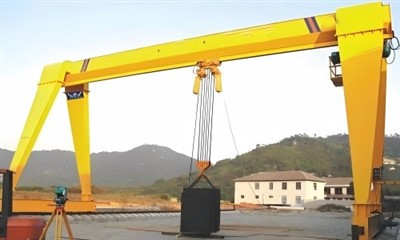
Crane type:box type gantry crane
Travelling speed:20m/min
Lifting mechanism:Electric Hoist
Control method:Ground Control+ Remote Control (customized)
Working duty:A5
Working Temperature:-20~+40℃
Industrial voltage:380V50HZ3Phanse or other
Color:Customised
Customization:Accepted

Pictures & Components
A traveling gantry crane consists of several key structural, mechanical, and electrical components that work together to enable efficient load handling and movement. Below is a comprehensive breakdown of its major parts:
1. Main Structural Components
A. Gantry Frame
Bridge Girder (Single or Double Girder)
The horizontal beam that carries the trolley and hoist.
Single girder: Lighter, cost-effective (up to ~20 tons).
Double girder: Higher capacity, more stable (20+ tons).
Legs (End Frames)
Vertical supports that hold the bridge girder.
Can be fixed-height or adjustable (telescopic).
Cross Beams & Bracing
Reinforce the structure for stability under load.


B. Traveling Mechanism (Movement System)
End Trucks (Wheel Assemblies)
Contain wheels for rail or floor movement.
Rail-mounted: Steel wheels run on fixed tracks.
Rubber-tired: Moves freely on smooth floors.
Drive Motors & Gearboxes
Power the movement along rails/floors (electric or hydraulic).
Braking System
Electromagnetic or mechanical brakes for safe stopping.


2. Lifting & Hoisting Components
A. Hoist Unit
Electric Chain Hoist (Light to medium loads, 0.5–20 tons).
Wire Rope Hoist (Heavy-duty, 5–500+ tons).
Manual Hoist (For small-scale or backup use).

B. Trolley (Hoist Carrier)
Moves the hoist horizontally along the girder.
Motorized trolley: Powered by electric drive.
Manual trolley: Pushed by hand (light loads).
C. Lifting Accessories
Hooks (Swivel, safety latch, or C-hooks).
Slings & Shackles (For securing loads).
Spreader Bars (For balanced lifting).

3. Control & Power Systems
A. Control System
Pendant Control (Wired Remote) – Hanging control panel.
Radio Remote Control – Wireless operation.
Cabin Control – For large industrial cranes.
B. Power Supply
Electric: 220V/380V/480V (for motorized cranes).
Hydraulic: Used in heavy-duty mobile gantries.
Manual: No power needed (hand-chain operation).

.
4. Safety & Support Components
A. Safety Features
Limit Switches (Prevents over-travel).
Overload Protection (Auto-shutoff if capacity exceeded).
Anti-Collision System (For multiple cranes).
Emergency Stop Button (Instant shutdown).
B. Support & Stabilization
Rail System (For guided movement).
Outriggers/Stabilizers (For mobile gantries).
Bumpers & Buffers (Shock absorption).

5. Optional Add-Ons
✔ Variable Speed Control (For precision lifting).
✔ Weighing System (Load measurement).
✔ Automation (PLC Control) – For smart operations.
✔ Weatherproofing – For outdoor use.

Sketch

Main technical

Advantages
Traveling gantry cranes offer unique benefits that make them indispensable in various industries. Here are their key advantages:
1. Enhanced Mobility & Flexibility
Rail or wheel-mounted movement allows coverage of large work areas.
Adjustable spans and heights adapt to different workspace requirements.
Can be relocated as needed, unlike fixed bridge cranes.
2. High Load Capacity & Durability
Handles 1 to 500+ tons, depending on design (double girder for heavy loads).
Robust steel/aluminum construction ensures long-term durability.
3. Cost-Effective Solution
Lower installation costs compared to overhead bridge cranes.
No permanent foundation required for most models.
Energy-efficient electric or manual operation options.
4. Improved Workspace Utilization
Does not require supporting columns, maximizing floor space.
Ideal for outdoor use (construction sites, shipyards).
5. Safety & Precision
Anti-sway technology for stable load positioning.
Overload protection & emergency brakes prevent accidents.
Smooth control (variable speed options available).
Application:
1. Construction & Heavy Industry
Steel beam erection in building projects.
Precast concrete handling at construction sites.
2. Shipping & Port Operations
Loading/unloading ship components in dry docks.
Container handling in small ports/logistics yards.
3. Manufacturing & Warehousing
Machinery assembly in factories.
Heavy pallet movement in warehouses.
4. Railway & Energy Sector
Locomotive maintenance in repair shops.
Wind turbine component installation.
5. Event & Stage Setup
Concert stage construction (for heavy equipment).
Temporary installation at exhibition halls.
Crane production procedure
1. Design and Engineering
Requirement Analysis: Define capacity, span, lift height, travel distances, control mode, and workshop constraints.
Structural Design: Design main girder, end carriages, legs, and connections according to relevant standards (ISO, FEM, GB).
Mechanical Components Selection: Choose motors, hoists, wheels, brakes, control system, safety devices.
Electrical Design: Control panel layout, wiring diagrams, power supply design.
Drawings and Approval: Prepare detailed fabrication and assembly drawings, get client approval.
2. Material Procurement
Purchase steel plates, profiles, motors, gearboxes, wheels, electrical components, and safety devices.
Verify material certifications and quality documents.
3. Steel Fabrication
Cutting: Steel plates and profiles cut to size using plasma, laser, or flame cutting.
Forming: Bending or rolling steel as per design.
Welding: Assemble main girder, end carriages, and legs using MIG or manual welding.
Machining: Machine mounting holes, wheel seats, bearing seats, and flange surfaces.
Heat Treatment: Stress relieving welding distortions if required.
4. Surface Treatment
Grinding: Smooth weld seams and surfaces.
Cleaning: Remove rust, oil, and contaminants.
Painting: Apply primer and finish coats (usually epoxy or polyurethane paint) for corrosion protection.
5. Component Assembly
Install wheels, bearings, hoist, motors, brakes, and electrical devices on the crane structure.
Assemble control panel and wiring.
6. Testing and Quality Control
Dimensional Inspection: Check all critical dimensions.
Load Testing: Perform rated load and overload tests according to standards.
Function Testing: Verify smooth operation of hoist, trolley, crane travel, brakes, and safety devices.
Electrical Testing: Check control circuits, emergency stops, alarms, limit switches.
Documentation: Prepare test reports and certificates.
7. Packaging and Delivery
Disassemble parts if needed for transport.
Protect components with rust preventatives and packaging materials.
Arrange shipping to customer site.
8. Installation and Commissioning (at customer site)
Assemble crane on site (main girder, legs, wheels).
Align rails or prepare floor surface.
Connect electrical power and controls.
Perform on-site testing and operator training.

Workshop view:
The company has installed an intelligent equipment management platform, and has installed 310 sets (sets) of handling and welding robots. After the completion of the plan, there will be more than 500 sets (sets), and the equipment networking rate will reach 95%. 32 welding lines have been put into use, 50 are planned to be installed, and the automation rate of the entire product line has reached 85%.


Hot Tags: traveling gantry cranes, China traveling gantry cranes manufacturers, suppliers, factory, Gantry Crane, Electric Hoist Single Girder Gantry Crane, Single Girder Gantry Crane
You Might Also Like



Send Inquiry