










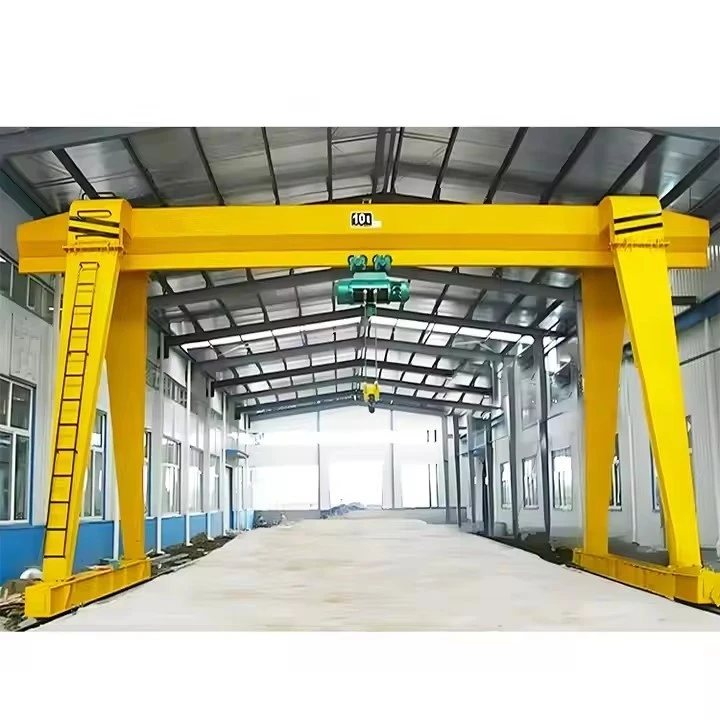
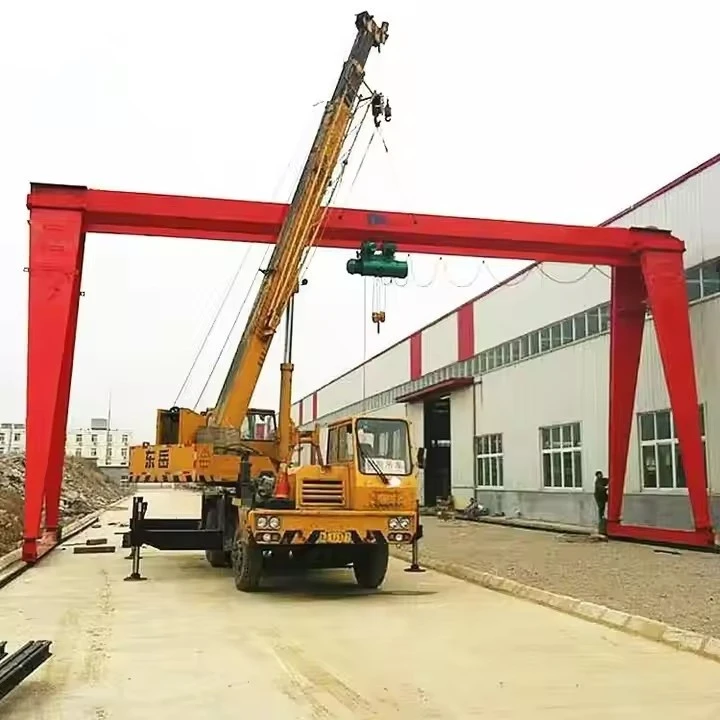
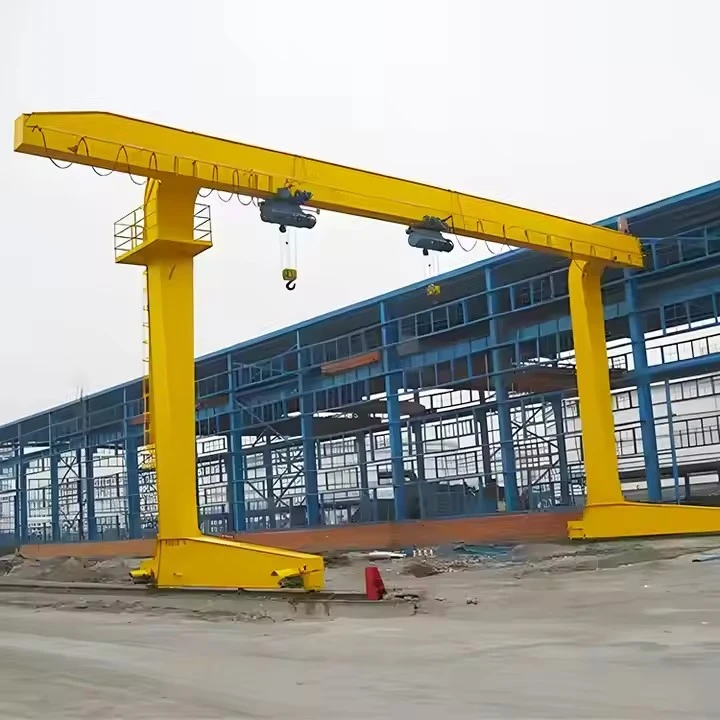
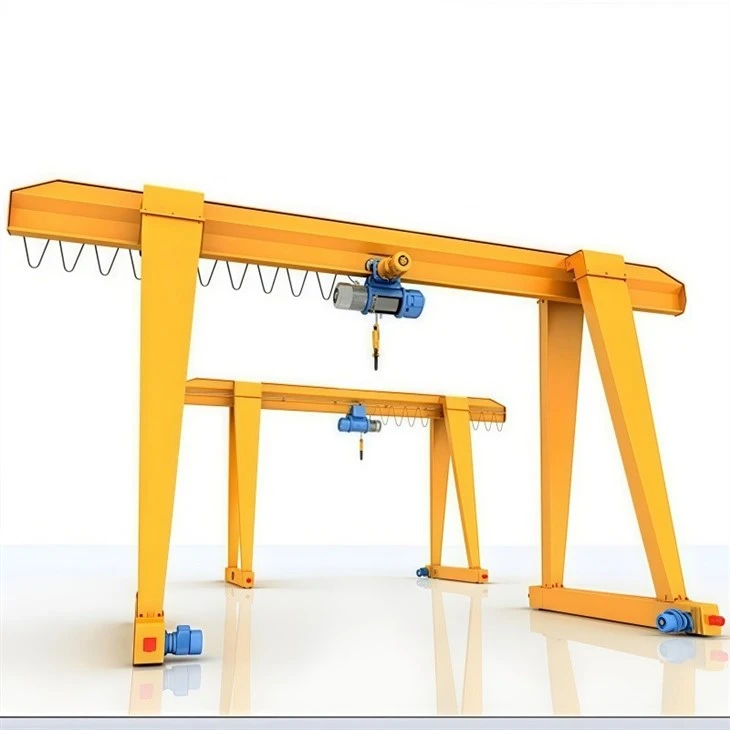
Indoor Electric Hoist 10 Ton Gantry Crane
Products Description
Key Features of a 10-Ton Indoor Electric Hoist Gantry Crane
Load Capacity – Designed to lift up to 10 metric tons (10,000 kg).
Electric Hoist – Equipped with an electric chain or wire rope hoist for smooth and efficient lifting.
Gantry Structure – Consists of two vertical legs and a horizontal beam (single or double girder).
Indoor Use – Designed for controlled environments (no exposure to harsh weather).
Mobility – Can be fixed or equipped with casters/wheels for movement (manual or motorized travel).
Control System – Pendant control (wired or wireless) for safe and precise operation.
Why Choose an Indoor Electric Gantry Crane Over Other Options?
| Feature | Indoor Gantry Crane | Overhead Crane | Jib Crane | Forklift |
|---|---|---|---|---|
| Mobility | ✅ (Can be moved) | ❌ (Fixed) | ❌ (Fixed) | ✅ |
| Capacity | Up to 10+ tons | Up to 100+ tons | Up to 5 tons | Up to 10 tons |
| Space Needed | Minimal (no runway beams) | Requires support structure | Small footprint | Needs aisle space |
| Precision | High (electric control) | High | Medium | Low |
| Cost | Affordable | Expensive | Low | Moderate |
| Indoor Use | ✅ Best suited | ✅ | ✅ | ✅ (but fumes possible) |
Lifting Capacity: 5 tons (5,000 kg)
Span: 3m–10m (adjustable)
Lifting Height: 3m–6m (customizable)
Hoist Type: Electric wire rope hoist (CD/MD type) or chain hoist
Travel System: Manual push or motorized travel (optional)
Wheel Type: Nylon/PU (indoor) or steel (rail-guided)
Material: High-grade steel (Q235B/Q345B)
Control: Pendant control (wired/wireless)
Power Supply: 380V/50Hz (3-phase) or 220V (single-phase)

Pictures & Components
A 10-ton indoor electric hoist gantry crane consists of several key components that work together to ensure safe and efficient lifting operations. Below is a detailed breakdown of the main components:
1. Gantry Crane Frame (Main Structure)
Vertical Legs (Uprights) – Provide support and stability; can be fixed or adjustable in height.
Cross Beam (Girder) – The horizontal beam that carries the hoist and trolley.
Single Girder – Lighter, more economical (common for 10-ton capacity).
Double Girder – More robust, used for higher precision or frequent heavy-duty lifting.
Bracing & Reinforcements – Diagonal supports to prevent swaying under load.


2. Electric Hoist (Lifting Mechanism)
Motor – Powers the lifting and lowering functions (typically 3-phase AC motor).
Lifting Gear –
Chain Hoist (e.g., CM Lodestar, Yale) – Compact, good for moderate lifting speeds.
Wire Rope Hoist (e.g., Demag, ABUS) – Smoother, faster lifting for heavy loads.
Hook Block – Fitted with a swivel hook for attaching loads.
Brake System – Ensures load stability and prevents accidental drops.


3. Trolley (Hoist Carrier)
Electric Trolley – Moves the hoist along the girder (motorized travel).
Manual Trolley – Pushed by hand (for lighter-duty applications).
Wheels & Rails – Guides the trolley smoothly along the beam.

4. End Trucks (Travel System)
Wheels / Casters – Allow the gantry crane to move along the floor.
Fixed Wheels – For stationary setups.
Swivel Casters – For mobile gantry cranes (manual pushing).
Motorized Travel Drives – For powered movement (optional).
Rail / Track (if applicable) – Some systems use ground rails for precise movement.

5. Electrical & Control System
Pendant Control – Handheld remote for operating the hoist and trolley.
Limit Switches – Prevent over-travel of the hoist or trolley.
Overload Protection – Cuts power if the load exceeds capacity.
Emergency Stop (E-Stop) – Instantly halts all crane operations.
Power Supply – Typically 380V/50Hz (3-phase) for industrial use.

6. Safety Components
Anti-Collision Devices – Sensors to prevent crashes (in multi-crane setups).
Load Indicator – Displays real-time weight.
Safety Latches (Hook) – Prevents slings from slipping off.
Bumpers (if mobile) – Protects walls/equipment from impact.
.
7. Optional Accessories
Radio Remote Control – Wireless operation for convenience.
Festoon / Cable Reel – Manages power cable for trolley movement.
Lighting & Alarms – For better visibility and warning signals.
Cabin / Operator Station – For seated control (rare in indoor gantry cranes).

Key Considerations When Selecting Components
Hoist Type – Chain hoists are cheaper, wire rope hoists offer smoother lifting.
Mobility – Fixed vs. mobile (manual push vs. motorized travel).
Span & Height – Must match your workspace dimensions.
Duty Cycle – Frequent use may require a higher-grade hoist (e.g., FEM/ISO Class M4-M6).

Sketch

Main technical

Advantages
High Lifting Capacity – Capable of handling heavy loads (up to 10 tons) efficiently, reducing manual labor.
Electric-Powered Operation – Smooth, controlled lifting with minimal effort compared to manual hoists.
Space-Saving Design – Does not require permanent installation like overhead cranes, making it ideal for workshops with limited space.
Mobility & Flexibility – Can be equipped with wheeled bases for easy repositioning, unlike fixed cranes.
Precision Control – Electric hoists allow for variable speed lifting, improving load placement accuracy.
Improved Safety – Features like overload protection, limit switches, and emergency stop reduce accident risks.
Low Maintenance – Electric hoists require less upkeep compared to hydraulic or pneumatic systems.
Cost-Effective – More affordable than bridge cranes while offering similar lifting capacity.
Quiet & Clean Operation – No fumes or loud noises, making it suitable for indoor environments.
Customizable – Adjustable height, span, and hoist type (chain or wire rope) to fit specific needs.
Application:
Applications of a 10-Ton Indoor Electric Hoist Gantry Crane
1. Warehousing & Logistics
Loading/unloading heavy pallets, machinery, and containers.
Moving large inventory items in distribution centers.
2. Manufacturing & Assembly Plants
Handling raw materials (steel coils, molds, castings).
Positioning heavy components in automotive/aerospace assembly.
3. Metalworking & Fabrication Shops
Lifting steel beams, plates, and CNC machine parts.
Assisting in welding and machining operations.
4. Construction Material Storage
Transporting concrete blocks, rebars, and scaffolding.
Organizing heavy building supplies indoors.
5. Maintenance & Repair Facilities
Hoisting engines, generators, and industrial equipment for servicing.
Supporting machinery installation and dismantling.
6. Power Plants & Heavy Industries
Handling transformers, turbines, and large mechanical parts.
Assisting in equipment maintenance in controlled environments.
Crane production procedure
1. Design & Engineering
Create detailed technical drawings and 3D models.
Perform structural analysis and stress calculations.
Select appropriate materials and components.
Plan production workflow and quality control points.
2. Material Procurement
Source high-quality steel plates, profiles, motors, electrical parts, and accessories.
Verify material certifications and compliance with standards.
3. Cutting & Preparation
Cut steel plates and profiles for main beam, legs, end carriages, and trolley parts using CNC cutting or plasma cutting.
Prepare components by cleaning, deburring, and pre-fitting.
4. Welding & Assembly
Weld the main girder, A-frame legs, and end carriages according to welding procedures.
Use fixtures and jigs to ensure dimensional accuracy and alignment.
Inspect weld quality via visual and non-destructive testing (NDT) methods like ultrasonic or magnetic particle inspection.
5. Machining
Machine critical parts such as wheel seats, motor mounts, and shaft holes.
Ensure precise fitting and smooth operation.
6. Surface Treatment
Clean and sandblast steel surfaces to remove rust and scale.
Apply primer and anti-corrosion paint coatings according to specifications.
Optional: Apply additional layers like polyurethane or epoxy paint for outdoor use.
7. Component Assembly
Install wheels, motors, hoisting mechanism, electrical wiring, limit switches, and safety devices.
Assemble the trolley and hook block.
8. Electrical System Installation
Wire motors, control panels, alarm systems, and limit switches.
Install control mode devices (pendant, radio remote, cabin controls).
Perform insulation and continuity tests.
9. Testing & Inspection
Conduct no-load functional tests for hoisting, trolley, and crane traveling.
Perform load testing with gradually increasing weights up to 125% of rated capacity.
Check all safety devices, alarms, and limit switches for proper operation.
Record test data and certify compliance with relevant standards.
10. Final Adjustments & Packaging
Make any necessary adjustments to mechanical and electrical components.
Clean and prepare the crane for shipment.
Package components securely to prevent damage during transport.

Workshop view:
The company has installed an intelligent equipment management platform, and has installed 310 sets (sets) of handling and welding robots. After the completion of the plan, there will be more than 500 sets (sets), and the equipment networking rate will reach 95%. 32 welding lines have been put into use, 50 are planned to be installed, and the automation rate of the entire product line has reached 85%.


Hot Tags: indoor electric hoist 10 ton gantry crane, China indoor electric hoist 10 ton gantry crane manufacturers, suppliers, factory, Gantry Crane, Single Girder Gantry Crane, Electric Hoist Single Girder Gantry Crane
Previous
Workshop Gantry CraneYou Might Also Like


Send Inquiry