





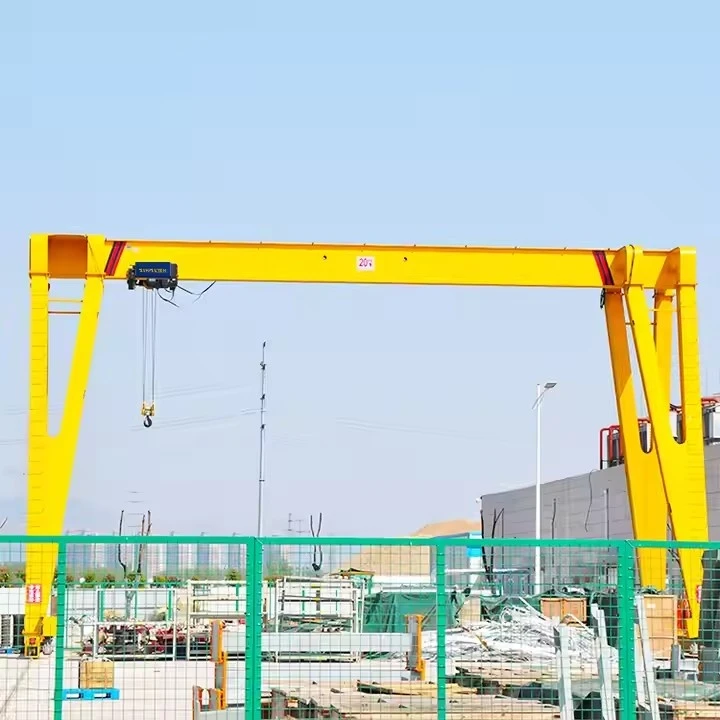


Electric Hoist Gantry Crane
Products Description
Types of Electric Hoist Gantry Cranes:
Adjustable Height Gantry – Allows for different lifting heights.
Portable/Mobile Gantry – Easy to move and reposition.
Semi-Gantry Crane – One leg runs on a runway beam, while the other is supported by a structure.
Full Gantry Crane – Both legs run on ground rails or wheels.
Advantages:
✔ No need for permanent overhead support (unlike bridge cranes).
✔ Flexible positioning (can be moved where needed).
✔ Electric hoist provides smooth, precise lifting.
✔ Suitable for indoor & outdoor use (depending on design).
Comparison with Other Crane Types
| Feature | Electric Hoist Gantry Crane | Overhead Bridge Crane | Jib Crane |
|---|---|---|---|
| Support Needed | Self-supporting (no building structure) | Requires runway beams & strong ceiling | Wall/floor-mounted |
| Mobility | Portable or rail-mounted | Fixed position | Limited rotation |
| Load Capacity | 0.5–50+ tons | 1–500+ tons | 0.1–10 tons |
| Best For | Outdoor/indoor, flexible locations | Large factories, high-capacity lifts | Small workshops, confined spaces |
Place of Origin:Henan, China
Warranty:2 years
Weight (KG):60000 kg
Video outgoing-inspection:Provided
Machinery Test Report:Provided
Application:warehouses,factory and other place
Crane type:box type gantry crane
Travelling speed:20m/min
Lifting mechanism:Electric Hoist
Control method:Ground Control+ Remote Control (customized)
Working duty:A5
Working Temperature:-20~+40℃
Industrial voltage:380V50HZ3Phanse or other
Color:Customised
Customization:Accepted

Pictures & Components
An electric hoist gantry crane consists of several key components that work together to provide efficient lifting and material handling. Below is a detailed breakdown of its main parts:
1. Gantry Frame (Main Structure)
The steel framework supports the entire crane and consists of:
Legs (Uprights) – Vertical supports (fixed or adjustable height).
Bridge Beam (Girder) – Horizontal beam where the hoist travels (single or double girder design).
End Trucks (for mobile gantry cranes) – Wheel assemblies that allow movement along the ground or rails.


2. Electric Hoist (Lifting Mechanism)
The motor-driven device that lifts and lowers loads:
Hoist Motor – Powers lifting operations (chain or wire rope type).
Lifting Medium –
Wire Rope Hoist (for heavier loads, smoother operation).
Chain Hoist (compact, suitable for lighter loads).
Hook Block – Attaches to the load (can include a swivel hook).
Drum or Sprocket – Winds the rope/chain for lifting.
Brake System – Ensures safe load holding.


3. Trolley (Hoist Movement Along the Beam)
Allows the hoist to move horizontally along the bridge beam.
Can be manual push or motorized (electric trolley).
Includes wheels and a drive mechanism (for powered versions).

4. Travel System (Crane Mobility)
Wheels/Casters – For mobile gantry cranes (may have brakes).
Rail System (for fixed gantry cranes) – Runs on ground rails for stability.
Drive Motors (for powered travel) – Electric motors for moving the entire crane.

5. Control System
Pendant Control – Handheld remote for operating the hoist and trolley.
Radio Remote (Optional) – Wireless control for better maneuverability.
Limit Switches – Prevent over-travel of the hoist/trolley.

6. Electrical Components
Power Supply – Typically 3-phase AC or single-phase (smaller hoists).
Control Panel – Houses contactors, relays, and overload protection.
Cable Reel (for rail-mounted gantry cranes) – Manages power cable movement.
.
7. Safety Features
Overload Protection – Prevents lifting beyond capacity.
Emergency Stop (E-Stop) – Instantly cuts power in emergencies.
Anti-Collision Devices – For multiple cranes in the same area.
Warning Lights/Alarms – For hazardous operations.

Optional Accessories
Festoon System – Manages cables for electric trolleys.
Weighing Scale – Integrated load measurement.
Cabin/Operator Station – For large industrial gantry cranes.

Sketch

Main technical

Advantages
1. No Overhead Support Required
Unlike bridge cranes, gantry cranes do not require a permanent ceiling or building structure for support.
Ideal for outdoor use or facilities with limited roof strength.
2. Mobility & Flexibility
Portable gantry cranes can be moved easily to different work areas.
Adjustable height/span models adapt to different load sizes and workspaces.
3. Electric Hoist Benefits
Smooth & Precise Lifting – Better control compared to manual hoists.
Higher Efficiency – Faster lifting and lowering with minimal effort.
Reduced Operator Fatigue – No manual chain pulling required.
4. Cost-Effective Solution
Lower installation costs compared to overhead bridge cranes.
Minimal maintenance (electric hoists are durable and reliable).
5. Versatile Load Handling
Suitable for light-duty (0.5–10 tons) and heavy-duty (10–50+ tons) applications.
Can be customized with different hoist types (chain or wire rope).
6. Safety Features
Overload protection prevents lifting beyond capacity.
Emergency stop buttons and limit switches enhance safety.
Stable & Sturdy Design reduces the risk of tipping.
Application:
1. Manufacturing & Workshops
Lifting machinery parts, engines, molds, and heavy tools.
Assembly line material handling.
2. Warehousing & Logistics
Loading/unloading pallets, containers, and heavy goods.
Moving materials in storage areas without permanent crane systems.
3. Construction & Infrastructure
Handling steel beams, concrete panels, and construction materials.
Temporary lifting at job sites where fixed cranes are unavailable.
4. Shipbuilding & Repair Yards
Moving ship components, engines, and heavy machinery.
Ideal for dry docks and maintenance areas.
5. Automotive & Aerospace
Lifting vehicle frames, aircraft parts, and engines.
Used in repair garages and production lines.
6. Power Plants & Heavy Industries
Handling transformers, turbines, and large industrial equipment.
Maintenance of heavy machinery in energy facilities.
7. Railway & Transportation
Lifting railway tracks, bogies, and locomotive parts.
Used in maintenance depots and assembly units.
Crane production procedure
1. Design and Engineering
Requirement Analysis: Define capacity, span, lift height, travel distances, control mode, and workshop constraints.
Structural Design: Design main girder, end carriages, legs, and connections according to relevant standards (ISO, FEM, GB).
Mechanical Components Selection: Choose motors, hoists, wheels, brakes, control system, safety devices.
Electrical Design: Control panel layout, wiring diagrams, power supply design.
Drawings and Approval: Prepare detailed fabrication and assembly drawings, get client approval.
2. Material Procurement
Purchase steel plates, profiles, motors, gearboxes, wheels, electrical components, and safety devices.
Verify material certifications and quality documents.
3. Steel Fabrication
Cutting: Steel plates and profiles cut to size using plasma, laser, or flame cutting.
Forming: Bending or rolling steel as per design.
Welding: Assemble main girder, end carriages, and legs using MIG or manual welding.
Machining: Machine mounting holes, wheel seats, bearing seats, and flange surfaces.
Heat Treatment: Stress relieving welding distortions if required.
4. Surface Treatment
Grinding: Smooth weld seams and surfaces.
Cleaning: Remove rust, oil, and contaminants.
Painting: Apply primer and finish coats (usually epoxy or polyurethane paint) for corrosion protection.
5. Component Assembly
Install wheels, bearings, hoist, motors, brakes, and electrical devices on the crane structure.
Assemble control panel and wiring.
6. Testing and Quality Control
Dimensional Inspection: Check all critical dimensions.
Load Testing: Perform rated load and overload tests according to standards.
Function Testing: Verify smooth operation of hoist, trolley, crane travel, brakes, and safety devices.
Electrical Testing: Check control circuits, emergency stops, alarms, limit switches.
Documentation: Prepare test reports and certificates.
7. Packaging and Delivery
Disassemble parts if needed for transport.
Protect components with rust preventatives and packaging materials.
Arrange shipping to customer site.
8. Installation and Commissioning (at customer site)
Assemble crane on site (main girder, legs, wheels).
Align rails or prepare floor surface.
Connect electrical power and controls.
Perform on-site testing and operator training.

Workshop view:
The company has installed an intelligent equipment management platform, and has installed 310 sets (sets) of handling and welding robots. After the completion of the plan, there will be more than 500 sets (sets), and the equipment networking rate will reach 95%. 32 welding lines have been put into use, 50 are planned to be installed, and the automation rate of the entire product line has reached 85%.


Hot Tags: electric hoist gantry crane, China electric hoist gantry crane manufacturers, suppliers, factory, Gantry Crane, Electric Hoist Single Girder Gantry Crane, Single Girder Gantry Crane
You Might Also Like


Send Inquiry