










Rail Mounted Gantry Container Cranes
Products Description
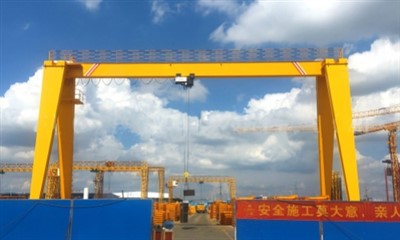
RMG cranes are pivotal in modern container terminals for their space efficiency, automation readiness, and eco-friendliness. While they require significant upfront investment, their long-term benefits in operational cost and productivity make them a preferred choice for high-volume ports
Comparison with Rubber-Tired Gantry (RTG) Cranes
| Feature | RMG | RTG |
|---|---|---|
| Mobility | ❌ Fixed rails | ✅ Rubber tires |
| Stacking Height | ✅ Higher (7+ layers) | ⚠️ Lower (5–6 layers) |
| Energy Use | ✅ Electric (1.5 kWh/box) | ❌ Diesel (2.2L/box) |
| Cost | ❌ High setup | ✅ Lower initial investment |
Place of Origin:Henan, China
Warranty:2 years
Weight (KG):80000 kg
Video outgoing-inspection:Provided
Machinery Test Report:Provided
Application:warehouses,factory and other place
Crane type:box type gantry crane
Travelling speed:20m/min
Lifting mechanism:Electric Hoist
Control method:Ground Control+ Remote Control (customized)
Working duty:A5
Working Temperature:-20~+40℃
Industrial voltage:380V50HZ3Phanse or other
Packing:According to client request
Control method: Ground Control, Remote Control (customized)
Power supply: 3 Phase 380V 50hz/Custmized

Pictures & Components
1. Main Girder (Bridge Beam)
Horizontal beam that supports the trolley and spreader. It spans the working area between the A-frame legs.
2. A-Frame Legs / Gantry Frame
Upright steel structures (often A-frame or straight-leg) that support the bridge girder and transfer loads to the ground rails.
3. Rail-Mounted End Carriages
Fitted with steel wheels that run on fixed rails, enabling longitudinal movement of the crane across the yard.


4. Trolley (Crab Unit)
Moves side-to-side along the main girder. It carries the hoisting mechanism and spreader.
5. Spreader (Container Lifting Tool)
A specialized frame that grips and lifts 20/40-foot containers using twist-lock mechanisms. Often adjustable and telescopic.


6. Hoisting Mechanism (Winch System)
Lifts and lowers containers via a wire rope or drum hoist integrated into the trolley.
7. Electrical System
Powers the crane's motors and control systems. Typically fed by cable reel, conductor bar, or diesel generator (in hybrid models).

8. Operator Cabin or Remote Control
Located on the trolley or bridge, providing full visibility. Some RMGs are controlled via remote or automated systems.
9. Rail Tracks (Ground Rails)
Fixed steel rails embedded into the yard surface for crane travel. Critical for precise linear motion.

10. Cable Festoon System / Energy Chain
Protects and organizes the electrical cables between moving parts.
11. Limit Switches & Sensors
Safety devices that prevent over-travel and ensure precise positioning of the crane and trolley.

.
12. Anti-Collision System
Uses radar, infrared, or GPS to avoid collisions with other cranes or yard equipment.
13. Wind Protection & Anchoring System
Includes rail clamps, storm anchors, and wind sensors to stabilize the crane during high winds or when not in use.

14. Lighting & Signaling
Provides safe operation during night shifts or low-visibility conditions.

Sketch

Main technical

Advantages
High Precision
Operates along fixed rails for exact positioning of containers during stacking or transfer.
Heavy Lifting Capacity
Typically handles 40 to 65-ton containers, including twin 20' or 40' containers.
Continuous Operation
Designed for 24/7 work cycles, ideal for high-throughput terminals.
Eco-Friendly
Powered by electric systems-lower emissions, less noise, and energy-efficient.
Automation Ready
Can be equipped with remote control, RTLS, OCR, and yard management systems for semi or full automation.
Space Optimization
High stacking height and precise travel allow for efficient yard layout and maximum storage density.
High Safety Standards
Equipped with anti-sway systems, limit switches, collision avoidance, and storm locks.
Low Maintenance Cost
Fewer moving parts than RTGs; runs on rails instead of tires, reducing wear and tear.
Lower Operational Costs
Compared to diesel RTGs, electric RMGs reduce fuel consumption and maintenance.
Application:
Port Terminals
Stacking and transferring containers from ships to yard blocks or from block to truck/train.
Rail Intermodal Yards
Loading/unloading containers from flatbed railcars or semi-trailers.
Logistics Distribution Centers
Integrating container handling into automated warehousing and inventory control systems.
Container Freight Stations (CFS)
Organizing and dispatching containerized cargo for export/import consolidation.
Industrial Container Yards
Managing large volumes of containers for manufacturing, energy, or mining industries.
Customs or Border Inspection Zones
Moving containers to inspection pits or screening areas with controlled precision.
Crane production procedure
1. Requirement Analysis & Technical Design
Client Consultation: Understand the customer's specific needs (load capacity, span, lifting height, working environment, control system, safety features).
Site Assessment: Evaluate the installation site, environmental conditions, and any special constraints.
Engineering Design:
Develop detailed 3D CAD drawings and structural calculations for the girder, end carriages, trolley, hoist, and electric systems.
Customize components such as motors, brakes, control panels, and safety devices based on project specifications.
Ensure compliance with international standards (ISO, FEM, CMAA, etc.).
2. Material Procurement
Steel Structure Materials: Source high-quality steel plates, beams, and profiles (Q235B/Q355B or equivalent) for the girder and frame.
Electrical & Mechanical Components: Purchase motors, gearboxes, brakes, hoists, control panels, limit switches, cables, and other electrical components from approved suppliers.
Specialty Items: Order additional customized parts (e.g., explosion-proof motors, stainless steel components, or corrosion-resistant finishes if needed).
3. Steel Structure Fabrication
Cutting: Use CNC cutting machines or laser cutters to process steel plates and profiles according to design specifications.
Beveling: Perform edge preparation for welding using beveling machines.
Welding:
Weld the main girder, end carriages, and other structural components according to certified welding procedures.
Conduct weld inspections (visual inspection, ultrasonic or X-ray testing if required).
Straightening: Use hydraulic presses to ensure the girder and frame are straight and dimensionally accurate.
Machining: Machine key connection points (e.g., wheel bases, trolley rails) for precise assembly.
4. Surface Treatment
Sandblasting/Shot Blasting: Remove rust, scale, and surface impurities from the steel structure to achieve SA2.5 or better surface grade.
Painting/Coating:
Apply primer and finishing coats based on the environmental working conditions (e.g., marine-grade paint for outdoor cranes).
Optional: Apply anti-corrosion, anti-static, or explosion-proof coatings depending on the client's requirements.
5. Component Assembly
Hoist & Trolley Assembly:
Assemble the electric hoist and trolley system, including motors, gear reducers, wire ropes or chains, and hook blocks.
Pre-install limit switches, brakes, and cable reels.
End Carriage Assembly:
Install traveling wheels, bearings, buffers, and drives onto the end carriages.
Electrical Wiring:
Pre-wire key components (e.g., hoist motor, trolley motor) in accordance with the electrical layout.
Install control systems, power supply cables, festoon systems, or cable carriers.
6. Pre-Assembly & Trial Fitting
Pre-assemble the girder, end carriages, hoist, trolley, and electrical system at the factory to ensure proper fit and alignment.
Conduct tolerance checks on critical dimensions (e.g., span, wheelbase, and diagonal measurements).
7. Factory Testing (Pre-Delivery Inspection)
Mechanical Testing: Perform no-load and partial-load tests on hoisting, trolley travel, and crane travel systems to verify smooth and reliable operation.
Electrical Testing: Verify proper functioning of motors, control panels, limit switches, alarms, and safety devices.
Safety Inspection:
Overload protection testing.
Emergency stop and brake system verification.
Check for proper function of sound and light alarms.
Note: A third-party inspection can be arranged if required by the client.
8. Disassembly & Packaging
Disassemble major components (girder, trolley, hoist, end carriages) for transport.
Protect all surfaces with anti-corrosion oil or protective wraps.
Use reinforced wooden crates or steel frames for sensitive components like motors, control systems, and electrical parts.
9. Delivery & Logistics
Organize transportation (by truck, rail, or sea) to the customer's site.
Provide detailed installation manuals, electrical diagrams, and operation guides along with the shipment.

Workshop view:
The company has installed an intelligent equipment management platform, and has installed 310 sets (sets) of handling and welding robots. After the completion of the plan, there will be more than 500 sets (sets), and the equipment networking rate will reach 95%. 32 welding lines have been put into use, 50 are planned to be installed, and the automation rate of the entire product line has reached 85%.


Hot Tags: rail mounted gantry container cranes, China rail mounted gantry container cranes manufacturers, suppliers, factory, Single Girder Gantry Crane, Gantry Crane, Electric Hoist Single Girder Gantry Crane
You Might Also Like




Send Inquiry