







Portable Mobile Adjustable Lifting Aluminum Gantry Crane
Product Introduction
The portable mobile adjustable lifting aluminum gantry crane is a versatile and robust lifting solution designed for a wide range of industrial and construction applications. Constructed from high-quality aluminum, this crane is lightweight yet durable, making it ideal for both indoor and outdoor use. Its portability and adjustable height allow for easy mobility and adaptability across various workspaces, enhancing efficiency and safety. The crane is made from high-strength aluminum, providing the perfect balance between weight and durability, ensuring easy transport and long-lasting performance.The height-adjustable feature allows the crane to accommodate different load requirements and workspace constraints, providing versatility for varying project needs. Equipped with caster wheels, the crane can be easily moved around the workspace, providing flexibility and reducing downtime by quickly reaching different lifting points.Despite its lightweight design, this aluminum gantry crane offers significant lifting power, typically suitable for loads ranging from 500 kg to several tons.The crane can be quickly set up and dismantled, making it an excellent choice for temporary setups or changing work environments.
Warranty:1 Year
Weight (KG):300 kg
Application:indoor, warehouse, outdoor
Product name:Portable Aluminum gantry crane
Lifting mechanism:Electric Hoist/Manual Hoist
Control Method:Pendent or Remote Control
Type:Gantry Crane
Voltage:380V/50HZ/3Ph AC
Color:Clients' Requirments
Work Duty:A3
Working Environment:-20-40 ℃
Capacity:0.5ton~5ton
 |
 |
Pictures & Components
The Portable Mobile Adjustable Lifting Aluminum Gantry Crane consists of several key components designed for ease of use, durability, and safe lifting operations. Here's a breakdown of the primary components:
1. Aluminum Frame
The main structural element, made of lightweight and corrosion-resistant aluminum, ensuring durability while allowing easy transport and assembly.
Typically includes vertical support columns and a horizontal beam for load distribution.
2. Adjustable Height Columns
Height-adjustable columns allow the crane's frame to be raised or lowered to suit different lifting needs or workspace limitations.
Adjustments are made through a locking mechanism or pin system, providing stability at various height settings.
3. Cross Beam (I-Beam)
The cross beam or horizontal I-beam connects the vertical columns and serves as the main lifting rail.
Often made from high-strength aluminum or steel, allowing for heavy load-bearing capacity and smooth trolley movement.
4. Trolley
A wheeled carriage that moves along the cross beam, enabling horizontal movement of the hoist and allowing loads to be lifted and moved across the length of the beam.
Comes in either manual or motorized versions for different mobility and precision needs.
5. Hoist
The lifting mechanism attached to the trolley, responsible for raising and lowering loads.
Available as either a manual chain hoist or an electric hoist, depending on the crane's intended use and load capacity.
6. Caster Wheels
Heavy-duty wheels attached to the base of each support column, enabling the crane to be moved easily across surfaces.
Casters typically have locking mechanisms for stability and safety once the crane is positioned.
7. Locking Mechanism
Safety locks on caster wheels and height-adjustment pins to prevent unwanted movement or slipping during operation.
Provides additional stability during lifting and transport.
8. End Stops
Positioned at the ends of the I-beam to prevent the trolley from sliding off the beam.
Adds safety and prevents overextension of the trolley and hoist during operation.
9. Stabilizers
Optional stabilizing feet or outriggers that enhance crane stability, especially for lifting heavier loads or on uneven surfaces.
Can be adjusted or positioned based on the terrain and weight requirements.
Each of these components plays a critical role in the performance and versatility of the portable adjustable aluminum gantry crane, making it a reliable lifting solution in various environments.
 |
 |
 |
 |
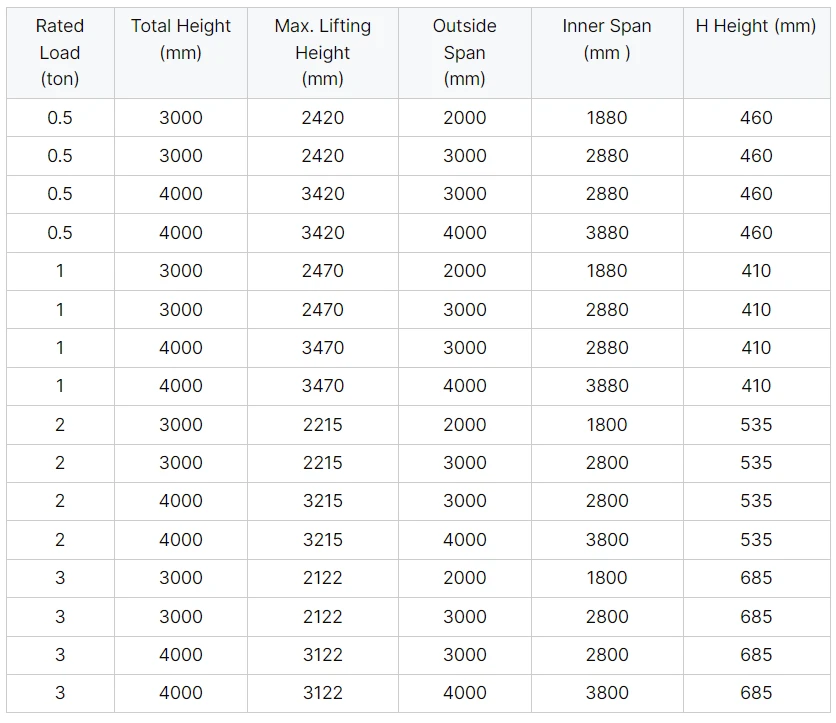
Sketch
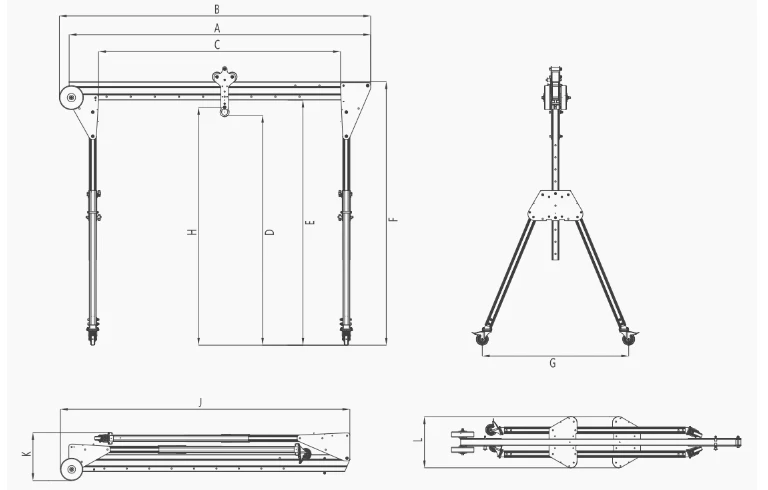
Main technical
Advantages
Portability and Mobility: These cranes are designed to be moved easily. Being lightweight and made of aluminum, they're much easier to maneuver than steel cranes. Many models have wheels, allowing operators to transport and position the crane quickly without heavy equipment.
Adjustability: Aluminum gantry cranes often feature adjustable heights, spans, and trolleys, making them versatile for various lifting tasks and environments. Adjustable heights are particularly helpful for passing through doors or working in confined spaces.
Corrosion Resistance: Aluminum is naturally resistant to rust and corrosion, making these cranes ideal for outdoor use or in environments where they might be exposed to moisture.
Lightweight Yet Strong: Despite being lightweight, aluminum has a high strength-to-weight ratio, allowing the crane to handle substantial loads without adding unnecessary bulk. This makes it easy to transport and set up with less manual effort.
Ease of Assembly and Disassembly: Aluminum gantry cranes are typically designed for quick assembly and disassembly. This feature is ideal for temporary jobs or when the crane needs to be frequently relocated.
Cost-Effective: Compared to installing permanent cranes or using heavier steel gantry cranes, portable aluminum gantry cranes are often more affordable while still meeting lifting needs for a range of applications.
Enhanced Safety Features: Many models include locking mechanisms for added stability and safety during lifting, ensuring that loads can be lifted and positioned securely.
Application:
Construction Sites: Used for lifting materials and equipment in temporary setups where quick assembly and mobility are essential. They're often used for lifting beams, pipes, and other materials on-site.
Warehouses and Distribution Centers: Ideal for loading and unloading goods, lifting and moving heavy boxes or equipment, and for relocating inventory within a confined space. Their adjustable height allows them to work with various rack heights.
Manufacturing Facilities: Commonly used in production lines or assembly areas to lift and position parts and equipment. Aluminum gantry cranes help with precision assembly tasks and are easily adjustable to accommodate various production setups.
Maintenance and Repair Shops: Useful in vehicle repair and maintenance facilities to lift engines, transmissions, and heavy machinery parts. Their portability allows them to be positioned exactly where they're needed.
Aerospace Industry: Used for lifting aircraft parts, engines, and components that require gentle handling. The crane's adjustability and lightweight design are particularly valuable when working around sensitive aerospace components.
Marine and Shipyards: Ideal for lifting heavy parts or equipment onto boats and ships or moving materials on docks. Their corrosion-resistant aluminum construction is well-suited for humid or salty environments.
Power Plants and Utilities: These cranes are used in facilities that require frequent maintenance or handling of heavy equipment, transformers, or pumps. Their mobility and ease of assembly allow quick deployment in different areas.
Events and Exhibitions: Often used for setting up stages, lighting, or audiovisual equipment. The lightweight and mobile design of the crane enables quick assembly and disassembly for temporary setups.
Research and Laboratories: Aluminum gantry cranes are also used for material testing or lifting heavy lab equipment in research environments. Their adjustability is helpful in confined spaces or for precise positioning.
HVAC Installation: Commonly used in HVAC installations for lifting and positioning units in areas where larger cranes are impractical. Their portability makes them an excellent choice for indoor and rooftop installations.
Crane production procedure
1. Design and Engineering
Specifications and Load Capacity: Engineers define the specifications, including load capacity, height, span, and adjustability. Material requirements for the aluminum frame, casters, and locking mechanisms are also established.
CAD Modeling: Computer-aided design (CAD) software is used to create a 3D model. Engineers analyze the design to optimize strength, stability, and weight.
Testing and Simulations: Simulations for stress, load-bearing, and durability are conducted to ensure the design meets safety and performance standards.
2. Material Selection
Aluminum Procurement: High-quality aluminum, known for its lightweight and strength, is selected. Alloys are chosen based on their corrosion resistance and mechanical properties to handle the specified loads.
Other Components: Materials for wheels, locking mechanisms, and adjustable parts are sourced, often in stainless steel or other durable metals for added longevity.
3. Cutting and Machining
Aluminum Cutting: Large aluminum sheets or beams are cut to required sizes and shapes using saws or laser cutting machines.
Machining: CNC machines and other tools are used to precisely shape parts, drill holes, and create adjustable features like telescoping legs and height adjustment mechanisms.
Surface Treatment: Aluminum parts may be anodized or coated to prevent corrosion, increasing the durability of the crane.
4. Welding and Assembly
Frame Assembly: Aluminum parts are welded together to form the main frame of the crane. Welds are carefully inspected to ensure structural integrity.
Wheels and Casters Installation: Wheels or casters are attached to the base, providing mobility. Often, locking casters are used for stability during lifting operations.
Adjustable Components: Components for height adjustment, such as telescoping legs, are installed. Additional locking or securing mechanisms are added for safety.
5. Quality Control and Testing
Load Testing: Each crane is tested to ensure it can handle its maximum rated load safely. Tests include lifting and mobility trials.
Safety Checks: Locking mechanisms, adjustable features, and casters are inspected for stability and ease of use. Safety standards and certifications are verified.
6. Finishing and Packaging
Final Coating: An anti-corrosion coating may be applied if required for specific environments, such as marine or outdoor use.
Packaging: The crane is disassembled or partially assembled and packaged securely, often with manuals and assembly instructions for easy installation by the end-user.
7. Distribution
The cranes are then distributed to various vendors, construction suppliers, or directly to clients in industries such as construction, manufacturing, and maintenance.
Workshop view:
The company has installed an intelligent equipment management platform, and has installed 310 sets (sets) of handling and welding robots. After the completion of the plan, there will be more than 500 sets (sets), and the equipment networking rate will reach 95%. 32 welding lines have been put into use, 50 are planned to be installed, and the automation rate of the entire product line has reached 85%.


Hot Tags: portable mobile adjustable lifting aluminum gantry crane, China portable mobile adjustable lifting aluminum gantry crane manufacturers, suppliers, factory
Next
No InformationYou Might Also Like


Send Inquiry