







RTG Rubber Tyre Gantry Crane
Products Description
What is an RTG Crane?
An RTG Crane is a highly mobile gantry crane used primarily for stacking and moving shipping containers in a yard. Unlike rail-mounted gantries, it runs on rubber tires, giving it the flexibility to move between stacking rows and transfer areas without being confined to a fixed track.
Advantages of RTG Cranes
High Flexibility and Mobility: Can be easily driven from one stack to another, making yard planning and reorganization much more adaptable.
High Stacking Density: Can stack containers 1-over-6 or 1-over-7, maximizing the utilization of valuable yard space.
Transfer Capability: Can pick up containers from one location and directly place them in another, or load/unload trucks and terminal tractors directly.
Relatively Lower Initial Investment: Compared to some automated stacking cranes, RTGs have a lower upfront cost.
Limitations
Higher Operational Cost (Diesel): Diesel-powered RTGs have significant fuel and maintenance costs.
Driver Required: Traditional RTGs require a skilled operator, which adds to labor costs (though remote-operated and autonomous RTGs are becoming common).
Tire Wear and Maintenance: The rubber tires are expensive and subject to wear and tear.
Less Precise Positioning: Can be less precise than rail-mounted systems, especially in windy conditions, though modern systems have largely mitigated this.
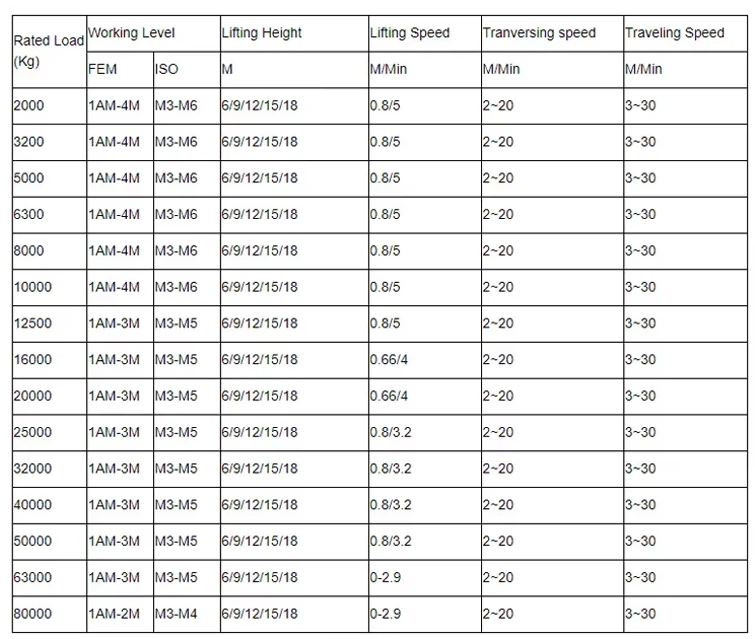
Lifting Capacity 320 tons
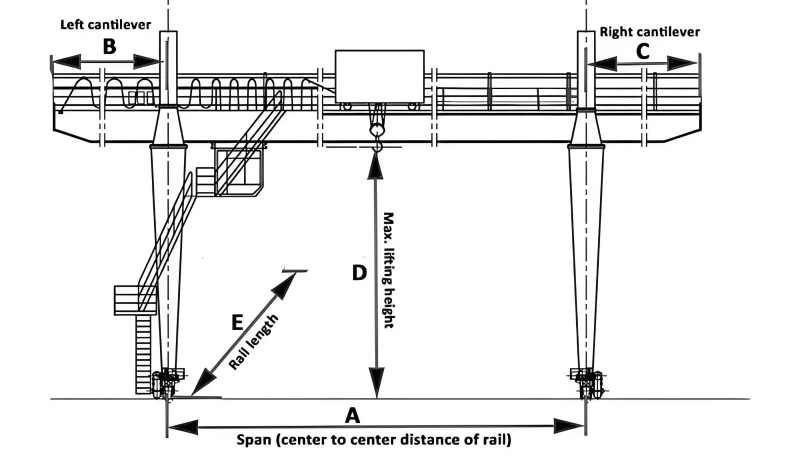
Span (Width) 3 - 12 meters (adjustable)
Lifting Height 3 - 10 meters
Working Class A3-A5 (light to medium duty)
Hoisting Speed 0.5 - 8 m/min (variable)
Main Beam Type Single/double girder (box-type)
Power Supply 220V/380V 3-phase or manual
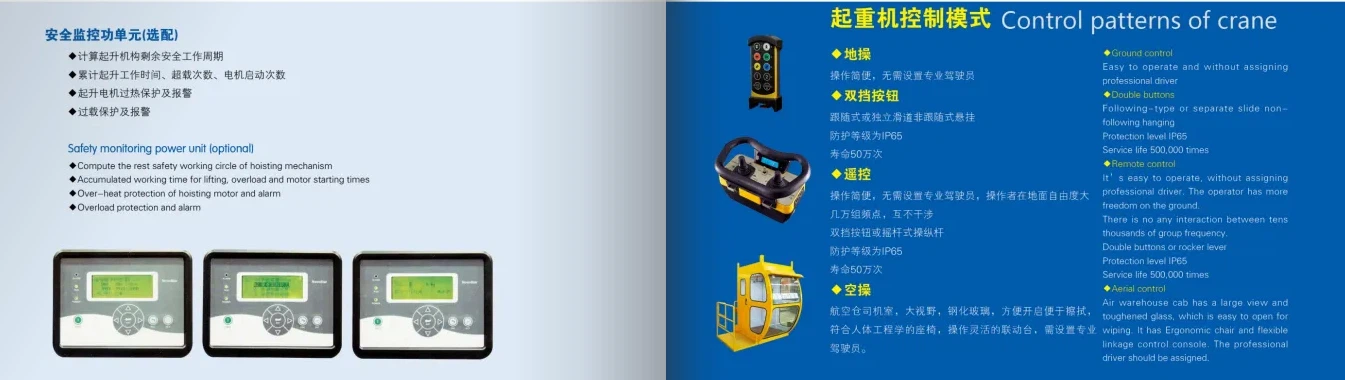
Control Mode Pendant control/wireless remote
Hoist Type Electric chain hoist/wire rope hoist
Travel Drive Manual push or motorized
Corrosion Protection Hot-dip galvanized or marine-grade paint
Wind Resistance Up to Beaufort scale 6 (for outdoor use)
Operating Temp -20°C to +50°C

Pictures & Components
The components of an RTG (Rubber Tyred Gantry) Crane are engineered for mobility, high-stacking, and relentless container handling. Here is a detailed breakdown.
1. Structural System (The Framework)
Main Girder (Bridge): The primary horizontal beam that spans the container stacks. It is a robust, welded box girder designed to resist twisting and support the trolley and spreader.
Legs (A-Frame Structure): The two vertical structures that support the main girder. They are typically an "A-frame" design for superior stability and strength, allowing them to withstand the dynamic forces of a moving, stacked load.
Trolley Frame: The structure that carries the hoist machinery and travels along rails mounted on the main girder (cross travel).
Trolley Rails: The rails fixed on the top of the main girder that guide the trolley.

2. Mobility & Power System (The Locomotion)
Tyre and Bogie System:
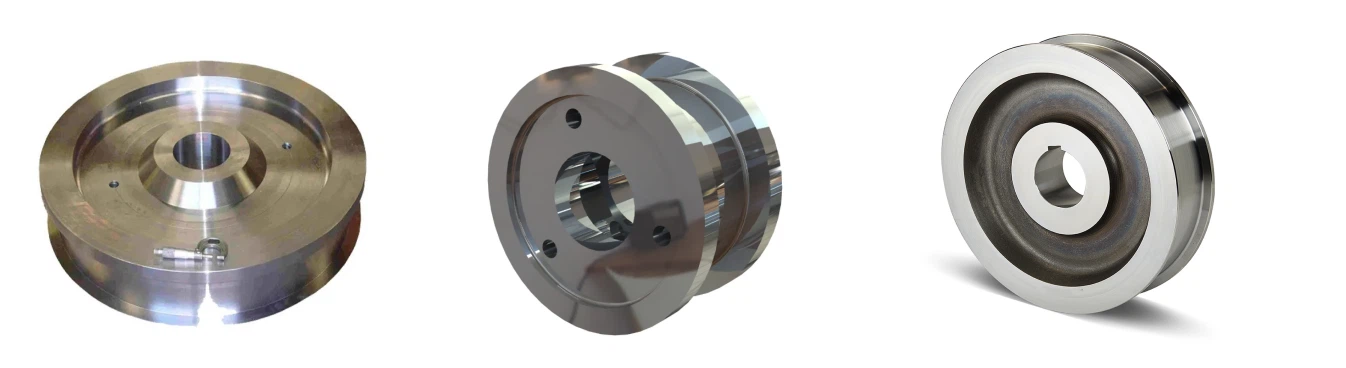
Wheels & Tires: Typically configured in 8 or 16 heavy-duty, pneumatic rubber tires mounted on bogies. This distributes the crane's massive weight and allows mobility on the asphalt yard.
Bogies: The assemblies that house the wheels, axles, and drive motors. They can often pivot to assist with steering.
Power Pack:
Diesel Generator Set: The most common power source. A large diesel engine drives a generator to produce electricity for all crane functions.
Alternative Power Sources:
eRTG (Electric RTG): Uses a cable reel or conductor bar to draw power from the terminal's electrical grid.
Hybrid RTG: Combines a smaller diesel generator with a battery bank to reduce fuel consumption.

Drive System:
Travel Motors: Electric motors that power the wheels for gantry travel.
Steering System: A hydraulic or electric system that controls the angle of the bogies. It includes modes like 90-degree steering (for crossing between stacks) and parallel steering (for long travel along a stack).
Gantry Travel Brakes: Multiple braking systems, including service brakes, parking brakes, and emergency brakes.
3. Lifting & Handling System (The Workhorse)
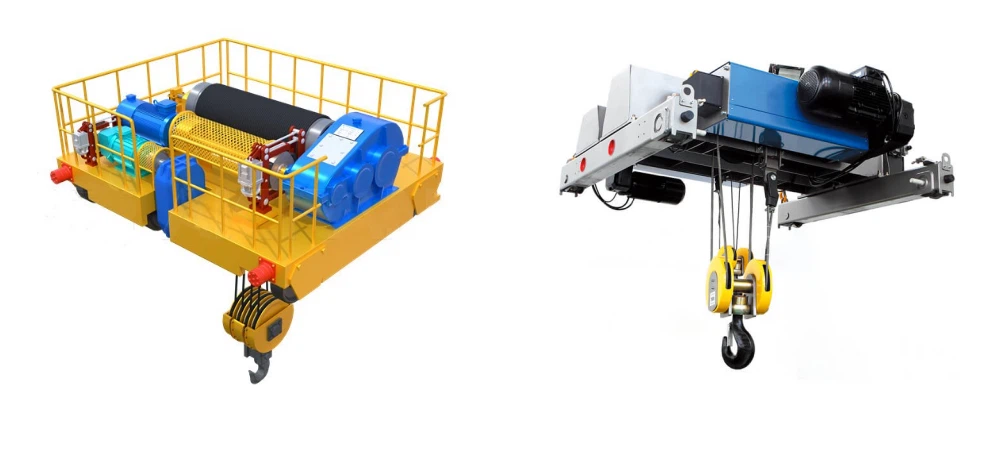
Main Hoist Unit:
Hoist Motor: A high-power electric motor that drives the hoisting mechanism.
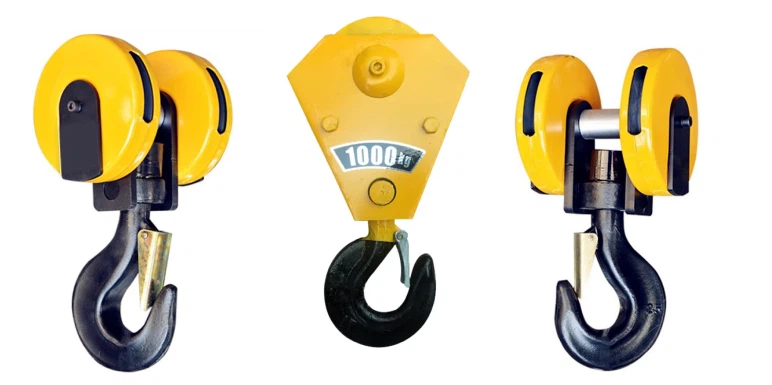
Wire Rope Drum: A grooved drum that spools the multiple falls of high-strength steel wire rope.
Sheaves & Blocks: A system of pulleys that multiplies the lifting capacity and provides a vertical path for the wire rope.
Container Spreader: The intelligent device that physically locks onto the container.
Twistlocks: Hydraulically or electrically operated locking pins that engage the corner castings of a shipping container.
Telescopic Mechanism: Allows the spreader to adjust its length to handle 20ft, 40ft, and 45ft containers.
Spreader Guides: "Shoes" or arms that help align the spreader with the container during landing.
Sensors: Weight sensors, container presence sensors, and twistlock status sensors provide critical data to the control system.


4. Control, Operator & Safety Systems (The Nerve Center)
Operator's Cab:
Located on one of the legs for a clear view down the stacking lane.
Equipped with ergonomic controls, joysticks for hoist/trolley/spreader, and multiple display screens showing camera feeds and crane status.
Control & Automation System:
Programmable Logic Controller (PLC): The central computer that manages all crane functions and interlocks.
Variable Frequency Drives (VFDs): Control the speed and torque of all major motors (hoist, trolley, gantry) for smooth and precise operation.

Steering & Alignment Systems:
Auto-Steering: Uses magnets embedded in the yard or GPS to keep the crane centered over the container stack automatically.
Cross-Tracking Prevention: Ensures the crane travels in a straight line.
Critical Safety Devices:
Anti-Collision System: Prevents collisions with other RTGs or objects in the yard.
Load Moment Indicator (LMI): Monitors the load to prevent dangerous overloads.
Limit Switches: For hoist, trolley, and gantry travel to prevent over-travel.
Anemometer & Wind Speed Indicator: Alarms or automatically shuts down operations in high winds.
Container Stack Profiling: A system that knows the height of each stack to prevent the spreader from colliding with stacked containers.
SKETCH
Main technical
Advantages
Advantages of RTG Cranes
RTGs offer a unique combination of mobility, density, and versatility that makes them indispensable in container yards.
1. Yard Flexibility and Superior Mobility
Unconstrained Movement: Unlike rail-mounted gantries (RMG), RTGs can be driven between different stacking areas or blocks. This allows terminal operators to reconfigure the yard layout as needed and use equipment where it's most required.
No Fixed Infrastructure: They operate on a standard asphalt pavement, requiring only painted lines and possibly guide magnets. This eliminates the cost and permanence of installing heavy rail tracks.
2. High Storage Density
High Stacking: RTGs are designed to stack containers 1-over-6 or even 1-over-7 (meaning 7 containers high). This vertical stacking maximizes the utilization of a terminal's valuable real estate.
Compact Stacking Rows: The legs of the RTG can be designed for a specific container footprint, allowing for dense, parallel stacking with minimal gaps between rows.
3. Multipurpose Functionality
All-in-One Solution: A single RTG can perform multiple tasks:
Stacking containers in the yard.
Loading and unloading terminal trucks (shuttle carriers) and external trucks directly.
Transferring containers from one part of the yard to another.
Direct Interfacing: This eliminates the need for additional equipment to service trucks, streamlining the container handling process.
4. Proven Technology and Lower Capital Expenditure (Capex)
Established & Reliable: RTG technology is mature, well-understood, and supported by a global service network. This makes them a reliable, lower-risk investment.
Lower Initial Cost: The upfront purchase and installation cost of an RTG system is generally lower than that of an equivalent Automated Stacking Crane (ASC) or RMG system, which requires extensive civil works for rails and foundations.
5. Evolving towards Eco-Efficiency and Automation
Power Options: While traditionally diesel-powered, modern RTGs offer more efficient options:
eRTG (Electric): Can be connected to the grid, eliminating onsite emissions and reducing noise.
Hybrid RTG: Uses a smaller diesel generator paired with a battery, cutting fuel consumption and emissions by 30-50%.
Automation Ready: Many new RTGs are "auto-ready" or can be retrofitted for:
ARMG (Automated RTG): Can be operated remotely from a control center or run fully autonomously, reducing labor costs and improving safety.
Application
Applications of RTG Cranes
The primary application is in container terminals and intermodal yards, where they serve as the key link between the quayside and landside transport.
1. Container Stacking and Storage (The Primary Role)
Function: RTGs are the default choice for creating and managing the high-density container stacks in a terminal's yard.
Process: They receive containers from terminal trucks that have been unloaded from a ship and stack them in designated blocks based on vessel, destination, or weight.
2. Truck Loading and Unloading
Function: RTGs directly service both internal terminal trucks and external customer trucks.
Process:
For export, an external truck delivers a container to the yard, and an RTG picks it up and stacks it.
For import, an RTG retrieves a container from the stack and directly loads it onto the waiting customer's truck.
3. Rail Terminal Operations
Function: In intermodal yards, RTGs are used to load and unload containers from trains.
Process: The RTG moves along the train, lifting containers on or off the railcars. Its mobility allows it to work on multiple tracks.
4. Container Sorting and Consolidation
Function: RTGs are constantly used to reorganize the yard.
Process: This involves "reshuffling" containers to dig out a specific box buried in the stack or consolidating containers for an upcoming vessel load, a process critical for maintaining terminal efficiency.
5. Port and Terminal Types
Multi-User Terminals: Their flexibility makes them ideal for terminals serving multiple shipping lines with varying operational needs.
Congested or Irregularly Shaped Yards: The ability to move between blocks is a major advantage in older or space-constrained terminals where a fixed rail system is impractical.
Truck-Intensive Terminals: Where a high volume of road trucks requires direct and rapid service.
Crane production process
The production process for an RTG (Rubber Tyred Gantry) Crane is a complex undertaking that combines heavy steel fabrication, precise mechanical assembly, and sophisticated electrical and control system integration. It results in a mobile, high-stacking giant.
Here is a detailed breakdown of the production process.
Stage 1: Design & Engineering
This stage defines the crane's capabilities and ensures it can handle the dynamic stresses of mobile operation.
Client Specification Review: Analyzing required capacity (typically 40-50 tons), span, stacking height (e.g., 1-over-6), power source (diesel, electric, hybrid), and level of automation.
Structural Analysis (FEA): Using Finite Element Analysis to model the A-frame legs and main girder under full load, accounting for dynamic forces like wind, braking, and cornering.
Mechanical Systems Design: Designing the hoist mechanism, trolley system, bogies, steering, and drive trains.
Electrical & Control Design: Creating schematics for power generation/distribution, motor controls, and the integrated control system (ICS) for steering, spreader, and automation.
Bill of Materials (BOM): Creating a comprehensive list of all materials and purchased components.
Stage 2: Material Procurement & Preparation
Procurement: Sourcing high-tensile steel plates, profiles, and purchased components like engines, generators, motors, brakes, axles, tires, and programmable logic controllers (PLCs).
Material Preparation: Steel plates are shot-blasted, primed, and cut to size using CNC plasma cutters for precision.
Stage 3: Structural Fabrication & Assembly
This is where the crane's "skeleton" is built.
Girder & Leg Fabrication:
Component Cutting: Web plates, flanges, and stiffeners for the main girder and A-frame legs are cut.
Sub-Assembly: Components are fit together in large jigs to form sections of the girders and legs.
Welding: Automated Submerged Arc Welding (SAW) is used for long, critical welds. Manual welding is used for complex nodes and brackets.
Stress Relieving: The completed main girder and leg sections are heat-treated in a large furnace to relieve internal welding stresses.
Machining: Critical mating surfaces, such as where the legs connect to the girder and where the trolley rails are mounted, are machined to ensure perfect alignment.
Bogie Frame Fabrication: The bogies that house the wheels and drives are fabricated from heavy steel plate.
Stage 4: Mechanical Assembly & Powertrain Installation
The crane begins to take its final form.
Major Component Assembly: The main girder is connected to the two A-frame legs to form the primary bridge structure.
Bogie and Powertrain Installation:
Bogie Assembly: Axles, wheels, and travel motors are installed onto the bogie frames.
Steering System: The hydraulic or electric steering cylinders and linkages are installed on the bogies.
Tire Mounting: Massive, heavy-duty pneumatic tires are mounted onto the wheel hubs.
Hoist and Trolley Assembly:
The main hoist unit (motor, drum, gearbox) is assembled and mounted onto the trolley frame.
The trolley frame, with its wheels and drive, is placed onto the trolley rails on the main girder.
Power Pack Installation: The diesel generator set (or the connection points for an eRTG system) is installed on its platform, typically on one of the legs.
Stage 5: Electrical & Control System Installation
The "nervous system" of the RTG is installed.
Cab Wiring: The operator's cab is fully wired with control panels, joysticks, and display screens.
Crane Wiring: Main control panels, VFDs (Variable Frequency Drives) for all major motions, and cable trays are installed throughout the structure.
Spreader Integration: The container spreader is connected, and its sensors (twistlock detection, weight, telescopic position) are calibrated.
Safety & Automation Systems:
Auto-Steering System: Guide magnets or GPS sensors are installed.
Anti-Collision System: Radar or laser sensors are mounted on the legs.
Load Moment Indicator (LMI): The system is installed and calibrated.
Limit Switches & E-Stops: All safety devices are wired in.
Stage 6: Pre-Delivery Testing & Inspection (FAT)
The complete RTG is put through its paces in the factory yard.
No-Load Tests: All functions-hoist, trolley, gantry travel, steering modes (90°, parallel, diagonal)-are tested without a load.
Load Testing:
Static Load Test: Lifting a test load of 125% of rated capacity to verify structural integrity and brake holding.
Dynamic Load Test: Lifting 110% of rated capacity and running it through all motions to simulate real-world operation.
System Function Tests:
Steering accuracy and alignment.
Spreader telescoping, twistlock operation, and container handling.
All safety system interventions (anti-collision, LMI, limits).
Stage 7: Dismantling, Painting & Packaging
Dismantling: The RTG is partially disassembled for transport. The legs are often separated from the main girder, and the boom may be removed.
Final Painting: A high-quality, corrosion-resistant paint system is applied, often in the customer's specified colors.
Weatherproofing: Electrical components are covered, and exposed machined surfaces are greased for protection during sea voyage.
Stage 8: Site Erection & Commissioning (SAT)
Site Erection: Specialist crews use mobile cranes to reassemble the RTG on the terminal's prepared asphalt yard.
Final Connections & Checks: Reconnecting electrical and hydraulic lines, and checking alignments.
Site Acceptance Test (SAT): The crane undergoes a final performance and safety test in its actual working environment with the customer present. Operator and maintenance training is conducted.

Workshop view:
The company has installed an intelligent equipment management platform, and has installed 310 sets (sets) of handling and welding robots. After the completion of the plan, there will be more than 500 sets (sets), and the equipment networking rate will reach 95%. 32 welding lines have been put into use, 50 are planned to be installed, and the automation rate of the entire product line has reached 85%.




Hot Tags: rtg rubber tyre gantry crane, China rtg rubber tyre gantry crane manufacturers, suppliers, factory
You Might Also Like


Send Inquiry