










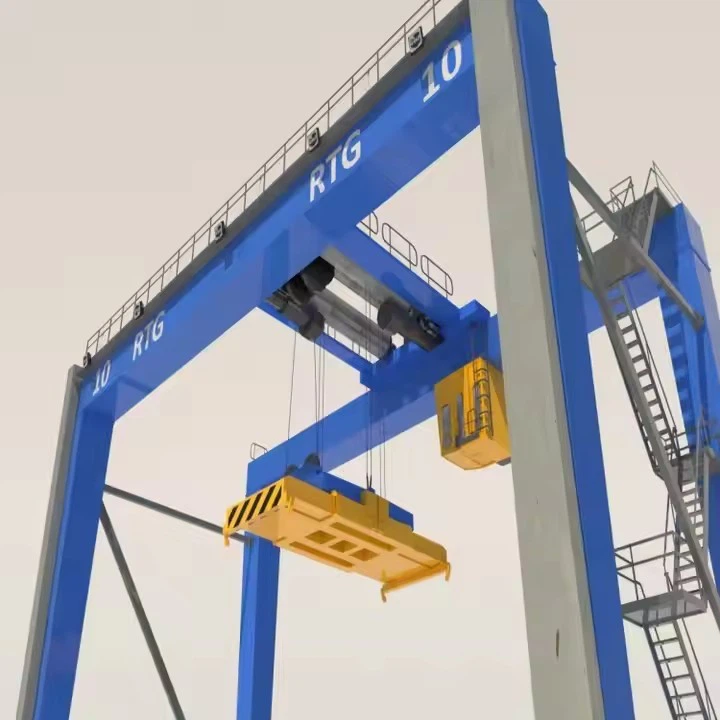


Remote Control Gantry Crane
Product Introduction
A remote control gantry crane improves safety, efficiency, and precision in lifting operations. It is ideal for boat handling, industrial lifting, and construction where operators need flexibility.
Recommended Models
A. Light-Duty (1–10 Tons)
Electric Chain Hoist + Wireless Remote
Best for: Small boatyards, workshops
B. Medium-Duty (10–30 Tons)
Wire Rope Hoist + Industrial Remote
Best for: Factories, construction sites
C. Heavy-Duty (30–50+ Tons)
Double Girder + Explosion-Proof Remote
Best for: Shipyards, steel plants
Advantages Over Manual Control
| Feature | Remote Control | Manual (Pendant Control) |
|---|---|---|
| Operator Safety | ✅ Safe distance | ❌ Near crane |
| Precision | ✅ Fine adjustments | ⚠️ Limited control |
| Efficiency | ✅ Faster operation | ⚠️ Slower movement |
| Multi-Crane Sync | ✅ Possible | ❌ Not possible |
Rated Loading Capacity:5 ton, 10 TON, 100 ton, customized, 16/3.2 ton, 20/5 ton, 32/5 ton, 50/10 ton
Max. Lifting Height:40m, customized
Span:35m or clients' demands
Warranty:1 Year
Weight (KG):20000 kg
Core Components:PLC, Engine, Bearing, Gearbox, Motor, Pressure vessel, Gear, Pump
Control way:Cab, wireless remote control or customized

Pictures & Components
A remote control gantry crane consists of mechanical, electrical, and control systems working together for safe and efficient operation. Below is a detailed breakdown of its components:
1. Structural Components
A. Main Girder (Bridge Beam)
Function: Primary load-bearing horizontal beam.
Types:
Single girder (for lighter loads, 1-20 tons).
Double girder (for heavy-duty, 20-500+ tons).
Material: High-strength steel (Q235B/Q345B) with corrosion-resistant coating.

B. Support Legs (End Carriages)
Function: Vertical columns supporting the girder.
Features:
Fixed or adjustable height.
Wheels (fixed or swivel) for mobility.
Rail-guided or rubber-tired for movement.
C. Base Frame & Runway System
Function: Provides stability and movement path.
Types:
Fixed rails (for permanent installations).
Wheeled tracks (for portable gantries).


2. Lifting Mechanism
A. Hoist Unit
Types:
Electric chain hoist (1-10 tons).
Wire rope hoist (5-500+ tons).
Features:
Variable speed control.
Overload protection.
B. Trolley Assembly
Function: Moves the hoist along the girder.
Types:
Manual push trolley (light-duty).
Motorized trolley (remote-controlled).
C. Lifting Accessories
Hooks, slings, spreader bars (for secure load attachment).
 |
 |
 |
3. Remote Control System
A. Wireless Transmitter (Remote Handheld Unit)
Frequency: 2.4 GHz (anti-interference).
Functions:
Hoist up/down.
Trolley left/right.
Crane forward/backward.
Emergency stop.
B. Receiver & Control Panel
Mounted on the crane, processes signals from the remote.
Safety features:
Signal loss detection (auto-braking).
Overload cut-off.
C. Power Supply
Electric: 220V/380V, 3-phase.
Battery-powered (for portable units).
 |
 |
 |
4. Drive & Motion System
A. Travel Motors
Function: Moves the crane along the runway.
Types:
Single-speed (basic).
Variable frequency drive (VFD) for smooth starts/stops.
B. Wheels & Tracks
Rail-mounted wheels (for heavy loads).
Rubber tires (for mobile gantries).
C. Braking System
Electromagnetic brakes (auto-lock when power cuts).
Manual brakes (for backup).

.
5. Safety Components
Component Function
Limit switches Prevents over-travel (up/down, left/right).
Anti-sway system Reduces load swinging.
Collision avoidance Sensors for multi-crane areas.
Emergency stop Instantly halts all movements.

6. Optional Add-Ons
Cabin control (alternative to remote).
LED warning lights & alarms.
Weatherproof enclosure (for outdoor use).
Load display (real-time weight monitoring).


A remote control gantry crane integrates structural strength, precision lifting, and wireless operation for safe, efficient material handling. Its modular design allows customization for marine, industrial, and construction applications.

SKETCH
Main technical

Advantages
Key Advantages:
Enhanced Safety
Operators control the crane from a safe distance (up to 100m)
Eliminates risks from falling loads or pinch points
Emergency stop function for immediate shutdown
Improved Precision & Control
Fine-tuned variable speed operation
Anti-sway technology for stable loads
Smooth acceleration/deceleration via VFD drives
Increased Productivity
Faster operation than pendant-controlled cranes
Single operator can control multiple functions simultaneously
Reduces manpower requirements
Versatile Operation
Works in confined spaces where cab operation isn't feasible
Suitable for hazardous environments (explosive/dusty areas with proper rating)
Can be operated from optimal viewing angles
Cost Efficiency
Lower installation costs compared to cab-operated systems
Reduced training requirements
Minimal maintenance needs
Application:
Primary Applications:
1. Manufacturing & Warehousing
Machine installation/maintenance
Heavy component assembly
Loading/unloading of materials
2. Marine & Shipbuilding
Boat launching/retrieval
Engine and propeller maintenance
Ship component handling
3. Construction Sites
Precast concrete placement
Steel beam installation
Material handling in tight spaces
4. Logistics & Transportation
Container loading/unloading
Heavy cargo handling
Warehouse management
5. Specialized Environments
Foundries (heat-resistant models)
Chemical plants (explosion-proof versions)
Outdoor operations (weatherproof systems)
Crane production procedure
1. Design and Engineering
Detailed Engineering: Develop detailed engineering drawings and specifications, including the main beam, hoist, trolley, end carriages, and other components.
Simulation and Modeling: Use computer-aided design (CAD) and simulation tools to model the crane's performance and optimize its design.
2. Material Selection
Material Specifications: Select high-quality materials that meet the requirements for strength, durability, and heat resistance. Common materials include high-strength steel, alloys, and specialized coatings.
Procurement: Source materials from approved suppliers, ensuring they meet the necessary quality and certification standards.
3. Component Fabrication
Cutting and Shaping: Cut and shape raw materials into the required components, such as beams, columns, and brackets. This may involve processes like plasma cutting, laser cutting, and machining.Welding and Assembly: Weld components together to form the crane's structural elements. This includes welding the main beam, end carriages, and other load-bearing parts.
4. Assembly
Sub-Assembly: Assemble individual components, such as the hoisting system, trolley, and end carriages, into sub-assemblies. This involves fitting parts together and ensuring proper alignment.Main Assembly: Combine sub-assemblies to construct the complete crane structure. This includes mounting the hoist and trolley on the main beam, attaching the end carriages, and installing the control systems.
5. Integration of Systems
Electrical Systems: Install electrical components, including motors, control panels, wiring, and sensors. Ensure that the crane's electrical systems are properly integrated and tested.
Control Systems: Implement and configure control systems, such as programmable logic controllers (PLCs), remote controls, and safety devices. Verify that the control systems function correctly and are calibrated.
6. Testing and Quality Assurance
Pre-Operational Testing: Conduct pre-operational tests to check the crane's functionality, including load testing, operational testing of the lifting and traveling mechanisms, and control system checks.
Safety Testing: Verify that safety features, such as limit switches, alarms, and emergency stops, are working correctly and meet safety standards.
Inspection: Perform a detailed inspection of the crane's structure and components to ensure compliance with design specifications and quality standards.
7. Final Adjustments and Calibration
Fine-Tuning: Make any necessary adjustments to optimize the crane's performance and ensure smooth operation. This may include calibrating sensors, adjusting controls, and fine-tuning the lifting system.
Documentation: Prepare and review documentation, including operation manuals, maintenance guides, and safety instructions.
8. Delivery and Installation
Transport: Arrange for the transport of the crane to the installation site, ensuring that it is handled and shipped safely to prevent damage.
Installation: Oversee the installation of the crane at the customer's facility, including assembly, alignment, and connection to power sources and control systems.
Training: Provide training for operators and maintenance personnel to ensure they are familiar with the crane's operation and safety procedures.
9. Commissioning and Handover
Commissioning: Conduct final commissioning tests to verify that the crane operates correctly under real-world conditions and meets performance specifications.
Handover: Officially hand over the crane to the customer, providing all necessary documentation, including certificates of compliance, warranty information, and maintenance schedules.

Workshop view
Material Inspection
Quality Inspection: Strict quality inspection is carried out on the purchased raw materials to ensure that they meet the design requirements and national standards.
Material Storage: Qualified materials are stored according to classification to prevent corrosion or damage.
Cutting and Forming
Steel Cutting: Use plasma cutting, laser cutting or flame cutting and other technologies to cut the steel according to the size of the design drawing.
Forming Processing: Form the steel plate through bending, rolling, welding and other processes to manufacture the main beam, end beam and other structural parts.
Welding
Component Welding: The cut and formed steel parts are welded into the main structures such as the main beam, end beam and trolley. The welding process needs to be strictly controlled to ensure the structural strength and welding quality.
Weld Inspection: Use non-destructive testing technology (such as ultrasonic testing, radiographic testing) to inspect the welds to ensure that there are no cracks or other defects.
Machining
Precision Machining: Precision machining is performed on the key components of the crane, such as wheel sets, bearing seats, pulleys, etc., to ensure their dimensional accuracy and surface quality.
Assembly of the whole machine
General assembly: On the basis of pre-assembly, the overall assembly of the crane is carried out, including the final installation of the main beam, end beam, lifting mechanism, walking mechanism, etc.
Commissioning and testing
Under dynamic conditions, the operating performance of the crane is tested, including the testing of lifting, walking, steering and other functions. The overall size of the assembled bridge crane is checked to ensure that all dimensions meet the design requirements.
Spraying and anti-corrosion treatment
Surface treatment Rust removal: Rust removal on the surface of the crane, common methods include sandblasting, pickling, etc. Primer spraying: Spray anti-corrosion primer on the treated surface to prevent metal oxidation and corrosion. Topcoat spraying Color spraying: Spray topcoat according to customer requirements or industry standards to give the crane a protective and decorative effect. Marking: After spraying, mark the crane's identification information in accordance with the specifications, such as model, rated load, etc.
Factory and installation
Packaging and transportation
Packaging protection: Protectively package the key components of the crane to prevent damage during transportation. Transportation arrangement: According to the equipment size and transportation conditions, select a suitable transportation method to transport the crane to the customer's site.
Acceptance and delivery
Customer acceptance
On-site acceptance: The customer conducts on-site acceptance of the crane according to the contract requirements and technical specifications to check the performance and quality of the equipment.
Problem rectification: If any problems are found, the manufacturer needs to rectify them in time to ensure that the equipment fully meets the customer's requirements. Delivery and use Operation training: The manufacturer usually trains the customer's operators to ensure that they can operate the crane correctly and safely.


Hot Tags: remote control gantry crane, China remote control gantry crane manufacturers, suppliers, factory, Double Girder Overhead Travelling Crane, Ladle Foundry Bridge Crane, Single Girder Gantry Crane, Steel Rail Wheels, Forged Crane Wheels, Single Beam Explosion Proof Overhead Crane
You Might Also Like


Send Inquiry