





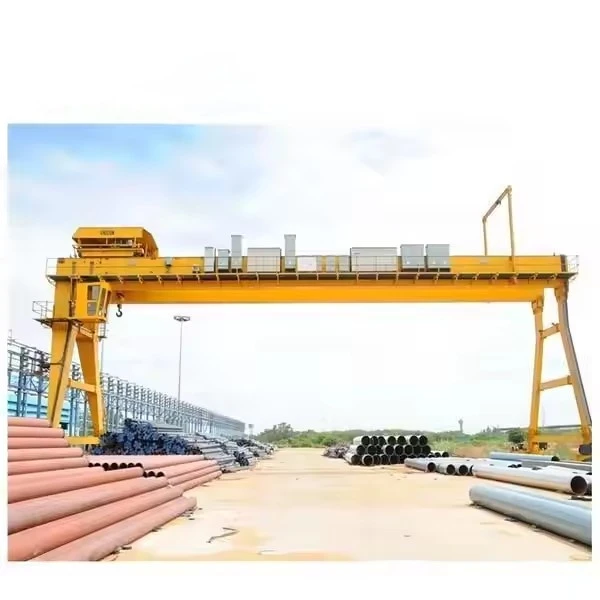


European-type Double Girder Gantry Crane
Products Description
Key Features
1. Structural Design
Double Box Girders: Reinforced steel construction for heavy loads.
End Carriages: Equipped with high-grade wheels for smooth rail movement.
Modular Design: Customizable span, height, and lifting capacity.
2. Hoisting Mechanism
Top-Running Hoist: Moves on rails above the girders (higher lift height).
Wire Rope Hoist (Standard): For capacities up to 500+ tons.
Chain Hoist (Optional): For lighter-duty precision lifting.
3. Drive & Control System
Travel Drives:
Motorized Travel: AC/DC motors with variable frequency drives (VFDs) for smooth operation.
Crab Steering: Allows diagonal movement for precise positioning.
Control Options:
Pendant Control (standard).
Radio Remote Control (wireless operation).
Operator Cabin (for heavy-duty applications).
4. Safety & Automation
Overload Protection: Load cells & limit switches.
Anti-Sway System: Reduces load swing for precision.
Collision Avoidance: Laser sensors for multi-crane environments.
PLC Automation: For automated lifting sequences (optional).
Comparison: European vs. American vs. Chinese Double Girder Gantry Cranes
| Feature | European-Type | American-Type | Chinese-Type |
|---|---|---|---|
| Design | High precision, modular | Ultra-heavy-duty | Cost-effective |
| Capacity | 5-500+ tons | 10-1000+ tons | 5-320 tons |
| Span | Up to 50m+ | Up to 60m+ | Up to 40m |
| Hoist Type | Top-running wire rope | Twin hoists for extreme loads | Standard wire rope |
| Control | Pendant/radio/cabin | Cabin/fully automated | Basic pendant |
| Automation | PLC & anti-sway common | Advanced AI integration | Limited |
| Price | Premium | Very High | Budget-friendly |
Lifting Capacity: 35 metric tons (35,000 kg)
Span: 10m–35m (customizable)
Lifting Height: 6m–20m (adjustable)
Hoist Type: Double-girder with electric wire rope hoist (QD-type)
Travel System: Motorized (rail-guided or rubber-tired)
Wheel Type: Steel wheels (for rails) / Pneumatic tires (floor use)
Control System: Cabin-operated or remote control
Power Supply: 380V/50Hz (3-phase)
Structural Steel: Q345B (high-strength) with corrosion-resistant coating

Pictures & Components
This heavy-duty lifting system consists of carefully engineered components working in harmony to handle extreme loads (5-500+ tons) with precision. Here's the complete technical breakdown:
1. Primary Structural Components
Main Girders (2x)
Fabricated from high-grade steel (S355JR/S460ML)
Box-type construction with internal stiffeners
Typically 1.2-3m height depending on span
Includes runway beams for hoist movement
End Carriages
Welded steel construction with machined wheel paths
Contains drive mechanisms and buffer systems
Anti-climb safety features
 |
 |
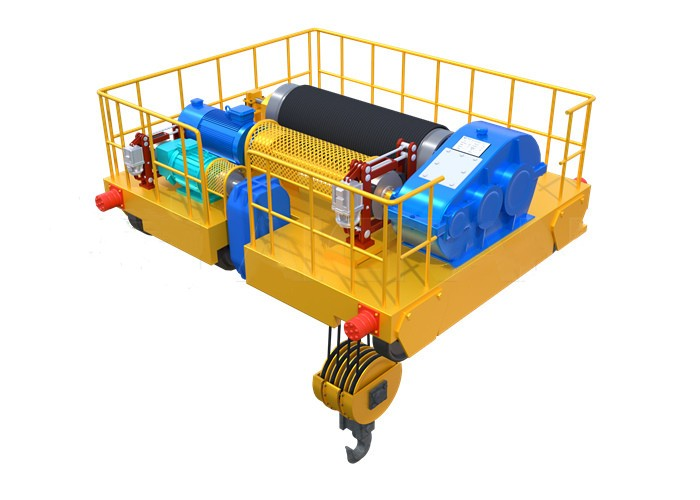
2. Hoisting System
Trolley Assembly
Dual-girder top-running configuration
4-8 wheel groups with hardened treads
Includes cross-travel motor (7.5-30kW typical)
Hoist Unit
European-standard wire rope hoist (DEMAG, ABUS)
2/1 or 4/1 reeving system
Drum diameter: 450-1200mm
Brake system: Dual-circuit fail-safe

|
 |
3. Drive & Power Systems
Travel Drives
AC squirrel cage motors (10-100kW)
Frequency inverters for smooth acceleration
Bevel gear reducers (1:20 to 1:40 ratio)
Power Supply
Festoon systems or conductor bars
400V/50Hz 3-phase standard
Emergency power-off circuits

4. Control & Safety Systems
Operator Interfaces
IP54-rated pendant stations
CAN-bus radio remote controls
Full cabin options with HVAC
Safety Components
Load moment indicators (Class IV)
Redundant limit switches
Anti-collision laser scanners
Wind speed monitors (for outdoor)

5. Mechanical Components
Wheel Assemblies
Forged steel wheels (Ø300-800mm)
Double-flange design
SKF/FAG bearings
Buffers & Bumpers
Hydraulic energy absorbers
Polyurethane end stops

6. Electrical Systems
Control Cabinet
PLC-based (Siemens/Allen-Bradley)
PROFIBUS communication
Condition monitoring ports
Sensors
Absolute encoders for position
Load cell systems
Thermal sensors for motors

7. Optional Systems
Automation Packages
Automatic positioning (±5mm)
RFID container tracking
Remote diagnostics
Special Environments
ATEX packages
Corrosion protection (C5-M)
High-temperature kits

SKETCH

Main technical

Advantages
1. Superior Lifting Performance
Higher Capacity: Handles 5-500+ tons vs single girder's 1-20T limit
Greater Span: Up to 50m+ with minimal deflection (L/800 standard)
Increased Hook Height: Top-running design provides 15-30% more vertical space
2. Enhanced Structural Integrity
Twin girders distribute load evenly, reducing stress concentrations
FEM 1.001 classification ensures 25+ year service life
<0.5mm/m alignment tolerance for precision operations
3. Advanced Control Systems
SIL3 safety-rated PLC controls
Predictive maintenance capabilities via IoT sensors
Anti-sway systems achieve ±5mm positioning accuracy
4. Operational Efficiency
30% faster trolley speeds (up to 60m/min) compared to Asian counterparts
Energy recovery systems reduce power consumption by 15-20%
Automated workflows increase throughput by 40%
5. Safety Features
Redundant braking systems (mechanical + regenerative)
360° collision avoidance with 10m detection range
Load monitoring with ±1% accuracy
6. Customization Options
Modular design allows 200+ configuration variants
ATEX, corrosion-resistant, or cryogenic versions available
Can integrate with existing smart factory systems
Application:
Heavy Industry
Steel Mills: Handling 40-ton coils at 800°C
Foundries: Moving 100-ton molds with precision
Transformer Stations: Installing 300-ton power units
Energy Sector
Wind Turbine Assembly: Positioning 80-ton nacelles
Nuclear Plants: Handling radioactive components
Hydroelectric Projects: Moving turbine components
Transport Infrastructure
Shipyards: Assembling 500-ton ship blocks
Bridge Construction: Precisely placing 200-ton segments
Railway Workshops: Lifting complete train cars
Advanced Manufacturing
Aerospace: Positioning aircraft fuselages (±2mm)
Automotive: Robotic cell integration
Space Industry: Satellite handling in cleanrooms
Specialized Applications
Magnetic Load Handling: For transformer production
Explosive Environments: ATEX-certified versions
Subzero Operations: -40°C Arctic versions
Crane production procedure
The production of a 35-ton Rubber Tire Gantry Crane (RTG) involves several key stages, from design and material procurement to assembly, testing, and commissioning. Below is a detailed production procedure:
1. Design & Engineering
Conceptual Design: Determine crane specifications (span, lifting height, power system, etc.).
Structural Analysis: Use CAD/CAE software (e.g., SolidWorks, ANSYS) to ensure load-bearing capacity and stability.
Electrical & Hydraulic Design: Plan power distribution, control systems, and motion mechanisms.
Regulatory Compliance: Ensure adherence to standards (ISO, FEM, OSHA, etc.).
2. Material Procurement
Steel Fabrication: High-quality steel (Q345B or equivalent) for beams, legs, and girders.
Rubber Tires & Bogies: Heavy-duty, non-marking rubber tires with a swivel mechanism.
Hoist & Trolley: 35-ton electric or hydraulic hoist with anti-sway technology.
Electrical Components: Motors, PLCs, sensors, and cables.
Hydraulic System (if applicable): Pumps, cylinders, and valves.
3. Fabrication of Major Components
A. Gantry Frame Fabrication
Cut and weld steel plates/beams to form the legs, girders, and end carriages.
Machine mating surfaces for precise assembly.
Shot-blast and prime surfaces for corrosion protection.
B. Trolley & Hoist Assembly
Assemble the trolley frame with wheels, motors, and gearboxes.
Mount the 35-ton hoist (wire rope or chain) with brakes and limit switches.
C. Rubber Tire Bogies
Fabricate wheel bogies with swivel and locking mechanisms.
Install hydraulic or electric drive motors for travel.
4. Electrical & Control Systems
Install PLC-based control system for smooth operation.
Wire power supply, sensors, and safety devices (e.g., overload protection, emergency stop).
Test radio remote control or cabin-operated system.
5. Assembly & Integration
Erect the gantry structure (legs and top beam).
Mount the trolley and hoist onto the girders.
Install bogies and rubber tires (ensure proper alignment).
Connect electrical and hydraulic systems.
6. Testing & Quality Control
A. Load Testing
Static Load Test: 1.25 × rated capacity (43.75 tons) to check structural integrity.
Dynamic Load Test: Verify performance under operational conditions.
B. Functional Tests
Travel Test: Check smooth movement along the runway.
Lifting & Lowering: Ensure precision and safety.
Safety Checks: Verify limit switches, brakes, and emergency stops.
C. Paint & Finishing
Apply final anti-corrosion paint (typically epoxy-based).
7. Commissioning & Delivery
On-site assembly (if shipped in modules).
Operator training for safe usage.
Final inspection & handover.


Workshop view
Material Inspection
Quality Inspection: Strict quality inspection is carried out on the purchased raw materials to ensure that they meet the design requirements and national standards.
Material Storage: Qualified materials are stored according to classification to prevent corrosion or damage.
Cutting and Forming
Steel Cutting: Use plasma cutting, laser cutting or flame cutting and other technologies to cut the steel according to the size of the design drawing.
Forming Processing: Form the steel plate through bending, rolling, welding and other processes to manufacture the main beam, end beam and other structural parts.
Welding
Component Welding: The cut and formed steel parts are welded into the main structures such as the main beam, end beam and trolley. The welding process needs to be strictly controlled to ensure the structural strength and welding quality.
Weld Inspection: Use non-destructive testing technology (such as ultrasonic testing, radiographic testing) to inspect the welds to ensure that there are no cracks or other defects.
Machining
Precision Machining: Precision machining is performed on the key components of the crane, such as wheel sets, bearing seats, pulleys, etc., to ensure their dimensional accuracy and surface quality.
Assembly of the whole machine
General assembly: On the basis of pre-assembly, the overall assembly of the crane is carried out, including the final installation of the main beam, end beam, lifting mechanism, walking mechanism, etc.
Commissioning and testing
Under dynamic conditions, the operating performance of the crane is tested, including the testing of lifting, walking, steering and other functions. The overall size of the assembled bridge crane is checked to ensure that all dimensions meet the design requirements.
Spraying and anti-corrosion treatment
Surface treatment Rust removal: Rust removal on the surface of the crane, common methods include sandblasting, pickling, etc. Primer spraying: Spray anti-corrosion primer on the treated surface to prevent metal oxidation and corrosion. Topcoat spraying Color spraying: Spray topcoat according to customer requirements or industry standards to give the crane a protective and decorative effect. Marking: After spraying, mark the crane's identification information in accordance with the specifications, such as model, rated load, etc.
Factory and installation
Packaging and transportation
Packaging protection: Protectively package the key components of the crane to prevent damage during transportation. Transportation arrangement: According to the equipment size and transportation conditions, select a suitable transportation method to transport the crane to the customer's site.
Acceptance and delivery
Customer acceptance
On-site acceptance: The customer conducts on-site acceptance of the crane according to the contract requirements and technical specifications to check the performance and quality of the equipment.
Problem rectification: If any problems are found, the manufacturer needs to rectify them in time to ensure that the equipment fully meets the customer's requirements. Delivery and use Operation training: The manufacturer usually trains the customer's operators to ensure that they can operate the crane correctly and safely.


Hot Tags: european-type double girder gantry crane, China european-type double girder gantry crane manufacturers, suppliers, factory
Previous
Gantry Crane For ShipyardYou Might Also Like


Send Inquiry