










RTG Container Gantry Crane
Products Description
Key Features of RTG Cranes:
Mobility on Rubber Tires
Unlike rail-mounted gantry cranes (RMG), RTGs move on rubber tires, allowing flexibility in yard operations.
They can be repositioned as needed, making them ideal for dense container stacking.
Gantry Structure
The crane spans multiple container rows (typically 6+1, 7+1, or more) and can stack containers 4-6 high.
The legs are designed to straddle container stacks while moving along the yard.
Lifting Mechanism
Equipped with a spreader (twistlock system) to lift containers of various sizes (20ft, 40ft, 45ft, etc.).
Some RTGs have automatic stacking capabilities for improved efficiency.
Power Options
Diesel-electric (common in older models) or electric (ERTG) with regenerative power systems.
Hybrid and battery-powered RTGs are emerging for sustainability.
Automation & Control
Can be manually operated or semi/fully automated (e.g., AutoRTG).
GPS, optical sensors, and AI assist in precise container handling.
Advantages of RTG Cranes:
✔ Flexibility – Can be moved between yard blocks.
✔ High Stacking Capacity – Optimizes yard space.
✔ Lower Infrastructure Cost – No need for fixed rails.
✔ Efficient for Medium-Sized Terminals – Balances cost and performance.
Disadvantages:
❌ Higher Maintenance (tires, diesel engines).
❌ Less Energy-Efficient than RMGs (unless electric/hybrid).
❌ Requires Skilled Operators (unless automated).
Comparison with Other Crane Types
| Feature | RTG Crane | RMG Crane | STS Crane |
|---|---|---|---|
| Mobility | ✅ Rubber tires | ❌ Rail-mounted | ❌ Fixed on rails |
| Stack Height | 4-6 high | 5-7 high | 1-2 high (yard use) |
| Infrastructure | Low (paved yard) | High (rails needed) | Very high (quay needed) |
| Automation | Possible (Auto-RTG) | Easier (fixed path) | Mostly manual |
| Best For | Medium terminals | High-volume terminals | Ship loading/unloading |
Core Components:Engine, Bearing, Gearbox, Motor, Gear
Place of Origin:Henan, China
Warranty:2 years
Weight (KG):50000 kg
Video outgoing-inspection:Provided
Machinery Test Report:Provided
Application:Outdoor
Keywords:Gantry Crane
Rated Loading Capacity:50Ton
Cross travelling speed:44.6m/min
Long travelling speed:47.1m/min
Control way:cabin
Power supply:Cable reel
Steel track:QU80
Power:3-phase AC 50HZ 380V
Pictures & Components
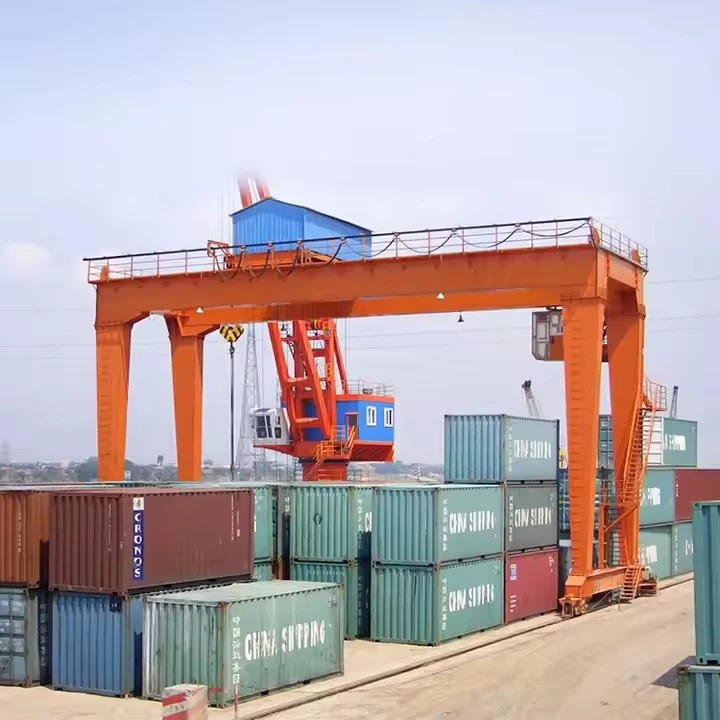
An RTG (Rubber-Tired Gantry) container gantry crane consists of several key components that work together to handle, stack, and transport shipping containers efficiently in port yards and intermodal terminals. Below is a breakdown of its main components:
1. Structural Components
A. Gantry Frame (Main Girder & Legs)
Main Girder (Bridge): The horizontal beam that spans the container stacks, supporting the trolley and hoist system.
Legs (End Frames): Vertical structures on either side that support the main girder and house the wheels/tires.
Cross Beams & Bracing: Reinforcements to ensure structural stability under heavy loads.
B. Boom (Optional)
Some RTGs have a cantilevered boom for extended reach (e.g., when working with trucks or rail cars).
 |
 |
2. Mobility & Drive System
A. Rubber Tires & Wheels
Tires: Heavy-duty, high-load rubber tires (usually 8-16 tires depending on crane size).
Steering System: Hydraulic or electric steering for maneuvering (crab, diagonal, or 90° steering modes).
Drive Motors: Electric or diesel-hydraulic motors powering the wheels.
B. Power Source
Diesel Engine (for conventional RTGs).
Electric (ERTG) – Powered via cable reel, battery, or conductor bar.
Hybrid (Diesel + Battery/Electric) – Reduces fuel consumption.
 |
 |
3. Lifting & Handling System
A. Hoisting Mechanism
Hoist Motor & Drum: Lifts/lowers the spreader via wire ropes or chains.
Wire Ropes & Sheaves: High-strength steel cables guided by pulleys for smooth lifting.
B. Spreader (Container Lifter)
Twistlock System: Locks onto container corner castings (handles 20ft, 40ft, 45ft, etc.).
Adjustable Spreader: Can shift between container sizes.
Smart Spreaders: Some have sensors for automatic locking and weight detection.
C. Trolley System
Moves horizontally along the main girder to position the spreader over containers.
Powered by electric motors with regenerative braking.

4. Control & Automation Systems
A. Operator Cabin
Located on one leg or centrally, with joysticks, screens, and safety controls.
Some modern RTGs use remote control or fully automated systems.
B. Automation Features (for Auto-RTGs)
Laser Scanners / Cameras – Detect container positions.
GPS / RFID – For tracking and positioning.
PLC & AI Systems – Optimize stacking patterns.
C. Safety Systems
Anti-Collision Sensors – Prevents crashes with other equipment.
Load Moment Indicators (LMI) – Prevents overloads.
Emergency Stop & Wind Alarms – For storm conditions.

5. Electrical & Hydraulic Systems
A. Electrical Panels & Drives
Variable Frequency Drives (VFDs) – Control motor speed.
Generators (in diesel RTGs) – Supply power to electric motors.
B. Hydraulic Systems
Used for steering, brakes, and sometimes spreader adjustments.

.
6. Ancillary Components
Outriggers / Stabilizers – Deployed during lifting for extra stability.
Lighting & Warning Systems – For night operations and safety.
Fuel Tanks / Battery Packs – Depending on power type.

Summary of Key RTG Components
| Category | Components |
|---|---|
| Structure | Gantry frame, legs, boom (optional) |
| Mobility | Rubber tires, drive motors, steering system |
| Lifting System | Hoist, spreader, trolley, wire ropes |
| Control | Operator cabin, PLC, sensors, automation |
| Power | Diesel engine / electric motors / hybrid |
| Safety | Anti-collision, LMI, emergency stops |

SKETCH

Main technical

Advantages
1. Mobility & Flexibility
Rubber tires allow easy repositioning across the yard without fixed rails.
Can be relocated to different stacking areas as needed.
Suitable for terminals with changing layouts.
2. High Stacking Density
Can stack containers 4 to 6 high, optimizing yard space.
Typically spans 6+1 or 7+1 rows (6 stacks + 1 truck lane).
3. Lower Infrastructure Cost
No need for expensive rail tracks (unlike RMG cranes).
Requires only a paved yard surface.
4. Versatility in Operations
Can handle multiple container sizes (20ft, 40ft, 45ft, etc.).
Used for truck loading/unloading, rail operations, and yard stacking.
5. Energy Efficiency (for E-RTGs & Hybrid Models)
Electric RTGs (E-RTGs) reduce emissions and fuel costs.
Some models use regenerative braking to save energy.
6. Automation-Ready
Can be upgraded to semi-automated or fully automated (Auto-RTG) systems.
Uses GPS, optical sensors, and AI for precise container handling.
7. Cost-Effective for Medium-Sized Terminals
Cheaper than STS (Ship-to-Shore) cranes and RMGs for smaller operations.
Lower initial investment compared to fixed rail systems.
Application
1. Port Container Terminals
Stacking containers in yard blocks before loading onto ships/trucks.
Transferring containers between trucks, trains, and storage areas.
2. Intermodal Rail Yards
Loading/unloading containers from trains to trucks (or vice versa).
Used in inland container depots (ICDs).
3. Depot & Logistics Hubs
Temporary storage in freight stations and distribution centers.
Handling containers for customs clearance and inspections.
4. Cross-Docking Operations
Moving containers between different transport modes quickly.
5. Military & Emergency Ports
Deployed in temporary ports due to their mobility.
Crane production procedure
1. Design and Engineering
Blueprint and Structural Design: Engineering teams design the crane based on specifications, considering the weight, span, lifting capacity, and working environment.
Component Specifications: Detailed specifications for components such as the main girders, end beams, hoist system, trolley, and electrical components are prepared.
2. Material Selection and Procurement
Steel Material Selection: High-strength steel materials are chosen for the main girders, columns, and other critical parts.
Procurement: Materials, such as steel plates, sections, bolts, and electrical components, are sourced and inspected for quality.
3. Cutting and Pre-Fabrication
Cutting and Shaping: Steel components are cut, shaped, and welded into preliminary forms according to the design specifications.
Pre-Fabrication Assembly: Components such as beams and girders are pre-assembled to verify that they fit together properly.
4. Welding and Structural Assembly
Welding: Main girders, columns, and other structural components are welded to create a sturdy framework. Specialized welding techniques are used to ensure strength and durability.
Structural Assembly: The main girders and end beams are assembled, ensuring precise alignment for balanced load distribution.
Quality Control: Welding seams and joints are inspected using non-destructive testing (e.g., ultrasonic or X-ray testing) for any structural defects.
5. Machining and Finishing
Machining of Parts: Critical parts such as the wheels, trolley components, and hoists undergo machining for proper fitting and smooth operation.
Surface Treatment: Steel parts are cleaned and subjected to surface treatments like sandblasting and coating to prevent rust and enhance durability.
Painting and Coating: Protective coatings are applied for weather resistance, with a primer followed by top coats.
6. Assembly of Crane Components
Main Girder Assembly: The two main girders are mounted and aligned.
End Beam Installation: End beams are fixed to the main girders, forming the frame of the crane.
Hoist and Trolley Installation: The hoist mechanism and trolley are mounted on the main girder rails and tested for alignment and operational smoothness.
7. Electrical and Control Systems Installation
Wiring and Cabling: Electrical wiring is installed for power supply, control circuits, and safety systems.
Control Panel and Safety Features: The control panel is mounted, with safety features such as limit switches, emergency stops, and overload protection integrated and tested.
Control System Programming: The crane's control system is programmed and tested for correct operation.
8. Testing and Quality Assurance
Load Testing: The crane is subjected to load tests to ensure it can handle its rated capacity without issues.
Operational Testing: Functional tests are performed to check movements, responsiveness, braking systems, and electrical operations.
Inspection and Certification: The crane undergoes final inspections to verify compliance with safety regulations and standards. Certification may be issued by relevant authorities.
9. Final Adjustments and Delivery Preparation
Final Adjustments: Any minor adjustments are made to ensure smooth operation.
Documentation: Operation manuals, maintenance guidelines, and certification documents are prepared for delivery.
Packaging and Shipping: The crane is packaged securely for shipment, ensuring all parts are protected during transit.
10. Installation and Commissioning (at Site)
On-site Assembly: The crane is assembled at the customer's location if required.

Workshop view:
The company has installed an intelligent equipment management platform, and has installed 310 sets (sets) of handling and welding robots. After the completion of the plan, there will be more than 500 sets (sets), and the equipment networking rate will reach 95%. 32 welding lines have been put into use, 50 are planned to be installed, and the automation rate of the entire product line has reached 85%.


Hot Tags: rtg container gantry crane, China rtg container gantry crane manufacturers, suppliers, factory
You Might Also Like



Send Inquiry