







Portal Gantry Crane 50t
Products Description
The 50T Portal Gantry Crane is designed for lifting and transporting heavy loads across wide work areas. It operates on rails or wheels and consists of a strong gantry frame supported by legs that straddle a workspace.
Key Features:
Structure: Made of high-strength steel, with a stable and robust frame.
Lifting Capacity: 30 tons, suitable for large-scale lifting tasks.
Span & Height: Customized according to operational requirements.
Mobility: Can be rail-mounted or rubber-tired for easy movement.
Lifting Mechanism: Equipped with a hoist and trolley system for precise control.
Safety Systems: Includes overload protection, emergency stop, and anti-sway technology.
Power Source: Electric or hydraulic, depending on application needs.
Types of 30T Portal Gantry Cranes:
Single Girder Gantry Crane: Lighter, cost-effective, and ideal for medium-duty applications.
Double Girder Gantry Crane: More robust, provides higher stability, and is suited for heavy-duty lifting.
Rubber-Tired Gantry (RTG) Crane: Mobile and flexible for outdoor applications.
Rail-Mounted Gantry (RMG) Crane: Runs on fixed tracks for precise and efficient operation.
Applications:
Shipbuilding & Ports: Loading/unloading containers and ship components.
Construction Sites: Handling steel beams, precast concrete, and other heavy materials.
Manufacturing & Assembly Plants: Moving large machinery and equipment.
Mining & Heavy Industries: Transporting ore, raw materials, and industrial components.
Advantages of a 30T Portal Gantry Crane:
✔ High lifting capacity with stability.
✔ Efficient material handling and reduced labor costs.
✔ Adaptable for indoor and outdoor use.
✔ Advanced automation options for precision and safety.
Would you like a technical specification sheet or a comparison of different models?
Core Components:Bearing, Gear, Gearbox, Motor
Place of Origin:Henan, China
Warranty:1 Year
Weight (KG):2000 kg
Video outgoing-inspection:Provided
Machinery Test Report:Provided
Keywords:gantry crane
Color: Customized
Size: Customized
Design: computer optimization design
Safety: High flexible flat cable power
Application: construction industrial,workshop,warehouse
Working class: A3-A8
Certification: ISO,CE,BV,S GS,TUV
Power Source: 380~480V,customized

Pictures & Components
1.Main Structure
Bridge/Girder: The horizontal beam that supports the hoist and trolley. It can be single girder or double girder, depending on the design.
Legs (Supports): Vertical columns that support the bridge and connect to the ground or wheels.
End Carriages: Located at both ends of the crane, they connect the bridge to the legs and house the drive mechanisms.

Lifting Mechanism
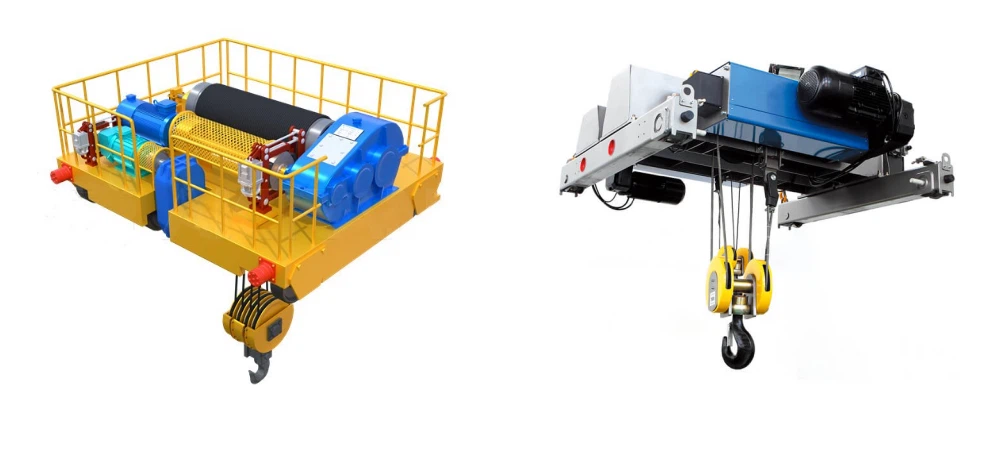
Hoist: The device responsible for lifting and lowering loads, usually powered by an electric motor.
Trolley: Moves along the bridge girder, carrying the hoist to different positions.
Wire Rope/Chain: Used to lift loads, supported by the hoist drum or chain mechanism.
Hook Block: The attachment point for lifting cargo, equipped with a safety latch.
3.End carriage
1)The end carriage of a cantilever gantry crane is an essential component that supports the crane's movement along the runway or ground track. It is located at both ends of the main girder and connects the crane to its traveling system.
2) The end beam is made from high-strength steel for durability and load-bearing capacity.Designed to ensure stable movement of the crane, even under heavy loads.
3) Functions of the End Carriage:
Support:Carries the weight of the crane and its load.
Mobility:Facilitates longitudinal movement of the crane along the track or runway.
Stability:Ensures balanced operation, preventing tipping or unwanted movements during lifting.
Load Distribution:Distributes the load evenly across the wheels, protecting the crane's structure and minimizing stress on the track.

4.Traveling Mechanism
Rail-mounted (RMG) or Rubber-tired (RTG): Determines the mobility of the crane.
Wheels/Rails: Allows movement along a track or freely in an open area.
Drive System: Includes electric motors, gearboxes, and brakes for controlled motion.
5.Trolley travelling mechanism
1) Structural composition
Trolley frame: The frame is the main structural support of the trolley, providing the necessary rigidity and strength to bear the load.It is typically made of high-strength steel to ensure durability and resistance to deformation under heavy loads.
Wheel set: The wheels are often mounted on axles, and the bearings inside these wheels are designed for high load-bearing capacity and smooth operation.
Electric Drive Motor: The trolley's movement is powered by an electric motor, which drives the wheel system via a gearbox and a system of pulleys or chains.The motor is typically installed on the trolley frame and is connected to the wheels through a drive mechanism, allowing for both forward and backward motion.
2) Function of the trolley operating mechanism
1. Horizontal Movement of the Hoist
The trolley, which carries the hoisting mechanism, moves horizontally along the gantry rail. This horizontal movement enables the crane to lift and lower materials over a large area, such as a yard, dock, or warehouse.
2. Smooth and Precise Positioning
The trolley traveling mechanism is designed for precise control of the trolley's position. This is critical for ensuring that loads are picked up and placed accurately at the desired locations.
3. Support for the Hoisting Mechanism
The hoist system is typically mounted on the trolley. The trolley traveling mechanism allows the hoist to traverse the length of the gantry, ensuring that the lifting equipment can cover the full area needed for operations.
4. Load Distribution and Stability
The trolley helps distribute the load evenly across the crane's structure. As the trolley moves, the load is kept stable, reducing the risk of imbalance that could lead to accidents.
5. Speed Control
The trolley traveling mechanism includes motors, gears, and sometimes variable frequency drives (VFDs), which provide the necessary speed control for the trolley's movement. This helps in adapting to different operational needs, whether moving slowly for precision or quickly for efficiency.
6. Integration with Other Crane Movements
The trolley traveling mechanism is integrated with the gantry's vertical (hoisting) and longitudinal (gantry traveling) movements. It works in coordination with these functions to ensure smooth and synchronized operation, making it easier to perform complex lifts and transfers of materials.
7. Safety and Load Handling
The mechanism often includes safety features, such as limit switches or sensors, to prevent the trolley from exceeding its operational boundaries or colliding with obstacles, enhancing the safety of the entire crane operation.
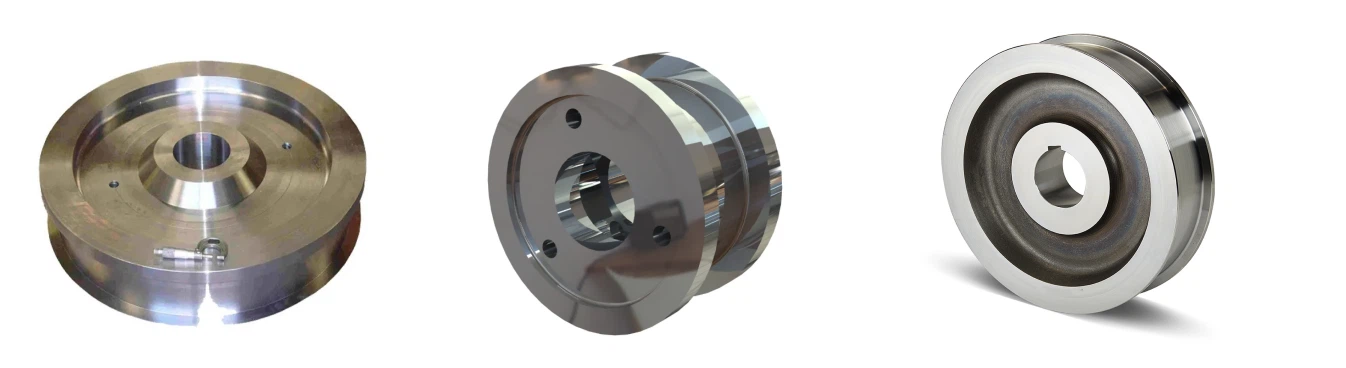
6.Crane wheel
1) Function of wheels
The wheels provide support for the crane structure and are essential for allowing the gantry crane to travel along its track.They also absorb the forces generated by the crane's weight and operational movements, distributing these forces to prevent damage to the track and other crane components.
Depending on the crane's purpose and the loads it handles, the wheels are engineered to handle different weight capacities. Larger cranes or those used for heavier lifting will have larger, more robust wheels.
2) Design requirements
Crane wheels are typically made of high-strength steel or alloy materials to withstand the weight of the crane and its load while enduring constant motion and heavy loads.The wheels are often designed with a flange to ensure smooth and stable movement along the rails and to prevent them from derailing.
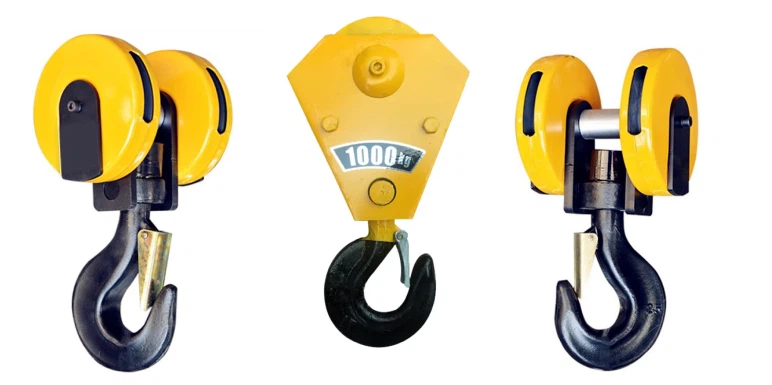
7.Crane Hook
The crane hook of a cantilever gantry crane is an essential component in the lifting and handling process. This hook is used to attach and support loads during hoisting operations.
The hook is typically made of high-strength steel to handle heavy loads. It has a curved shape, with a deep throat for secure attachment to slings, chains, or other lifting devices.The hook usually has a safety latch to prevent the load from accidentally coming loose during operation.
The primary function of the crane hook is to connect the crane's lifting mechanism (such as the hoist) with the load. It moves along the gantry crane's beam (which is supported by the legs of the gantry structure) and can be raised or lowered depending on the lifting requirements.
Motor
The motor of a cantilever gantry crane is a crucial component responsible for driving the various movements of the crane, such as the hoisting, trolley travel, and gantry movement. Depending on the design and size of the crane, the motor can vary in type and specifications. The motors are typically controlled by a PLC (Programmable Logic Controller) or VFDs (Variable Frequency Drives) to adjust speeds and torque for efficient operation.
Hoisting Motor:Purpose: Drives the hoist to lift and lower the load.Motor Type: Typically an electric motor, often an AC induction motor.Power: Varies depending on the load capacity, ranging from a few kW to several hundred kW.
Travelling Motor (Trolley Movement):Purpose: Moves the trolley along the gantry rail.Motor Type: Usually a three-phase AC motor.Power: Selected based on the required speed and capacity of the trolley.
Gantry Traveling Motor (Bridge Movement):Purpose: Moves the entire gantry structure along the ground rail, allowing it to span over the load area.Motor Type: A heavy-duty electric motor, often with a variable speed drive (VSD) for fine control.Power: Similar to the trolley motor but typically higher, as it needs to move the entire crane structure.

.
Sound and light alarm system & limit switch
1) Sound and light alarm system
The sound and light alarm system for a Cantilever Gantry Crane is designed to enhance safety by providing visual and audible signals in case of abnormal conditions or hazards. These alarms help warn operators, workers, and personnel in the vicinity of potential risks.
Sound Alarm (Horn or Siren):Purpose: Alerts personnel to an emergency or abnormal situation.Sound: Typically loud and attention-grabbing, such as a siren or a horn with varying patterns (continuous, intermittent, or pulsed) to signal different types of alerts.Placement: Usually installed at the crane's control cabin, near the gantry, or at strategic locations where workers are most likely to be present.
Light Alarm (Strobe Light or Flashing Beacon):Purpose: Provides a visual alert that can be seen in areas where sound alone might not be effective (e.g., in noisy environments or at a distance).Light Type: Flashing or rotating strobe lights or beacons are commonly used, often with different colors to indicate different warning levels.
Red: Critical alarm (dangerous situation).
Yellow/Amber: Caution (warning or a non-urgent issue).
Blue: May indicate operational status or a different specific condition.
2) Limit switch
A limit switch on a cantilever gantry crane is a safety device used to prevent the crane from over-traveling or moving beyond its predefined limits. It is an essential component for ensuring the proper and safe operation of the crane. The cantilever gantry crane typically consists of a large structure with a bridge and hoisting mechanism, which is often used in industrial environments like ports or warehouses for lifting and moving heavy loads.
Function of the Limit Switch:
Position Detection: The limit switch detects when the crane's hoist or trolley has reached its designated end position (either fully raised, lowered, or moved along the track). This helps prevent mechanical damage caused by over-travel.
Safety: It acts as a fail-safe to stop the crane from moving if it reaches its boundary. This reduces the risk of accidents and protects both the crane and surrounding equipment.
Automation: Limit switches can be connected to the crane's control system. When the limit switch is triggered, it sends a signal to the control system to stop the crane or reverse its direction.
Types of Limit Switches for Gantry Cranes:
Mechanical Limit Switch: This type uses a physical actuator to open or close contacts when the crane reaches a limit. It is a commonly used, simple, and cost-effective solution.
Magnetic Limit Switch: These use magnetic fields to detect the position of a target without direct contact, providing a more durable and longer-lasting solution.
Proximity Limit Switch: It detects the presence of a target without contact, using a sensor, and is often used in more advanced or higher-speed applications.

10.Safety Features
Overload Protection: Prevents lifting beyond the crane's capacity.
Emergency Stop System: Allows immediate shutdown in case of danger.
Anti-Sway System: Reduces swinging of loads for precise handling.
Buffer & Bumper System: Protects the crane from impacts.
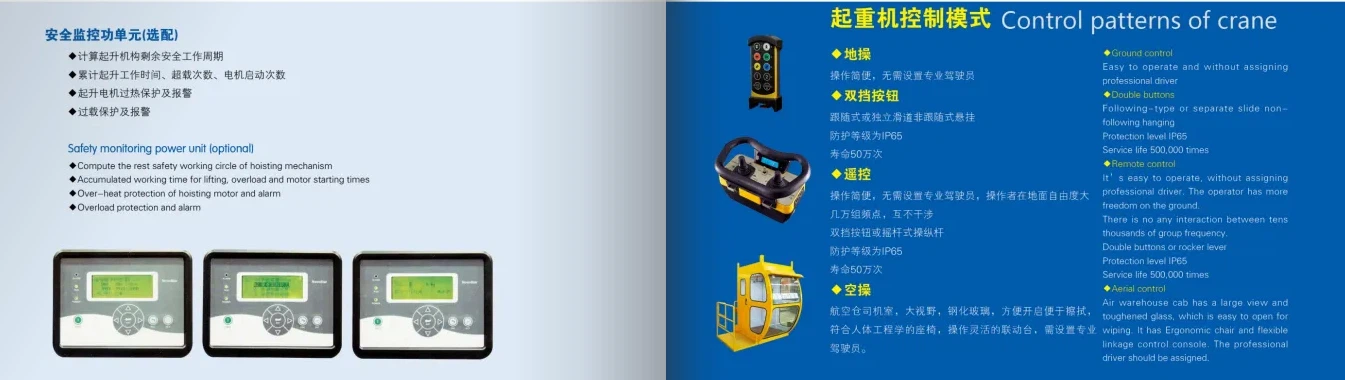
11.Control Mode
1)1. Manual Control
Description: Operators manually control the crane using push-button pendants, levers, or control panels directly on-site.
Features:
Simple to use and maintain.
Suitable for less complex lifting tasks.
Applications: Used in smaller-scale operations or locations with low automation requirements.
2. Remote Control
Description: Operators use a wireless remote control device to operate the crane from a safe distance.
Features:
Improved safety by allowing the operator to stay clear of the load.
Greater operational flexibility.
Can handle more complex movements.
Applications: Warehousing, logistics yards, and other environments requiring higher precision.
3. Cabin Control
Description: The operator sits in a cabin attached to the crane and controls operations using joysticks or control panels.
Features:
Provides the operator with a clear view of the load and working area.
Suitable for heavy-duty and long-duration operations.
Applications: Large-scale industrial sites, such as shipyards, steel mills, or construction sites.
4. Semi-Automatic Control
Description: Some operations (like repetitive movements) are automated, while others require manual input.
Features:
Reduces operator workload.
Increases efficiency for repetitive tasks.
Applications: Assembly lines, logistics hubs, and tasks involving repeated lifting and positioning.
5. Fully Automatic Control
Description: The crane operates autonomously based on pre-programmed instructions or sensor inputs.
Features:
High precision and efficiency.
Eliminates human error and reduces labor costs.
Often integrated with smart systems or IoT for monitoring and data analysis.
Applications: Ports, automated warehouses, and environments requiring high-speed, precise operations.
6. Hybrid Control (Manual + Automatic)
Description: Combines manual and automatic control options, allowing flexibility based on task requirements.
Features:
Adaptable to varying operational needs.
Enhances efficiency without sacrificing control.
Applications: Sites that require both human supervision and automation.
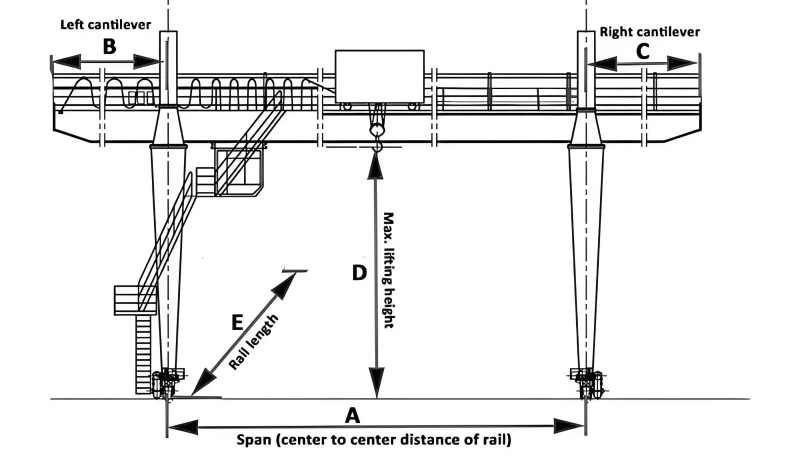
12.Sketch
Main technical
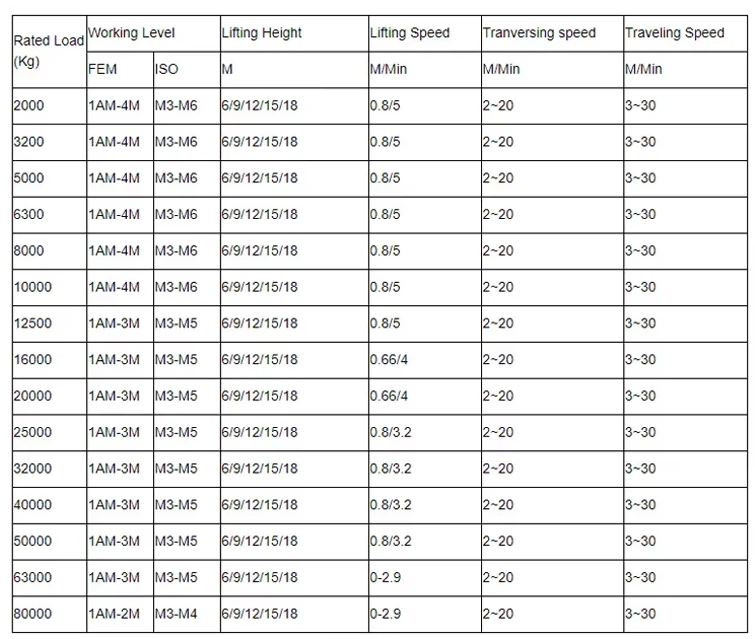
Advantages
1. High Lifting Capacity
Designed to handle heavy loads up to 50 tons, making it ideal for industrial and construction applications.
2. Versatile Applications
Suitable for shipyards, rail yards, construction sites, steel mills, and manufacturing plants.
Can be used for lifting, loading, and unloading large materials and machinery.
3. Customizable Design
Available in rail-mounted or rubber-tired configurations for mobility.
Adjustable span and lifting height to fit specific operational needs.
4. High Efficiency
Fast lifting and movement speeds improve productivity and reduce downtime.
Reduces reliance on manual labor, minimizing fatigue and human error.
5. Enhanced Safety Features
Overload protection prevents damage due to excessive loads.
Anti-sway technology ensures stable and precise load control.
Emergency stop system for instant shutdown in case of a malfunction.
Limit switches to prevent over-traveling and excessive lifting.
6. Cost-Effective
Lower operational costs compared to fixed lifting equipment.
Reduces the need for additional lifting machinery, optimizing workforce efficiency.
7. Durability & Longevity
Built with high-strength steel to withstand harsh industrial environments.
Designed for long service life with minimal maintenance requirements.
Application
1. Shipbuilding & Marine Industry
Used for lifting and assembling large ship components.
Moves heavy ship sections, engines, and containers in docks and shipyards.
Ideal for launching and repairing ships.
2. Construction & Infrastructure Projects
Lifts heavy construction materials such as steel beams, concrete blocks, and precast components.
Essential for bridge construction, tunnel projects, and large infrastructure works.
Used for moving prefabricated structures efficiently.
3. Manufacturing & Heavy Industry
Handles large machinery, metal components, and industrial equipment.
Assists in the fabrication, welding, and assembly of heavy structures.
Improves production efficiency in heavy engineering plants.
4. Railway & Transport Hubs
Lifts and moves train components, rail tracks, and bogies.
Used in rail yard maintenance for heavy lifting operations.
Ideal for loading and unloading cargo containers in railway freight stations.
5. Steel Mills & Metal Processing Plants
Transfers large steel coils, metal sheets, and fabricated structures.
Helps in steel plate cutting, rolling, and stacking operations.
Supports hot and cold rolling processes in steel manufacturing.
6. Power Plants & Energy Sector
Assists in lifting turbines, transformers, and power generation equipment.
Used in hydropower, wind power, and nuclear power plant maintenance.
Helps with installation and repair of heavy electrical infrastructure.
7. Mining & Material Handling
Used for lifting ore, minerals, and heavy mining equipment.
Helps in transporting extracted materials efficiently.
Suitable for underground and open-pit mining operations.
8. Aerospace Industry
Supports assembly and maintenance of aircraft components.
Used for handling large fuselage sections and aerospace equipment.
Enhances precision lifting in aircraft manufacturing plants.
Crane production procedure
1. Design and Engineering
Requirement Analysis
Understand the client's specifications (load capacity, span, height, working environment, etc.).
Determine operational parameters: lifting height, travel speed, working frequency, etc.
Preliminary Design
Create conceptual designs and 3D models.
Choose materials based on strength and environmental conditions.
Detailed Engineering
Develop detailed engineering drawings (structural components, mechanisms, electrical systems).
Perform stress and fatigue analysis to ensure safety.
2. Material Procurement
Source high-quality materials, including:
Steel plates and profiles for structural components.
Motors, gearboxes, and other mechanical parts.
Electrical systems and control components.
Inspect materials to ensure compliance with quality standards.
3. Fabrication
Structural Component Fabrication
Cut, weld, and assemble the steel structures (main girder, cantilever arms, legs, etc.).
Ensure precise alignment and dimensions.
Perform surface treatment (e.g., shot blasting, painting) for corrosion protection.
Mechanical Assembly
Assemble mechanical parts (trolley, hoist, wheels, etc.).
Install motors, gearboxes, and drive systems.
Electrical Assembly
Install electrical components (control panels, cables, sensors).
Wire and connect the system to ensure functionality.
4. Quality Inspection
Material Inspection
Verify material certification and conduct tests (e.g., tensile tests).
Structural Inspection
Inspect weld quality (e.g., ultrasonic testing).
Ensure dimensional accuracy and surface finishing.
Assembly Inspection
Check alignment and functionality of all parts (mechanical and electrical).
Load Testing
Conduct static and dynamic load tests to ensure safe operation.
5. Factory Acceptance Testing (FAT)
Conduct a comprehensive trial run, including:
Full load and overload tests.
Functionality of all safety devices (e.g., limit switches, emergency brakes).
Smooth operation of trolley, hoist, and crane travel.
Document results and obtain client approval.
6. Disassembly and Packing
Disassemble the crane into transportable sections.
Pack components securely to prevent damage during transportation.
Label and prepare a packing list for efficient reassembly.
7. Transportation
Deliver the crane components to the installation site using appropriate transportation methods.
8. Installation and Commissioning
On-Site Assembly
Assemble structural components and mechanical systems.
Install electrical systems and control panels.
Calibration and Testing
Recalibrate the crane system for site-specific conditions.
Perform on-site load testing to verify performance.
9. Handover
Provide training to the client's personnel on safe operation and maintenance.
Deliver technical documentation (user manual, maintenance guide, certificates).
Obtain final approval and acceptance from the client.
10. After-Sales Support
Offer warranty services and maintenance support.
Provide spare parts and technical assistance as needed.

Workshop view:
The company has installed an intelligent equipment management platform, and has installed 310 sets (sets) of handling and welding robots. After the completion of the plan, there will be more than 500 sets (sets), and the equipment networking rate will reach 95%. 32 welding lines have been put into use, 50 are planned to be installed, and the automation rate of the entire product line has reached 85%.




Hot Tags: portal gantry crane 50t, China portal gantry crane 50t manufacturers, suppliers, factory
Previous
Gantry Crane 120 TonsYou Might Also Like


Send Inquiry