












Gantry Girder Crane
Product Introduction
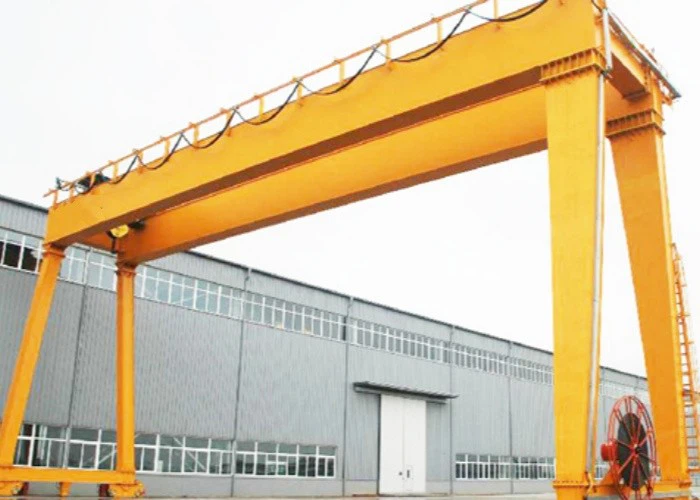
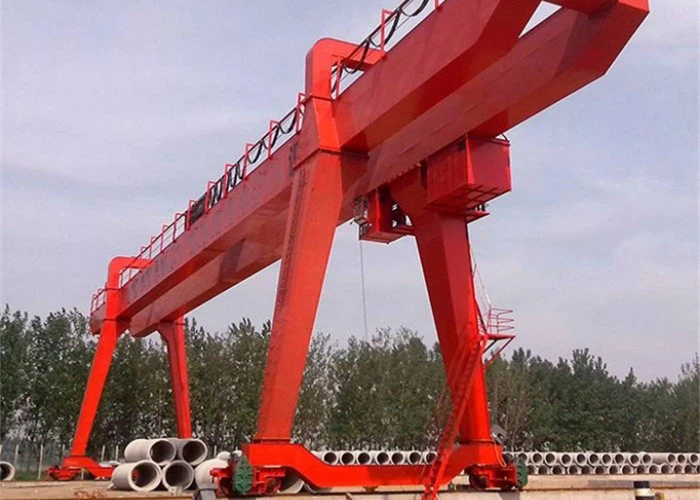
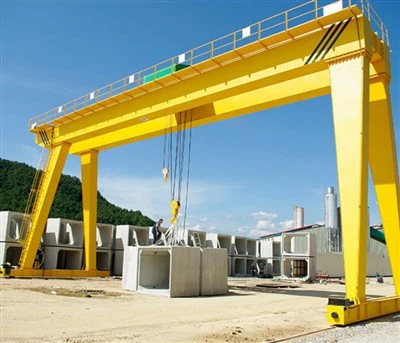
The Gantry Girder Crane is an important lifting equipment and is widely used in factories, docks, cargo yards and other places for heavy object handling and loading and unloading operations. The Gantry Girder Crane adopts a double-girder structure design and has high strength and rigidity, which allows it to carry a large lifting capacity. Compared with single-girder cranes, the double-girder structure provides better stability and balance, and is suitable for various complex operating environments, such as high temperature, humidity, and open air. Gantry Girder Crane has become an indispensable lifting equipment in various industrial fields with its unique structural design, excellent performance advantages and wide range of application scenarios. Through reasonable operation and regular maintenance, this crane will provide users with efficient, safe and stable lifting solutions.
Warranty:1.5years
Weight (KG):5000 kg
Feature:Gantry Crane
Application:Widely
Color:Yellow,red,blue or customized
Pictures & Components
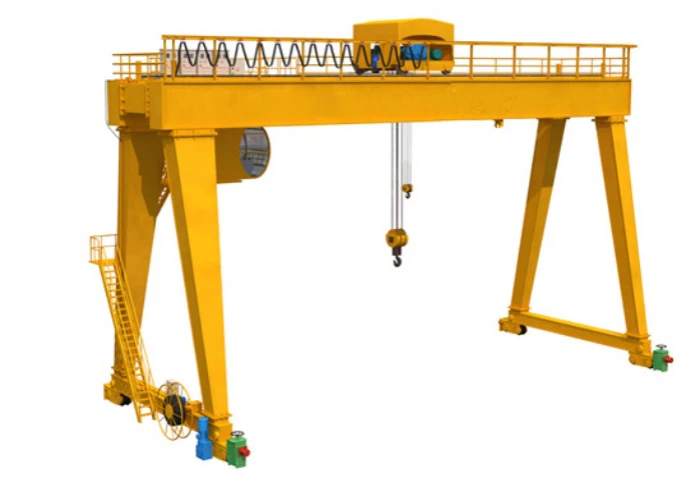
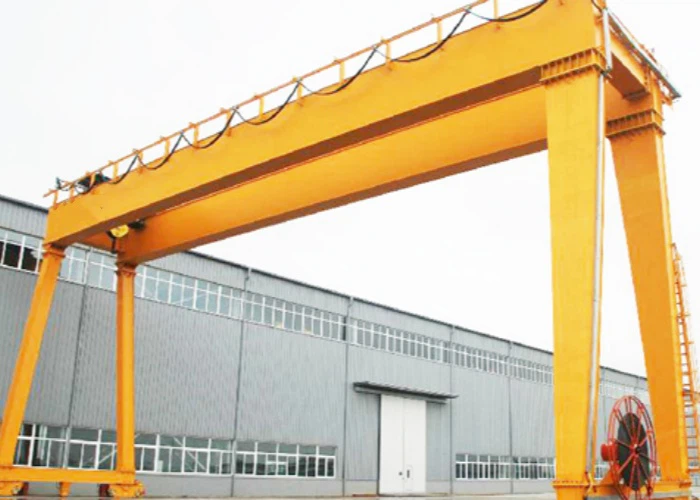
Mast: The gantry is the skeleton of a Gantry Girder Crane and consists of a main beam and outriggers. The main beam usually adopts a box-shaped or truss structure, which has high strength and rigidity and can carry a large lifting weight. The outriggers are supported on ground rails to ensure the stable operation of the crane.

Crane operating mechanism: The crane operating mechanism is responsible for the movement of the crane along the track. It is mainly composed of motors, brakes, reducers, couplings, transmission shafts, wheels and other components. This mechanism provides the power for longitudinal movement of the crane and ensures smooth and precise movement.

Trolley: The trolley is located on the bridge guide rail and can move along the width of the workshop. It is mainly composed of a steel plate welded trolley frame and the trolley running mechanism and lifting mechanism on it. The motor drives the trolley driving wheel through the reducer and drags the trolley to move along the guide rail.

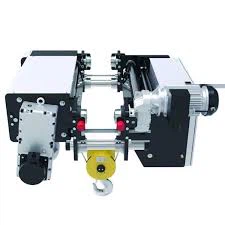
Hoist: In double girder gantry cranes, the hoist is usually in electric form, i.e. electric hoist. Electric hoists are driven by electric motors and lift goods through wire ropes or chains. The core component of the electric hoist is the motor, which drives the transmission system to rotate the drum to lift or lower the goods. The drum is used to wrap the wire rope or chain and control the lifting and lowering of the goods through its rotation. To prevent possible dangers during operation, electric hoists are equipped with limit switches and a variety of safety devices, such as overload protection and anti-fall devices.
Sketch:

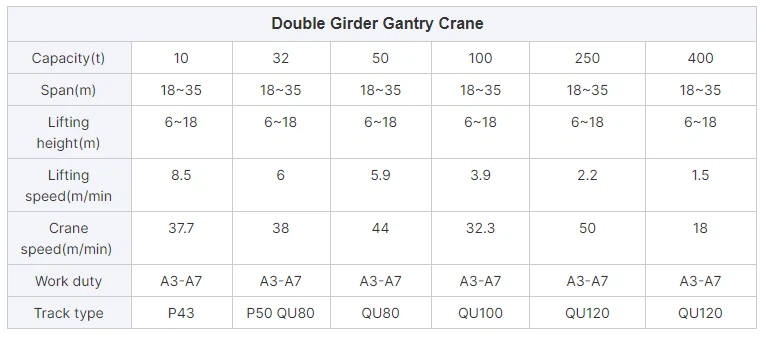
Main technical data

Advantages
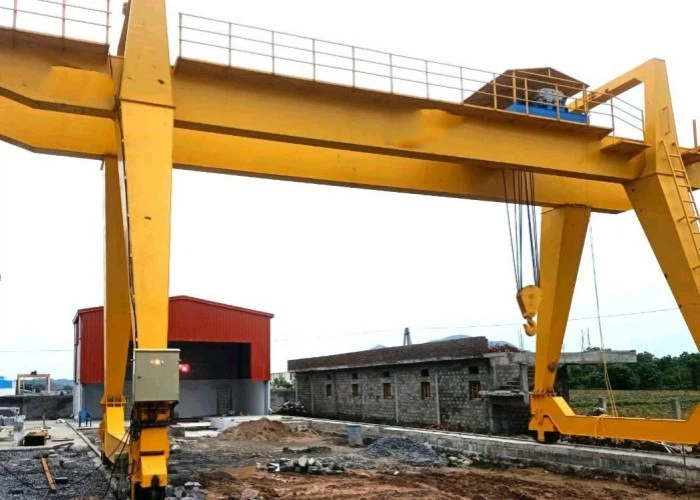
Stability and reliability: Gantry Girder Cranes adopt a double-girder structure. This design provides greater stability and balance, ensuring good mechanical stability when lifting and moving heavy objects. Compared with single-girder cranes, the double-girder structure can withstand larger lifting loads while reducing structural stress and wear caused by uneven loads.
Efficient lifting capacity: Gantry Girder Cranes are designed with optimized lifting mechanisms and are usually equipped with electric hoists. These hoists are characterized by high efficiency and quick response. This means that when performing lifting tasks, the crane can quickly raise or lower the load and position it accurately, thereby improving overall work efficiency.
Flexibility and adaptability: Gantry Girder Cranes can be customized according to different industrial applications, such as track span, lifting height and load capacity can be adjusted according to actual needs. This ability to customize allows it to adapt to a variety of work environments, such as factory floors, warehouses, docks and even outdoor job sites.
Environmental protection and energy saving: The new Gantry Girder Crane pays more attention to environmental protection and energy saving when designing, using high-efficiency motors and energy recovery systems to reduce energy consumption and operating costs. These environmentally friendly designs not only reduce the company's operating expenses, but also meet the requirements of modern industrial production for sustainable development.
Application:
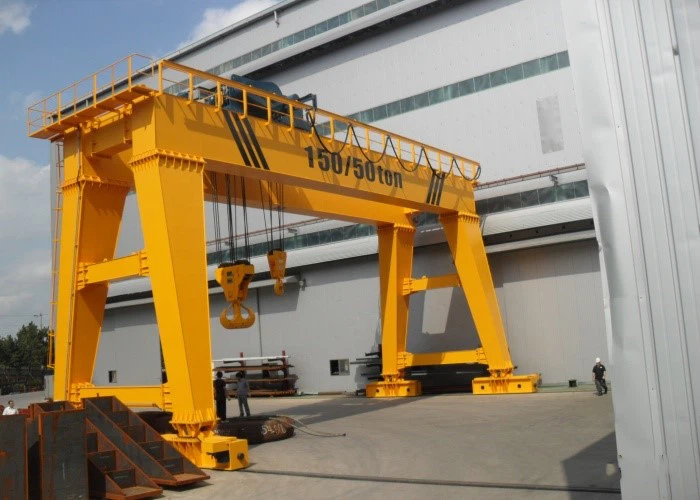
Construction: On construction sites, Gantry Girder Cranes are used to lift and move construction materials such as concrete, steel bars, and prefabricated elements. Its high efficiency and stability greatly improve the construction efficiency and shorten the construction period.
Steel industry: In steel companies, Gantry Girder Cranes are widely used in material handling between raw material warehouses, finished product warehouses and production lines to ensure the continuity and safety of production.
Aviation and shipbuilding: In these industries, Gantry Girder Cranes are not only used for the assembly of large components, but also participate in material handling and equipment maintenance throughout the production process, providing strong support.
Terminals and cargo yards: Gantry Girder Cranes play a key role in docks and cargo yards and are mainly used for loading, unloading, stacking and transshipment of goods. Its efficient lifting capacity greatly improves cargo handling efficiency and reduces ship docking time.
GlobalMarket

Crane production procedure

Workshop view
Material Inspection
Quality Inspection: Strict quality inspection is carried out on the purchased raw materials to ensure that they meet the design requirements and national standards.
Material Storage: Qualified materials are stored according to classification to prevent corrosion or damage.
Cutting and Forming
Steel Cutting: Use plasma cutting, laser cutting or flame cutting and other technologies to cut the steel according to the size of the design drawing.
Forming Processing: Form the steel plate through bending, rolling, welding and other processes to manufacture the main beam, end beam and other structural parts.
Welding
Component Welding: The cut and formed steel parts are welded into the main structures such as the main beam, end beam and trolley. The welding process needs to be strictly controlled to ensure the structural strength and welding quality.
Weld Inspection: Use non-destructive testing technology (such as ultrasonic testing, radiographic testing) to inspect the welds to ensure that there are no cracks or other defects.
Machining
Precision Machining: Precision machining is performed on the key components of the crane, such as wheel sets, bearing seats, pulleys, etc., to ensure their dimensional accuracy and surface quality.
Assembly of the whole machine
General assembly: On the basis of pre-assembly, the overall assembly of the crane is carried out, including the final installation of the main beam, end beam, lifting mechanism, walking mechanism, etc.
Commissioning and testing
Under dynamic conditions, the operating performance of the crane is tested, including the testing of lifting, walking, steering and other functions. The overall size of the assembled bridge crane is checked to ensure that all dimensions meet the design requirements.
Spraying and anti-corrosion treatment
Surface treatment Rust removal: Rust removal on the surface of the crane, common methods include sandblasting, pickling, etc. Primer spraying: Spray anti-corrosion primer on the treated surface to prevent metal oxidation and corrosion. Topcoat spraying Color spraying: Spray topcoat according to customer requirements or industry standards to give the crane a protective and decorative effect. Marking: After spraying, mark the crane's identification information in accordance with the specifications, such as model, rated load, etc.
Factory and installation
Packaging and transportation
Packaging protection: Protectively package the key components of the crane to prevent damage during transportation. Transportation arrangement: According to the equipment size and transportation conditions, select a suitable transportation method to transport the crane to the customer's site.
Acceptance and delivery
Customer acceptance
On-site acceptance: The customer conducts on-site acceptance of the crane according to the contract requirements and technical specifications to check the performance and quality of the equipment.
Problem rectification: If any problems are found, the manufacturer needs to rectify them in time to ensure that the equipment fully meets the customer's requirements. Delivery and use Operation training: The manufacturer usually trains the customer's operators to ensure that they can operate the crane correctly and safely.


Hot Tags: gantry girder crane, China gantry girder crane manufacturers, suppliers, factory
You Might Also Like



Send Inquiry