










200 Tons Motor Driven Double Girder Gantry Crane

200 Tons Motor Driven Double Girder Gantry Crane

200 Tons Motor Driven Double Girder Gantry Crane

200 Tons Motor Driven Double Girder Gantry Crane

200 Tons Motor Driven Double Girder Gantry Crane

200 Tons Motor Driven Double Girder Gantry Crane

200 Tons Motor Driven Double Girder Gantry Crane

200 Tons Motor Driven Double Girder Gantry Crane
200 Tons Motor Driven Double Girder Gantry Crane
Products Description
A 200-ton motor-driven double girder gantry crane is a high-capacity, heavy-duty lifting solution designed for demanding industrial applications requiring the movement of extremely heavy and oversized loads. Engineered for strength, stability, and efficiency, this type of crane features two robust girders running parallel across a gantry framework, powered by an integrated motorized drive system for both hoisting and crane movement.
Ideal for outdoor environments and large-scale industrial sites, it offers exceptional load-bearing performance, precision handling, and operational safety in sectors such as shipbuilding, steel manufacturing, power generation, and heavy construction.
Key Features:
Lifting Capacity: Up to 200 tons, suitable for the most challenging lifting tasks.
Double Girder Design: Ensures optimal load distribution, reduced deflection, and increased structural strength.
Motorized Drive System: Enables smooth, precise movements for hoisting, trolley travel, and crane travel.
Heavy-Duty Trolley with Hoist: Carries the hoisting mechanism across the crane span for efficient load positioning.
Steel Gantry Frame: Rigid and stable, often supported by rail-mounted or wheel-mounted legs depending on installation.
Customizable Span & Height: Tailored to meet specific site dimensions and operational needs.
Applications:
Lifting turbines and generators in power plants
Handling ship sections and components in shipyards
Transporting large structural steel components in fabrication yards
Moving heavy precast segments in bridge and infrastructure construction
Supporting industrial assembly and maintenance of large equipment
Advantages:
High load-bearing capability with excellent safety and stability
Efficient material handling in large open workspaces
Durable construction suited for continuous, long-term operations
Custom-engineered design for unique operational needs
Motorized control ensures smooth and safe operation under heavy load conditions
Core Components:Engine, Bearing, Gearbox, Motor, Gear
Place of Origin:Henan, China
Warranty:2 years
Weight (KG):50000 kg
Video outgoing-inspection:Provided
Machinery Test Report: Provided
Application: Outdoor
Keywords: Gantry Crane
Rated Loading Capacity: 50Ton
Cross travelling speed: 44.6m/min
Long travelling speed: 47.1m/min
Control way: cabin
Power supply: Cable reel
Steel track: QU80
Power: 3-phase AC 50HZ 380V
Certification: CE ISO
Products Description
1.Double Main Girders
Structure: Two parallel steel box girders or I-beams form the main load-bearing components.
Function: Support the trolley and hoisting system, distributing the load evenly across the span.
Feature: Designed to handle high stress and minimal deflection under extreme loads.
Gantry Legs (Support Structure)
Type: A-frame or box-type vertical supports.
Material: Welded steel designed to bear high axial and lateral loads.
Function: Transmits the load from the girders down to the wheels or rails.
Hoisting Mechanism
Type: Heavy-duty motor-driven hoist, often with dual motors for safety and power.
Components: Wire rope drum, lifting motor, gearbox, brakes, and sheave system.
Function: Performs vertical lifting/lowering of the load with precision and stability.
 |
 |
3.End Carriages / Bottom Beams
Structure: Horizontal members at the base connecting the legs.
Function: Houses the wheels and supports the gantry's mobility.
Note: Often includes buffers and safety stops at travel limits.
 |
 |
4.Crane travelling mechanism
1) Working principle
The working principle of the crane's traveling mechanism involves a combination of electrical and mechanical systems to achieve controlled, smooth horizontal movement.The electric motor receives power from a source (such as a power supply from a busbar or cable). The motor's rotation drives the gear system, which in turn rotates the travel wheels mounted on the crane's bogies.The travel wheels rotate, causing the entire crane structure to move along the rails. Since the wheels are mounted on either side of the crane's girder, the force is distributed evenly, helping in balanced movement.The speed of the crane's travel is controlled by varying the frequency of the motor supply or by using a variable frequency drive (VFD). This allows the crane to move at the desired speed, whether slow for precision or fast for large movements.
2) Functions of the crane operating mechanism
The crane traveling mechanism in a double girder gantry crane is essential for the crane's overall functionality, enabling it to move efficiently within its operational area, transport heavy loads safely, and enhance productivity. It integrates seamlessly with the lifting and hoisting mechanisms to offer a comprehensive solution for material handling in large industrial environments.
5.Trolley travelling mechanism
1) Structural composition
Trolley frame: High-strength steel is commonly used to ensure the frame can handle the substantial weight and stresses during operation.
Wheel set: Large, durable wheels are mounted on the trolley to allow smooth movement along the gantry rails or beams. These wheels are designed for heavy-duty operations and may be equipped with bearings for better efficiency.
Drive device: High-power electric motors drive the trolley, usually using variable speed drives for precise control. These motors are located within the trolley frame.
2) Function of the trolley operating mechanism
The trolley travel mechanism of the largest double girder gantry crane plays a critical role in the crane's operation by moving the hoisting mechanism (or hook) horizontally along the length of the crane's span.The trolley is responsible for moving the load horizontally across the crane's beam (double girder structure). This allows the crane to position the load at different locations within its working area.By traveling along the girders, the trolley can transport loads across the entire span of the crane, facilitating the lifting and placing of heavy materials or equipment in various positions within the crane's working range.The trolley travel mechanism allows for precise positioning of the load along the beam, which is crucial for tasks that require accurate placement, such as loading/unloading containers, large construction materials, or heavy industrial equipment.
6.Crane wheel
The crane wheel of a double girder gantry crane, particularly one designed for heavy-duty or large-scale applications, is a critical component. It is engineered to support and facilitate the movement of the crane along its runway tracks.
Typically made of high-strength forged steel or cast steel, such as 42CrMo4 or 65Mn, to endure high loads and resist wear.Heat-treated for improved durability and resistance to deformation under heavy loads. Tread Profile: Precision-machined to fit the rail perfectly, ensuring smooth operation and minimal wear. Larger cranes require larger diameter wheels to distribute the load effectively and reduce stress on the rail and wheel.Designed to bear the immense static and dynamic loads of the crane, which can weigh several hundred tons, including the load being lifted.
Some wheels are powered (drive wheels) to move the crane, while others are idlers. The drive wheels are connected to motors and gearboxes to provide traction.Bearings and wheel surfaces are often lubricated to reduce wear and prolong lifespan.Regular inspections are critical to monitor for cracks, wear, or deformation.

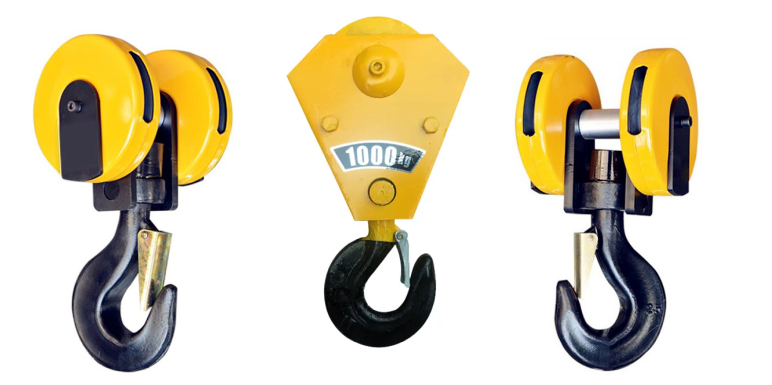
7.Crane Hook
The crane hook of the largest double-girder gantry crane is a critical component, specifically designed to handle heavy-duty lifting tasks in industrial environments such as shipyards, steel mills, and large construction sites.
For the largest gantry cranes, the hook may handle loads in the range of hundreds of tons, depending on the crane's rated capacity. For instance, hooks for 500-ton or larger cranes are common in specialized industries.
Made from high-strength alloy steels like forged carbon steel or alloy steel to provide the necessary tensile strength and durability.Heat-treated for enhanced toughness and resistance to wear and deformation.
Hooks are generally single or double hooks, with double hooks used for better load distribution in high-capacity systems.May feature a rotating design to allow precise positioning of the load.
Hooks are often customized based on the specific lifting needs of the application, such as lifting containers, coils, slabs, or other heavy objects.
Motor
1) The motor of the largest double girder gantry crane is a critical component as it powers the lifting and moving mechanisms. These motors are typically chosen based on the crane's capacity, operational requirements, and environmental conditions.
2) The motors in the largest gantry cranes can have power ratings in the range of hundreds of kilowatts, depending on the crane's load capacity (e.g., 500 tons or more).Motors are sized to ensure smooth operation even under maximum load conditions.
3) Operates on industrial power supplies, typically 380-690V AC, with higher voltage systems used for ultra-heavy cranes.Some cranes use multiple motors for redundancy, ensuring that one motor failure does not halt operation.Equipped with emergency stop systems and overload protection.

.
Sound and light alarm system & limit switch
1) Sound and light alarm system
The sound and light alarm system of a double-girder gantry crane is a critical safety component designed to alert personnel in the crane's vicinity about its operation or potential hazards.
Audible Alarm (Sound): Produce loud and distinctive sounds to warn workers.High-decibel siren or buzzer (typically 80-120 dB, adjustable based on site requirements).
Visual Alarm (Light): Provide a visible warning, especially in noisy environments or for hearing-impaired workers.Flashing LED or strobe lights with high visibility.Different colors for specific warnings (e.g., red for emergency, yellow for caution).
2) Limit switch
A limit switch is a crucial safety and operational device in a double girder gantry crane, particularly for the largest and most heavy-duty models. Its primary function is to ensure the safe operation of the crane by restricting its motion within defined parameters to prevent accidents or equipment damage.
Hoist Limit Switch:Prevents the hook or load block from traveling too high or too low.Ensures that the wire rope does not over-tighten or unwind completely, which could lead to snapping or tangling.
Travel Limit Switch:Limits the horizontal movement of the crane or trolley along the gantry or runway beams.Prevents collisions with end stops or other equipment by halting movement at preset points.
Slew Limit Switch:Restricts the rotation of the crane to specific angles.
Load Limit Switch (Overload Protection):Detects when the crane is lifting more than its rated capacity.Stops operations to prevent mechanical failure and accidents.
Wind Speed Limit Switch: For outdoor gantry cranes, monitors wind speed.

10.Safety Devices
1) Overload protection device:Prevents the crane from lifting loads exceeding its rated capacity.
2) Limit Switches: Prevent the crane from moving beyond its designated operational area.
3) Emergency Stop System: Allows operators to immediately stop all crane operations in case of an emergency.
4) Anti-Collision Systems: Prevents collisions with other cranes, objects, or structures in the operating area.
5) Wind Speed Alarm and Locking Devices: Ensures the crane's stability during high winds, especially for outdoor cranes.
6) Load Moment Limiter: Prevents the crane from tipping due to excessive load or improper load distribution.
11.Control Mode
1) Manual control: The operator directly controls the various operating mechanisms of the crane through buttons or switches on the manual control panel. Simple operation, suitable for small or short-term operations; can be quickly adjusted according to specific needs.
2) Wireless remote control: The various functions of the crane are controlled by a wireless remote control, and the operator can operate at a safe distance. Improves the flexibility and safety of operation, especially suitable for complex or dangerous working environments.
3) Wired remote control: Operate through the control line connected to the crane, and the operator inputs instructions through a handheld controller. Compared with wireless remote control, the signal is stable and not easily interfered with, which is suitable for operation in a fixed area.
4) Automated control: Automated operation is achieved through PLC (Programmable Logic Controller) or computer system, and the operation of the crane is controlled according to the preset program. Improves the accuracy and consistency of operation, suitable for large-scale and repetitive operations, and reduces interference from human factors.
5) Frequency conversion control: The speed of the motor is adjusted by the frequency converter to achieve precise control of the operating speed of the crane. It can smoothly accelerate and decelerate, improve the safety and efficiency of lifting operations, and reduce the impact on equipment.

12.Sketch
Main technical

Advantages
Advantages of 200 Tons Motor-Driven Double Girder Gantry Crane
1. Exceptional Lifting Capacity
Capable of handling extremely heavy and oversized loads (up to 200 tons), making it suitable for demanding industrial operations like shipbuilding, power plants, and heavy manufacturing.
2. High Structural Strength and Stability
The double girder configuration ensures even load distribution, enhanced rigidity, and minimal deflection, enabling safe and stable lifting of large components.
3. Efficient and Motorized Operation
All movements (lifting, trolley travel, and crane travel) are motor-driven, ensuring smooth, consistent, and precise control, even under full load.
4. Large Span and Coverage Area
Can be customized with long spans and high lifting heights, providing wide-area coverage for large yards or construction zones without the need for support structures like building columns.
5. Flexible Outdoor and Indoor Use
Designed for open yard operation on rails or tracks, especially in areas where overhead crane installation is not practical.
6. Reduced Infrastructure Cost
Unlike overhead cranes, it does not require a runway structure or building modifications, reducing civil construction and foundation costs.
7. Customizable and Scalable
Can be tailored with specific span, height, hoist type, control systems (e.g., cabin, remote), and optional automation features based on project needs.
8. Durability in Harsh Environments
Built from high-strength, weather-resistant materials with coatings that resist corrosion, moisture, and dust, ensuring long service life with minimal maintenance.
9. Enhanced Safety Features
Equipped with load limiters, emergency brakes, anti-sway systems, limit switches, and overload protection, reducing risk to personnel and equipment.
10. Versatile Applications
Suitable for diverse industries such as:
Shipbuilding and marine logistics
Steel and metal fabrication
Power generation and infrastructure construction
Railways, aerospace, and heavy machinery manufacturing
Application:
Heavy Manufacturing: Used for lifting and assembling large ship components like hulls, engines, and turbines. Handling large steel plates, beams, and structural components.Transporting and installing turbines, generators, and other heavy equipment.
Construction: Lifting heavy precast concrete beams, girders, and segments for bridges.Handling materials like concrete blocks, turbines, and gates for hydropower projects.Moving large prefabricated sections or steel structures.
Ports and Logistics: Moving large shipping containers in port terminals.Transporting materials like coal, minerals, or aggregates.
Aerospace and Defense:Lifting and assembling large aircraft parts such as fuselages, wings, and engines.Transporting spacecraft or rocket components during assembly and testing.
Mining: Handling large mining equipment or transporting extracted materials. Assisting in the maintenance of heavy mining machinery.
Energy: Lifting and placing reactor components and containment structures. Handling and installing large turbine components like blades and nacelles.
Railways: Moving railcars, engines, and tracks during production or maintenance.
Crane production procedure
Design and Engineering: Identify the crane's purpose, load capacity, span, height, speed, and working environment.Create detailed CAD models and structural analyses for the girders, gantry legs, and trolley system to ensure load handling capacity and compliance with standards (e.g., FEM, ISO, or CMAA).Determine the types of motors, hoisting mechanisms, rail systems, and control systems to be used.Include safety systems like anti-collision devices, limit switches, overload protection, and wind-resistance mechanisms.
Material Procurement: Source high-grade steel (often Q345 or equivalent) for girders, legs, and other structural components.Purchase hoisting mechanisms, motors, drives, brakes, and control panels. Acquire paints and coatings for corrosion resistance.
Fabrication of Components: Use CNC cutting machines to shape the steel plates.Weld the plates into the box or I-beam sections for girders and legs, following strict quality standards.Perform stress-relieving heat treatment to prevent deformation during use.Use ultrasonic or radiographic testing to ensure weld integrity.Fabricate and assemble gears with precisionAssemble the hoisting drum and wire ropes.Create precise grooves and surfaces for wheels and rail contact.Fit wheels, axles, and other mechanical components.Assemble and program control panels, variable frequency drives (VFDs), and PLCs (Programmable Logic Controllers).Install wiring for motors, limit switches, and sensors.
Pre-Assembly: Assemble the major components (girders, legs, trolley) in the workshop to check alignment and fit.Make adjustments or refinements as needed.Apply anti-corrosion coatings or paint.
Transportation to Site: Dismantle the crane into transportable components.Arrange heavy-haul vehicles or ships for transportation, considering the crane's size and weight.
On-Site Assembly: Ensure rail tracks or crane runways are installed and aligned.Use heavy-duty cranes to erect and position the girders, legs, and trolley. Securely join components.
Commissioning and Testing: Perform no-load, rated-load, and overload tests to ensure stability and functionality.Verify safety devices like limit switches and emergency stops.Check rail alignment and trolley travel.Validate the control systems, sensors, and power connections.
Final Inspection and Handover:Conduct a final inspection with the client or certifying authority.Provide documentation, including operating manuals, maintenance schedules, and test certificates.Train operators and maintenance staff on proper crane operation and upkeep.
Maintenance and Support:Offer periodic inspections, spare parts, and after-sales support to ensure long-term reliability.The production process demands high precision, rigorous testing, and adherence to international standards to ensure safety and performance.

Workshop view:
The company has installed an intelligent equipment management platform, and has installed 310 sets (sets) of handling and welding robots. After the completion of the plan, there will be more than 500 sets (sets), and the equipment networking rate will reach 95%. 32 welding lines have been put into use, 50 are planned to be installed, and the automation rate of the entire product line has reached 85%.



Hot Tags: 200 tons motor driven double girder gantry crane, China 200 tons motor driven double girder gantry crane manufacturers, suppliers, factory
You Might Also Like


Send Inquiry