










Double Main Beam Grab Gantry Crane
Products Description
Key Components
Double Main Beams (Girders):
Provide strong support and distribute the load evenly.
Allow for greater lifting capacity and span compared to single girder cranes.
Gantry Legs:
Support the entire structure and travel along fixed rails on the ground.
Grab Bucket:
Used to scoop and transport loose or bulk materials.
Operated via a mechanical, hydraulic, or electro-hydraulic system.
Trolley and Hoist Mechanism:
Mounted on the double girders.
Moves horizontally to position the grab accurately.
Traveling Mechanism:
Enables the crane to move along rails in the working area.
Provides mobility for material handling across large spaces.
Control System:
Can be operated manually via a cabin or remotely using wireless controls.
Advanced systems may include PLC and automation for improved efficiency.
Applications
Ports and Shipyards: Unloading and loading bulk cargo.
Steel Mills and Foundries: Handling scrap metal and raw materials.
Power Plants: Moving coal and other fuels.
Waste Management: Handling solid waste in recycling and waste-to-energy plants.
Advantages
High Load Capacity: Double girder design allows for lifting heavy loads.
Wide Span: Suitable for large, open workspaces.
Efficient Bulk Handling: Grab bucket system speeds up loading/unloading.
Durability: Built for continuous operation in tough environments.
Warranty :1 Year
Weight (KG):35000 kg
Feature:Gantry Crane
Application:Railway Station/Sea Port/Yard/Subway
Rated Lifting Moment:Different
Material: Q235/Q345
Working Temperature:-40~40 ℃
Legs space:Bigger than normal
Control:Cabin control
Electrical parts:Schneider
Power Source:380~480V, 50hz/60hz
Power supply:M5~M8 (ISO)
Main electrical parts:Schneider Brand
Crane feature:High Efficiency

Pictures & Components
1.Double Main Beams (Double Girders)
Two parallel horizontal beams that form the bridge of the crane.
Provide strong structural support for the trolley and grab mechanism.
Made of welded box-type steel structures for durability and stability.
Gantry Frame (Legs or Support Structure)
Vertical legs that support the bridge.
Can be A-frame, U-frame, or box-type structure.
Mounted on wheels or rail wheels for ground movement.

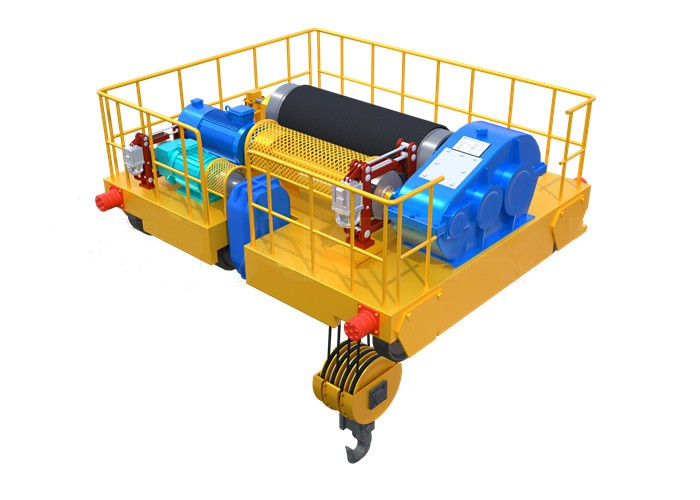
Trolley with Hoisting Mechanism
Travels along the double main beams.
Houses the winch and grab operation mechanism.
Enables precise positioning of the grab over the material pile.
 |
 |
3.End carriage
1) The function of the end beam is to support the entire structure of the crane and realize the longitudinal movement of the crane on the track together with the trolley running mechanism. It connects the two main beams and distributes the load of the crane smoothly to the running track by installing wheels and drive devices, ensuring that the equipment can move flexibly in the work site.
2) The end beam of a double-beam gantry crane is an important load-bearing and mobile structure of the entire crane. It ensures the smooth operation of the crane on the track through components such as wheel sets, drive devices, and guide devices, and ensures the safe operation of the crane through safety devices such as brakes and limit switches. Reasonable design and regular maintenance can greatly extend the service life of the end beam and improve the overall working efficiency and safety of the crane.
3) The main components of the end beam.
①Frame structure :The end beam is usually a box-type or I-type structure made of high-strength steel, with sufficient rigidity and strength to withstand the static and dynamic loads of the entire crane.
②Wheel set:The wheel set on the end beam is the part that is in direct contact with the track. It is responsible for distributing the load of the crane to the track and realizing longitudinal movement. The wheels are usually divided into driving wheels and driven wheels. The driving wheels are connected to the motor and drive system to drive the crane to move, while the driven wheels play an auxiliary support role.
③Drive device : The drive device on the end beam is responsible for the operation of the crane trolley and is usually composed of an electric motor, a reducer, a coupling and a brake.
④Guide device :In order to prevent the crane from deviating or derailing when running on the track, the end beam is usually equipped with a guide device.
⑤Anti-slip device:In order to prevent the crane wheels from derailing due to unexpected situations (such as strong winds, sudden load changes, etc.) during operation, an anti-slip device is often installed on the end beam.
⑥Limit switches: Limit switches are usually installed at both ends of the end beam to prevent the crane from exceeding the designed operating range on the track.
 |
 |
4.Crane Traveling Mechanism
Motorized system allowing the entire crane to move along fixed rails.
Includes wheels, drive motors, gearboxes, and braking systems.
5.Trolley travelling mechanism
1) Structural composition
Trolley frame: The trolley frame is the basic structure of the entire trolley traveling mechanism. It is usually made of welded or cast steel structure with high strength and rigidity to bear the weight of the lifting mechanism and the load of the cargo. The trolley frame needs to have torsion and compression resistance to ensure that the structure does not deform during traveling and keep the trolley running smoothly.
Wheels and tracks : The trolley runs on the track of the double-beam main beam through its wheels. The wheels are usually divided into driving wheels and driven wheels. The driving wheels are connected to the electric motor to provide power, and the driven wheels serve as auxiliary support and balance.
Drive device: The driving system is the power source for the trolley, which is generally composed of an electric motor, a reducer and a transmission mechanism. The driving wheel is used to realize the lateral movement of the trolley along the main beam.
Guide device: In order to prevent the trolley from deviating or derailing during operation, the trolley running mechanism is equipped with a guide device. The guide wheels are usually set on both sides of the trolley to keep in contact with the side wall of the track of the main beam to prevent the trolley from lateral swing.
Braking system : The braking system of the trolley running mechanism is used to control the stopping position of the trolley, ensuring that it can stop quickly and safely when needed, and preventing the trolley from running off the running track due to inertia.
Limit switch : The limit switch is used to ensure that the trolley does not exceed the predetermined range when running on the main beam and prevent the trolley from hitting the two ends of the main beam.
Cable pulley or cable reel: In order to provide power for the trolley's drive system, the trolley Traveling mechanism is usually equipped with a cable pulley or cable reel device to manage and protect the cable, ensuring that the cable can maintain appropriate length and tension at all times during the movement of the trolley.
2) Function of the trolley traveling mechanism
The trolley mechanism of a double-beam gantry crane is a key device responsible for realizing the lateral movement of the spreader or lifting mechanism along the main beam. It is used in conjunction with the lifting mechanism to complete the precise positioning and handling of the goods in the span direction. The trolley mechanism is crucial in a double-beam gantry crane, determining the lateral coverage and operational flexibility of the crane at the work site.
6.Crane wheel
1) Function of wheels
Support and load-bearing:The crane wheels are the main load-bearing parts of the crane, supporting the weight of the entire crane and the weight of the lifted cargo. The wheels evenly distribute the weight of the crane to the track by contacting with the track, ensuring that the crane can smoothly bear the heavy load when moving.
Provide mobile functionality:The crane wheels enable the crane to move horizontally or vertically along the track. The electric motor drives the driving wheel, and the wheels roll to drive the entire trolley on the track, realizing the crane's wide range of operation needs.
Stable operation:The wheels of the trolley are in contact with the rails, ensuring that the crane can still move smoothly under heavy loads and avoid shaking or tilting. At the same time, the wheels are designed with flanges that can fit tightly on both sides of the rails to prevent the crane from derailing or shifting, ensuring the safety and stability of the equipment when moving at high speeds.
Reduce friction and wear:Trolley wheels are usually equipped with anti-friction devices such as bearings to reduce friction between the wheels and the rails, thereby reducing energy consumption during operation. High-quality wheel materials and reasonable lubrication and maintenance can reduce wear, extend the service life of the wheels, and ensure long-term and efficient operation of the crane.
Achieve precise positioning:The trolley wheels work with the crane's drive and control system to enable the crane to move accurately to the designated position on the track. Through the precise rolling and braking systems of the wheels, the crane can stop exactly where it is needed, ensuring that the lifting task is completed safely and efficiently.
Absorbing and distributing loads:The wheels help absorb and disperse the shock and vibration generated during the operation of the crane, ensuring the smooth operation of the crane and preventing damage to the crane body or track due to excessive impact force. This is particularly important for maintaining the structural integrity and operational safety of the crane.
Guidance function:The wheel flange and guide device work together to ensure that the crane runs along the preset track direction and prevents lateral deviation. The guiding function is particularly important for cranes running over long distances, ensuring that the crane always stays on the correct track and avoids running deviations.

7.Crane Hook
1) The hook is the part that directly carries and fixes the heavy objects. It is connected to the wire rope of the lifting mechanism and is used to hang and lift the goods. The rotation and safety lock device of the hook ensures its flexibility and safety during operation.
2) Lifting hooks are usually made of high-strength steel, which is resistant to stretching and fatigue and is suitable for lifting various types of heavy objects.

Motor
Key technical requirements of motors
1.High starting torque: It can start smoothly when the load is large, especially the lifting motor, which must be able to withstand the starting requirements of heavy loads.
2. Accurate speed regulation: The motor needs to have good speed regulation function to adapt to the operating requirements under different working conditions and ensure smooth operation during operation.
3. Reliable braking system: The lifting motor needs to be equipped with a safe and reliable brake to ensure that the heavy objects will not fall accidentally in an emergency.
4. Energy saving: With the requirements of energy saving and environmental protection, more and more 20 Ton Gantry Crane use variable frequency motors and permanent magnet synchronous motors to reduce energy consumption.

.
Sound and light alarm system & limit switch
1. Sound and light alarm system
The sound and light alarm system is to warn the operator and surrounding personnel of the operating status of the crane by emitting sound and light signals, especially to warn of dangerous actions (such as lifting, lowering, and moving) during the operation of the crane to avoid potential safety hazards.
2. Limit switch
The limit switch is a safety device used to limit the double-beam gantry crane from exceeding the safe range when lifting, lowering or moving. It detects the movement limit position of the crane by mechanical or electrical means to ensure that the crane operates safely within the specified range.

10.Safety Devices
1. Overload limiter:When the hoisted load exceeds the rated load of the crane, the overload limiter will sound an alarm and stop the lifting operation to prevent equipment overload damage or safety accidents.
2. Buffer:When the crane's trolley or car moves to the end of the track, the buffer can absorb most of the impact force to prevent equipment damage and accidents.
3. Brake:In the event of power failure or emergency, the brake can quickly brake the crane to prevent the hanging objects from falling or the equipment from continuing to move.
4. Anemometer:When the wind speed exceeds the safe operating range, the anemometer will sound an alarm to remind the operator to stop the operation to prevent overturning or derailment accidents caused by strong winds.
5. Anti-collision device:By setting a sensing device, when two cranes approach a certain distance, the system will automatically slow down or stop to prevent collisions between cranes.
6. Emergency stop button:When a dangerous situation or equipment abnormality is found, press the emergency stop button, the system will immediately cut off the power supply, stop all movements, and prevent accidents.
7. Electrical protection device:Prevent the crane from continuing to operate when the electrical system fails.
8. Track clamp (wind clamp):When the crane stops running or encounters strong winds, the track clamp will fix the crane on the track to prevent the crane from derailing or causing danger due to wind or inertia.
11.Control Mode
1. Manual control mode
Manual control mode means that the operator directly controls the various actions of the crane by manually operating the control buttons or joysticks on the equipment. This method relies on the real-time operation of the operator, and the crane will not perform any actions autonomously.
2. Remote control mode
Remote control means that the operator controls the crane remotely through a wireless remote control device (usually a handheld remote control). This method allows the operator to control the crane from a distance, which is suitable for dangerous or narrow operating space.
3. Semi-automatic control mode
Semi-automatic control mode combines automation technology with part of manual operation. In this mode, some operations are completed automatically, while other parts require manual intervention. This mode can reduce the burden on the operator and provide higher efficiency and safety.
4. Fully automatic control mode
Fully automatic control mode means that the crane can autonomously complete all operations according to preset programs or sensor feedback data without human operation. This mode usually relies on sensors, computer systems and automation control programs.
5. Variable frequency speed control
The variable frequency speed control mode controls the speed of the motor through the frequency converter, thereby achieving smooth start, stop and operation of the crane. This control method not only improves the stability of operation, but also effectively reduces energy consumption.

12.Sketch

Main technical

Advantages
Advantages of Double Main Beam Grab Gantry Crane
1. High Lifting Capacity
The double girder design provides greater load-bearing strength, making it ideal for lifting heavy and large-volume bulk materials.
2. Wide Span and Coverage
Suitable for large yards or storage areas due to its ability to span long distances.
Offers wide operational range both horizontally and vertically.
3. Efficient Bulk Material Handling
Equipped with a grab bucket, it can quickly pick up and release materials like coal, ore, sand, or waste, improving operational efficiency.
4. Strong Structural Stability
The dual-beam structure provides excellent rigidity, reducing deformation under load.
Performs reliably in harsh environments such as ports, mines, and steel yards.
5. Enhanced Durability and Longevity
Made with heavy-duty materials and designed for continuous operation, leading to lower maintenance frequency and longer service life.
6. Customizable Configuration
Can be equipped with different types of grabs, control systems (manual or automated), and travel mechanisms based on specific application needs.
7. Improved Safety
Built-in safety features like overload protection, emergency brakes, limit switches, and collision avoidance systems protect both operators and the crane.
8. Flexible Operation
Options for cab control, pendant control, or wireless remote control offer flexibility in various working conditions.
9. Cost-Effective for Large-Scale Handling
Reduces manual labor and handling time, especially in continuous or high-volume operations.
Application:
1. Ports and Harbors
Loading and unloading bulk cargo from ships, such as:
Coal
Minerals
Grain
Fertilizer
Efficient in open yards and dockside operations.
🔩 2. Steel Mills and Foundries
Handling scrap metal, raw materials, and slag.
Supports the feeding of materials into furnaces or transfer stations.
Can operate in high-temperature, dusty environments.
⚡ 3. Power Plants
Transporting coal or biomass to storage yards or conveyor systems.
Integral to fuel supply chains for thermal power stations.
Often combined with dust control systems.
🔄 4. Waste-to-Energy Plants and Recycling Facilities
Handling municipal solid waste (MSW) with a grab bucket.
Used to feed incinerators or transfer waste between processing zones.
🏗️ 5. Cement and Building Materials Industry
Loading/unloading and stacking of bulk cement, sand, limestone, etc.
Efficient yard management for bulk construction materials.
🌾 6. Grain Terminals and Agricultural Storage
Handling grain, soybeans, and other bulk food products.
Helps automate and speed up storage and shipping processes.
🛢️ 7. Chemical and Fertilizer Plants
Used to manage bulk raw materials and fertilizers stored in open or closed yards.
🚛 8. Logistics and Bulk Storage Yards
Ideal for material loading/unloading, stacking, and stockpiling in large open spaces.
Crane production procedure
1. Design and Planning
Demand Analysis: According to customer needs and usage scenarios, a detailed demand analysis is carried out to determine the specifications, load, span, lifting height, etc. of the crane.
Engineering Design: Engineers use CAD and other design software to carry out detailed design, including structural, mechanical, electrical and other aspects to ensure that the design meets relevant standards and specifications.
2. Material Procurement
Material Selection: Select appropriate steel, motors, control systems and other components according to design requirements.
Supplier Screening: Screen suppliers of materials and components to ensure the quality and reliability of materials.
3. Processing and Manufacturing
Cutting and Forming: Cut, weld, bend and other processes on steel to form main beams, end beams and other structural components.
Machining: Precision machining of key components, such as turning, milling, drilling, etc., to ensure that the size and accuracy meet the design requirements.
Surface Treatment: Spray, galvanize or rust-proof metal parts to enhance corrosion resistance and aesthetics.
4. Assembly
Component Assembly: Assemble the main beam, end beam, trolley, lifting mechanism and other components to form a complete crane structure.
Installation of electrical system: Install electrical equipment such as motors, control cabinets, sensors, limit switches, etc. to ensure the normal operation of the electrical system.
5. Debugging and testing
Preliminary debugging: Carry out preliminary debugging of the crane to check the coordination and operation of each component.
Load test: Carry out load test to ensure the safety and stability of the crane under rated load, and test the functions of safety devices such as overload protection and limit switches.
Performance test: Test the performance indicators of the crane such as lifting speed, running speed, braking effect, etc. to ensure that they meet the design requirements.
6. Quality inspection
Quality inspection: Carry out a comprehensive quality inspection of the crane, including appearance, size, performance, etc., to ensure compliance with relevant standards.
Safety assessment: Carry out safety assessment to ensure the normal operation of all safety devices and systems.
7. Delivery and installation
Packaging and transportation: Pack qualified cranes and prepare them for transportation to the customer site.
On-site installation: Carry out on-site installation according to customer requirements, including basic production and equipment debugging.
Training and handover: Train operators to ensure that they master the operation methods and safety precautions of the equipment and complete the handover work.


Workshop view
Material Inspection
Quality Inspection: Strict quality inspection is carried out on the purchased raw materials to ensure that they meet the design requirements and national standards.
Material Storage: Qualified materials are stored according to classification to prevent corrosion or damage.
Cutting and Forming
Steel Cutting: Use plasma cutting, laser cutting or flame cutting and other technologies to cut the steel according to the size of the design drawing.
Forming Processing: Form the steel plate through bending, rolling, welding and other processes to manufacture the main beam, end beam and other structural parts.
Welding
Component Welding: The cut and formed steel parts are welded into the main structures such as the main beam, end beam and trolley. The welding process needs to be strictly controlled to ensure the structural strength and welding quality.
Weld Inspection: Use non-destructive testing technology (such as ultrasonic testing, radiographic testing) to inspect the welds to ensure that there are no cracks or other defects.
Machining
Precision Machining: Precision machining is performed on the key components of the crane, such as wheel sets, bearing seats, pulleys, etc., to ensure their dimensional accuracy and surface quality.
Assembly of the whole machine
General assembly: On the basis of pre-assembly, the overall assembly of the crane is carried out, including the final installation of the main beam, end beam, lifting mechanism, walking mechanism, etc.
Commissioning and testing
Under dynamic conditions, the operating performance of the crane is tested, including the testing of lifting, walking, steering and other functions. The overall size of the assembled bridge crane is checked to ensure that all dimensions meet the design requirements.
Spraying and anti-corrosion treatment
Surface treatment Rust removal: Rust removal on the surface of the crane, common methods include sandblasting, pickling, etc. Primer spraying: Spray anti-corrosion primer on the treated surface to prevent metal oxidation and corrosion. Topcoat spraying Color spraying: Spray topcoat according to customer requirements or industry standards to give the crane a protective and decorative effect. Marking: After spraying, mark the crane's identification information in accordance with the specifications, such as model, rated load, etc.
Factory and installation
Packaging and transportation
Packaging protection: Protectively package the key components of the crane to prevent damage during transportation. Transportation arrangement: According to the equipment size and transportation conditions, select a suitable transportation method to transport the crane to the customer's site.
Acceptance and delivery
Customer acceptance
On-site acceptance: The customer conducts on-site acceptance of the crane according to the contract requirements and technical specifications to check the performance and quality of the equipment.
Problem rectification: If any problems are found, the manufacturer needs to rectify them in time to ensure that the equipment fully meets the customer's requirements. Delivery and use Operation training: The manufacturer usually trains the customer's operators to ensure that they can operate the crane correctly and safely.


Hot Tags: double main beam grab gantry crane, China double main beam grab gantry crane manufacturers, suppliers, factory
You Might Also Like


Send Inquiry