










Bridge Crane Wheels
Bridge crane wheels are critical components that facilitate the smooth movement of the crane along the runway rails. They bear the entire load of the crane and the lifted materials, ensuring stable and efficient operation.
1. Function of Bridge Crane Wheels
Support & Movement: The wheels support the crane's weight (including the hoist and load) and enable horizontal travel along the runway beams.
Load Distribution: They distribute the crane's load evenly to prevent excessive stress on the rail or wheel surfaces.
Guidance: Wheels maintain alignment with the rails to prevent derailment and ensure precise positioning.
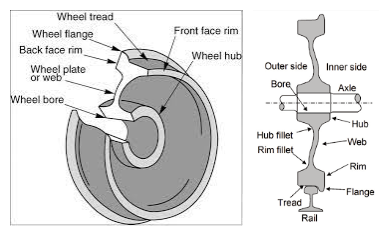
2. Types of Bridge Crane Wheels
A. Based on Material
Forged Steel Wheels:
High strength and durability for heavy-duty applications.
Resistant to wear and deformation.
Cast Iron Wheels:
Economical but less durable than steel; used for lighter loads.
Prone to cracking under heavy impact.
Nylon/Polyurethane Wheels:
Used in specialized environments (e.g., noise-sensitive areas or corrosive conditions).
Lower load capacity but quieter operation.
B. Based on Flange Design
Double Flange Wheels:
Flanges on both sides to prevent lateral movement (common for main bridge girders).
Single Flange Wheels:
One flange for guidance, used in systems with additional rail restraints.
Flangeless Wheels:
Used with external guide rollers or in systems where rails provide alignment.
C. Based on Load Capacity
Standard Duty Wheels: For light to moderate loads.
Heavy-Duty Wheels: Designed for high-capacity cranes (e.g., steel mills, ports).

3. Key Design Considerations
Wheel Diameter: Larger diameters reduce wear and improve load distribution.
Hardness: Wheels are often heat-treated (e.g., HRC 55-60) to resist wear.
Tread Profile: Flat or slightly convex to match rail shape and minimize contact stress.
Bore Type: Keyway, tapered bore, or plain bore for mounting on the axle.
4. Common Failure Modes
Wear: Due to friction or abrasive debris.
Pitting: Surface fatigue from repeated load cycles.
Cracking: Caused by overloading or material defects.
Flange Damage: Misalignment or rail issues can deform flanges.
Material:
Bridge crane wheels are typically made from high-strength, wear-resistant materials to handle heavy loads and frequent use. Common materials include:
1. Forged Steel
Grade 65Mn (65 Manganese Steel) – High toughness and wear resistance, commonly used for medium-duty cranes.
Grade 42CrMo (Alloy Steel) – Offers higher strength and impact resistance, suitable for heavy-duty applications.
Hardened & Tempered Steel (HB 300-400) – Provides excellent durability under high load conditions.
2. Cast Steel
ZG340-640 (Cast Carbon Steel) – Used for large wheels where forging is impractical.
ZG50SiMn (Alloy Cast Steel) – Better wear resistance than standard carbon cast steel.
3. Ductile Iron (QT500-7, QT600-3)
Good shock absorption and wear resistance, often used for lighter to medium-duty cranes.
4. Nylon or Polyurethane (For Special Cases)
Used in environments where noise reduction or corrosion resistance is needed (e.g., food processing, chemical plants).
- Diameter: Φ250, Φ350, Φ400, Φ500, Φ600, Φ700, Φ800, Φ 1000, Φ 1200 or as your requirement
- Technique: Casting or forging
- Quenching Depth: more than 25mm
- Heat Treatment: Quenching and tempering
- Work environment temperature: -25℃~+40℃, relative humidity ≤85%
- Reference Price Range: $80-1000/piece
- Rated Loading Capacity: 1~1200 ton
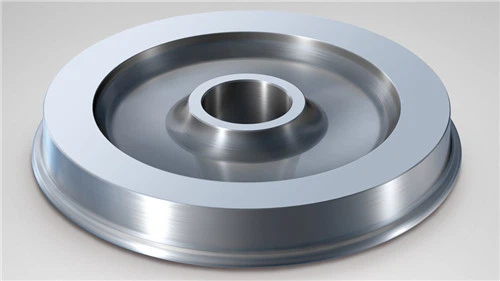
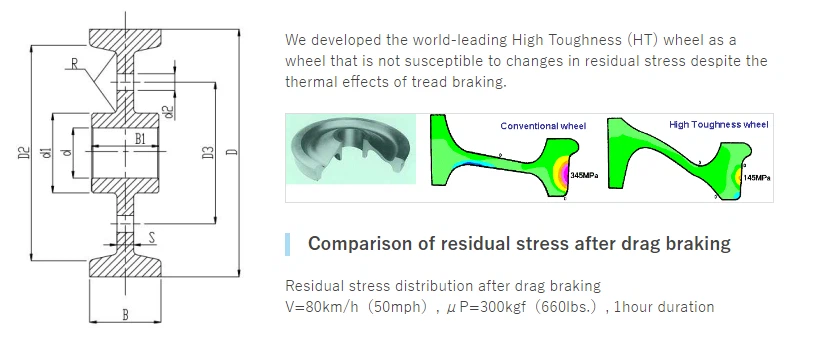
Sketch
Advantages
Bridge crane wheels are critical components that ensure smooth movement, stability, and load-bearing capacity. Here are the key advantages of high-quality bridge crane wheels:
1. High Load-Bearing Capacity
Designed to handle heavy loads without deformation.
Made from durable materials (forged steel, cast iron, or polyurethane) to support crane weight and payload.
2. Smooth & Precise Movement
Precision-machined for even rolling, reducing jerks or vibrations.
Ensures accurate positioning of loads, crucial in manufacturing and warehousing.
3. Reduced Friction & Wear
Hardened tread surfaces minimize wear from constant rail contact.
Lubricated or sealed bearings reduce rolling resistance, extending lifespan.
4. Low Maintenance Requirements
Robust construction reduces frequent replacements.
Sealed bearings prevent dust and debris ingress, lowering maintenance needs.
5. Noise Reduction
Polyurethane or nylon wheels operate more quietly than metal wheels, ideal for indoor facilities.
6. Corrosion & Heat Resistance
Stainless steel or coated wheels resist rust in humid
Application
Bridge crane wheels are critical components that facilitate the smooth movement of the crane along the runway rails. They are designed to bear heavy loads while ensuring stability, precision, and durability. Here's an overview of their applications, types, and key considerations:
Applications of Bridge Crane Wheels
Overhead Cranes (EOT Cranes)
Used in manufacturing plants, warehouses, and workshops for lifting and transporting heavy materials.
Commonly found in steel mills, automotive industries, and construction sites.
Gantry Cranes
Employed in shipyards, container handling, and outdoor storage yards where the crane moves on ground-level rails.
Jib Cranes
Used in smaller workspaces (e.g., assembly lines) where rotational movement is required.
Monorail Systems
Used in material handling systems where loads move along a fixed path (e.g., production lines).


Production Procedure
The production procedure for bridge crane wheels involves several critical steps to ensure durability, load-bearing capacity, and smooth operation. Below is a detailed outline of the manufacturing process:
1. Material Selection
Primary Material: Typically forged or cast steel (e.g., 42CrMo, 65Mn, or 55 Steel) for high strength and wear resistance.
Heat Treatment: Alloy steel wheels undergo quenching and tempering to achieve hardness (typically HRC 45-55) and toughness.
2. Manufacturing Process
A. Forging or Casting
Forging (Preferred for Heavy Loads):
Billet steel is heated and pressed into wheel blanks for superior grain structure.
Better mechanical properties than casting.
Casting (Cost-Effective for Lower Loads):
Molten steel is poured into molds (sand casting or precision casting).
Requires post-casting machining for precision.
B. Rough Machining
Turning the forged/cast blank to approximate dimensions.
Processes:
Lathe turning for outer diameter (OD), inner diameter (ID), and tread profile.
Drilling/Boring for axle bore.
C. Heat Treatment
Quenching & Tempering: Enhances hardness and wear resistance.
Induction Hardening: Optional for tread surface to extend lifespan.
D. Precision Machining
CNC Lathe/Milling: Achieves tight tolerances (IT7-IT8).
Grinding: Ensures smooth tread surface (Ra ≤ 1.6 μm).
Keyway/Groove Machining: For wheel flanges (if required).
E. Flange & Tread Profiling
Flanges are machined to prevent derailment.
Tread profile may be flat, conical, or crowned for alignment.
3. Quality Control
Dimensional Inspection: Calipers, micrometers, CMM (Coordinate Measuring Machine).
Hardness Testing: Rockwell or Brinell testers.
NDT (Non-Destructive Testing):
Ultrasonic Testing (UT) for internal defects.
Magnetic Particle Inspection (MPI) for surface cracks.
Dynamic Balance Test: Ensures smooth rotation at high speeds.
4. Surface Treatment
Shot Blasting: Cleans and improves fatigue resistance.
Painting/Galvanizing: Anti-corrosion coating (e.g., zinc plating for harsh environments).
5. Assembly & Testing
Press-Fitting onto Axles: Wheels are mounted with bearings (e.g., tapered roller bearings).
Load Testing: Simulated crane operation under max load (e.g., 1.25x rated capacity).
Run-In Test: Checks for noise, vibration, and alignment.
6. Packaging & Shipping
Wooden crates or steel pallets for protection.
Marked with specifications (material, load rating, hardness).


Workshop View
The company has installed an intelligent equipment management platform, and has installed 310 sets (sets) of handling and welding robots. After the completion of the plan, there will be more than 500 sets (sets), and the equipment networking rate will reach 95%. 32 welding lines have been put into use, 50 are planned to be installed, and the automation rate of the entire product line has reached.


Hot Tags: bridge crane wheels, China bridge crane wheels manufacturers, suppliers, factory, Railway Wheel, Forged Part
Previous
Railway WheelNext
No InformationYou Might Also Like




Send Inquiry