







Bridge Beam Launcher
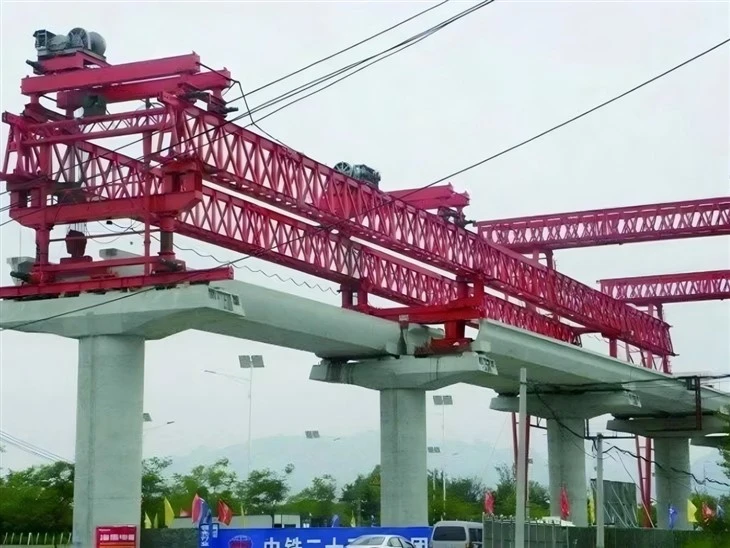
The Bridge Beam Launcher, also known as a Girder Launcher or Beam Erection Machine, is a specialized construction equipment designed for the precise and efficient installation of precast concrete beams (girders) in bridge construction projects. Engineered to handle heavy loads with high safety and stability standards, the Bridge Beam Launcher is essential for modern bridge-building operations.
Key Features:
High Load Capacity: Capable of lifting and launching beams weighing up to 900 tons (customizable based on project requirements).
Flexible Design: Suitable for various bridge types including highway bridges, railway bridges, urban viaducts, and overpasses.
Advanced Safety Systems: Equipped with multiple safety devices including overload protection, anti-tilt systems, and emergency stop mechanisms.
Precision Control: Utilizes hydraulic systems and advanced control units for smooth and accurate beam positioning.
Easy Assembly & Disassembly: Modular design allows for fast transportation, assembly, and disassembly, improving overall project efficiency.
Adaptability: Supports both simply-supported and continuous beam erection, adaptable to complex terrain and construction environments.

specification
1. Lifting capacity: 160 tons (excluding spreader weight)
2. Self-weight of the bridge erecting machine: 118 tons (maximum weight of a single piece: 7t)
3. Wind resistance
No-load walking state: 8 level
No-load anchoring state: 12 grades
Lifting state with full load: Level 7
4. Lifting speed: full load: 0~1.0/min
No load: 0~1.5 m/min
5. Luffing speed: 0~0.6 m/min (with load luffing)
6. Working range: Rmin=7m Rmax=12m
7. The walking mode of the whole machine: walking type (the oil cylinder is pushed up, and there is no load during the walking process)
8. Traveling speed of the whole machine: The whole movement is 15m , including the anchoring disassembly, reversing the track, and positioning, the whole process takes no more than 2 hours.
9. No-load climbing ability of the whole machine: ±3.5°
10. Lifting height: 65m below the bridge deck, 1m above the bridge
11. Front and rear anchoring distance: 18m (16m, 19.5m)
12. The distance between the left and right support points during work: outside 10.5m, inside 5.7m
Distance between front and rear support points: 16.85m
13. Lifting deflection angle: horizontal bridge direction 1.5 degrees, longitudinal bridge direction 3.5 degrees
14. Spreader leveling performance: With vertical and horizontal leveling functions
15. The installed capacity of the whole machine: 110Kw
16. Stability factor of the whole machine: meets the requirements of GB3811-83 ( various working conditions∑M>0 )
17. Product features and advantages: Double-width and two-way beam erection, step-by-step walking, counterweight cross-span, front and rear outriggers are equipped with hydraulic systems, outriggers can be adjusted by 0.8-1 meters, the main beam can be adjusted, and 45-degree inclined beams can be erected, etc.

Pictures & Components
A Bridge Beam Launcher (also called a launching gantry or bridge girder erection machine) is a specialized construction machine used for placing precast bridge girders/beams. It's commonly used in segmental bridge construction, especially for highway and railway projects. Here are the key components of a bridge beam launcher:
1)Main Girder / Launching Girder
The primary structure that spans the gap between bridge piers.
Supports the beam as it is moved into place.
Often designed as a truss or box girder.
2)End Carriages / Bogies
Trolley mechanisms located at both ends of the launching girder.
Allow the entire launcher to move longitudinally along the piers.
3)Winches and Hoisting Mechanism
Used to lift and lower the precast beams/girders from the ground to the launcher and into final position.
Equipped with wire ropes, hooks, or spreader beams.
4)Trolley / Beam Trolley
Moves along the main girder to carry and position the precast beam laterally.
Allows precise placement of beams on the piers or bearings.
5)Hydraulic System
Powers the lifting, shifting, and other movement functions.
Includes hydraulic cylinders, pumps, and control units.
6)Electrical System & Control Cabin
Houses control panels and electrical components.
Operator cabin is often located on the launcher for monitoring and controlling the machine.
7)Front and Rear Legs (Supports)
Adjustable legs that rest on the piers or temporary supports.
Can be hydraulic or mechanical.
Provides vertical support during beam launching.
8)Side Shifting Mechanism
Allows for lateral movement of the launcher to adjust beam alignment.
9)Safety Systems
Load sensors, limit switches, anti-collision devices, and emergency stop systems.
10)Temporary Bracing / Stabilizers
Provides additional stability during beam placement, especially on curves or inclined spans.

Sketch


Advantages
A Bridge Beam Launcher (also called a girder launcher or bridge girder erection machine) is specialized equipment used for installing precast beams or girders during bridge construction. Here are some key advantages of using a bridge beam launcher:
1)Increased Efficiency
It allows for faster installation of bridge beams compared to conventional cranes.
Can handle multiple beam placements in a single setup, reducing cycle time.
2)High Precision
The launcher provides precise alignment and positioning of beams, ensuring structural accuracy.
3)Cost-Effective in Large Projects
While the initial investment is high, for large-scale projects it reduces labor costs and the need for heavy cranes.
Lowers transportation and mobilization costs as it stays on-site for extended periods.
4)Adaptability to Complex Terrains
Especially useful in challenging environments such as deep valleys, rivers, or highways where ground-based cranes are impractical.
5)Enhanced Safety
Reduces risks to workers by limiting the need for manual lifting and positioning of heavy beams.
Operates on its own track or rails, minimizing movement of equipment in congested work zones.
6)Versatility
Can be used for various types of bridge construction: highway bridges, railway bridges, viaducts, and segmental bridges.
Suitable for both simply supported beams and continuous girder erection.
7)Reduces Environmental Impact
Requires less ground disturbance compared to traditional crane setups, preserving natural landscapes or minimizing disruption to urban settings.

Application
A Bridge Beam Launcher (also known as a bridge girder launcher or beam launching gantry) is specialized construction equipment used primarily for the installation of precast bridge girders or beams. Its main application is in bridge construction, particularly in projects involving precast concrete or steel beams. Here's a breakdown of its key applications:
1)Bridge Construction
Precast Beam Placement: Used to place precast concrete or steel beams onto bridge piers and abutments.
Segmental Bridge Construction: Helps in launching and installing multiple segments of bridges efficiently.
Highway and Railway Bridges: Commonly used in highway overpasses, railway viaducts, and elevated metro or light rail transit systems.
2)Difficult Terrain or Over Obstacles
River Crossings: Essential for installing beams over rivers, valleys, or roads where ground-based cranes cannot be used.
Urban Areas: Effective in congested areas where crane mobilization is restricted.
3)Accelerated Bridge Construction (ABC)
Faster Installation: Reduces construction time by quickly launching beams without the need for scaffolding or falsework.
Minimizes Disruption: Used to minimize traffic disruption in busy areas by allowing night or off-peak hour operations.
4)Long-span Bridge Projects
Heavy Lift Capacity: Capable of launching heavy beams for long-span bridges where traditional lifting equipment may not suffice.
Multiple Span Installations: Facilitates beam launching across multiple spans without moving heavy ground-based equipment.
5)Special Construction Scenarios
Curved Bridges: Some advanced beam launchers are designed to handle the installation of beams in curved bridge alignments.
Sloped Terrains: Used where bridge alignment crosses sloped or uneven ground conditions.
production procedure
1. Design & Engineering
Requirement Analysis: Understand project specifications, bridge span, load capacity, and site conditions.
Structural Design: Create detailed structural and mechanical designs, including load calculations, stress analysis, and safety factors.
Approval & Review: Submit design for client and engineering team review, followed by any necessary revisions.
2. Material Procurement
Steel & Components: Purchase high-grade steel plates, sections (H-beam, box girder profiles), and other raw materials.
Hydraulic & Electrical Systems: Procure hydraulic cylinders, motors, control systems, sensors, and other essential parts.
3. Steel Structure Fabrication
Cutting: CNC plasma/laser cutting of steel plates and beams according to design drawings.
Machining: Precision machining of key components like pin holes, bearing seats, and joints.
Welding: Assembly and welding of steel structures (main girder, front/rear legs, cross beams, etc.).
Non-Destructive Testing (NDT): Ultrasonic or magnetic particle testing to inspect welds.
4. Surface Treatment
Blasting: Sandblasting or shot blasting to remove rust and impurities.
Painting: Apply primer, intermediate coats, and topcoats according to corrosion protection standards (e.g., epoxy or polyurethane coatings).
5. Assembly of Mechanical Components
Hydraulic System Installation: Mount hydraulic cylinders, pumps, hoses, and control units.
Electrical System Wiring: Install control panels, limit switches, wiring, and other automation components.
Gearbox & Winch Installation: Assemble lifting winches, gearboxes, and drive systems.
6. Pre-Assembly & Testing
Trial Assembly: Pre-assemble key modules (e.g., main girder with support legs) at the workshop.
Functional Testing: Test hydraulic and electrical systems, verify lifting/lowering mechanisms, and perform load simulations.
7. Disassembly & Packing
Disassembly: Break down the launcher into transportable modules.
Packing: Apply anti-corrosion treatment and pack components for shipment (e.g., wooden crates, steel frames).
8. Transportation to Site
Logistics Planning: Organize transport of launcher modules to the bridge construction site.
9. On-site Assembly & Commissioning
Final Assembly: Assemble the launcher on-site under the supervision of engineers.
Commissioning & Load Testing: Perform real-time load tests, safety checks, and adjustments.
10. Handover & Training
Handover to Client: Officially hand over the fully assembled launcher.
Operator Training: Provide training to client's operators on safe operation and maintenance.

2. The production process begins with the design and engineering phase, where the technical specifications are established. This involves careful planning and analysis, taking into consideration factors such as the intended use, dimensions, weight capacity and location. Skilled engineers work together to create a detailed blueprint of the Bridge Girder Launcher, which serves as the foundation for the actual production.
3. The second phase of the production process involves the actual fabrication of the Bridge Girder Launcher. This requires the use of specialized equipment and expertise, as well as adherence to strict safety protocols to ensure a safe and efficient production process. Skilled technicians work with the materials to create the girder segments and launcher components, which are then assembled to create the final Bridge Girder Launcher.
4. Once the Bridge Girder Launcher is complete, it undergoes a rigorous quality control process to ensure that it meets all technical specifications and safety standards. This involves testing the Launcher's durability, weight capacity and accuracy in launching girders.
5. Throughout the entire production process, a positive and proactive attitude is crucial to ensure a successful project outcome. Each step requires careful attention to detail and perseverance, as well as a commitment to excellence and innovation.
6. In conclusion, the production of a Bridge Girder Launcher is a vital component of the bridge construction process. It requires the skills and expertise of a highly trained team, who work diligently and with a positive attitude to ensure a successful outcome. By maintaining a focus on quality, safety and innovation, we can continue to build the infrastructure that will shape our future.

Workshop View
The company has installed an intelligent equipment management platform, and has installed 310 sets (sets) of handling and welding robots. After the completion of the plan, there will be more than 500 sets (sets), and the equipment networking rate will reach 95%. 32 welding lines have been put into use, 50 are planned to be installed, and the automation rate of the entire product line has reached 85%.


Hot Tags: bridge beam launcher, China bridge beam launcher manufacturers, suppliers, factory
Previous
Bridge Launcher Girder CraneYou Might Also Like




Send Inquiry