










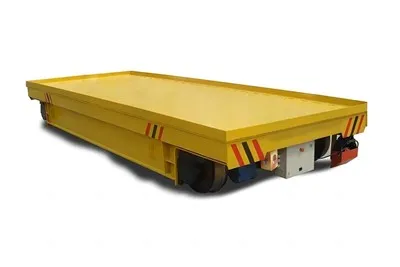
Heavy Duty Transfer Cart
The heavy duty transfer cart is an industrial transport solution designed to move heavy loads efficiently within factories, warehouses, and workstations. Built for durability and high performance, these carts are ideal for handling materials such as steel, machinery, molds, and other oversized goods.
Key Features
✅ High Load Capacity – Supports loads ranging from 1 ton to 500 tons, depending on customization.
✅ Customizable Power Options – Available in battery-powered, rail-powered, cable reel, or manual operation.
✅ Robust Construction – Made of heavy-duty steel to ensure stability and longevity.
✅ Flexible Steering & Control – Options include remote control, automation, and manual operation for precise movement.
✅ Safety Features – Equipped with emergency stop buttons, anti-collision sensors, and speed control for safe operation.

Parts & Components
A heavy duty transfer cart is an industrial vehicle designed for transporting heavy loads within factories, warehouses, and construction sites. These carts can be powered by batteries, rails, or other means, depending on the application. The key components of a heavy-duty transfer cart include:
1. Frame & Structure
Main Frame – The cart's robust structure, usually made of steel, designed to support heavy loads.
Load Platform – The flat or customized surface where goods or materials are placed.
Reinforcement Beams – Added structural supports to handle heavy loads and prevent deformation.
2. Power System (varies based on type)
Battery (for battery-powered carts) – Provides electrical energy to drive motors.
Cable Reel (for cable-powered carts) – Supplies power through a retractable cable.
Rail Power System (for rail carts) – Uses an electrified rail system to draw power.
Diesel Engine (for diesel-powered carts) – Uses fuel for power, often in outdoor or off-grid settings.
3. Drive System
Electric Motor – Drives the cart's wheels for movement.
Gearbox & Transmission – Transfers power from the motor to the wheels.
Wheels & Bearings –
PU-coated Wheels (for smooth floors)
Steel Wheels (for rail-guided carts)
Rubber Wheels (for all-terrain use)
4. Steering & Control System
Manual Steering (for push-pull carts) – Operator manually pushes or pulls the cart.
Remote Control (for automated carts) – Wireless control for easier maneuverability.
PLC Control (for automated systems) – Programmable system for precise movement.
5. Safety & Protection Features
Emergency Stop Button – Stops the cart in case of an emergency.
Limit Switches & Sensors – Prevents collisions by detecting obstacles.
Warning Lights & Alarms – Alerts workers when the cart is in motion.
Speed Control Mechanism – Regulates the speed for safety and efficiency.
6. Additional Features (Optional)
Lifting Mechanism – Hydraulic or scissor lifts for adjusting height.
Turntable System – Allows for rotation in limited spaces.
Track Guidance System – Keeps the cart aligned on tracks.
Automatic Charging System – Enables self-charging for battery-powered carts.

Notes:
● Load capacity,table size and rail gauge can be customized
● Options
■ Cable reel: spring type, magnetic coupling type, motor-driven type
■ Automatic stop when detecting obstacle or person, limit switches (to limit travel)
■ Operation model: hand held control pendant, remote radio control or operation platform with the cart
■ Electrical parts: imported or made in China
■ Power supply position middle or two ends
■ Variable speed control
■ Can be designed to meet special working environment such as high temperature
Sketch

Technical Parameter

Advantages
Heavy-duty transfer carts are essential for industrial environments where the movement of heavy materials is required. Here are some key advantages of using heavy-duty transfer carts:
1. High Load Capacity
Designed to transport extremely heavy loads, ranging from a few tons to over 100 tons, making them suitable for industries like steel, automotive, shipbuilding, and manufacturing.
2. Increased Efficiency
Streamlines material handling processes by reducing manual labor and increasing productivity.
Reduces downtime and speeds up operations in warehouses and production facilities.
3. Versatility in Applications
Can be used indoors or outdoors, on factory floors, assembly lines, or across different workstations.
Available in different models such as rail-guided, trackless, battery-powered, or cable-powered carts.
4. Enhanced Safety
Reduces the risk of workplace injuries associated with manual handling of heavy loads.
Equipped with safety features such as emergency stop buttons, anti-collision sensors, and overload protection.
5. Cost-Effective Solution
Lowers operating costs compared to cranes or forklifts in certain applications.
Reduces dependency on expensive lifting equipment and skilled operators.
6. Customizable Designs
Can be tailored to specific industrial needs, including different sizes, power sources (battery, electric, diesel), and control systems.
Options for automation and remote control for increased convenience.
7. Eco-Friendly Operation
Battery-powered and electric models produce zero emissions, making them environmentally friendly.
Helps companies meet sustainability goals while reducing energy consumption.
8. Durability and Low Maintenance
Constructed with heavy-duty materials to withstand harsh working conditions.
Requires minimal maintenance compared to other heavy-load handling solutions.

Application
Heavy-duty transfer carts are essential in industrial settings for transporting heavy loads efficiently and safely. They are widely used in various industries due to their robust construction and adaptability. Below are some key applications:
1. Manufacturing & Assembly Lines
Used in automotive, aerospace, and heavy machinery industries to move large components between workstations.
Ideal for transporting engines, chassis, and structural parts during the production process.
2. Metal & Steel Industry
Handles heavy metal coils, steel plates, and billets in steel plants.
Reduces labor costs and increases operational safety compared to overhead cranes.
3. Warehousing & Logistics
Efficiently transfers bulky goods, pallets, and raw materials within warehouses and storage facilities.
Helps in optimizing inventory management and reducing manual handling.
4. Shipbuilding & Marine Industry
Moves large ship components like hull sections and turbines during ship assembly.
Facilitates precision positioning in dry docks.
5. Mining & Construction
Used to transport mining equipment, construction materials, and machinery across rough terrains.
Enhances productivity by reducing downtime in operations.
6. Energy & Power Plants
Transfers heavy transformers, turbines, and power plant equipment.
Supports maintenance and installation processes in thermal, hydro, and nuclear plants.
7. Rail & Locomotive Industry
Moves train bogies, locomotives, and railway components in production and maintenance yards.
Ensures seamless integration with railway infrastructure.
Conclusion
Heavy-duty transfer carts provide a cost-effective and safe solution for handling oversized and heavy materials across multiple industries. Their customization options, such as rail-mounted, battery-powered, and automated guided vehicles (AGVs), make them adaptable to different operational needs.

Production Procedure
1. Design & Engineering
Requirement Analysis: Load capacity, power source (battery, rail, cable reel, etc.), size, and operational environment.
3D Modeling & Structural Analysis: Using CAD software to ensure structural integrity.
Electrical & Control System Design: Choosing motors, batteries, and automation features.
2. Material Procurement
Steel plates for the frame and chassis.
Motors, wheels, and driving systems.
Electrical components (controllers, wiring, batteries, or cable systems).
3. Frame Fabrication
Cutting and Shaping: CNC plasma cutting or laser cutting for precision.
Welding: Assembling the chassis using high-strength welding techniques.
Surface Treatment: Sandblasting and rust-proof coating application.
4. Mechanical Assembly
Mounting wheels, axles, and drive system.
Installing suspension or shock-absorbing elements (if required).
5. Electrical System Installation
Installing batteries (for battery-powered carts) or connecting power supply (cable reel/rail).
Wiring the motor, control panel, and safety devices.
Configuring automation systems (if applicable).
6. Painting & Finishing
Anti-corrosion coating.
Final color coating and branding.
7. Testing & Quality Control
Load Testing: Ensuring it can carry the required weight safely.
Electrical Testing: Checking battery life, power distribution, and control functions.
Safety Inspection: Verifying emergency stop functions, brakes, and overload protection.
8. Packing & Delivery
Disassembling large parts (if needed) for transportation.
Secure packaging to prevent damage.
Shipping via truck, container, or specialized transport.

Workshop View


Hot Tags: heavy duty transfer cart, China heavy duty transfer cart manufacturers, suppliers, factory
Previous
Steel Coil Transfer CartYou Might Also Like



Send Inquiry