










Coil Transfer Carts
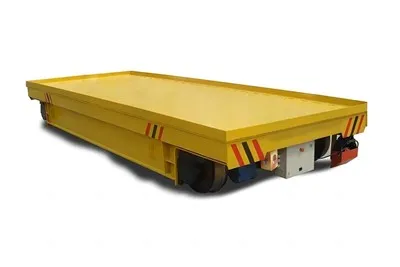
Coil transfer carts are specialized material handling equipment designed for transporting heavy and large coils, such as steel, aluminum, or copper coils, within factories, warehouses, and industrial plants. These carts ensure the safe, efficient, and damage-free movement of coils, improving productivity and reducing manual labor risks.
Key Features
- Load Capacity: Designed to carry heavy loads ranging from a few tons to over 100 tons.
- Power Supply Options: Available in battery-powered, rail-powered, cable-powered, or busbar-powered models.
- Customization: Can be customized with V-shaped cradles, rollers, or supports to securely hold coils.
- Control System: Operated via a handheld pendant, remote control, or onboard panel for ease of use.
- Safety Features: Includes emergency stop buttons, warning alarms, speed control, and anti-collision sensors.
- Versatility: Suitable for industries such as steel manufacturing, shipbuilding, automotive, and aerospace.

Parts & Components
Coil Transfer Carts are specialized material handling equipment used in steel mills, metal processing plants, and manufacturing facilities to transport heavy coils (such as steel, aluminum, or copper) efficiently. Here are the key components of a coil transfer cart:
1. Structural Components
Chassis/Frame – Heavy-duty steel construction to support coil weight.
Deck/Platform – Flat or V-shaped surface to cradle the coil securely.
Wheel Assembly – Includes wheels, axles, and bearings for smooth movement.
Steel/Rubber Wheels – Depending on track type (rail or floor).
Flanged Wheels – For guided rail movement.
2. Drive System
Electric Motor (AC/DC) – Provides propulsion.
Gearbox/Reducer – Adjusts speed and torque.
Drive Wheels – Powered wheels for movement.
Braking System – Mechanical or electromagnetic brakes for safety.
3. Power Supply
Battery (for battery-operated carts) – Rechargeable lithium-ion or lead-acid.
Cable Reel System – For electric carts powered via trailing cable.
Conductor Bars/Rail Pickup – For electrified rail systems.
4. Coil Handling Mechanism
Coil Cradles/V-Shaped Supports – Prevent rolling during transit.
Adjustable Arms/Clamps – For securing different coil sizes.
Hydraulic/Pneumatic Lift System (optional) – For lifting/lowering coils.
5. Control System
Operator Control Panel – Push-button, pendant, or remote control.
Variable Frequency Drive (VFD) – For speed regulation.
Limit Switches & Sensors – For automated positioning.
6. Safety Features
Emergency Stop (E-Stop) – Instantly halts the cart.
Anti-Collision Sensors – Infrared or ultrasonic for obstacle detection.
Warning Lights & Horns – Alerts nearby workers.
Load Limit Sensors – Prevents overloading.
7. Optional Accessories
Turntable – For 90°/180° rotation.
Tilting Mechanism – For coil loading/unloading.
Automated Guided Vehicle (AGV) Integration – For smart factory use.
Weighing System – In-built load cells for weight measurement.

Notes:
● Load capacity table size and rail gauge can be customized.
● Options
■ Remote radio control
■ Automatic stop when detecting obstacle or person, limit switches (to limit travel)
■ Drive mode:Battery or cable reels
■ Electrical parts: imported or made in China
■ Can be designed to meet special working environment such as high temperature
Sketch

Technical Parameter

Advantages
Coil transfer carts are specialized material handling equipment designed to transport heavy coils, rolls, and other cylindrical loads within industrial facilities. Here are some key advantages of using coil transfer carts:
1. High Load Capacity
Designed to carry heavy loads, often ranging from several tons to over 100 tons, depending on the model.
2. Enhanced Safety
Reduces the risk of accidents and injuries associated with manual handling or overhead cranes.
Equipped with safety features like emergency stop buttons, warning alarms, and anti-collision sensors.
3. Efficient & Flexible Material Handling
Allows for quick and easy transportation of coils between different workstations, warehouses, and production lines.
Can operate on rails or be battery-powered, offering both guided and free-moving options.
4. Customizable Design
Can be tailored with V-shaped cradles or rollers to securely hold coils.
Available in manual, semi-automatic, or fully automated versions to suit operational needs.
5. Cost-Effective Solution
Reduces labor costs by minimizing manual handling.
Lowers maintenance costs compared to forklifts or cranes, especially for long-term use.
6. Suitable for Various Industries
Used in steel, aluminum, paper, cable, and automotive industries for transporting coils, rolls, and spools efficiently.
cturers offer customization options to meet specific industry and application requirements, ensuring a perfect fit for diverse needs.

Application
Coil transfer carts are specialized material handling equipment designed for transporting heavy steel or aluminum coils in industrial environments, such as steel mills, aluminum plants, and metal processing facilities. These carts ensure safe, efficient, and damage-free movement of coils within production areas, warehouses, or between different processing stages.
Key Applications of Coil Transfer Carts
Steel & Aluminum Mills
Transporting hot or cold coils between rolling mills, annealing furnaces, and storage yards.
Moving coils from production lines to inspection or packaging areas.
Metal Processing Facilities
Shifting coils between slitting, cutting, or stamping machines.
Feeding coils into blanking or leveling lines.
Warehousing & Logistics
Loading/unloading coils from trucks or rail cars.
Organizing coil storage in warehouses with optimized space utilization.
Automotive & Appliances Manufacturing
Supplying coils to press shops for automotive body parts.
Transporting material for appliance manufacturing (e.g., refrigerators, washing machines).
Ports & Shipping Terminals
Handling coil cargo in ports for import/export operations.
Transferring coils between storage and shipping containers.

Production Procedure
Coil Transfer Carts Production Procedure
Manufacturing coil transfer carts involves several key stages, from design and material selection to assembly and final testing. Below is a general step-by-step production procedure:
1. Design & Engineering
Gather customer requirements (capacity, dimensions, power source, etc.).
Create 2D and 3D CAD designs.
Perform load calculations and structural analysis.
Develop an electrical and mechanical system blueprint.
2. Material Selection & Procurement
Select high-strength steel for the frame.
Choose appropriate wheels (PU-coated, solid steel, or rubber).
Procure motors, batteries (if battery-operated), control systems, and electrical components.
Source hydraulic or mechanical lifting mechanisms (if required).
3. Cutting & Fabrication
Laser Cutting – Cut steel sheets based on design specifications.
CNC Machining – Process components for precision fitting.
Welding & Assembly – Weld the main frame, support structures, and lifting mechanism (if applicable).
4. Surface Treatment
Sandblasting – Remove rust and impurities.
Primer Coating – Prevents corrosion.
Final Coating & Painting – Enhances durability and aesthetics.
5. Electrical & Mechanical Assembly
Motor Installation – Mount electric or hydraulic motors.
Wheel & Rail System – Install the wheels and ensure smooth movement.
Battery & Wiring (if applicable) – Set up battery connections and electrical circuits.
Remote Control System (if applicable) – Install PLC, wireless control, or automation features.
6. Quality Control & Testing
Load Testing – Verify load capacity under different weights.
Motion Testing – Check speed, turning radius, and braking.
Electrical Inspection – Ensure proper wiring and circuit protection.
Safety Testing – Verify emergency stop functions and other safety features.
7. Packaging & Shipping
Secure components to prevent movement during transport.
Use wooden crates or steel reinforcements for safe shipping.
Arrange logistics and documentation for international or local delivery.
8. Installation & After-Sales Service
Provide on-site or remote installation guidance.
Offer maintenance instructions and operation manuals.
Provide warranty and after-sales support.

Workshop View


Hot Tags: coil transfer carts, China coil transfer carts manufacturers, suppliers, factory
Previous
Coil Transfer CartYou Might Also Like



Send Inquiry