










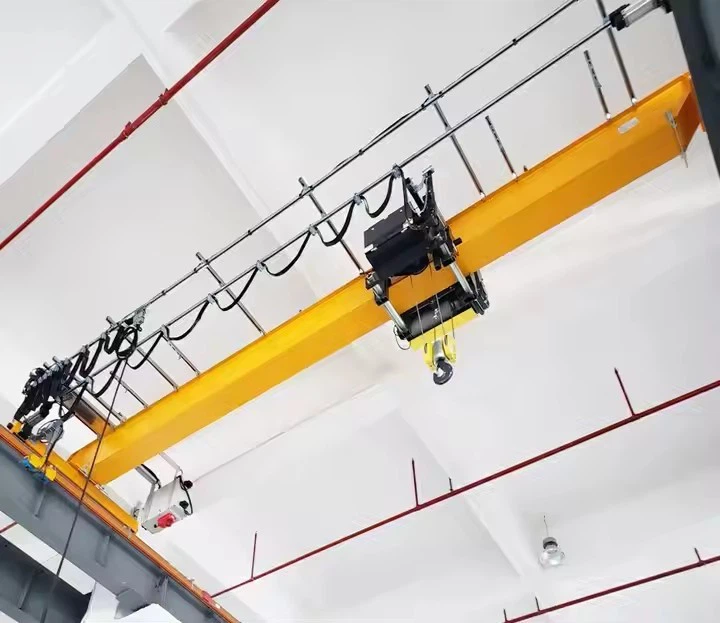
Electric Single Girder Overhead Crane
Products Description
An electric single girder overhead crane is an efficient and economical choice for light to medium-duty lifting tasks. It offers flexibility, ease of operation, and requires minimal structural support, making it a popular choice in various industries.
Comparison with Double Girder Cranes:
| Feature | Single Girder Crane | Double Girder Crane |
|---|---|---|
| Cost | Lower | Higher |
| Height | More headroom | Less headroom (due to higher hook height) |
| Capacity | Up to 20 tons | Up to 100+ tons |
| Span | Shorter spans |
Longer spans |
Technical Specifications:
Lifting Capacity: 1–20 tons
Span: 5–25 meters (customizable)
Lifting Height: 3–30 meters
Power Supply: 380V/415V, 3-phase or customized
Control: Pendant / Radio remote

Pictures & Components
An Electric Single Girder Overhead Crane consists of several key components that work together to enable efficient lifting and material handling. Below is a detailed breakdown of its main parts:
1. Main Girder (Bridge Beam)
The primary horizontal beam that spans the work area.
Typically made of rolled steel (I-beam) or welded box-type construction.
Supports the hoist and trolley, distributing the load to the end trucks.

2. End Trucks (End Carriages)
Located at both ends of the main girder.
Equipped with wheels that run on the runway rails.
Includes drive motors (for traveling motion) and brakes.
Can be single-wheel or double-wheel configuration, depending on load capacity.
 |
 |
3. Hoist Unit
The lifting mechanism mounted on the girder.
Types:
Electric Chain Hoist (for lighter loads, up to ~5 tons).
Wire Rope Hoist (for heavier loads, up to 20+ tons).
Includes:
Motor (for lifting/lowering).
Gearbox (to reduce speed & increase torque).
Drum or Sprocket (for rope/chain winding).
Hook Block (to attach the load).
 |
 |
4. Trolley (Hoist Travel Mechanism)
Allows the hoist to move along the length of the girder (cross travel).
Powered by an electric motor with gearbox and wheels.
Can be motorized (for powered movement) or manual push (for light-duty cranes).

5. Runway System
Consists of runway beams (rails) mounted on columns or building structure.
Provides the path for the crane's longitudinal movement (bridge travel).
Includes rail clamps (for locking the crane in position).

6. Electrical System
Power Supply: Typically 3-phase AC (380V/415V, 50/60Hz).
Control Methods:
Pendant Control (hang-down push-button station).
Radio Remote Control (wireless operation).
Cabin Control (for larger cranes).
Limit Switches:
Upper/Lower limit switches (prevents over-hoisting).
End travel limit switches (prevents crane from hitting end stops).
Festoon or Conductor Bar System (for power and signal transmission along the runway).

.
7. Safety & Auxiliary Components
Overload Protection: Prevents lifting beyond rated capacity.
Emergency Stop (E-Stop): Instantly cuts power in emergencies.
Bumpers: Absorb impact at runway ends.
Warning Devices: Horns or lights for operational alerts.
Insulated Pad (for explosive environments): Prevents sparking.

Optional Components
Crane Scale: Integrated weighing system.
Anti-Sway System: Reduces load swing.
Variable Frequency Drive (VFD): Smooth speed control.
Explosion-Proof Design: For hazardous environments.

Sketch

Main technical

Advantages
Cost-Effective
Lower initial cost compared to double girder cranes due to simpler design and fewer components.
Reduced installation and maintenance expenses.
Space-Saving Design
Compact structure requires less headroom, making it ideal for facilities with height restrictions.
Lighter weight reduces the need for heavy runway support structures.
Easy Installation & Maintenance
Pre-assembled components allow for quick setup.
Fewer moving parts mean lower maintenance costs and easier servicing.
Energy Efficient
Electric operation consumes less power compared to hydraulic or pneumatic systems.
Regenerative braking in some models improves efficiency.
Smooth & Precise Operation
Electric hoists provide better speed control than manual or hydraulic alternatives.
Optional Variable Frequency Drive (VFD) allows adjustable lifting and traveling speeds.
Versatile Load Handling
Suitable for light to medium-duty loads (typically 1–20 tons).
Can be customized with different hoist types (chain or wire rope) and lifting heights.
Improved Safety Features
Built-in overload protection, limit switches, and emergency stop functions.
Anti-collision systems available for multiple cranes in the same runway.
Application:
1. Manufacturing & Workshops
Assembly lines (automotive, machinery, etc.).
Handling raw materials, molds, and finished products.
2. Warehousing & Logistics
Loading/unloading goods in distribution centers.
Stacking and transporting palletized loads.
3. Construction & Material Handling
Moving steel beams, concrete panels, and construction tools.
Prefabrication workshops for modular buildings.
4. Power Plants & Utilities
Maintenance of turbines, generators, and heavy equipment.
Handling coal, ash, and other materials in energy plants.
5. Automotive & Aerospace
Lifting engines, fuselage parts, and heavy components.
Used in repair and maintenance hangars.
6. Paper & Printing Industry
Transporting paper rolls and heavy printing machinery.
7. Food & Beverage Processing
Hygienic designs available for clean environments.
Moving bulk ingredients, packaged goods, and machinery.
8. Mining & Heavy Industries
Light-duty material handling in mines and processing plants.
Crane production procedure
1. Design & Engineering
Requirement Analysis: Confirm load capacity, span, lift height, automation level, control mode, and safety features based on customer needs.
Structural Design: Design the single girder main beam, end carriages, trolley, and hoist assembly using CAD software.
Electrical & Control Design: Develop control system schematics including PLC programming, motor selection, VFDs, sensors, alarms, and safety interlocks.
Simulation & Validation: Use FEA (Finite Element Analysis) for structural integrity and dynamic simulation for motion control.
2. Material Procurement
Source high-quality steel (Q345B or equivalent) for main beam and components.
Acquire motors, hoists, VFDs, PLCs, limit switches, and alarm systems from trusted suppliers.
Ensure all components meet relevant certifications and standards (ISO, CE, GB).
3. Main Beam Fabrication
Cutting: Steel plates cut to size using CNC flame/plasma cutting machines.
Forming: Roll or shape plates into the I-beam or box girder profile.
Welding: Perform welding of flanges, web, and stiffeners following welding procedure specifications (WPS).
Heat Treatment: Stress relief if necessary to reduce welding deformation.
Machining: Drill holes for end carriage and trolley mounting; machine crane rails if integrated.
Inspection: Check weld quality (X-ray or ultrasonic), dimensions, and surface finish.
4. End Carriage & Trolley Assembly
Frame Fabrication: Cut and weld end carriage frames and trolley frames.
Wheel Assembly: Mount wheels and fit bearings; assemble drive motor and gearbox.
Installation: Attach wheels to frames and mount brakes and limit switches.
Testing: Static and dynamic tests on wheels and brakes for smooth rotation and load bearing.
5. Hoist Assembly
Assemble wire rope or chain hoist on the trolley.
Install hook block, safety latch, load limiter, and load sensors.
Connect hoist motor, gearbox, brake, and encoders.
Conduct functional tests on hoisting speed, lifting capacity, and braking.
6. Electrical Wiring & Control System
Install motor cables, control cables, and communication lines.
Mount PLC, VFDs, contactors, and safety relays in the control cabinet.
Wire limit switches, alarms, emergency stop, and sensors.
Program PLC with automated control logic, safety interlocks, and diagnostics.
7. Surface Treatment
Cleaning: Remove rust, oil, and debris from all steel parts.
Primer Coating: Apply anti-corrosion primer.
Final Paint: Spray high-durability industrial paint to protect against wear and corrosion.
Curing: Allow proper drying time to ensure finish quality.
8. Pre-Installation Testing
No-Load Tests: Run crane, trolley, and hoist without load to verify movement, speed, and control.
Load Test: Perform rated load test per standards to ensure lifting capacity and structural integrity.
Safety Device Check: Verify operation of overload limiter, limit switches, emergency stop, and alarms.
Automation Validation: Test automated sequences, positioning accuracy, and sensor feedback.
9. Packing & Shipping
Disassemble parts if necessary for transport.
Protect components with rust-proofing, padding, and secure packing.
Prepare documentation including user manuals, maintenance guides, and test certificates.
10. Installation & Commissioning (On-Site)
Reassemble crane components at customer site.
Align crane rails and secure runway structure.
Connect power and control wiring.
Calibrate sensors and test automated control functions.
Train operators and maintenance personnel.
Hand over documentation and certification.

Workshop view:
The company has installed an intelligent equipment management platform, and has installed 310 sets (sets) of handling and welding robots. After the completion of the plan, there will be more than 500 sets (sets), and the equipment networking rate will reach 95%. 32 welding lines have been put into use, 50 are planned to be installed, and the automation rate of the entire product line has reached 85%.


Hot Tags: electric single girder overhead crane, China electric single girder overhead crane manufacturers, suppliers, factory, Single Girder Overhead Crane, Single Girder Overhead Travelling Crane
You Might Also Like


Send Inquiry